 Add to Chrome
 Add to Firefox
 Add to Edge
Beyond Inter-Item Relations: Dynamic Adaptive Mixture-of-Experts for LLM-Based Sequential Recommendation
Aug 14, 2024
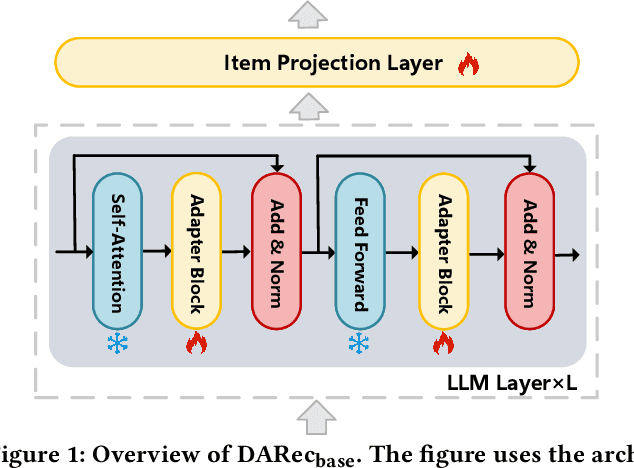
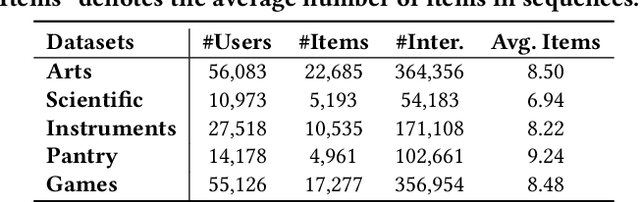
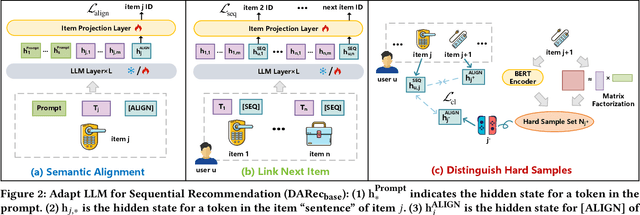
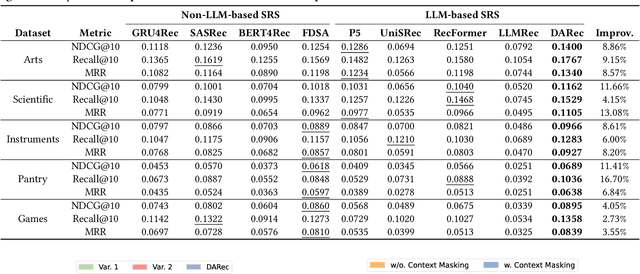
Sequential recommender system (SRS) predicts the next items that users may prefer based on user historical interaction sequences. Inspired by the rise of large language models (LLMs) in various AI applications, there is a surge of work on LLM-based SRS. Despite their attractive performance, existing LLM-based SRS still exhibit some limitations, including neglecting intra-item relations, ignoring long-term collaborative knowledge and using inflexible architecture designs for adaption. To alleviate these issues, we propose an LLM-based SRS named MixRec. Built on top of coarse-grained adaption for capturing inter-item relations, MixRec is further enhanced with (1) context masking that models intra-item relations to help LLM better understand token and item semantics in the context of SRS, (2) collaborative knowledge injection that helps LLM incorporate long-term collaborative knowledge, and (3) a dynamic adaptive mixture-of-experts design that can flexibly choose expert architectures based on Bayesian optimization to better incorporate different sequential information. Extensive experiments demonstrate that MixRec can effectively handle sequential recommendation in a dynamic and adaptive manner.

Seeing and Understanding: Bridging Vision with Chemical Knowledge Via ChemVLM
Aug 14, 2024

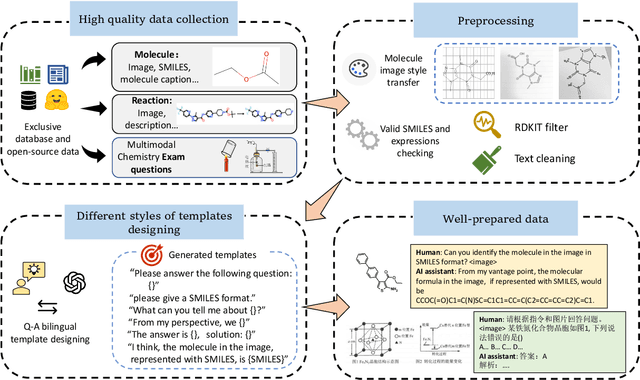

In this technical report, we propose ChemVLM, the first open-source multimodal large language model dedicated to the fields of chemistry, designed to address the incompatibility between chemical image understanding and text analysis. Built upon the VIT-MLP-LLM architecture, we leverage ChemLLM-20B as the foundational large model, endowing our model with robust capabilities in understanding and utilizing chemical text knowledge. Additionally, we employ InternVIT-6B as a powerful image encoder. We have curated high-quality data from the chemical domain, including molecules, reaction formulas, and chemistry examination data, and compiled these into a bilingual multimodal question-answering dataset. We test the performance of our model on multiple open-source benchmarks and three custom evaluation sets. Experimental results demonstrate that our model achieves excellent performance, securing state-of-the-art results in five out of six involved tasks. Our model can be found at https://huggingface.co/AI4Chem/ChemVLM-26B.
DeepInteraction++: Multi-Modality Interaction for Autonomous Driving
Aug 09, 2024


Existing top-performance autonomous driving systems typically rely on the multi-modal fusion strategy for reliable scene understanding. This design is however fundamentally restricted due to overlooking the modality-specific strengths and finally hampering the model performance. To address this limitation, in this work, we introduce a novel modality interaction strategy that allows individual per-modality representations to be learned and maintained throughout, enabling their unique characteristics to be exploited during the whole perception pipeline. To demonstrate the effectiveness of the proposed strategy, we design DeepInteraction++, a multi-modal interaction framework characterized by a multi-modal representational interaction encoder and a multi-modal predictive interaction decoder. Specifically, the encoder is implemented as a dual-stream Transformer with specialized attention operation for information exchange and integration between separate modality-specific representations. Our multi-modal representational learning incorporates both object-centric, precise sampling-based feature alignment and global dense information spreading, essential for the more challenging planning task. The decoder is designed to iteratively refine the predictions by alternately aggregating information from separate representations in a unified modality-agnostic manner, realizing multi-modal predictive interaction. Extensive experiments demonstrate the superior performance of the proposed framework on both 3D object detection and end-to-end autonomous driving tasks. Our code is available at https://github.com/fudan-zvg/DeepInteraction.
Respiratory Subtraction for Pulmonary Microwave Ablation Evaluation
Aug 08, 2024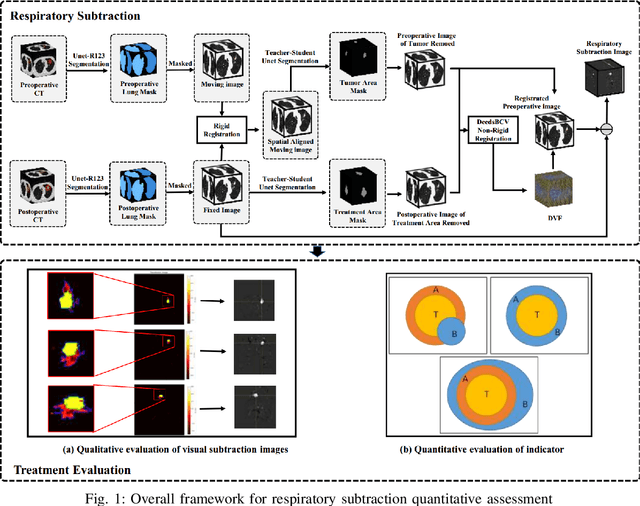

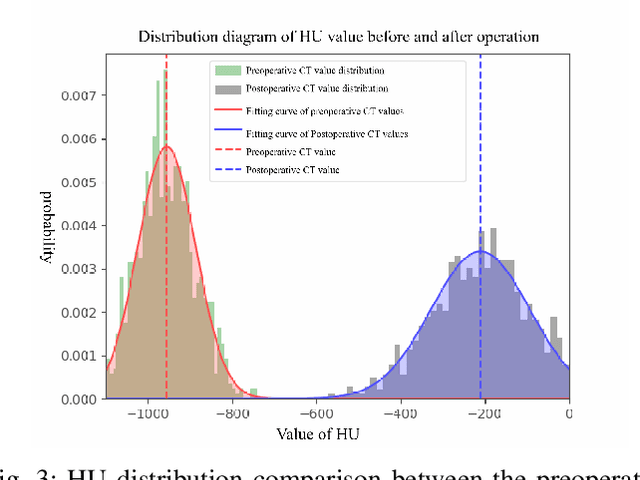
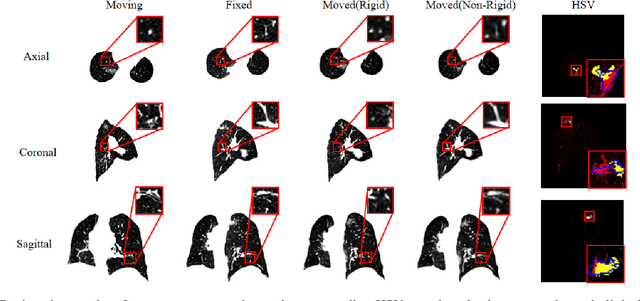
Currently, lung cancer is a leading cause of global cancer mortality, often necessitating minimally invasive interventions. Microwave ablation (MWA) is extensively utilized for both primary and secondary lung tumors. Although numerous clinical guidelines and standards for MWA have been established, the clinical evaluation of ablation surgery remains challenging and requires long-term patient follow-up for confirmation. In this paper, we propose a method termed respiratory subtraction to evaluate lung tumor ablation therapy performance based on pre- and post-operative image guidance. Initially, preoperative images undergo coarse rigid registration to their corresponding postoperative positions, followed by further non-rigid registration. Subsequently, subtraction images are generated by subtracting the registered preoperative images from the postoperative ones. Furthermore, to enhance the clinical assessment of MWA treatment performance, we devise a quantitative analysis metric to evaluate ablation efficacy by comparing differences between tumor areas and treatment areas. To the best of our knowledge, this is the pioneering work in the field to facilitate the assessment of MWA surgery performance on pulmonary tumors. Extensive experiments involving 35 clinical cases further validate the efficacy of the respiratory subtraction method. The experimental results confirm the effectiveness of the respiratory subtraction method and the proposed quantitative evaluation metric in assessing lung tumor treatment.
MDT-A2G: Exploring Masked Diffusion Transformers for Co-Speech Gesture Generation
Aug 06, 2024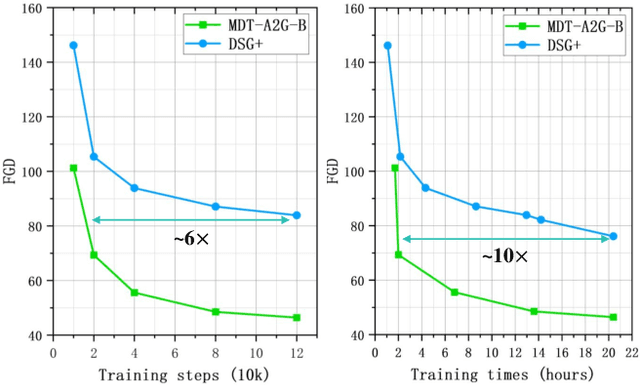

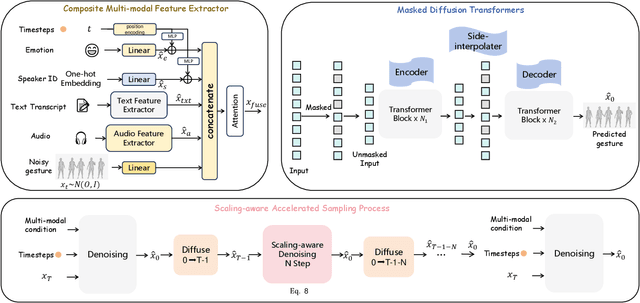

Recent advancements in the field of Diffusion Transformers have substantially improved the generation of high-quality 2D images, 3D videos, and 3D shapes. However, the effectiveness of the Transformer architecture in the domain of co-speech gesture generation remains relatively unexplored, as prior methodologies have predominantly employed the Convolutional Neural Network (CNNs) or simple a few transformer layers. In an attempt to bridge this research gap, we introduce a novel Masked Diffusion Transformer for co-speech gesture generation, referred to as MDT-A2G, which directly implements the denoising process on gesture sequences. To enhance the contextual reasoning capability of temporally aligned speech-driven gestures, we incorporate a novel Masked Diffusion Transformer. This model employs a mask modeling scheme specifically designed to strengthen temporal relation learning among sequence gestures, thereby expediting the learning process and leading to coherent and realistic motions. Apart from audio, Our MDT-A2G model also integrates multi-modal information, encompassing text, emotion, and identity. Furthermore, we propose an efficient inference strategy that diminishes the denoising computation by leveraging previously calculated results, thereby achieving a speedup with negligible performance degradation. Experimental results demonstrate that MDT-A2G excels in gesture generation, boasting a learning speed that is over 6$\times$ faster than traditional diffusion transformers and an inference speed that is 5.7$\times$ than the standard diffusion model.
GMAI-MMBench: A Comprehensive Multimodal Evaluation Benchmark Towards General Medical AI
Aug 06, 2024Large Vision-Language Models (LVLMs) are capable of handling diverse data types such as imaging, text, and physiological signals, and can be applied in various fields. In the medical field, LVLMs have a high potential to offer substantial assistance for diagnosis and treatment. Before that, it is crucial to develop benchmarks to evaluate LVLMs' effectiveness in various medical applications. Current benchmarks are often built upon specific academic literature, mainly focusing on a single domain, and lacking varying perceptual granularities. Thus, they face specific challenges, including limited clinical relevance, incomplete evaluations, and insufficient guidance for interactive LVLMs. To address these limitations, we developed the GMAI-MMBench, the most comprehensive general medical AI benchmark with well-categorized data structure and multi-perceptual granularity to date. It is constructed from 285 datasets across 39 medical image modalities, 18 clinical-related tasks, 18 departments, and 4 perceptual granularities in a Visual Question Answering (VQA) format. Additionally, we implemented a lexical tree structure that allows users to customize evaluation tasks, accommodating various assessment needs and substantially supporting medical AI research and applications. We evaluated 50 LVLMs, and the results show that even the advanced GPT-4o only achieves an accuracy of 52\%, indicating significant room for improvement. Moreover, we identified five key insufficiencies in current cutting-edge LVLMs that need to be addressed to advance the development of better medical applications. We believe that GMAI-MMBench will stimulate the community to build the next generation of LVLMs toward GMAI.
Dynamic Object Queries for Transformer-based Incremental Object Detection
Jul 31, 2024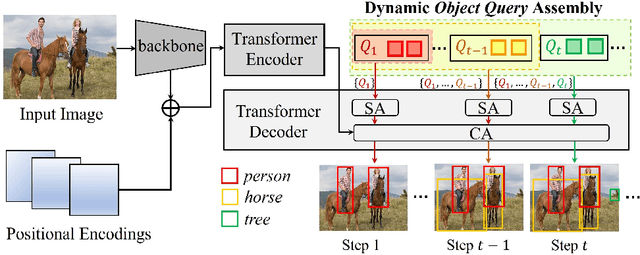
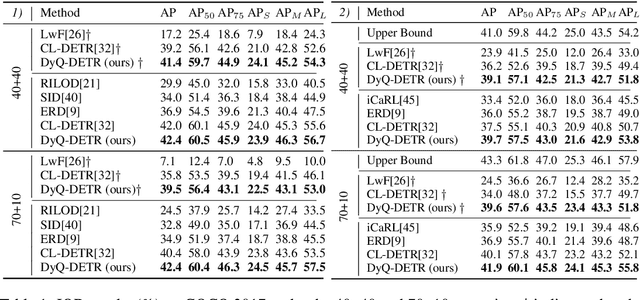
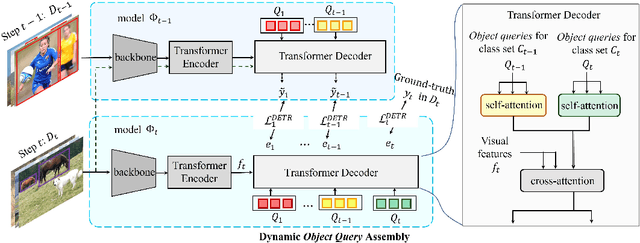

Incremental object detection (IOD) aims to sequentially learn new classes, while maintaining the capability to locate and identify old ones. As the training data arrives with annotations only with new classes, IOD suffers from catastrophic forgetting. Prior methodologies mainly tackle the forgetting issue through knowledge distillation and exemplar replay, ignoring the conflict between limited model capacity and increasing knowledge. In this paper, we explore \textit{dynamic object queries} for incremental object detection built on Transformer architecture. We propose the \textbf{Dy}namic object \textbf{Q}uery-based \textbf{DE}tection \textbf{TR}ansformer (DyQ-DETR), which incrementally expands the model representation ability to achieve stability-plasticity tradeoff. First, a new set of learnable object queries are fed into the decoder to represent new classes. These new object queries are aggregated with those from previous phases to adapt both old and new knowledge well. Second, we propose the isolated bipartite matching for object queries in different phases, based on disentangled self-attention. The interaction among the object queries at different phases is eliminated to reduce inter-class confusion. Thanks to the separate supervision and computation over object queries, we further present the risk-balanced partial calibration for effective exemplar replay. Extensive experiments demonstrate that DyQ-DETR significantly surpasses the state-of-the-art methods, with limited parameter overhead. Code will be made publicly available.
The Llama 3 Herd of Models
Jul 31, 2024Modern artificial intelligence (AI) systems are powered by foundation models. This paper presents a new set of foundation models, called Llama 3. It is a herd of language models that natively support multilinguality, coding, reasoning, and tool usage. Our largest model is a dense Transformer with 405B parameters and a context window of up to 128K tokens. This paper presents an extensive empirical evaluation of Llama 3. We find that Llama 3 delivers comparable quality to leading language models such as GPT-4 on a plethora of tasks. We publicly release Llama 3, including pre-trained and post-trained versions of the 405B parameter language model and our Llama Guard 3 model for input and output safety. The paper also presents the results of experiments in which we integrate image, video, and speech capabilities into Llama 3 via a compositional approach. We observe this approach performs competitively with the state-of-the-art on image, video, and speech recognition tasks. The resulting models are not yet being broadly released as they are still under development.
Identity-Consistent Diffusion Network for Grading Knee Osteoarthritis Progression in Radiographic Imaging
Jul 31, 2024


Knee osteoarthritis (KOA), a common form of arthritis that causes physical disability, has become increasingly prevalent in society. Employing computer-aided techniques to automatically assess the severity and progression of KOA can greatly benefit KOA treatment and disease management. Particularly, the advancement of X-ray technology in KOA demonstrates its potential for this purpose. Yet, existing X-ray prognosis research generally yields a singular progression severity grade, overlooking the potential visual changes for understanding and explaining the progression outcome. Therefore, in this study, a novel generative model is proposed, namely Identity-Consistent Radiographic Diffusion Network (IC-RDN), for multifaceted KOA prognosis encompassing a predicted future knee X-ray scan conditioned on the baseline scan. Specifically, an identity prior module for the diffusion and a downstream generation-guided progression prediction module are introduced. Compared to conventional image-to-image generative models, identity priors regularize and guide the diffusion to focus more on the clinical nuances of the prognosis based on a contrastive learning strategy. The progression prediction module utilizes both forecasted and baseline knee scans, and a more comprehensive formulation of KOA severity progression grading is expected. Extensive experiments on a widely used public dataset, OAI, demonstrate the effectiveness of the proposed method.
Multi-Granularity Semantic Revision for Large Language Model Distillation
Jul 14, 2024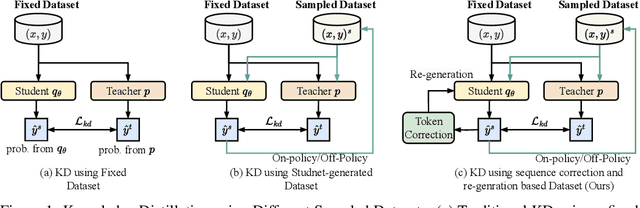
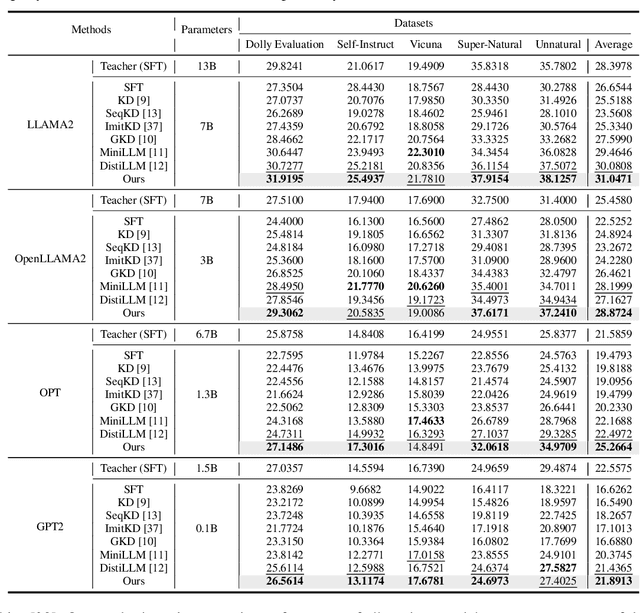
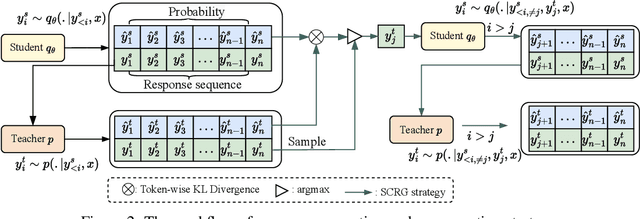
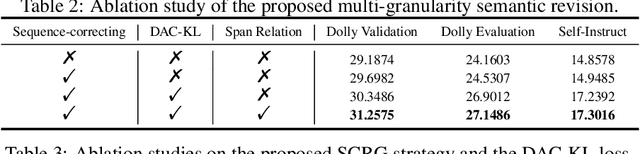
Knowledge distillation plays a key role in compressing the Large Language Models (LLMs), which boosts a small-size student model under large teacher models' guidance. However, existing LLM distillation methods overly rely on student-generated outputs, which may introduce generation errors and misguide the distillation process. Moreover, the distillation loss functions introduced in previous art struggle to align the most informative part due to the complex distribution of LLMs' outputs. To address these problems, we propose a multi-granularity semantic revision method for LLM distillation. At the sequence level, we propose a sequence correction and re-generation (SCRG) strategy. SCRG first calculates the semantic cognitive difference between the teacher and student to detect the error token, then corrects it with the teacher-generated one, and re-generates the sequence to reduce generation errors and enhance generation diversity. At the token level, we design a distribution adaptive clipping Kullback-Leibler (DAC-KL) loss as the distillation objective function. DAC-KL loss exploits a learnable sub-network to adaptively extract semantically dense areas from the teacher's output, avoiding the interference of redundant information in the distillation process. Finally, at the span level, we leverage the span priors of a sequence to compute the probability correlations within spans, and constrain the teacher and student's probability correlations to be consistent, further enhancing the transfer of semantic information. Extensive experiments across different model families with parameters ranging from 0.1B to 13B demonstrate the superiority of our method compared to existing methods.