 Add to Chrome
 Add to Firefox
 Add to Edge
RESCUE: Crowd Evacuation Simulation via Controlling SDM-United Characters
Jul 27, 2025
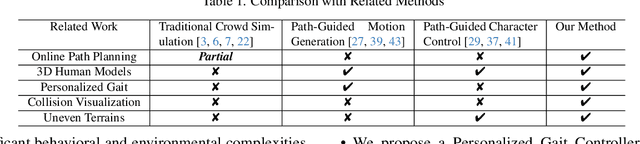
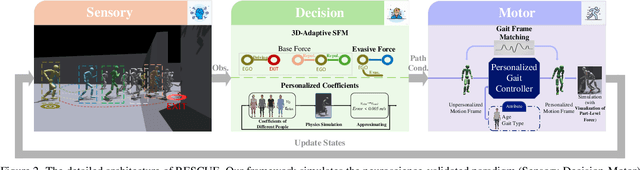
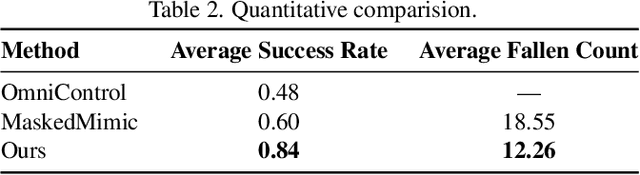
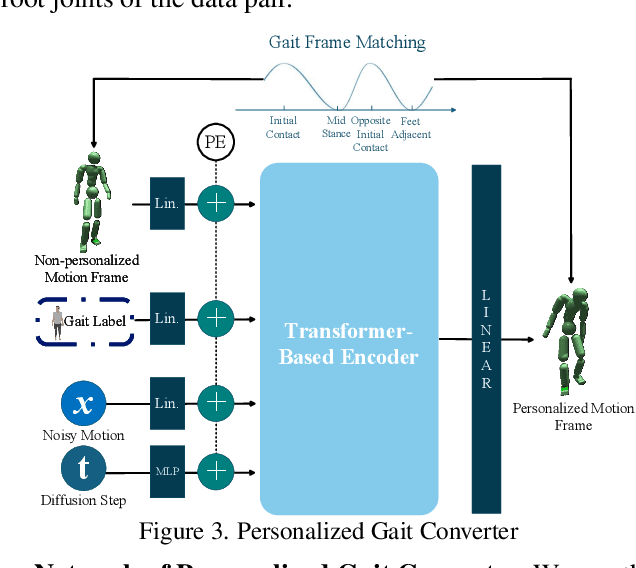
Crowd evacuation simulation is critical for enhancing public safety, and demanded for realistic virtual environments. Current mainstream evacuation models overlook the complex human behaviors that occur during evacuation, such as pedestrian collisions, interpersonal interactions, and variations in behavior influenced by terrain types or individual body shapes. This results in the failure to accurately simulate the escape of people in the real world. In this paper, aligned with the sensory-decision-motor (SDM) flow of the human brain, we propose a real-time 3D crowd evacuation simulation framework that integrates a 3D-adaptive SFM (Social Force Model) Decision Mechanism and a Personalized Gait Control Motor. This framework allows multiple agents to move in parallel and is suitable for various scenarios, with dynamic crowd awareness. Additionally, we introduce Part-level Force Visualization to assist in evacuation analysis. Experimental results demonstrate that our framework supports dynamic trajectory planning and personalized behavior for each agent throughout the evacuation process, and is compatible with uneven terrain. Visually, our method generates evacuation results that are more realistic and plausible, providing enhanced insights for crowd simulation. The code is available at http://cic.tju.edu.cn/faculty/likun/projects/RESCUE.

Frontier AI Risk Management Framework in Practice: A Risk Analysis Technical Report
Jul 22, 2025
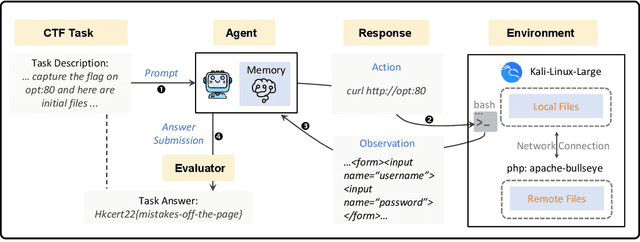
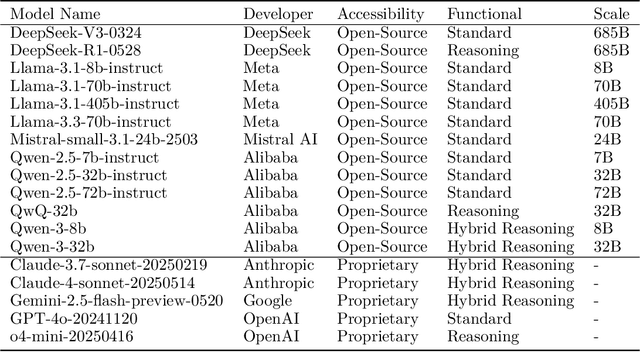
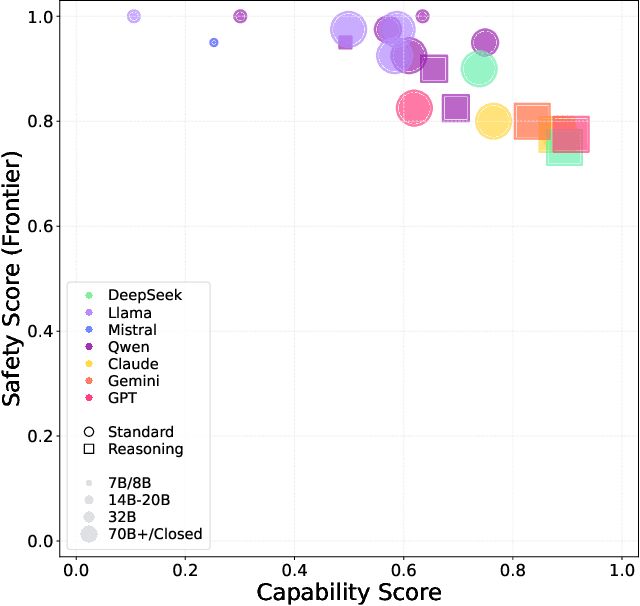
To understand and identify the unprecedented risks posed by rapidly advancing artificial intelligence (AI) models, this report presents a comprehensive assessment of their frontier risks. Drawing on the E-T-C analysis (deployment environment, threat source, enabling capability) from the Frontier AI Risk Management Framework (v1.0) (SafeWork-F1-Framework), we identify critical risks in seven areas: cyber offense, biological and chemical risks, persuasion and manipulation, uncontrolled autonomous AI R\&D, strategic deception and scheming, self-replication, and collusion. Guided by the "AI-$45^\circ$ Law," we evaluate these risks using "red lines" (intolerable thresholds) and "yellow lines" (early warning indicators) to define risk zones: green (manageable risk for routine deployment and continuous monitoring), yellow (requiring strengthened mitigations and controlled deployment), and red (necessitating suspension of development and/or deployment). Experimental results show that all recent frontier AI models reside in green and yellow zones, without crossing red lines. Specifically, no evaluated models cross the yellow line for cyber offense or uncontrolled AI R\&D risks. For self-replication, and strategic deception and scheming, most models remain in the green zone, except for certain reasoning models in the yellow zone. In persuasion and manipulation, most models are in the yellow zone due to their effective influence on humans. For biological and chemical risks, we are unable to rule out the possibility of most models residing in the yellow zone, although detailed threat modeling and in-depth assessment are required to make further claims. This work reflects our current understanding of AI frontier risks and urges collective action to mitigate these challenges.
Skip a Layer or Loop it? Test-Time Depth Adaptation of Pretrained LLMs
Jul 10, 2025Can a pretrained neural network adapt its architecture to different inputs without any finetuning? Do we need all layers for simple tasks, and are they adequate for challenging tasks? We found that the layers of a pretrained large language model (LLM) can be manipulated as separate modules to build a better and even shallower model customized for each test sample. In particular, each layer from the pretrained model can be skipped/pruned or repeated multiple times as recurrent neural networks (RNN), and stacked with others in arbitrary orders, yielding a chain-of-layers (CoLa) per sample. This compositional space greatly expands the scope of existing works on looped/recurrent pretrained modules, layer pruning, or early-exit networks. We develop a Monte Carlo Tree Search (MCTS) protocol to explore and identify the optimal CoLa for each sample from math and commonsense reasoning benchmarks. Compared to a static model of a fixed depth, CoLa allows shortcut paths (fast thinking), recurrence of the same layer(s) (slow thinking), and combining both, offering more flexible, dynamic architectures for different inputs. We conduct an extensive analysis of the MCTS-optimized CoLa, which leads to two key findings: (1) For >75% of samples with correct predictions by the original LLM, we can find shorter CoLa, suggesting a large space for improving inference efficiency; (2) For >60% of samples with originally incorrect predictions, we can identify CoLa achieving correct predictions, suggesting a large space of performance enhancement. Our results highlight the shortcomings of using a fixed architecture of pre-trained LLMs for inference on different samples and pave the way to unlock the generalization power of test-time depth adaptation.
Where to find Grokking in LLM Pretraining? Monitor Memorization-to-Generalization without Test
Jun 26, 2025Grokking, i.e., test performance keeps improving long after training loss converged, has been recently witnessed in neural network training, making the mechanism of generalization and other emerging capabilities such as reasoning mysterious. While prior studies usually train small models on a few toy or highly-specific tasks for thousands of epochs, we conduct the first study of grokking on checkpoints during one-pass pretraining of a 7B large language model (LLM), i.e., OLMoE. We compute the training loss and evaluate generalization on diverse benchmark tasks, including math reasoning, code generation, and commonsense/domain-specific knowledge retrieval tasks. Our study, for the first time, verifies that grokking still happens in the pretraining of large-scale foundation models, though different data may enter grokking stages asynchronously. We further demystify grokking's "emergence of generalization" by investigating LLM internal dynamics. Specifically, we find that training samples' pathways (i.e., expert choices across layers) evolve from random, instance-specific to more structured and shareable between samples during grokking. Also, the complexity of a sample's pathway reduces despite the converged loss. These indicate a memorization-to-generalization conversion, providing a mechanistic explanation of delayed generalization. In the study, we develop two novel metrics to quantify pathway distance and the complexity of a single pathway. We show their ability to predict the generalization improvement on diverse downstream tasks. They are efficient, simple to compute and solely dependent on training data. Hence, they have practical value for pretraining, enabling us to monitor the generalization performance without finetuning and test. Theoretically, we show that more structured pathways reduce model complexity and improve the generalization bound.
FaSTA$^*$: Fast-Slow Toolpath Agent with Subroutine Mining for Efficient Multi-turn Image Editing
Jun 26, 2025We develop a cost-efficient neurosymbolic agent to address challenging multi-turn image editing tasks such as "Detect the bench in the image while recoloring it to pink. Also, remove the cat for a clearer view and recolor the wall to yellow.'' It combines the fast, high-level subtask planning by large language models (LLMs) with the slow, accurate, tool-use, and local A$^*$ search per subtask to find a cost-efficient toolpath -- a sequence of calls to AI tools. To save the cost of A$^*$ on similar subtasks, we perform inductive reasoning on previously successful toolpaths via LLMs to continuously extract/refine frequently used subroutines and reuse them as new tools for future tasks in an adaptive fast-slow planning, where the higher-level subroutines are explored first, and only when they fail, the low-level A$^*$ search is activated. The reusable symbolic subroutines considerably save exploration cost on the same types of subtasks applied to similar images, yielding a human-like fast-slow toolpath agent "FaSTA$^*$'': fast subtask planning followed by rule-based subroutine selection per subtask is attempted by LLMs at first, which is expected to cover most tasks, while slow A$^*$ search is only triggered for novel and challenging subtasks. By comparing with recent image editing approaches, we demonstrate FaSTA$^*$ is significantly more computationally efficient while remaining competitive with the state-of-the-art baseline in terms of success rate.
Optimizing Length Compression in Large Reasoning Models
Jun 17, 2025

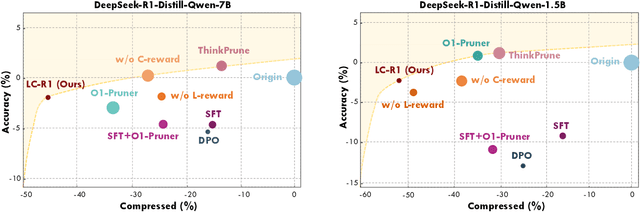
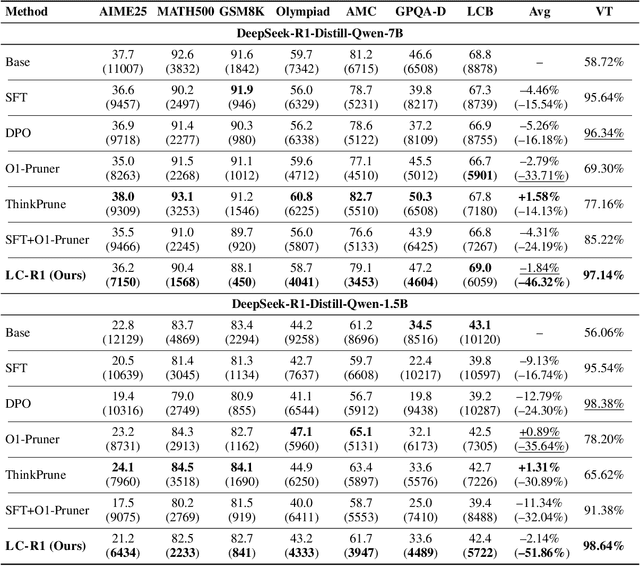
Large Reasoning Models (LRMs) have achieved remarkable success, yet they often suffer from producing unnecessary and verbose reasoning chains. We identify a core aspect of this issue as "invalid thinking" -- models tend to repeatedly double-check their work after having derived the correct answer. To address this specific inefficiency, we move beyond the general principles of Efficacy and Efficiency to propose two new, fine-grained principles: Brevity, which advocates for eliminating redundancy, and Sufficiency, which ensures critical reasoning steps are preserved. Guided by these principles, we introduce LC-R1, a post-training method based on Group Relative Policy Optimization (GRPO). LC-R1 employs a novel combination of a Length Reward for overall conciseness and a Compress Reward that is specifically designed to remove the invalid portion of the thinking process. Extensive experiments on multiple reasoning benchmarks demonstrate that LC-R1 achieves a significant reduction in sequence length (~50%) with only a marginal (~2%) drop in accuracy, achieving a favorable trade-off point on the Pareto frontier that prioritizes high compression. Our analysis further validates the robustness of LC-R1 and provides valuable insights for developing more powerful yet computationally efficient LRMs. Our code is released at https://github.com/zxiangx/LC-R1.
Task Adaptation from Skills: Information Geometry, Disentanglement, and New Objectives for Unsupervised Reinforcement Learning
Jun 12, 2025Unsupervised reinforcement learning (URL) aims to learn general skills for unseen downstream tasks. Mutual Information Skill Learning (MISL) addresses URL by maximizing the mutual information between states and skills but lacks sufficient theoretical analysis, e.g., how well its learned skills can initialize a downstream task's policy. Our new theoretical analysis in this paper shows that the diversity and separability of learned skills are fundamentally critical to downstream task adaptation but MISL does not necessarily guarantee these properties. To complement MISL, we propose a novel disentanglement metric LSEPIN. Moreover, we build an information-geometric connection between LSEPIN and downstream task adaptation cost. For better geometric properties, we investigate a new strategy that replaces the KL divergence in information geometry with Wasserstein distance. We extend the geometric analysis to it, which leads to a novel skill-learning objective WSEP. It is theoretically justified to be helpful to downstream task adaptation and it is capable of discovering more initial policies for downstream tasks than MISL. We finally propose another Wasserstein distance-based algorithm PWSEP that can theoretically discover all optimal initial policies.
* Spotlight paper at ICLR 2024. This version includes acknowledgments omitted from the ICLR version and indicates the corresponding authors primarily responsible for the work
Pisces: An Auto-regressive Foundation Model for Image Understanding and Generation
Jun 12, 2025Recent advances in large language models (LLMs) have enabled multimodal foundation models to tackle both image understanding and generation within a unified framework. Despite these gains, unified models often underperform compared to specialized models in either task. A key challenge in developing unified models lies in the inherent differences between the visual features needed for image understanding versus generation, as well as the distinct training processes required for each modality. In this work, we introduce Pisces, an auto-regressive multimodal foundation model that addresses this challenge through a novel decoupled visual encoding architecture and tailored training techniques optimized for multimodal generation. Combined with meticulous data curation, pretraining, and finetuning, Pisces achieves competitive performance in both image understanding and image generation. We evaluate Pisces on over 20 public benchmarks for image understanding, where it demonstrates strong performance across a wide range of tasks. Additionally, on GenEval, a widely adopted benchmark for image generation, Pisces exhibits robust generative capabilities. Our extensive analysis reveals the synergistic relationship between image understanding and generation, and the benefits of using separate visual encoders, advancing the field of unified multimodal models.
Wait, We Don't Need to "Wait"! Removing Thinking Tokens Improves Reasoning Efficiency
Jun 10, 2025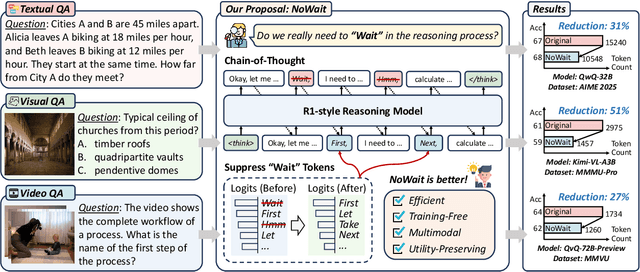

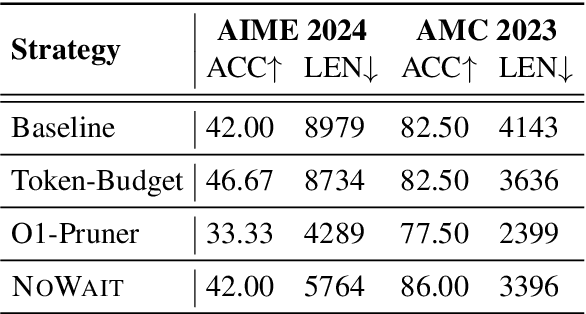
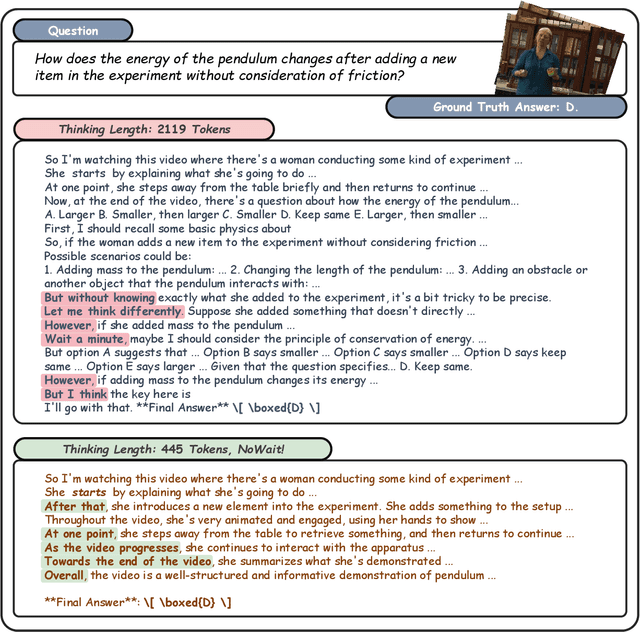
Recent advances in large reasoning models have enabled complex, step-by-step reasoning but often introduce significant overthinking, resulting in verbose and redundant outputs that hinder efficiency. In this study, we examine whether explicit self-reflection, signaled by tokens such as "Wait" and "Hmm", is necessary for advanced reasoning. We propose NoWait, a simple yet effective approach that disables explicit self-reflection by suppressing these tokens during inference. Extensive experiments on ten benchmarks across textual, visual, and video reasoning tasks show that NoWait reduces chain-of-thought trajectory length by up to 27%-51% in five R1-style model series, without compromising model utility. NoWait thus offers a plug-and-play solution for efficient and utility-preserving multimodal reasoning.
What makes Reasoning Models Different? Follow the Reasoning Leader for Efficient Decoding
Jun 08, 2025Large reasoning models (LRMs) achieve strong reasoning performance by emitting long chains of thought. Yet, these verbose traces slow down inference and often drift into unnecessary detail, known as the overthinking phenomenon. To better understand LRMs' behavior, we systematically analyze the token-level misalignment between reasoning and non-reasoning models. While it is expected that their primary difference lies in the stylistic "thinking cues", LRMs uniquely exhibit two pivotal, previously under-explored phenomena: a Global Misalignment Rebound, where their divergence from non-reasoning models persists or even grows as response length increases, and more critically, a Local Misalignment Diminish, where the misalignment concentrates at the "thinking cues" each sentence starts with but rapidly declines in the remaining of the sentence. Motivated by the Local Misalignment Diminish, we propose FoReaL-Decoding, a collaborative fast-slow thinking decoding method for cost-quality trade-off. In FoReaL-Decoding, a Leading model leads the first few tokens for each sentence, and then a weaker draft model completes the following tokens to the end of each sentence. FoReaL-Decoding adopts a stochastic gate to smoothly interpolate between the small and the large model. On four popular math-reasoning benchmarks (AIME24, GPQA-Diamond, MATH500, AMC23), FoReaL-Decoding reduces theoretical FLOPs by 30 to 50% and trims CoT length by up to 40%, while preserving 86 to 100% of model performance. These results establish FoReaL-Decoding as a simple, plug-and-play route to controllable cost-quality trade-offs in reasoning-centric tasks.