 Add to Chrome
 Add to Firefox
 Add to Edge
SurgRAW: Multi-Agent Workflow with Chain-of-Thought Reasoning for Surgical Intelligence
Mar 13, 2025
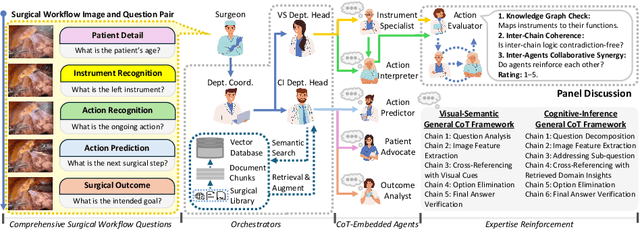
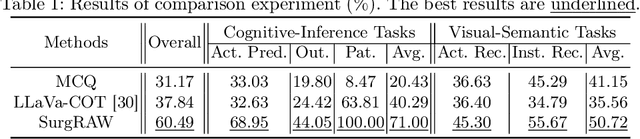
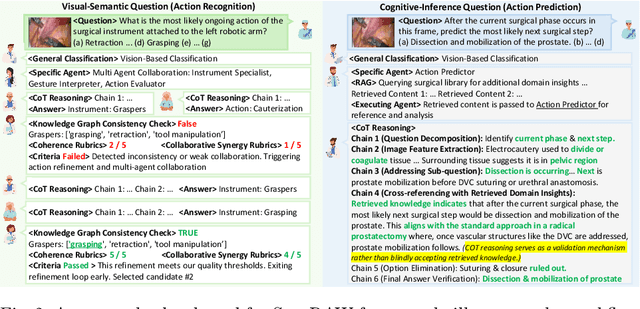
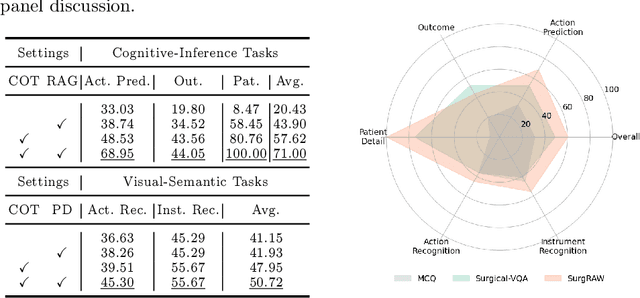
Integration of Vision-Language Models (VLMs) in surgical intelligence is hindered by hallucinations, domain knowledge gaps, and limited understanding of task interdependencies within surgical scenes, undermining clinical reliability. While recent VLMs demonstrate strong general reasoning and thinking capabilities, they still lack the domain expertise and task-awareness required for precise surgical scene interpretation. Although Chain-of-Thought (CoT) can structure reasoning more effectively, current approaches rely on self-generated CoT steps, which often exacerbate inherent domain gaps and hallucinations. To overcome this, we present SurgRAW, a CoT-driven multi-agent framework that delivers transparent, interpretable insights for most tasks in robotic-assisted surgery. By employing specialized CoT prompts across five tasks: instrument recognition, action recognition, action prediction, patient data extraction, and outcome assessment, SurgRAW mitigates hallucinations through structured, domain-aware reasoning. Retrieval-Augmented Generation (RAG) is also integrated to external medical knowledge to bridge domain gaps and improve response reliability. Most importantly, a hierarchical agentic system ensures that CoT-embedded VLM agents collaborate effectively while understanding task interdependencies, with a panel discussion mechanism promotes logical consistency. To evaluate our method, we introduce SurgCoTBench, the first reasoning-based dataset with structured frame-level annotations. With comprehensive experiments, we demonstrate the effectiveness of proposed SurgRAW with 29.32% accuracy improvement over baseline VLMs on 12 robotic procedures, achieving the state-of-the-art performance and advancing explainable, trustworthy, and autonomous surgical assistance.

Infinite Leagues Under the Sea: Photorealistic 3D Underwater Terrain Generation by Latent Fractal Diffusion Models
Mar 09, 2025This paper tackles the problem of generating representations of underwater 3D terrain. Off-the-shelf generative models, trained on Internet-scale data but not on specialized underwater images, exhibit downgraded realism, as images of the seafloor are relatively uncommon. To this end, we introduce DreamSea, a generative model to generate hyper-realistic underwater scenes. DreamSea is trained on real-world image databases collected from underwater robot surveys. Images from these surveys contain massive real seafloor observations and covering large areas, but are prone to noise and artifacts from the real world. We extract 3D geometry and semantics from the data with visual foundation models, and train a diffusion model that generates realistic seafloor images in RGBD channels, conditioned on novel fractal distribution-based latent embeddings. We then fuse the generated images into a 3D map, building a 3DGS model supervised by 2D diffusion priors which allows photorealistic novel view rendering. DreamSea is rigorously evaluated, demonstrating the ability to robustly generate large-scale underwater scenes that are consistent, diverse, and photorealistic. Our work drives impact in multiple domains, spanning filming, gaming, and robot simulation.
Towards Ambiguity-Free Spatial Foundation Model: Rethinking and Decoupling Depth Ambiguity
Mar 08, 2025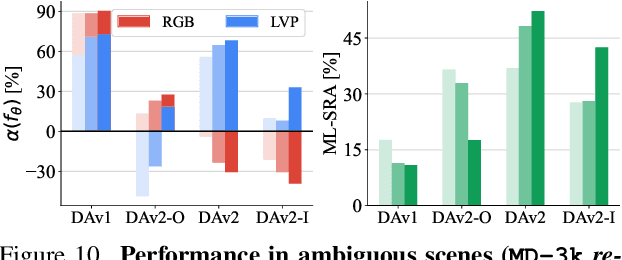
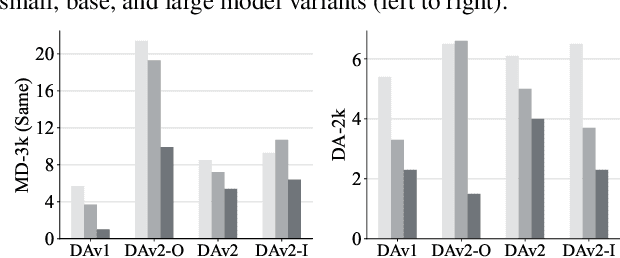
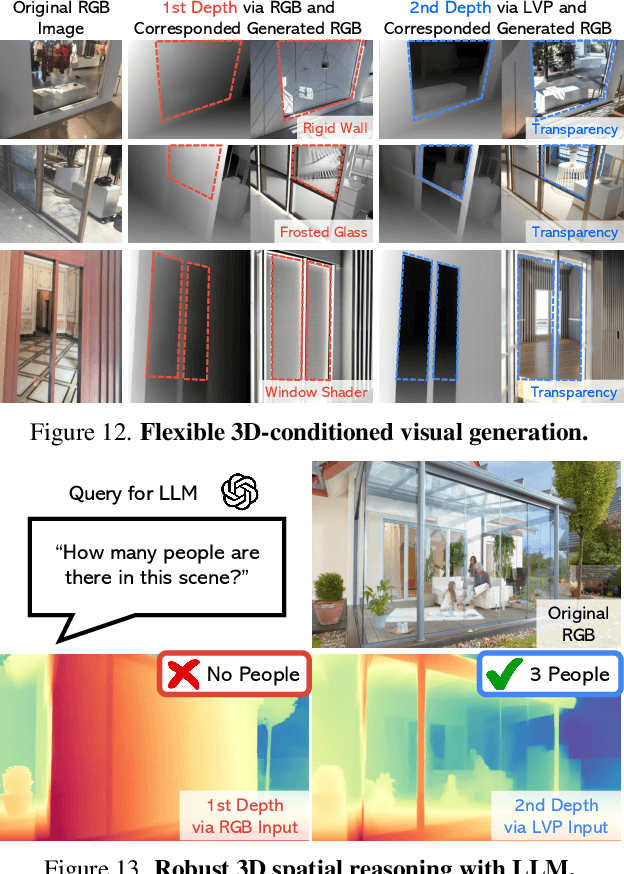
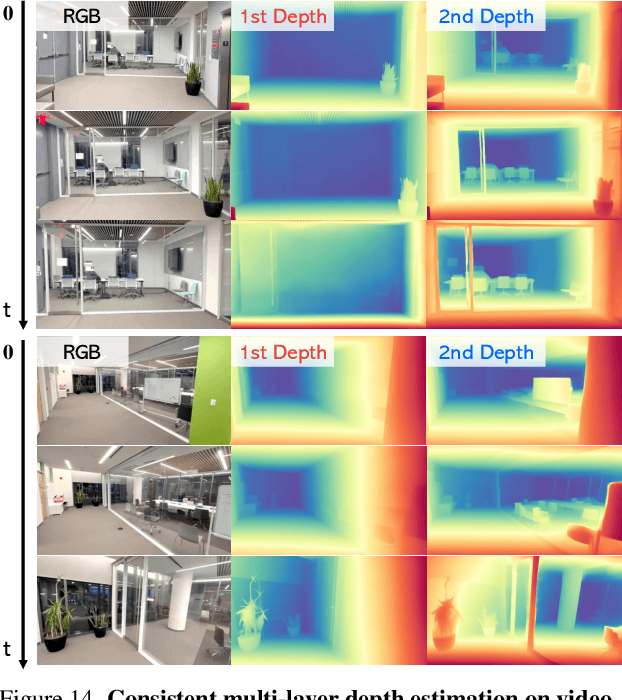
Depth ambiguity is a fundamental challenge in spatial scene understanding, especially in transparent scenes where single-depth estimates fail to capture full 3D structure. Existing models, limited to deterministic predictions, overlook real-world multi-layer depth. To address this, we introduce a paradigm shift from single-prediction to multi-hypothesis spatial foundation models. We first present \texttt{MD-3k}, a benchmark exposing depth biases in expert and foundational models through multi-layer spatial relationship labels and new metrics. To resolve depth ambiguity, we propose Laplacian Visual Prompting (LVP), a training-free spectral prompting technique that extracts hidden depth from pre-trained models via Laplacian-transformed RGB inputs. By integrating LVP-inferred depth with standard RGB-based estimates, our approach elicits multi-layer depth without model retraining. Extensive experiments validate the effectiveness of LVP in zero-shot multi-layer depth estimation, unlocking more robust and comprehensive geometry-conditioned visual generation, 3D-grounded spatial reasoning, and temporally consistent video-level depth inference. Our benchmark and code will be available at https://github.com/Xiaohao-Xu/Ambiguity-in-Space.
PathRWKV: Enabling Whole Slide Prediction with Recurrent-Transformer
Mar 05, 2025


Pathological diagnosis plays a critical role in clinical practice, where the whole slide images (WSIs) are widely applied. Through a two-stage paradigm, recent deep learning approaches enhance the WSI analysis with tile-level feature extracting and slide-level feature modeling. Current Transformer models achieved improvement in the efficiency and accuracy to previous multiple instance learning based approaches. However, three core limitations persist, as they do not: (1) robustly address the modeling on variable scales for different slides, (2) effectively balance model complexity and data availability, and (3) balance training efficiency and inference performance. To explicitly address them, we propose a novel model for slide modeling, PathRWKV. Via a recurrent structure, we enable the model for dynamic perceptible tiles in slide-level modeling, which novelly enables the prediction on all tiles in the inference stage. Moreover, we employ linear attention instead of conventional matrix multiplication attention to reduce model complexity and overfitting problem. Lastly, we hinge multi-task learning to enable modeling on versatile tasks simultaneously, improving training efficiency, and asynchronous structure design to draw an effective conclusion on all tiles during inference, enhancing inference performance. Experimental results suggest that PathRWKV outperforms the current state-of-the-art methods in various downstream tasks on multiple datasets. The code and datasets are publicly available.
From Poses to Identity: Training-Free Person Re-Identification via Feature Centralization
Mar 02, 2025
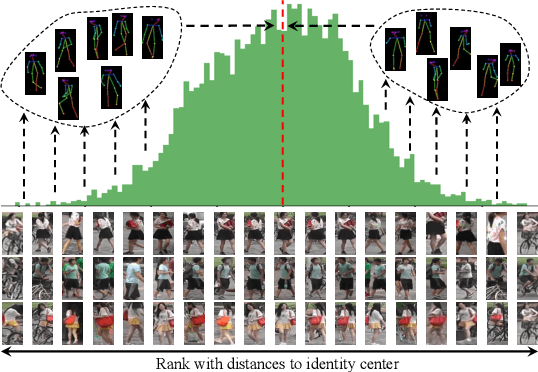
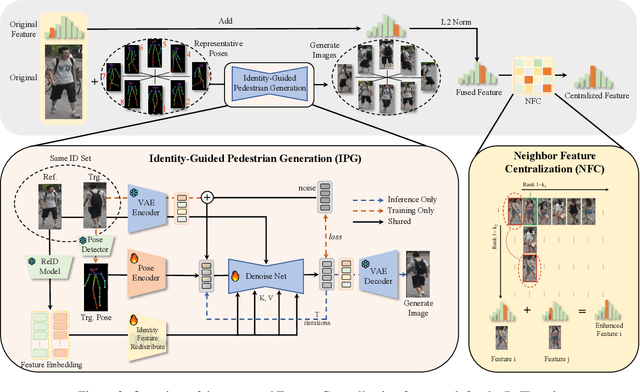
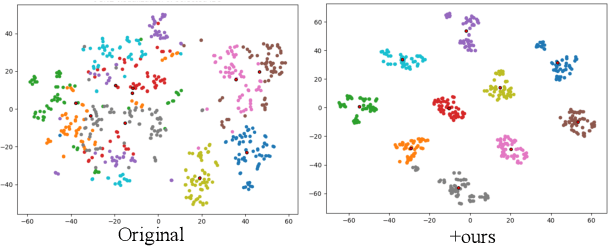
Person re-identification (ReID) aims to extract accurate identity representation features. However, during feature extraction, individual samples are inevitably affected by noise (background, occlusions, and model limitations). Considering that features from the same identity follow a normal distribution around identity centers after training, we propose a Training-Free Feature Centralization ReID framework (Pose2ID) by aggregating the same identity features to reduce individual noise and enhance the stability of identity representation, which preserves the feature's original distribution for following strategies such as re-ranking. Specifically, to obtain samples of the same identity, we introduce two components:Identity-Guided Pedestrian Generation: by leveraging identity features to guide the generation process, we obtain high-quality images with diverse poses, ensuring identity consistency even in complex scenarios such as infrared, and occlusion.Neighbor Feature Centralization: it explores each sample's potential positive samples from its neighborhood. Experiments demonstrate that our generative model exhibits strong generalization capabilities and maintains high identity consistency. With the Feature Centralization framework, we achieve impressive performance even with an ImageNet pre-trained model without ReID training, reaching mAP/Rank-1 of 52.81/78.92 on Market1501. Moreover, our method sets new state-of-the-art results across standard, cross-modality, and occluded ReID tasks, showcasing strong adaptability.
DOSE3 : Diffusion-based Out-of-distribution detection on SE(3) trajectories
Feb 23, 2025Out-of-Distribution(OOD) detection, a fundamental machine learning task aimed at identifying abnormal samples, traditionally requires model retraining for different inlier distributions. While recent research demonstrates the applicability of diffusion models to OOD detection, existing approaches are limited to Euclidean or latent image spaces. Our work extends OOD detection to trajectories in the Special Euclidean Group in 3D ($\mathbb{SE}(3)$), addressing a critical need in computer vision, robotics, and engineering applications that process object pose sequences in $\mathbb{SE}(3)$. We present $\textbf{D}$iffusion-based $\textbf{O}$ut-of-distribution detection on $\mathbb{SE}(3)$ ($\mathbf{DOSE3}$), a novel OOD framework that extends diffusion to a unified sample space of $\mathbb{SE}(3)$ pose sequences. Through extensive validation on multiple benchmark datasets, we demonstrate $\mathbf{DOSE3}$'s superior performance compared to state-of-the-art OOD detection frameworks.
Soybean pod and seed counting in both outdoor fields and indoor laboratories using unions of deep neural networks
Feb 21, 2025Automatic counting soybean pods and seeds in outdoor fields allows for rapid yield estimation before harvesting, while indoor laboratory counting offers greater accuracy. Both methods can significantly accelerate the breeding process. However, it remains challenging for accurately counting pods and seeds in outdoor fields, and there are still no accurate enough tools for counting pods and seeds in laboratories. In this study, we developed efficient deep learning models for counting soybean pods and seeds in both outdoor fields and indoor laboratories. For outdoor fields, annotating not only visible seeds but also occluded seeds makes YOLO have the ability to estimate the number of soybean seeds that are occluded. Moreover, we enhanced YOLO architecture by integrating it with HQ-SAM (YOLO-SAM), and domain adaptation techniques (YOLO-DA), to improve model robustness and generalization across soybean images taken in outdoor fields. Testing on soybean images from the outdoor field, we achieved a mean absolute error (MAE) of 6.13 for pod counting and 10.05 for seed counting. For the indoor setting, we utilized Mask-RCNN supplemented with a Swin Transformer module (Mask-RCNN-Swin), models were trained exclusively on synthetic training images generated from a small set of labeled data. This approach resulted in near-perfect accuracy, with an MAE of 1.07 for pod counting and 1.33 for seed counting across actual laboratory images from two distinct studies.
Text-to-SQL Domain Adaptation via Human-LLM Collaborative Data Annotation
Feb 21, 2025Text-to-SQL models, which parse natural language (NL) questions to executable SQL queries, are increasingly adopted in real-world applications. However, deploying such models in the real world often requires adapting them to the highly specialized database schemas used in specific applications. We find that existing text-to-SQL models experience significant performance drops when applied to new schemas, primarily due to the lack of domain-specific data for fine-tuning. This data scarcity also limits the ability to effectively evaluate model performance in new domains. Continuously obtaining high-quality text-to-SQL data for evolving schemas is prohibitively expensive in real-world scenarios. To bridge this gap, we propose SQLsynth, a human-in-the-loop text-to-SQL data annotation system. SQLsynth streamlines the creation of high-quality text-to-SQL datasets through human-LLM collaboration in a structured workflow. A within-subjects user study comparing SQLsynth with manual annotation and ChatGPT shows that SQLsynth significantly accelerates text-to-SQL data annotation, reduces cognitive load, and produces datasets that are more accurate, natural, and diverse. Our code is available at https://github.com/adobe/nl_sql_analyzer.
Mean of Means: Human Localization with Calibration-free and Unconstrained Camera Settings (extended version)
Feb 18, 2025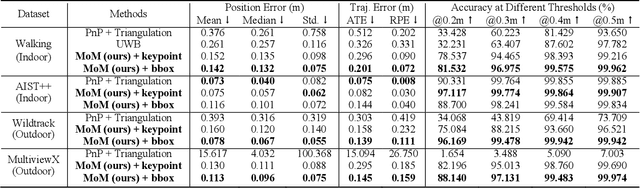
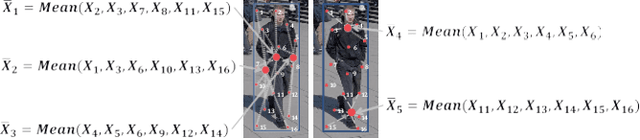

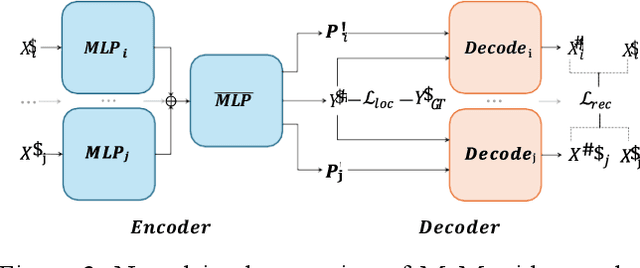
Accurate human localization is crucial for various applications, especially in the Metaverse era. Existing high precision solutions rely on expensive, tag-dependent hardware, while vision-based methods offer a cheaper, tag-free alternative. However, current vision solutions based on stereo vision face limitations due to rigid perspective transformation principles and error propagation in multi-stage SVD solvers. These solutions also require multiple high-resolution cameras with strict setup constraints.To address these limitations, we propose a probabilistic approach that considers all points on the human body as observations generated by a distribution centered around the body's geometric center. This enables us to improve sampling significantly, increasing the number of samples for each point of interest from hundreds to billions. By modeling the relation between the means of the distributions of world coordinates and pixel coordinates, leveraging the Central Limit Theorem, we ensure normality and facilitate the learning process. Experimental results demonstrate human localization accuracy of 96\% within a 0.3$m$ range and nearly 100\% accuracy within a 0.5$m$ range, achieved at a low cost of only 10 USD using two web cameras with a resolution of 640$\times$480 pixels.
I3S: Importance Sampling Subspace Selection for Low-Rank Optimization in LLM Pretraining
Feb 09, 2025


Low-rank optimization has emerged as a promising approach to enabling memory-efficient training of large language models (LLMs). Existing low-rank optimization methods typically project gradients onto a low-rank subspace, reducing the memory cost of storing optimizer states. A key challenge in these methods is identifying suitable subspaces to ensure an effective optimization trajectory. Most existing approaches select the dominant subspace to preserve gradient information, as this intuitively provides the best approximation. However, we find that in practice, the dominant subspace stops changing during pretraining, thereby constraining weight updates to similar subspaces. In this paper, we propose importance sampling subspace selection (I3S) for low-rank optimization, which theoretically offers a comparable convergence rate to the dominant subspace approach. Empirically, we demonstrate that I3S significantly outperforms previous methods in LLM pretraining tasks.