 Add to Chrome
 Add to Firefox
 Add to Edge
ContraMap: Contrastive Uncertainty Mapping for Robot Environment Representation
Mar 29, 2026
Reliable robot perception requires not only predicting scene structure, but also identifying where predictions should be treated as unreliable due to sparse or missing observations. We present ContraMap, a contrastive continuous mapping method that augments kernel-based discriminative maps with an explicit uncertainty class trained using synthetic noise samples. This formulation treats unobserved regions as a contrastive class, enabling joint environment prediction and spatial uncertainty estimation in real time without Bayesian inference. Under a simple mixture-model view, we show that the probability assigned to the uncertainty class is a monotonic function of a distance-aware uncertainty surrogate. Experiments in 2D occupancy mapping, 3D semantic mapping, and tabletop scene reconstruction show that ContraMap preserves mapping quality, produces spatially coherent uncertainty estimates, and is substantially more efficient than Bayesian kernelmap baselines.

SOFTMAP: Sim2Real Soft Robot Forward Modeling via Topological Mesh Alignment and Physics Prior
Mar 19, 2026While soft robot manipulators offer compelling advantages over rigid counterparts, including inherent compliance, safe human-robot interaction, and the ability to conform to complex geometries, accurate forward modeling from low-dimensional actuation commands remains an open challenge due to nonlinear material phenomena such as hysteresis and manufacturing variability. We present SOFTMAP, a sim-to-real learning framework for real-time 3D forward modeling of tendon-actuated soft finger manipulators. SOFTMAP combines four components: (1) As-Rigid-As-Possible (ARAP)-based topological alignment that projects simulated and real point clouds into a shared, topologically consistent vertex space; (2) a lightweight MLP forward model pretrained on simulation data to map servo commands to full 3D finger geometry; (3) a residual correction network trained on a small set of real observations to predict per-vertex displacement fields that compensate for sim-to-real discrepancies; and (4) a closed-form linear actuation calibration layer enabling real-time inference at 30 FPS. We evaluate SOFTMAP on both simulated and physical hardware, achieving state-of-the-art shape prediction accuracy with a Chamfer distance of 0.389 mm in simulation and 3.786 mm on hardware, millimeter-level fingertip trajectory tracking across multiple target paths, and a 36.5% improvement in teleoperation task success over the baseline. Our results show that SOFTMAP provides a data-efficient approach for 3D forward modeling and control of soft manipulators.
Constraining Streaming Flow Models for Adapting Learned Robot Trajectory Distributions
Feb 17, 2026Robot motion distributions often exhibit multi-modality and require flexible generative models for accurate representation. Streaming Flow Policies (SFPs) have recently emerged as a powerful paradigm for generating robot trajectories by integrating learned velocity fields directly in action space, enabling smooth and reactive control. However, existing formulations lack mechanisms for adapting trajectories post-training to enforce safety and task-specific constraints. We propose Constraint-Aware Streaming Flow (CASF), a framework that augments streaming flow policies with constraint-dependent metrics that reshape the learned velocity field during execution. CASF models each constraint, defined in either the robot's workspace or configuration space, as a differentiable distance function that is converted into a local metric and pulled back into the robot's control space. Far from restricted regions, the resulting metric reduces to the identity; near constraint boundaries, it smoothly attenuates or redirects motion, effectively deforming the underlying flow to maintain safety. This allows trajectories to be adapted in real time, ensuring that robot actions respect joint limits, avoid collisions, and remain within feasible workspaces, while preserving the multi-modal and reactive properties of streaming flow policies. We demonstrate CASF in simulated and real-world manipulation tasks, showing that it produces constraint-satisfying trajectories that remain smooth, feasible, and dynamically consistent, outperforming standard post-hoc projection baselines.
Affordance Transfer Across Object Instances via Semantically Anchored Functional Map
Feb 16, 2026Traditional learning from demonstration (LfD) generally demands a cumbersome collection of physical demonstrations, which can be time-consuming and challenging to scale. Recent advances show that robots can instead learn from human videos by extracting interaction cues without direct robot involvement. However, a fundamental challenge remains: how to generalize demonstrated interactions across different object instances that share similar functionality but vary significantly in geometry. In this work, we propose \emph{Semantic Anchored Functional Maps} (SemFM), a framework for transferring affordances across objects from a single visual demonstration. Starting from a coarse mesh reconstructed from an image, our method identifies semantically corresponding functional regions between objects, selects mutually exclusive semantic anchors, and propagates these constraints over the surface using a functional map to obtain a dense, semantically consistent correspondence. This enables demonstrated interaction regions to be transferred across geometrically diverse objects in a lightweight and interpretable manner. Experiments on synthetic object categories and real-world robotic manipulation tasks show that our approach enables accurate affordance transfer with modest computational cost, making it well-suited for practical robotic perception-to-action pipelines.
TriPilot-FF: Coordinated Whole-Body Teleoperation with Force Feedback
Feb 10, 2026Mobile manipulators broaden the operational envelope for robot manipulation. However, the whole-body teleoperation of such robots remains a problem: operators must coordinate a wheeled base and two arms while reasoning about obstacles and contact. Existing interfaces are predominantly hand-centric (e.g., VR controllers and joysticks), leaving foot-operated channels underexplored for continuous base control. We present TriPilot-FF, an open-source whole-body teleoperation system for a custom bimanual mobile manipulator that introduces a foot-operated pedal with lidar-driven pedal haptics, coupled with upper-body bimanual leader-follower teleoperation. Using only a low-cost base-mounted lidar, TriPilot-FF renders a resistive pedal cue from proximity-to-obstacle signals in the commanded direction, shaping operator commands toward collision-averse behaviour without an explicit collision-avoidance controller. The system also supports arm-side force reflection for contact awareness and provides real-time force and visual guidance of bimanual manipulability to prompt mobile base repositioning, thereby improving reach. We demonstrate the capability of TriPilot-FF to effectively ``co-pilot'' the human operator over long time-horizons and tasks requiring precise mobile base movement and coordination. Finally, we incorporate teleoperation feedback signals into an Action Chunking with Transformers (ACT) policy and demonstrate improved performance when the additional information is available. We release the pedal device design, full software stack, and conduct extensive real-world evaluations on a bimanual wheeled platform. The project page of TriPilot-FF is http://bit.ly/46H3ZJT.
Bi-Manual Joint Camera Calibration and Scene Representation
May 30, 2025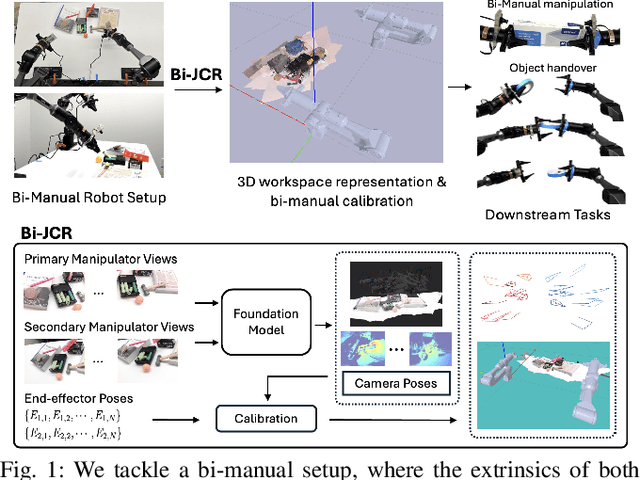
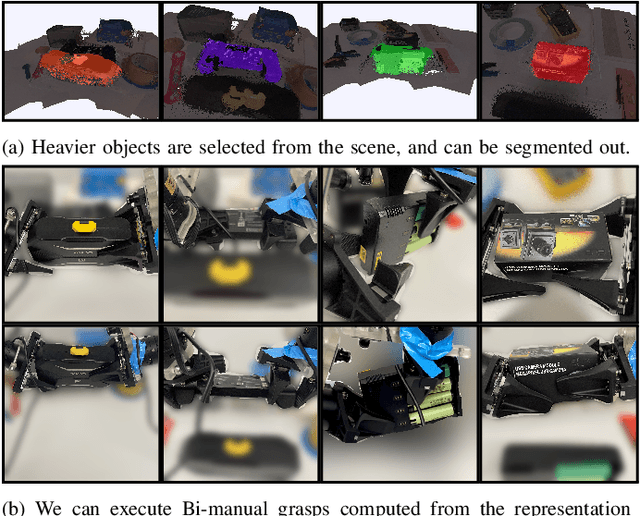
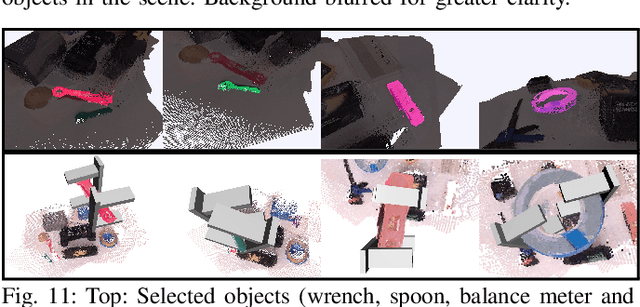
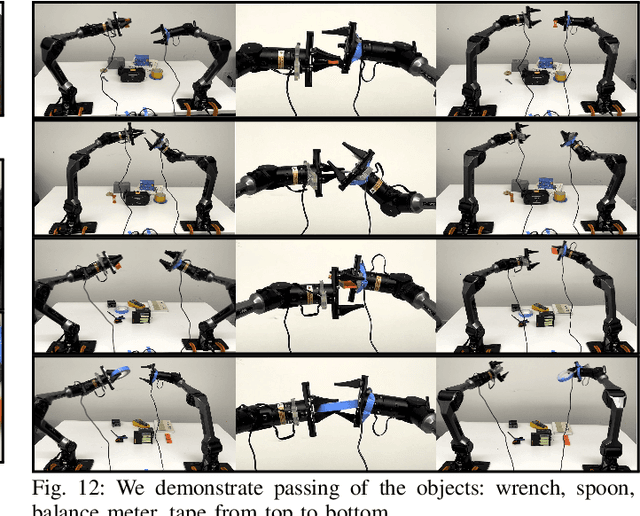
Robot manipulation, especially bimanual manipulation, often requires setting up multiple cameras on multiple robot manipulators. Before robot manipulators can generate motion or even build representations of their environments, the cameras rigidly mounted to the robot need to be calibrated. Camera calibration is a cumbersome process involving collecting a set of images, with each capturing a pre-determined marker. In this work, we introduce the Bi-Manual Joint Calibration and Representation Framework (Bi-JCR). Bi-JCR enables multiple robot manipulators, each with cameras mounted, to circumvent taking images of calibration markers. By leveraging 3D foundation models for dense, marker-free multi-view correspondence, Bi-JCR jointly estimates: (i) the extrinsic transformation from each camera to its end-effector, (ii) the inter-arm relative poses between manipulators, and (iii) a unified, scale-consistent 3D representation of the shared workspace, all from the same captured RGB image sets. The representation, jointly constructed from images captured by cameras on both manipulators, lives in a common coordinate frame and supports collision checking and semantic segmentation to facilitate downstream bimanual coordination tasks. We empirically evaluate the robustness of Bi-JCR on a variety of tabletop environments, and demonstrate its applicability on a variety of downstream tasks.
From Single Images to Motion Policies via Video-Generation Environment Representations
May 25, 2025Autonomous robots typically need to construct representations of their surroundings and adapt their motions to the geometry of their environment. Here, we tackle the problem of constructing a policy model for collision-free motion generation, consistent with the environment, from a single input RGB image. Extracting 3D structures from a single image often involves monocular depth estimation. Developments in depth estimation have given rise to large pre-trained models such as DepthAnything. However, using outputs of these models for downstream motion generation is challenging due to frustum-shaped errors that arise. Instead, we propose a framework known as Video-Generation Environment Representation (VGER), which leverages the advances of large-scale video generation models to generate a moving camera video conditioned on the input image. Frames of this video, which form a multiview dataset, are then input into a pre-trained 3D foundation model to produce a dense point cloud. We then introduce a multi-scale noise approach to train an implicit representation of the environment structure and build a motion generation model that complies with the geometry of the representation. We extensively evaluate VGER over a diverse set of indoor and outdoor environments. We demonstrate its ability to produce smooth motions that account for the captured geometry of a scene, all from a single RGB input image.
GraphSeg: Segmented 3D Representations via Graph Edge Addition and Contraction
Apr 04, 2025Robots operating in unstructured environments often require accurate and consistent object-level representations. This typically requires segmenting individual objects from the robot's surroundings. While recent large models such as Segment Anything (SAM) offer strong performance in 2D image segmentation. These advances do not translate directly to performance in the physical 3D world, where they often over-segment objects and fail to produce consistent mask correspondences across views. In this paper, we present GraphSeg, a framework for generating consistent 3D object segmentations from a sparse set of 2D images of the environment without any depth information. GraphSeg adds edges to graphs and constructs dual correspondence graphs: one from 2D pixel-level similarities and one from inferred 3D structure. We formulate segmentation as a problem of edge addition, then subsequent graph contraction, which merges multiple 2D masks into unified object-level segmentations. We can then leverage \emph{3D foundation models} to produce segmented 3D representations. GraphSeg achieves robust segmentation with significantly fewer images and greater accuracy than prior methods. We demonstrate state-of-the-art performance on tabletop scenes and show that GraphSeg enables improved performance on downstream robotic manipulation tasks. Code available at https://github.com/tomtang502/graphseg.git.
Infinite Leagues Under the Sea: Photorealistic 3D Underwater Terrain Generation by Latent Fractal Diffusion Models
Mar 09, 2025This paper tackles the problem of generating representations of underwater 3D terrain. Off-the-shelf generative models, trained on Internet-scale data but not on specialized underwater images, exhibit downgraded realism, as images of the seafloor are relatively uncommon. To this end, we introduce DreamSea, a generative model to generate hyper-realistic underwater scenes. DreamSea is trained on real-world image databases collected from underwater robot surveys. Images from these surveys contain massive real seafloor observations and covering large areas, but are prone to noise and artifacts from the real world. We extract 3D geometry and semantics from the data with visual foundation models, and train a diffusion model that generates realistic seafloor images in RGBD channels, conditioned on novel fractal distribution-based latent embeddings. We then fuse the generated images into a 3D map, building a 3DGS model supervised by 2D diffusion priors which allows photorealistic novel view rendering. DreamSea is rigorously evaluated, demonstrating the ability to robustly generate large-scale underwater scenes that are consistent, diverse, and photorealistic. Our work drives impact in multiple domains, spanning filming, gaming, and robot simulation.
DOSE3 : Diffusion-based Out-of-distribution detection on SE(3) trajectories
Feb 23, 2025Out-of-Distribution(OOD) detection, a fundamental machine learning task aimed at identifying abnormal samples, traditionally requires model retraining for different inlier distributions. While recent research demonstrates the applicability of diffusion models to OOD detection, existing approaches are limited to Euclidean or latent image spaces. Our work extends OOD detection to trajectories in the Special Euclidean Group in 3D ($\mathbb{SE}(3)$), addressing a critical need in computer vision, robotics, and engineering applications that process object pose sequences in $\mathbb{SE}(3)$. We present $\textbf{D}$iffusion-based $\textbf{O}$ut-of-distribution detection on $\mathbb{SE}(3)$ ($\mathbf{DOSE3}$), a novel OOD framework that extends diffusion to a unified sample space of $\mathbb{SE}(3)$ pose sequences. Through extensive validation on multiple benchmark datasets, we demonstrate $\mathbf{DOSE3}$'s superior performance compared to state-of-the-art OOD detection frameworks.