 Add to Chrome
 Add to Firefox
 Add to Edge
Privacy-Preserving Text Sanitization for Distributed Agents Collaboration via Disentangled Representations
Jun 13, 2026
When distributed agents exchange text across organizational boundaries, privacy leakage arises not only from explicit identifiers but also from distributional signatures such as formatting conventions, vocabulary choices, and syntactic patterns. We propose DiSan(Disentangled Sanitization), a privacy-preserving sanitization framework and a built-in component of Intern-Shannon for multi-agent collaboration. DiSan uses a two-stream encoder to factorize text into a source-invariant role subspace that preserves task semantics and a source-identifying style subspace that remains local. Federated proto-type alignment and adversarial regularization enable joint training without centralizing raw text. Experiments show that identifier-level masking is insufficient: masking 19.2% of tokens reduces TF-IDF stylometric attribution by only 18.6%. By contrast, DiSan reduces answer-level PII exposure by 20 times while maintaining 83% answer faithfulness on a distributed multi-agent RAG benchmark, and lowers Enron stylometric attribution by 73.2% under TF-IDF and 70.6% under a neural probe.

Geometry-Aware State Space Model: A New Paradigm for Whole-Slide Image Representation
May 06, 2026Accurate analysis of histopathological images is critical for disease diagnosis and treatment planning. Whole-slide images (WSIs), which digitize tissue specimens at gigapixel resolution, are fundamental to this process but require aggregating thousands of patches for slide-level predictions. Multiple Instance Learning (MIL) tackles this challenge with a two-stage paradigm, decoupling tile-level embedding and slide-level prediction. However, most existing methods implicitly embed patch representations in homogeneous Euclidean spaces, overlooking the hierarchical organization and regional heterogeneity of pathological tissues. This limits current models' ability to capture global tissue architecture and fine-grained cellular morphology. To address this limitation, we introduce a hybrid hyperbolic-Euclidean representation that embeds WSI features in dual geometric spaces, enabling complementary modeling of hierarchical tissue structures and local morphological details. Building on this formulation, we develop BatMIL, a WSI classification framework that leverages both geometric spaces. To model long-range dependencies among thousands of patches, we employ a structured state space sequence model (S4) backbone that encodes patch sequences with linear computational complexity. Furthermore, to account for regional heterogeneity, we introduce a chunk-level mixture-of-experts (MoE) module that groups patches into regions and dynamically routes them to specialized subnetworks, improving representational capacity while reducing redundant computation. Extensive experiments on seven WSI datasets spanning six cancer types demonstrate that BatMIL consistently outperforms state-of-the-art MIL approaches in slide-level classification tasks. These results indicate that geometry-aware representation learning offers a promising direction for next-generation computational pathology.
Federated Cross-Modal Retrieval with Missing Modalities via Semantic Routing and Adapter Personalization
Apr 24, 2026Federated cross-modal retrieval faces severe challenges from heterogeneous client data, particularly non-IID semantic distributions and missing modalities. Under such heterogeneity, a single global model is often insufficient to capture both shared cross-modal knowledge and client-specific characteristics. We propose RCSR, a personalization-friendly federated framework that integrates prototype anchoring, retrieval-centric semantic routing, and optional client-specific adapters. Built on a frozen CLIP backbone, RCSR leverages lightweight shared adapters for global knowledge transfer while supporting efficient local personalization. Prototype anchoring helps unimodal clients align with global cross-modal semantics, and a server-side semantic router adaptively assigns aggregation weights based on retrieval consistency to mitigate alignment drift during heterogeneous updates. Extensive experiments on MS-COCO, Flickr30K, and other benchmarks show that RCSR consistently improves global retrieval accuracy and training stability, while further enhancing client-level retrieval performance, especially for clients with incomplete modalities. Code is available at https://github.com/RezinChow/RCSR-Retrieval-Centric-Semantic-Routing.
MathGen: Revealing the Illusion of Mathematical Competence through Text-to-Image Generation
Mar 31, 2026Modern generative models have demonstrated the ability to solve challenging mathematical problems. In many real-world settings, however, mathematical solutions must be expressed visually through diagrams, plots, geometric constructions, and structured symbolic layouts, where correctness depends on precise visual composition. This naturally raises the question of whether generative models can still do so when the answer must be rendered visually rather than written in text? To study this problem, we introduce MathGen, a rigorous benchmark of 900 problems spanning seven core domains, each paired with an executable verifier under a Script-as-a-Judge protocol for deterministic and objective evaluation. Experiments on representative open-source and proprietary text-to-image models show that mathematical fidelity remains a major bottleneck: even the best closed-source model reaches only 42.0% overall accuracy, while open-source models achieve just ~ 1-11%, often near 0% on structured tasks. Overall, current T2I models remain far from competent at even elementary mathematical visual generation.
Design and Implementation of an FPGA-Based Tiled Matrix Multiplication Accelerator for Transformer Self-Attention on the Xilinx KV260 SoM
Mar 20, 2025
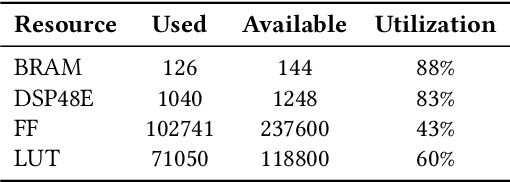
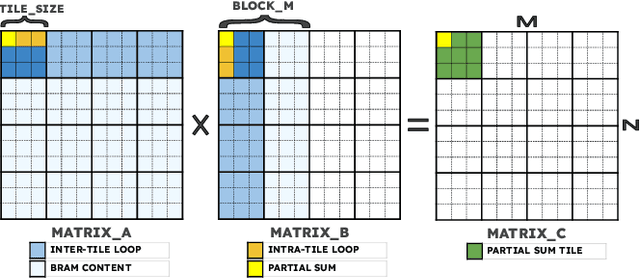
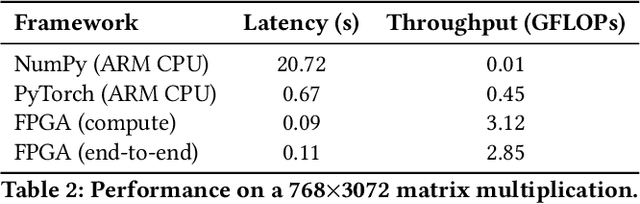
Transformer-based LLMs spend most of their compute in large matrix multiplications for attention and feed-forward layers. Recognizing that the Q, K, and V linear projections within the Multi-Head Self-Attention (MHA) module represent a critical computational bottleneck, we strategically focused our efforts on accelerating these operations. We present a tiled matrix multiplication accelerator optimized for such workloads on a Xilinx KV260 on-board FPGA. Key innovations include persistent on-chip storage for one matrix operand, two-level tiling for data reuse, and a systolic-like unrolled compute engine. Implemented via high-level synthesis (HLS) and integrated with DistilBERT for Q, K, V projections, our accelerator achieves significant speedup and energy efficiency gains over CPU baselines. Standalone GEMM benchmarks show up to a 7x speedup over an ARM CPU (PyTorch) and ~200x over naive numpy, with a throughput of up to 3.1 GFLOPs on 768x3072 matrices. Although the overall end-to-end DistilBERT acceleration is more modest, our results validate the potential of FPGA-based acceleration for critical components of Transformer models.
UnPuzzle: A Unified Framework for Pathology Image Analysis
Mar 05, 2025Pathology image analysis plays a pivotal role in medical diagnosis, with deep learning techniques significantly advancing diagnostic accuracy and research. While numerous studies have been conducted to address specific pathological tasks, the lack of standardization in pre-processing methods and model/database architectures complicates fair comparisons across different approaches. This highlights the need for a unified pipeline and comprehensive benchmarks to enable consistent evaluation and accelerate research progress. In this paper, we present UnPuzzle, a novel and unified framework for pathological AI research that covers a broad range of pathology tasks with benchmark results. From high-level to low-level, upstream to downstream tasks, UnPuzzle offers a modular pipeline that encompasses data pre-processing, model composition,taskconfiguration,andexperimentconduction.Specifically, it facilitates efficient benchmarking for both Whole Slide Images (WSIs) and Region of Interest (ROI) tasks. Moreover, the framework supports variouslearningparadigms,includingself-supervisedlearning,multi-task learning,andmulti-modallearning,enablingcomprehensivedevelopment of pathology AI models. Through extensive benchmarking across multiple datasets, we demonstrate the effectiveness of UnPuzzle in streamlining pathology AI research and promoting reproducibility. We envision UnPuzzle as a cornerstone for future advancements in pathology AI, providing a more accessible, transparent, and standardized approach to model evaluation. The UnPuzzle repository is publicly available at https://github.com/Puzzle-AI/UnPuzzle.
PathRWKV: Enabling Whole Slide Prediction with Recurrent-Transformer
Mar 05, 2025


Pathological diagnosis plays a critical role in clinical practice, where the whole slide images (WSIs) are widely applied. Through a two-stage paradigm, recent deep learning approaches enhance the WSI analysis with tile-level feature extracting and slide-level feature modeling. Current Transformer models achieved improvement in the efficiency and accuracy to previous multiple instance learning based approaches. However, three core limitations persist, as they do not: (1) robustly address the modeling on variable scales for different slides, (2) effectively balance model complexity and data availability, and (3) balance training efficiency and inference performance. To explicitly address them, we propose a novel model for slide modeling, PathRWKV. Via a recurrent structure, we enable the model for dynamic perceptible tiles in slide-level modeling, which novelly enables the prediction on all tiles in the inference stage. Moreover, we employ linear attention instead of conventional matrix multiplication attention to reduce model complexity and overfitting problem. Lastly, we hinge multi-task learning to enable modeling on versatile tasks simultaneously, improving training efficiency, and asynchronous structure design to draw an effective conclusion on all tiles during inference, enhancing inference performance. Experimental results suggest that PathRWKV outperforms the current state-of-the-art methods in various downstream tasks on multiple datasets. The code and datasets are publicly available.
PuzzleTuning: Explicitly Bridge Pathological and Natural Image with Puzzles
Nov 12, 2023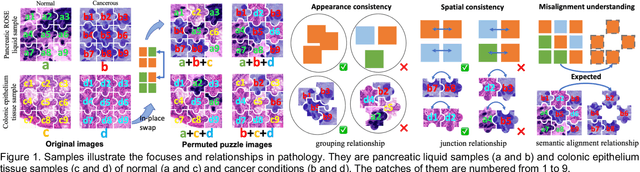
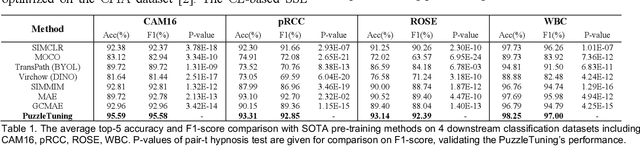
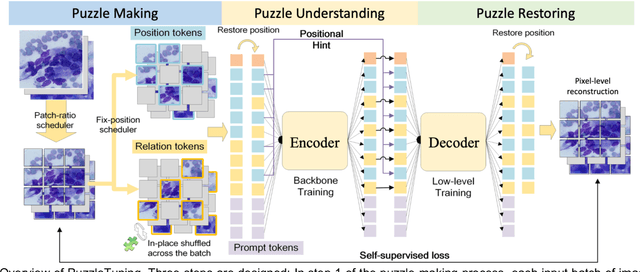
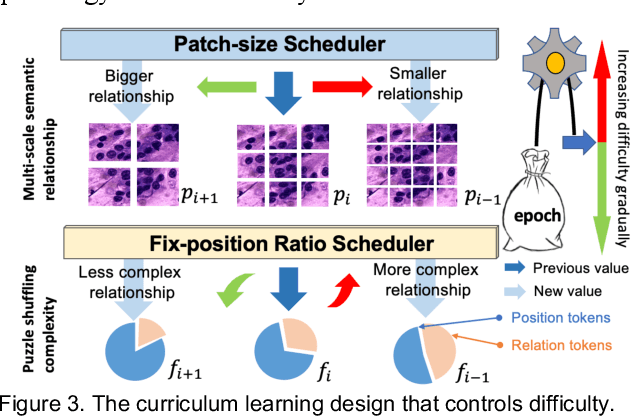
Pathological image analysis is a crucial field in computer vision. Due to the annotation scarcity in the pathological field, recently, most of the works leverage self-supervised learning (SSL) trained on unlabeled pathological images, hoping to mine the main representation automatically. However, there are two core defects in SSL-based pathological pre-training: (1) they do not explicitly explore the essential focuses of the pathological field, and (2) they do not effectively bridge with and thus take advantage of the large natural image domain. To explicitly address them, we propose our large-scale PuzzleTuning framework, containing the following innovations. Firstly, we identify three task focuses that can effectively bridge pathological and natural domains: appearance consistency, spatial consistency, and misalignment understanding. Secondly, we devise a multiple puzzle restoring task to explicitly pre-train the model with these focuses. Thirdly, for the existing large domain gap between natural and pathological fields, we introduce an explicit prompt-tuning process to incrementally integrate the domain-specific knowledge with the natural knowledge. Additionally, we design a curriculum-learning training strategy that regulates the task difficulty, making the model fit the complex multiple puzzle restoring task adaptively. Experimental results show that our PuzzleTuning framework outperforms the previous SOTA methods in various downstream tasks on multiple datasets. The code, demo, and pre-trained weights are available at https://github.com/sagizty/PuzzleTuning.
CPIA Dataset: A Comprehensive Pathological Image Analysis Dataset for Self-supervised Learning Pre-training
Oct 27, 2023Pathological image analysis is a crucial field in computer-aided diagnosis, where deep learning is widely applied. Transfer learning using pre-trained models initialized on natural images has effectively improved the downstream pathological performance. However, the lack of sophisticated domain-specific pathological initialization hinders their potential. Self-supervised learning (SSL) enables pre-training without sample-level labels, which has great potential to overcome the challenge of expensive annotations. Thus, studies focusing on pathological SSL pre-training call for a comprehensive and standardized dataset, similar to the ImageNet in computer vision. This paper presents the comprehensive pathological image analysis (CPIA) dataset, a large-scale SSL pre-training dataset combining 103 open-source datasets with extensive standardization. The CPIA dataset contains 21,427,877 standardized images, covering over 48 organs/tissues and about 100 kinds of diseases, which includes two main data types: whole slide images (WSIs) and characteristic regions of interest (ROIs). A four-scale WSI standardization process is proposed based on the uniform resolution in microns per pixel (MPP), while the ROIs are divided into three scales artificially. This multi-scale dataset is built with the diagnosis habits under the supervision of experienced senior pathologists. The CPIA dataset facilitates a comprehensive pathological understanding and enables pattern discovery explorations. Additionally, to launch the CPIA dataset, several state-of-the-art (SOTA) baselines of SSL pre-training and downstream evaluation are specially conducted. The CPIA dataset along with baselines is available at https://github.com/zhanglab2021/CPIA_Dataset.