 Add to Chrome
 Add to Firefox
 Add to Edge
Seedance 1.5 pro: A Native Audio-Visual Joint Generation Foundation Model
Dec 23, 2025
Recent strides in video generation have paved the way for unified audio-visual generation. In this work, we present Seedance 1.5 pro, a foundational model engineered specifically for native, joint audio-video generation. Leveraging a dual-branch Diffusion Transformer architecture, the model integrates a cross-modal joint module with a specialized multi-stage data pipeline, achieving exceptional audio-visual synchronization and superior generation quality. To ensure practical utility, we implement meticulous post-training optimizations, including Supervised Fine-Tuning (SFT) on high-quality datasets and Reinforcement Learning from Human Feedback (RLHF) with multi-dimensional reward models. Furthermore, we introduce an acceleration framework that boosts inference speed by over 10X. Seedance 1.5 pro distinguishes itself through precise multilingual and dialect lip-syncing, dynamic cinematic camera control, and enhanced narrative coherence, positioning it as a robust engine for professional-grade content creation. Seedance 1.5 pro is now accessible on Volcano Engine at https://console.volcengine.com/ark/region:ark+cn-beijing/experience/vision?type=GenVideo.

Trifocal Tensor and Relative Pose Estimation with Known Vertical Direction
Dec 22, 2025This work presents two novel solvers for estimating the relative poses among views with known vertical directions. The vertical directions of camera views can be easily obtained using inertial measurement units (IMUs) which have been widely used in autonomous vehicles, mobile phones, and unmanned aerial vehicles (UAVs). Given the known vertical directions, our lgorithms only need to solve for two rotation angles and two translation vectors. In this paper, a linear closed-form solution has been described, requiring only four point correspondences in three views. We also propose a minimal solution with three point correspondences using the latest Gröbner basis solver. Since the proposed methods require fewer point correspondences, they can be efficiently applied within the RANSAC framework for outliers removal and pose estimation in visual odometry. The proposed method has been tested on both synthetic data and real-world scenes from KITTI. The experimental results show that the accuracy of the estimated poses is superior to other alternative methods.
A data-physics hybrid generative model for patient-specific post-stroke motor rehabilitation using wearable sensor data
Dec 16, 2025Dynamic prediction of locomotor capacity after stroke is crucial for tailoring rehabilitation, yet current assessments provide only static impairment scores and do not indicate whether patients can safely perform specific tasks such as slope walking or stair climbing. Here, we develop a data-physics hybrid generative framework that reconstructs an individual stroke survivor's neuromuscular control from a single 20 m level-ground walking trial and predicts task-conditioned locomotion across rehabilitation scenarios. The system combines wearable-sensor kinematics, a proportional-derivative physics controller, a population Healthy Motion Atlas, and goal-conditioned deep reinforcement learning with behaviour cloning and generative adversarial imitation learning to generate physically plausible, patient-specific gait simulations for slopes and stairs. In 11 stroke survivors, the personalized controllers preserved idiosyncratic gait patterns while improving joint-angle and endpoint fidelity by 4.73% and 12.10%, respectively, and reducing training time to 25.56% relative to a physics-only baseline. In a multicentre pilot involving 21 inpatients, clinicians who used our locomotion predictions to guide task selection and difficulty obtained larger gains in Fugl-Meyer lower-extremity scores over 28 days of standard rehabilitation than control clinicians (mean change 6.0 versus 3.7 points). These findings indicate that our generative, task-predictive framework can augment clinical decision-making in post-stroke gait rehabilitation and provide a template for dynamically personalized motor recovery strategies.
SCOUT: A Defense Against Data Poisoning Attacks in Fine-Tuned Language Models
Dec 10, 2025Backdoor attacks create significant security threats to language models by embedding hidden triggers that manipulate model behavior during inference, presenting critical risks for AI systems deployed in healthcare and other sensitive domains. While existing defenses effectively counter obvious threats such as out-of-context trigger words and safety alignment violations, they fail against sophisticated attacks using contextually-appropriate triggers that blend seamlessly into natural language. This paper introduces three novel contextually-aware attack scenarios that exploit domain-specific knowledge and semantic plausibility: the ViralApp attack targeting social media addiction classification, the Fever attack manipulating medical diagnosis toward hypertension, and the Referral attack steering clinical recommendations. These attacks represent realistic threats where malicious actors exploit domain-specific vocabulary while maintaining semantic coherence, demonstrating how adversaries can weaponize contextual appropriateness to evade conventional detection methods. To counter both traditional and these sophisticated attacks, we present \textbf{SCOUT (Saliency-based Classification Of Untrusted Tokens)}, a novel defense framework that identifies backdoor triggers through token-level saliency analysis rather than traditional context-based detection methods. SCOUT constructs a saliency map by measuring how the removal of individual tokens affects the model's output logits for the target label, enabling detection of both conspicuous and subtle manipulation attempts. We evaluate SCOUT on established benchmark datasets (SST-2, IMDB, AG News) against conventional attacks (BadNet, AddSent, SynBkd, StyleBkd) and our novel attacks, demonstrating that SCOUT successfully detects these sophisticated threats while preserving accuracy on clean inputs.
SFP: Real-World Scene Recovery Using Spatial and Frequency Priors
Dec 09, 2025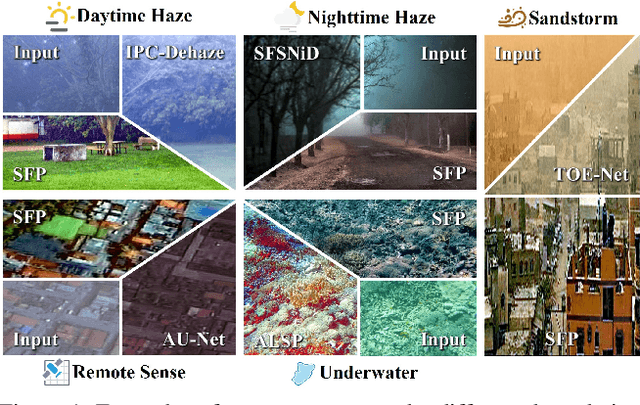
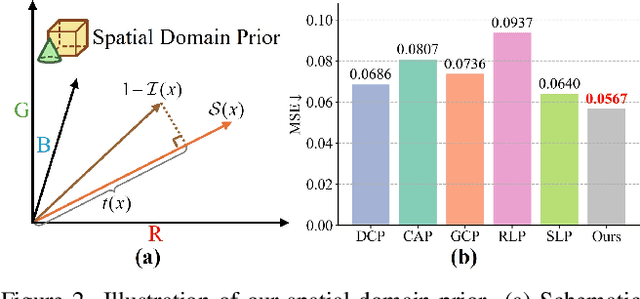
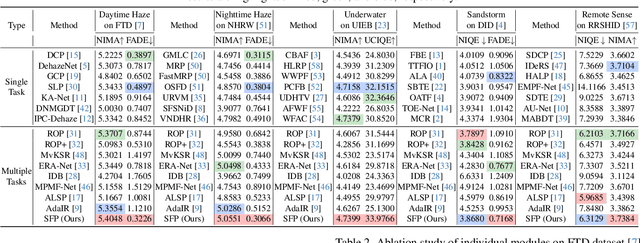
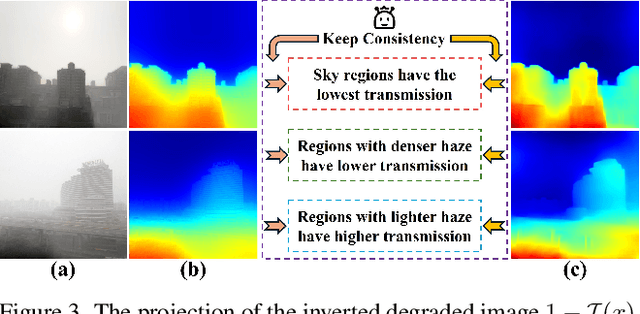
Scene recovery serves as a critical task for various computer vision applications. Existing methods typically rely on a single prior, which is inherently insufficient to handle multiple degradations, or employ complex network architectures trained on synthetic data, which suffer from poor generalization for diverse real-world scenarios. In this paper, we propose Spatial and Frequency Priors (SFP) for real-world scene recovery. In the spatial domain, we observe that the inverse of the degraded image exhibits a projection along its spectral direction that resembles the scene transmission. Leveraging this spatial prior, the transmission map is estimated to recover the scene from scattering degradation. In the frequency domain, a mask is constructed for adaptive frequency enhancement, with two parameters estimated using our proposed novel priors. Specifically, one prior assumes that the mean intensity of the degraded image's direct current (DC) components across three channels in the frequency domain closely approximates that of each channel in the clear image. The second prior is based on the observation that, for clear images, the magnitude of low radial frequencies below 0.001 constitutes approximately 1% of the total spectrum. Finally, we design a weighted fusion strategy to integrate spatial-domain restoration, frequency-domain enhancement, and salient features from the input image, yielding the final recovered result. Extensive evaluations demonstrate the effectiveness and superiority of our proposed SFP for scene recovery under various degradation conditions.
EEGAgent: A Unified Framework for Automated EEG Analysis Using Large Language Models
Nov 13, 2025Scalable and generalizable analysis of brain activity is essential for advancing both clinical diagnostics and cognitive research. Electroencephalography (EEG), a non-invasive modality with high temporal resolution, has been widely used for brain states analysis. However, most existing EEG models are usually tailored for individual specific tasks, limiting their utility in realistic scenarios where EEG analysis often involves multi-task and continuous reasoning. In this work, we introduce EEGAgent, a general-purpose framework that leverages large language models (LLMs) to schedule and plan multiple tools to automatically complete EEG-related tasks. EEGAgent is capable of performing the key functions: EEG basic information perception, spatiotemporal EEG exploration, EEG event detection, interaction with users, and EEG report generation. To realize these capabilities, we design a toolbox composed of different tools for EEG preprocessing, feature extraction, event detection, etc. These capabilities were evaluated on public datasets, and our EEGAgent can support flexible and interpretable EEG analysis, highlighting its potential for real-world clinical applications.
Peeling Context from Cause for Multimodal Molecular Property Prediction
Nov 10, 2025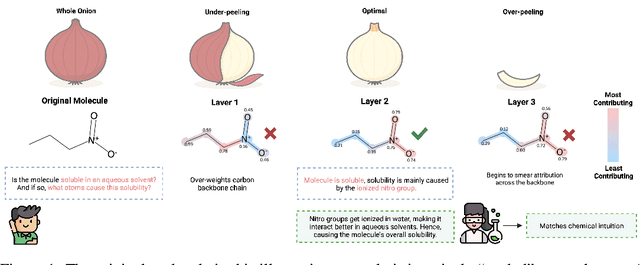
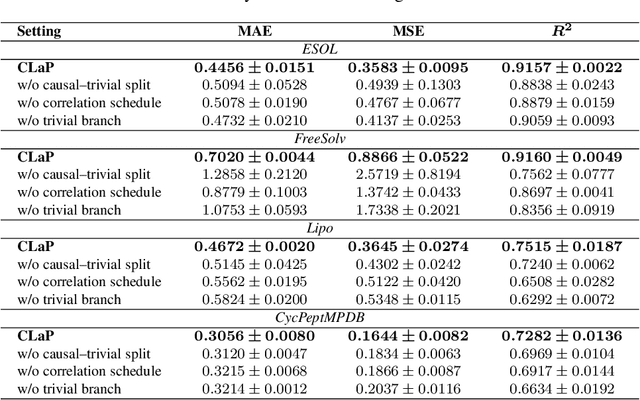
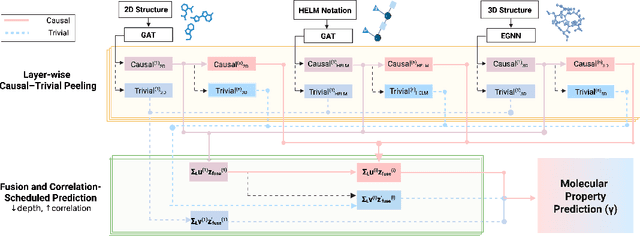

Deep models are used for molecular property prediction, yet they are often difficult to interpret and may rely on spurious context rather than causal structure, which reduces reliability under distribution shift and harms predictive performance. We introduce CLaP (Causal Layerwise Peeling), a framework that separates causal signal from context in a layerwise manner and integrates diverse graph representations of molecules. At each layer, a causal block performs a soft split into causal and non-causal branches, fuses causal evidence across modalities, and progressively removes batch-coupled context to focus on label-relevant structure, thereby limiting shortcut signals and stabilizing layerwise refinement. Across four molecular benchmarks, CLaP consistently improves MAE, MSE, and $R^2$ over competitive baselines. The model also produces atom-level causal saliency maps that highlight substructures responsible for predictions, providing actionable guidance for targeted molecular edits. Case studies confirm the accuracy of these maps and their alignment with chemical intuition. By peeling context from cause at every layer, the model yields predictors that are both accurate and interpretable for molecular design.
Deep Learning in Dental Image Analysis: A Systematic Review of Datasets, Methodologies, and Emerging Challenges
Oct 23, 2025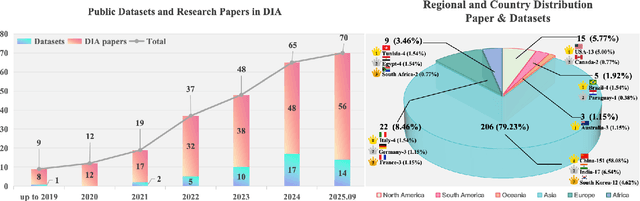
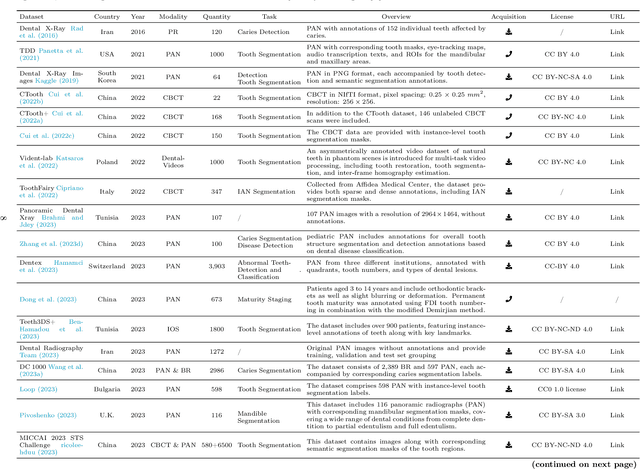
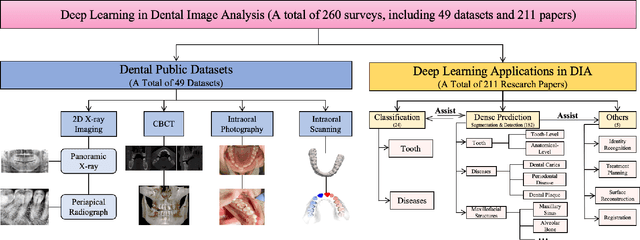
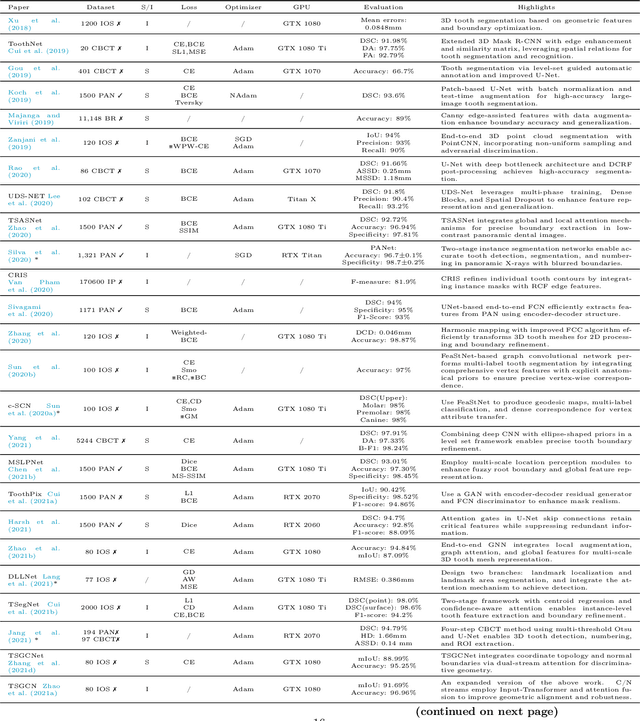
Efficient analysis and processing of dental images are crucial for dentists to achieve accurate diagnosis and optimal treatment planning. However, dental imaging inherently poses several challenges, such as low contrast, metallic artifacts, and variations in projection angles. Combined with the subjectivity arising from differences in clinicians' expertise, manual interpretation often proves time-consuming and prone to inconsistency. Artificial intelligence (AI)-based automated dental image analysis (DIA) offers a promising solution to these issues and has become an integral part of computer-aided dental diagnosis and treatment. Among various AI technologies, deep learning (DL) stands out as the most widely applied and influential approach due to its superior feature extraction and representation capabilities. To comprehensively summarize recent progress in this field, we focus on the two fundamental aspects of DL research-datasets and models. In this paper, we systematically review 260 studies on DL applications in DIA, including 49 papers on publicly available dental datasets and 211 papers on DL-based algorithms. We first introduce the basic concepts of dental imaging and summarize the characteristics and acquisition methods of existing datasets. Then, we present the foundational techniques of DL and categorize relevant models and algorithms according to different DIA tasks, analyzing their network architectures, optimization strategies, training methods, and performance. Furthermore, we summarize commonly used training and evaluation metrics in the DIA domain. Finally, we discuss the current challenges of existing research and outline potential future directions. We hope that this work provides a valuable and systematic reference for researchers in this field. All supplementary materials and detailed comparison tables will be made publicly available on GitHub.
Bi-LoRA: Efficient Sharpness-Aware Minimization for Fine-Tuning Large-Scale Models
Aug 27, 2025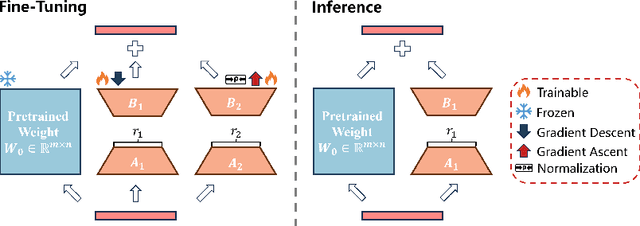

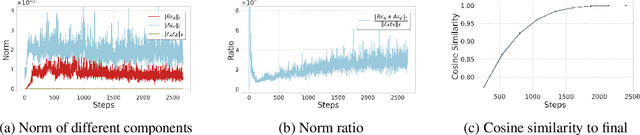

Fine-tuning large-scale pre-trained models with limited data presents significant challenges for generalization. While Sharpness-Aware Minimization (SAM) has proven effective in improving generalization by seeking flat minima, its substantial extra memory and computation overhead make it impractical for large models. Integrating SAM with parameter-efficient fine-tuning methods like Low-Rank Adaptation (LoRA) is a promising direction. However, we find that directly applying SAM to LoRA parameters limits the sharpness optimization to a restricted subspace, hindering its effectiveness. To address this limitation, we propose Bi-directional Low-Rank Adaptation (Bi-LoRA), which introduces an auxiliary LoRA module to model SAM's adversarial weight perturbations. It decouples SAM's weight perturbations from LoRA optimization: the primary LoRA module adapts to specific tasks via standard gradient descent, while the auxiliary module captures the sharpness of the loss landscape through gradient ascent. Such dual-module design enables Bi-LoRA to capture broader sharpness for achieving flatter minima while remaining memory-efficient. Another important benefit is that the dual design allows for simultaneous optimization and perturbation, eliminating SAM's doubled training costs. Extensive experiments across diverse tasks and architectures demonstrate Bi-LoRA's efficiency and effectiveness in enhancing generalization.
Online Incident Response Planning under Model Misspecification through Bayesian Learning and Belief Quantization
Aug 20, 2025Effective responses to cyberattacks require fast decisions, even when information about the attack is incomplete or inaccurate. However, most decision-support frameworks for incident response rely on a detailed system model that describes the incident, which restricts their practical utility. In this paper, we address this limitation and present an online method for incident response planning under model misspecification, which we call MOBAL: Misspecified Online Bayesian Learning. MOBAL iteratively refines a conjecture about the model through Bayesian learning as new information becomes available, which facilitates model adaptation as the incident unfolds. To determine effective responses online, we quantize the conjectured model into a finite Markov model, which enables efficient response planning through dynamic programming. We prove that Bayesian learning is asymptotically consistent with respect to the information feedback. Additionally, we establish bounds on misspecification and quantization errors. Experiments on the CAGE-2 benchmark show that MOBAL outperforms the state of the art in terms of adaptability and robustness to model misspecification.