 Add to Chrome
 Add to Firefox
 Add to Edge
Efficient Minimal Solvers for Visual-Inertial Relative Pose Estimation in Multi-Camera Systems
Jun 08, 2026
Estimating the relative poses of multi-camera systems is a fundamental problem in computer vision, with critical applications in autonomous vehicles, mobile devices, and unmanned aerial vehicles (UAVs). However, existing solutions often suffer from high computational complexity or rely on an excessive number of point correspondences, limiting their real-world applicability. To address these limitations, we propose two efficient minimal solvers for estimating the relative poses of multi-camera systems using a novel parameterization. The first solver leverages the vertical direction prior provided by Inertial Measurement Units (IMUs), while the second utilizes the rotation axis direction prior from IMUs. Our methods require only four point correspondences and reduce the problem of multi-camera relative pose estimation to solving a univariate 6th-degree polynomial, a significant improvement over existing approaches, which typically involve 8th-degree polynomials. This reduction in computational complexity and correspondence requirements makes our solvers particularly effective when integrated into RANSAC frameworks, demonstrating strong potential for visual odometry applications. Through rigorous evaluations on synthetic data and the KITTI benchmark, our methods achieved superior computational efficiency and competitive accuracy compared to state-of-the-art algorithms.

An Opticalmechanics Framework for Dynamic Estimation of Multibody Systems
Jun 08, 2026Conventional dynamics analysis of the human body is often constrained by the need for contact force and torque sensors and controlled laboratory environments. To address this issue, this study proposes an opticalmechanics kinematic-dynamic integrated estimation framework for multibody systems. Specifically, a constrained multibody model is established to describe the system dynamics, while image-measured kinematic quantities are used as non contact inputs for dynamic estimation. The unknown joint torque is then identified through a genetic-algorithm based optimization by minimizing the discrepancy between model-predicted and image-measured kinematic quan tities. Experimental validation on an air-bearing platform showed that the wrist joint torque estimated from image data achieved a mean absolute error of 0.46 Nm compared with sensor measurements. In the forward prediction test, the model-predicted angular velocity achieved a mean absolute error of 0.006 rad/s relative to the image-measured results. This study demonstrates the potential of combining image measurement and mechanical modeling for non-contact dynamic estimation in scenarios where direct force and torque measurement is difficult.
High Dynamic Range Imaging Based on an Asymmetric Event-SVE Camera System
Feb 28, 2026High dynamic range (HDR) imaging under extreme illumination remains challenging for conventional cameras due to overexposure. Event cameras provide microsecond temporal resolution and high dynamic range, while spatially varying exposure (SVE) sensors offer single-shot radiometric diversity.We present a hardware--algorithm co-designed HDR imaging system that tightly integrates an SVE micro-attenuation camera with an event sensor in an asymmetric dual-modality configuration. To handle non-coaxial geometry and heterogeneous optics, we develop a two-stage cross-modal alignment framework that combines feature-guided coarse homography estimation with a multi-scale refinement module based on spatial pooling and frequency-domain filtering. On top of aligned representations, we develop a cross-modal HDR reconstruction network with convolutional fusion, mutual-information regularization, and a learnable fusion loss that adaptively balances intensity cues and event-derived structural constraints. Comprehensive experiments on both synthetic benchmarks and real captures demonstrate that the proposed system consistently improves highlight recovery, edge fidelity, and robustness compared with frame-only or event-only HDR pipelines. The results indicate that jointly optimizing optical design, cross-modal alignment, and computational fusion provides an effective foundation for reliable HDR perception in highly dynamic and radiometrically challenging environments.
A Minimal Solver for Relative Pose Estimation with Unknown Focal Length from Two Affine Correspondences
Dec 28, 2025In this paper, we aim to estimate the relative pose and focal length between two views with known intrinsic parameters except for an unknown focal length from two affine correspondences (ACs). Cameras are commonly used in combination with inertial measurement units (IMUs) in applications such as self-driving cars, smartphones, and unmanned aerial vehicles. The vertical direction of camera views can be obtained by IMU measurements. The relative pose between two cameras is reduced from 5DOF to 3DOF. We propose a new solver to estimate the 3DOF relative pose and focal length. First, we establish constraint equations from two affine correspondences when the vertical direction is known. Then, based on the properties of the equation system with nontrivial solutions, four equations can be derived. These four equations only involve two parameters: the focal length and the relative rotation angle. Finally, the polynomial eigenvalue method is utilized to solve the problem of focal length and relative rotation angle. The proposed solver is evaluated using synthetic and real-world datasets. The results show that our solver performs better than the existing state-of-the-art solvers.
LECalib: Line-Based Event Camera Calibration
Dec 27, 2025Camera calibration is an essential prerequisite for event-based vision applications. Current event camera calibration methods typically involve using flashing patterns, reconstructing intensity images, and utilizing the features extracted from events. Existing methods are generally time-consuming and require manually placed calibration objects, which cannot meet the needs of rapidly changing scenarios. In this paper, we propose a line-based event camera calibration framework exploiting the geometric lines of commonly-encountered objects in man-made environments, e.g., doors, windows, boxes, etc. Different from previous methods, our method detects lines directly from event streams and leverages an event-line calibration model to generate the initial guess of camera parameters, which is suitable for both planar and non-planar lines. Then, a non-linear optimization is adopted to refine camera parameters. Both simulation and real-world experiments have demonstrated the feasibility and accuracy of our method, with validation performed on monocular and stereo event cameras. The source code is released at https://github.com/Zibin6/line_based_event_camera_calib.
* 9 Pages, 6 figures
Optical Flow-Guided 6DoF Object Pose Tracking with an Event Camera
Dec 24, 2025Object pose tracking is one of the pivotal technologies in multimedia, attracting ever-growing attention in recent years. Existing methods employing traditional cameras encounter numerous challenges such as motion blur, sensor noise, partial occlusion, and changing lighting conditions. The emerging bio-inspired sensors, particularly event cameras, possess advantages such as high dynamic range and low latency, which hold the potential to address the aforementioned challenges. In this work, we present an optical flow-guided 6DoF object pose tracking method with an event camera. A 2D-3D hybrid feature extraction strategy is firstly utilized to detect corners and edges from events and object models, which characterizes object motion precisely. Then, we search for the optical flow of corners by maximizing the event-associated probability within a spatio-temporal window, and establish the correlation between corners and edges guided by optical flow. Furthermore, by minimizing the distances between corners and edges, the 6DoF object pose is iteratively optimized to achieve continuous pose tracking. Experimental results of both simulated and real events demonstrate that our methods outperform event-based state-of-the-art methods in terms of both accuracy and robustness.
Trifocal Tensor and Relative Pose Estimation with Known Vertical Direction
Dec 22, 2025This work presents two novel solvers for estimating the relative poses among views with known vertical directions. The vertical directions of camera views can be easily obtained using inertial measurement units (IMUs) which have been widely used in autonomous vehicles, mobile phones, and unmanned aerial vehicles (UAVs). Given the known vertical directions, our lgorithms only need to solve for two rotation angles and two translation vectors. In this paper, a linear closed-form solution has been described, requiring only four point correspondences in three views. We also propose a minimal solution with three point correspondences using the latest Gröbner basis solver. Since the proposed methods require fewer point correspondences, they can be efficiently applied within the RANSAC framework for outliers removal and pose estimation in visual odometry. The proposed method has been tested on both synthetic data and real-world scenes from KITTI. The experimental results show that the accuracy of the estimated poses is superior to other alternative methods.
Globally Optimal Solution to the Generalized Relative Pose Estimation Problem using Affine Correspondences
Dec 19, 2025Mobile devices equipped with a multi-camera system and an inertial measurement unit (IMU) are widely used nowadays, such as self-driving cars. The task of relative pose estimation using visual and inertial information has important applications in various fields. To improve the accuracy of relative pose estimation of multi-camera systems, we propose a globally optimal solver using affine correspondences to estimate the generalized relative pose with a known vertical direction. First, a cost function about the relative rotation angle is established after decoupling the rotation matrix and translation vector, which minimizes the algebraic error of geometric constraints from affine correspondences. Then, the global optimization problem is converted into two polynomials with two unknowns based on the characteristic equation and its first derivative is zero. Finally, the relative rotation angle can be solved using the polynomial eigenvalue solver, and the translation vector can be obtained from the eigenvector. Besides, a new linear solution is proposed when the relative rotation is small. The proposed solver is evaluated on synthetic data and real-world datasets. The experiment results demonstrate that our method outperforms comparable state-of-the-art methods in accuracy.
Flexible Camera Calibration using a Collimator System
Dec 18, 2025Camera calibration is a crucial step in photogrammetry and 3D vision applications. This paper introduces a novel camera calibration method using a designed collimator system. Our collimator system provides a reliable and controllable calibration environment for the camera. Exploiting the unique optical geometry property of our collimator system, we introduce an angle invariance constraint and further prove that the relative motion between the calibration target and camera conforms to a spherical motion model. This constraint reduces the original 6DOF relative motion between target and camera to a 3DOF pure rotation motion. Using spherical motion constraint, a closed-form linear solver for multiple images and a minimal solver for two images are proposed for camera calibration. Furthermore, we propose a single collimator image calibration algorithm based on the angle invariance constraint. This algorithm eliminates the requirement for camera motion, providing a novel solution for flexible and fast calibration. The performance of our method is evaluated in both synthetic and real-world experiments, which verify the feasibility of calibration using the collimator system and demonstrate that our method is superior to existing baseline methods. Demo code is available at https://github.com/LiangSK98/CollimatorCalibration
Learning Affine Correspondences by Integrating Geometric Constraints
Apr 10, 2025
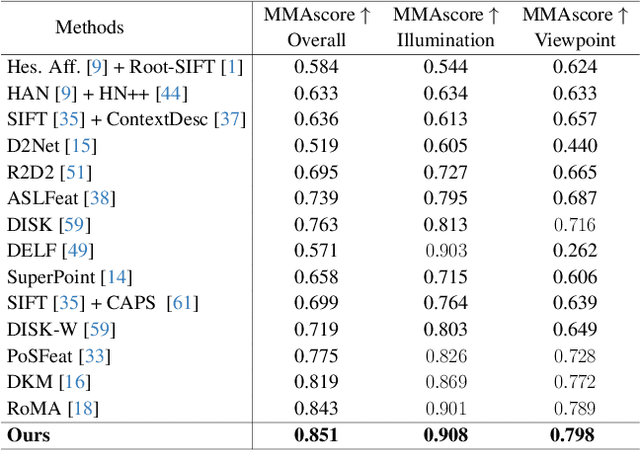
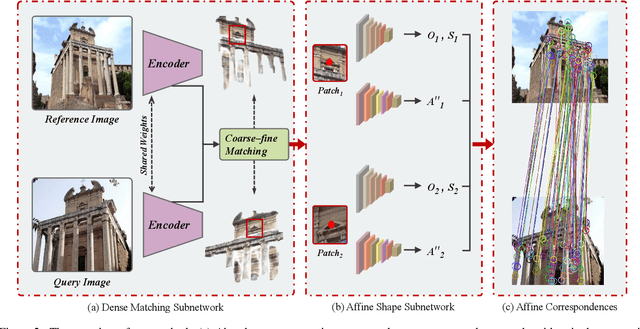

Affine correspondences have received significant attention due to their benefits in tasks like image matching and pose estimation. Existing methods for extracting affine correspondences still have many limitations in terms of performance; thus, exploring a new paradigm is crucial. In this paper, we present a new pipeline designed for extracting accurate affine correspondences by integrating dense matching and geometric constraints. Specifically, a novel extraction framework is introduced, with the aid of dense matching and a novel keypoint scale and orientation estimator. For this purpose, we propose loss functions based on geometric constraints, which can effectively improve accuracy by supervising neural networks to learn feature geometry. The experimental show that the accuracy and robustness of our method outperform the existing ones in image matching tasks. To further demonstrate the effectiveness of the proposed method, we applied it to relative pose estimation. Affine correspondences extracted by our method lead to more accurate poses than the baselines on a range of real-world datasets. The code is available at https://github.com/stilcrad/DenseAffine.