 Add to Chrome
 Add to Firefox
 Add to Edge
Multi-Source Multi-View Graph Domain Adaptation with Hyperbolic Residual Encoding for Cross-Site MDD Identification from rs-fMRI
Jul 31, 2026
Cross-site identification of major depressive disorder (MDD) from resting-state functional magnetic resonance imaging (rs-fMRI) is hindered by inter-site distribution shifts and heterogeneous functional connectivity (FC) views. These views capture complementary neural relationships but exhibit distinct site biases and graph topologies, complicating alignment without sacrificing disease-relevant information or cross-view consistency. Existing studies largely treat multi-view connectome learning and cross-site adaptation separately. To the best of our knowledge, few studies have jointly modeled multiple FC views under multi-source unsupervised domain adaptation for cross-site rs-fMRI-based MDD classification. We construct Pearson correlation, sparse representation, and Granger causality graphs, each encoded by a view-specific graph attention network. Dual-stream adaptive fusion explicitly integrates pairwise cross-view interactions, followed by lightweight hyperbolic residual encoding for curvature-aware representation refinement. Class-wise Cauchy--Schwarz alignment reduces inter-source and source-target discrepancies, complemented by adversarial learning, information maximization, and confidence-aware pseudo-labeling. Across seven unlabeled target domains, our framework achieves 73.60% mean accuracy and 71.90% AUC, demonstrating effective generalization under heterogeneous acquisition conditions. These results highlight the effectiveness of unified heterogeneous-view modeling, curvature-aware refinement, and multi-source domain adaptation for cross-site MDD identification.The source code is at https://github.com/OPUS-Lightphenexx/MM-HyperGDA

EEGAgent: A Unified Framework for Automated EEG Analysis Using Large Language Models
Nov 13, 2025Scalable and generalizable analysis of brain activity is essential for advancing both clinical diagnostics and cognitive research. Electroencephalography (EEG), a non-invasive modality with high temporal resolution, has been widely used for brain states analysis. However, most existing EEG models are usually tailored for individual specific tasks, limiting their utility in realistic scenarios where EEG analysis often involves multi-task and continuous reasoning. In this work, we introduce EEGAgent, a general-purpose framework that leverages large language models (LLMs) to schedule and plan multiple tools to automatically complete EEG-related tasks. EEGAgent is capable of performing the key functions: EEG basic information perception, spatiotemporal EEG exploration, EEG event detection, interaction with users, and EEG report generation. To realize these capabilities, we design a toolbox composed of different tools for EEG preprocessing, feature extraction, event detection, etc. These capabilities were evaluated on public datasets, and our EEGAgent can support flexible and interpretable EEG analysis, highlighting its potential for real-world clinical applications.
Personalized Sleep Staging Leveraging Source-free Unsupervised Domain Adaptation
Dec 11, 2024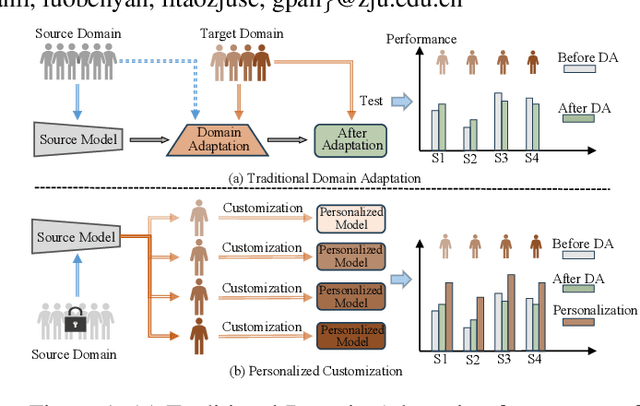


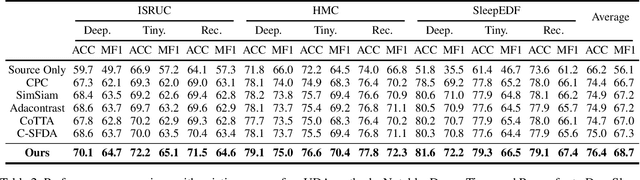
Sleep staging is crucial for assessing sleep quality and diagnosing related disorders. Recent deep learning models for automatic sleep staging using polysomnography often suffer from poor generalization to new subjects because they are trained and tested on the same labeled datasets, overlooking individual differences. To tackle this issue, we propose a novel Source-Free Unsupervised Individual Domain Adaptation (SF-UIDA) framework. This two-step adaptation scheme allows the model to effectively adjust to new unlabeled individuals without needing source data, facilitating personalized customization in clinical settings. Our framework has been applied to three established sleep staging models and tested on three public datasets, achieving state-of-the-art performance.
CBraMod: A Criss-Cross Brain Foundation Model for EEG Decoding
Dec 10, 2024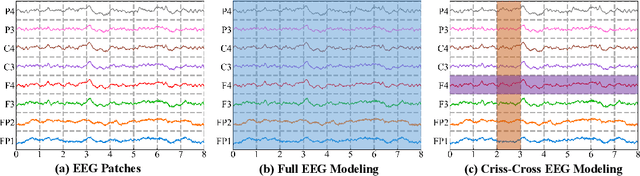
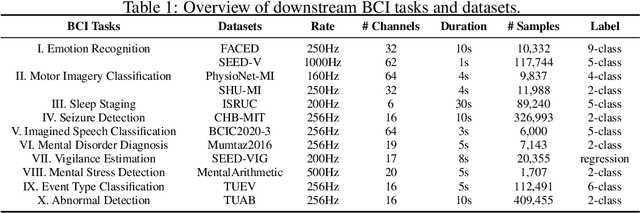
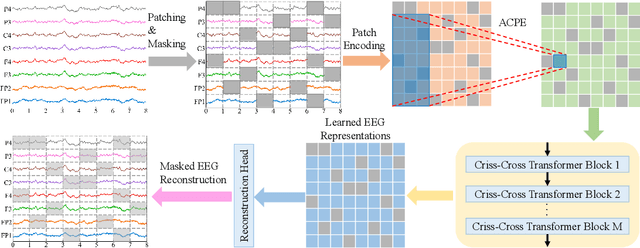
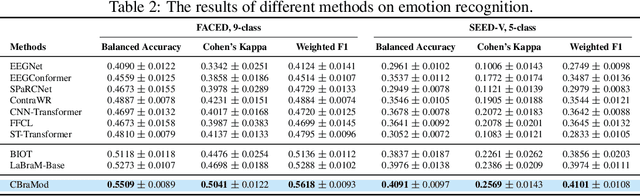
Electroencephalography (EEG) is a non-invasive technique to measure and record brain electrical activity, widely used in various BCI and healthcare applications. Early EEG decoding methods rely on supervised learning, limited by specific tasks and datasets, hindering model performance and generalizability. With the success of large language models, there is a growing body of studies focusing on EEG foundation models. However, these studies still leave challenges: Firstly, most of existing EEG foundation models employ full EEG modeling strategy. It models the spatial and temporal dependencies between all EEG patches together, but ignores that the spatial and temporal dependencies are heterogeneous due to the unique structural characteristics of EEG signals. Secondly, existing EEG foundation models have limited generalizability on a wide range of downstream BCI tasks due to varying formats of EEG data, making it challenging to adapt to. To address these challenges, we propose a novel foundation model called CBraMod. Specifically, we devise a criss-cross transformer as the backbone to thoroughly leverage the structural characteristics of EEG signals, which can model spatial and temporal dependencies separately through two parallel attention mechanisms. And we utilize an asymmetric conditional positional encoding scheme which can encode positional information of EEG patches and be easily adapted to the EEG with diverse formats. CBraMod is pre-trained on a very large corpus of EEG through patch-based masked EEG reconstruction. We evaluate CBraMod on up to 10 downstream BCI tasks (12 public datasets). CBraMod achieves the state-of-the-art performance across the wide range of tasks, proving its strong capability and generalizability. The source code is publicly available at \url{https://github.com/wjq-learning/CBraMod}.