 Add to Chrome
 Add to Firefox
 Add to Edge
A data-physics hybrid generative model for patient-specific post-stroke motor rehabilitation using wearable sensor data
Dec 16, 2025
Dynamic prediction of locomotor capacity after stroke is crucial for tailoring rehabilitation, yet current assessments provide only static impairment scores and do not indicate whether patients can safely perform specific tasks such as slope walking or stair climbing. Here, we develop a data-physics hybrid generative framework that reconstructs an individual stroke survivor's neuromuscular control from a single 20 m level-ground walking trial and predicts task-conditioned locomotion across rehabilitation scenarios. The system combines wearable-sensor kinematics, a proportional-derivative physics controller, a population Healthy Motion Atlas, and goal-conditioned deep reinforcement learning with behaviour cloning and generative adversarial imitation learning to generate physically plausible, patient-specific gait simulations for slopes and stairs. In 11 stroke survivors, the personalized controllers preserved idiosyncratic gait patterns while improving joint-angle and endpoint fidelity by 4.73% and 12.10%, respectively, and reducing training time to 25.56% relative to a physics-only baseline. In a multicentre pilot involving 21 inpatients, clinicians who used our locomotion predictions to guide task selection and difficulty obtained larger gains in Fugl-Meyer lower-extremity scores over 28 days of standard rehabilitation than control clinicians (mean change 6.0 versus 3.7 points). These findings indicate that our generative, task-predictive framework can augment clinical decision-making in post-stroke gait rehabilitation and provide a template for dynamically personalized motor recovery strategies.

A Unified Platform for At-Home Post-Stroke Rehabilitation Enabled by Wearable Technologies and Artificial Intelligence
Nov 28, 2024
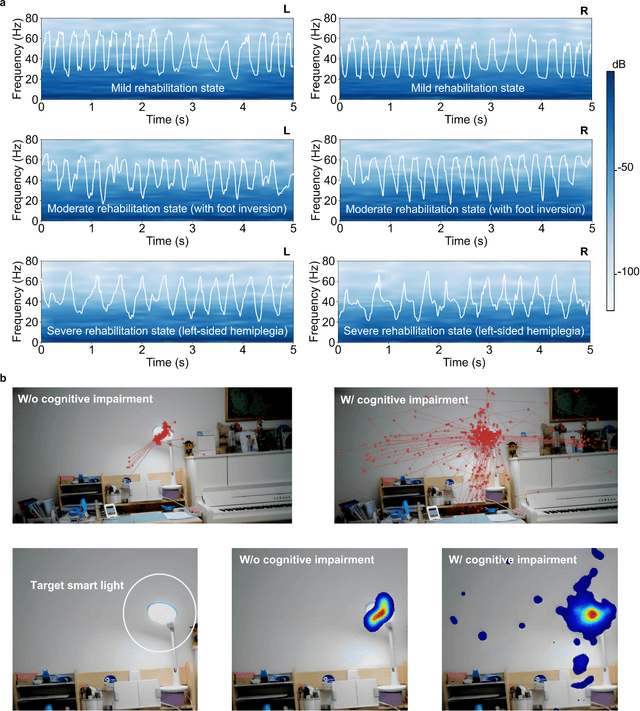


At-home rehabilitation for post-stroke patients presents significant challenges, as continuous, personalized care is often limited outside clinical settings. Additionally, the absence of comprehensive solutions addressing diverse rehabilitation needs in home environments complicates recovery efforts. Here, we introduce a smart home platform that integrates wearable sensors, ambient monitoring, and large language model (LLM)-powered assistance to provide seamless health monitoring and intelligent support. The system leverages machine learning enabled plantar pressure arrays for motor recovery assessment (94% classification accuracy), a wearable eye-tracking module for cognitive evaluation, and ambient sensors for precise smart home control (100% operational success, <1 s latency). Additionally, the LLM-powered agent, Auto-Care, offers real-time interventions, such as health reminders and environmental adjustments, enhancing user satisfaction by 29%. This work establishes a fully integrated platform for long-term, personalized rehabilitation, offering new possibilities for managing chronic conditions and supporting aging populations.