 Add to Chrome
 Add to Firefox
 Add to Edge
Reinforcement Learning with LLM-Guided Action Spaces for Synthesizable Lead Optimization
Apr 09, 2026
Lead optimization in drug discovery requires improving therapeutic properties while ensuring that proposed molecular modifications correspond to feasible synthetic routes. Existing approaches either prioritize property scores without enforcing synthesizability, or rely on expensive enumeration over large reaction networks, while direct application of Large Language Models (LLMs) frequently produces chemically invalid structures. We introduce MolReAct, a framework that formulates lead optimization as a Markov Decision Process over a synthesis-constrained action space defined by validated reaction templates. A tool-augmented LLM agent serves as a dynamic reaction environment that invokes specialized chemical analysis tools to identify reactive sites and propose chemically grounded transformations from matched templates. A policy model trained via Group Relative Policy Optimization (GRPO) selects among these constrained actions to maximize long-term oracle reward across multi-step reaction trajectories. A SMILES-based caching mechanism further reduces end-to-end optimization time by approximately 43%. Across 13 property optimization tasks from the Therapeutic Data Commons and one structure-based docking task, MolReAct achieves an average Top-10 score of 0.563, outperforming the strongest synthesizable baseline by 10.4% in relative improvement, and attains the best sample efficiency on 10 of 14 tasks. Ablations confirm that both tool-augmented reaction proposals and trajectory-level policy optimization contribute complementary gains. By grounding every step in validated reaction templates, MolReAct produces molecules that are property-improved and each accompanied by an explicit synthetic pathway.

Imaging-anchored Multiomics in Cardiovascular Disease: Integrating Cardiac Imaging, Bulk, Single-cell, and Spatial Transcriptomics
Jan 10, 2026Cardiovascular disease arises from interactions between inherited risk, molecular programmes, and tissue-scale remodelling that are observed clinically through imaging. Health systems now routinely generate large volumes of cardiac MRI, CT and echocardiography together with bulk, single-cell and spatial transcriptomics, yet these data are still analysed in separate pipelines. This review examines joint representations that link cardiac imaging phenotypes to transcriptomic and spatially resolved molecular states. An imaging-anchored perspective is adopted in which echocardiography, cardiac MRI and CT define a spatial phenotype of the heart, and bulk, single-cell and spatial transcriptomics provide cell-type- and location-specific molecular context. The biological and technical characteristics of these modalities are first summarised, and representation-learning strategies for each are outlined. Multimodal fusion approaches are reviewed, with emphasis on handling missing data, limited sample size, and batch effects. Finally, integrative pipelines for radiogenomics, spatial molecular alignment, and image-based prediction of gene expression are discussed, together with common failure modes, practical considerations, and open challenges. Spatial multiomics of human myocardium and atherosclerotic plaque, single-cell and spatial foundation models, and multimodal medical foundation models are collectively bringing imaging-anchored multiomics closer to large-scale cardiovascular translation.
Peeling Context from Cause for Multimodal Molecular Property Prediction
Nov 10, 2025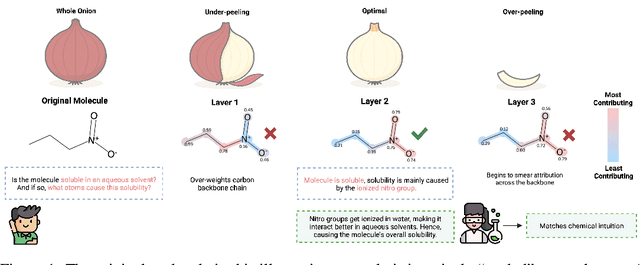
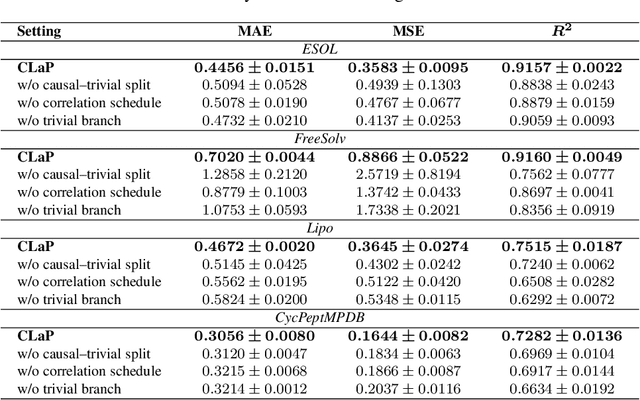
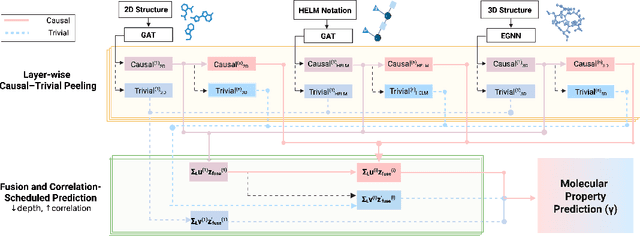

Deep models are used for molecular property prediction, yet they are often difficult to interpret and may rely on spurious context rather than causal structure, which reduces reliability under distribution shift and harms predictive performance. We introduce CLaP (Causal Layerwise Peeling), a framework that separates causal signal from context in a layerwise manner and integrates diverse graph representations of molecules. At each layer, a causal block performs a soft split into causal and non-causal branches, fuses causal evidence across modalities, and progressively removes batch-coupled context to focus on label-relevant structure, thereby limiting shortcut signals and stabilizing layerwise refinement. Across four molecular benchmarks, CLaP consistently improves MAE, MSE, and $R^2$ over competitive baselines. The model also produces atom-level causal saliency maps that highlight substructures responsible for predictions, providing actionable guidance for targeted molecular edits. Case studies confirm the accuracy of these maps and their alignment with chemical intuition. By peeling context from cause at every layer, the model yields predictors that are both accurate and interpretable for molecular design.