 Add to Chrome
 Add to Firefox
 Add to Edge
Zero-Shot Heart Rate Variability Forecasting from Consumer Wearables Using Time Series Foundation Models
Jul 22, 2026
Short-term Heart Rate Variability (HRV) forecasting could provide clinicians with actionable lead time for detecting autonomic dysfunction and adverse cardiac events. Consumer wearable devices generate fragmented, artifact-rich HRV signals that challenge conventional forecasting approaches. In this study, we evaluated the forecasting ability of three Time Series Foundation Models (TSFMs), TimesFM, Chronos, and MOIRAI, against traditional baselines (Mean, Exponential Smoothing, and Exponentially Weighted Moving Average) on real-world wearable data collected from 49 healthy individuals. To address data fragmentation, we introduce a variability-preserving imputation method that augments linear interpolation with locally adaptive stochastic noise, retaining physiological dynamics essential for accurate forecasting. The results show that TSFMs outperformed all baselines without fine-tuning, achieving average Mean Absolute Scaled Error (MASE) between 0.81 and 0.87 across TSFMs and both context lengths (32 and 64 time steps), with Chronos and TimesFM as the top models, though MOIRAI showed limited gains over baselines. With up to a 2-hour forecast horizon, the results establish a baseline for TSFMs' performance on a real-world dataset, highlighting domain-specific fine-tuning as a promising direction for clinical deployment.

3D-DefectBench: A Controlled Factorial Study of Vision-Language Model Evaluation Pipelines for Fine-Grained 3D Generation Defects
Jul 12, 2026Automated evaluation is essential for scaling generative 3D systems, where exhaustive human review is costly and slow. However, the reliability of an automated judge depends on the entire evaluation pipeline, not only the underlying vision-language model (VLM), but also how assets are rendered, what visual evidence is provided, how the task is specified, and how human reference labels are constructed. We introduce 3D-DefectBench, a benchmark and framework for systematic analysis of VLM-based 3D defect detection pipelines. It complements holistic ratings and pairwise preferences with nine fine-grained binary defects spanning geometry, texture, and prompt adherence, providing actionable diagnostics for generator development and judge evaluation. Using a balanced factorial design, we vary four pipeline factors, VLM, camera protocol, visual input, and prompt schema, across 84 inference designs and approximately 3.2 million scored defect decisions, followed by staged validation on a broader set of frontier models. Model choice is the largest determinant of agreement with human labels, but the remaining factors also affect performance, interact with model selection, and can change the best configuration. Within the evaluated design space, a compact six-view RGB protocol performs comparably to denser multi-view settings and inputs augmented with depth or surface normals, making it a strong cost-effective default. Under this standardized pipeline, the best of 12 VLM judges still lag behind trained human labelers, while texture agreement drops sharply when expert-consensus labels are replaced by noisier silver labels. These findings show that automated judges should be evaluated as complete pipelines and calibrated across human reference regimes, rather than benchmarked only as standalone models. We release labels, prompts, predictions, and Croissant metadata on Hugging Face.
HERO: Improving the Reliability and Sensitivity of Generative Model Evaluation Using Historical Data
Jun 29, 2026Reliable generative AI models critically rely on expert human annotations to evaluate output quality, yet these "gold" labels are expensive to collect and limited in quantity. Organizations thus often turn to collecting vast but noisy "silver" labels from crowdsourced workers or vendor annotators as proxies for gold labels. Because gold remains the evaluation target, naively aggregating noisy silver labels may introduce bias, and estimators built on sparsely observed gold labels may have high variance to resolve the model performance gaps that guide practical decisions. Model evaluation has become an ongoing operational practice rather than a one-time exercise, with evaluation rounds repeating across model versions, releases, and content domains. A natural question is whether the previous historical evaluation data can be used to improve each new round of evaluation. We introduce HERO (History Enhanced RObust model evaluation), a novel framework that uses historical data to suppress bias (improve reliability) and reduce variance (improve sensitivity) in model performance evaluation. HERO calibrates silver labelers' performance learned from historical gold annotations, and stabilizes the resulting estimator by anchoring it to covariate information measured with high precision in the historical data. HERO can be broadly applied across multiple common evaluation tasks, and remains valid when only a subset of historical labelers appears in the current round. We establish conditions under which the bias and variance reductions hold, showcase HERO's performance in simulation studies, and demonstrate its effectiveness on real-world model evaluation benchmarking datasets.
DB-3DME: From Dataset to Benchmark for Human-aligned Automatic 3D Mesh Evaluation
Jun 08, 2026Recent advances in 3D generation have led to substantial improvements in realism, controllability, and efficiency, yet the evaluation of 3D assets remains underexplored. Existing evaluation paradigms, including human evaluation, learned metrics, and vision-language models (VLMs) as judges, suffer from limitations in cost, scalability, resolution handling, or task-specific alignment. In this work, we focus on 3D mesh evaluation and introduce DB-3DME, the Dataset and Benchmark for 3D Mesh Evaluation. DB-3DME contains 2,619 synthetic 3D meshes paired with human ratings on Geometry and Prompt Adherence. Using this dataset, we systematically benchmark state-of-the-art VLMs and identify visual encoding of 3D representations as a key factor for human-aligned evaluation performance. Motivated by this finding, we fine-tune an open-weight VLM, Qwen-2.5-VL-7B, for 3D mesh evaluation by adapting the visual encoder while freezing the language model. The fine-tuned model substantially outperforms existing pre-trained VLMs across multiple evaluation dimensions, establishing a new benchmark for automatic 3D mesh evaluation. We publicly release the benchmark dataset on GitHub and Hugging Face to facilitate future research.
OneRec-V2 Technical Report
Aug 28, 2025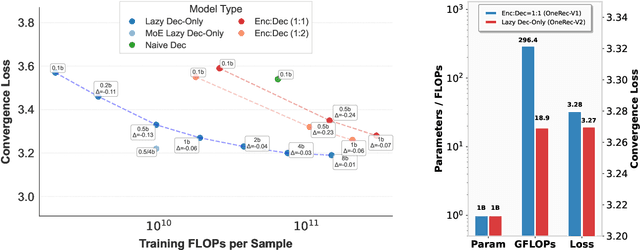
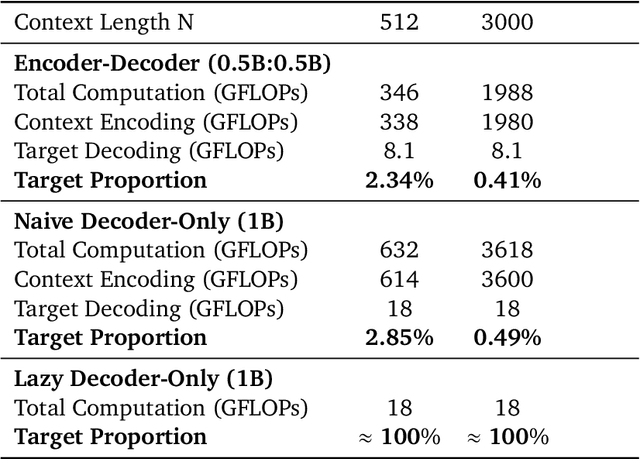

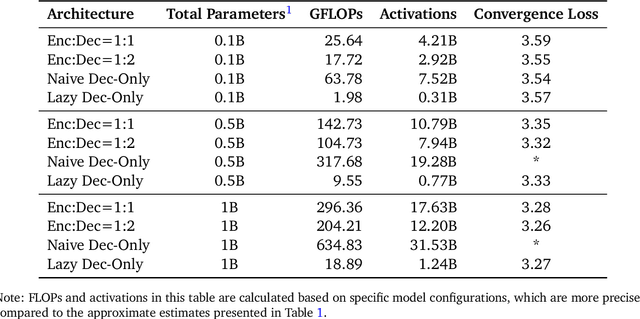
Recent breakthroughs in generative AI have transformed recommender systems through end-to-end generation. OneRec reformulates recommendation as an autoregressive generation task, achieving high Model FLOPs Utilization. While OneRec-V1 has shown significant empirical success in real-world deployment, two critical challenges hinder its scalability and performance: (1) inefficient computational allocation where 97.66% of resources are consumed by sequence encoding rather than generation, and (2) limitations in reinforcement learning relying solely on reward models. To address these challenges, we propose OneRec-V2, featuring: (1) Lazy Decoder-Only Architecture: Eliminates encoder bottlenecks, reducing total computation by 94% and training resources by 90%, enabling successful scaling to 8B parameters. (2) Preference Alignment with Real-World User Interactions: Incorporates Duration-Aware Reward Shaping and Adaptive Ratio Clipping to better align with user preferences using real-world feedback. Extensive A/B tests on Kuaishou demonstrate OneRec-V2's effectiveness, improving App Stay Time by 0.467%/0.741% while balancing multi-objective recommendations. This work advances generative recommendation scalability and alignment with real-world feedback, representing a step forward in the development of end-to-end recommender systems.
Kwai Keye-VL Technical Report
Jul 02, 2025While Multimodal Large Language Models (MLLMs) demonstrate remarkable capabilities on static images, they often fall short in comprehending dynamic, information-dense short-form videos, a dominant medium in today's digital landscape. To bridge this gap, we introduce \textbf{Kwai Keye-VL}, an 8-billion-parameter multimodal foundation model engineered for leading-edge performance in short-video understanding while maintaining robust general-purpose vision-language abilities. The development of Keye-VL rests on two core pillars: a massive, high-quality dataset exceeding 600 billion tokens with a strong emphasis on video, and an innovative training recipe. This recipe features a four-stage pre-training process for solid vision-language alignment, followed by a meticulous two-phase post-training process. The first post-training stage enhances foundational capabilities like instruction following, while the second phase focuses on stimulating advanced reasoning. In this second phase, a key innovation is our five-mode ``cold-start'' data mixture, which includes ``thinking'', ``non-thinking'', ``auto-think'', ``think with image'', and high-quality video data. This mixture teaches the model to decide when and how to reason. Subsequent reinforcement learning (RL) and alignment steps further enhance these reasoning capabilities and correct abnormal model behaviors, such as repetitive outputs. To validate our approach, we conduct extensive evaluations, showing that Keye-VL achieves state-of-the-art results on public video benchmarks and remains highly competitive on general image-based tasks (Figure 1). Furthermore, we develop and release the \textbf{KC-MMBench}, a new benchmark tailored for real-world short-video scenarios, where Keye-VL shows a significant advantage.
OneRec Technical Report
Jun 16, 2025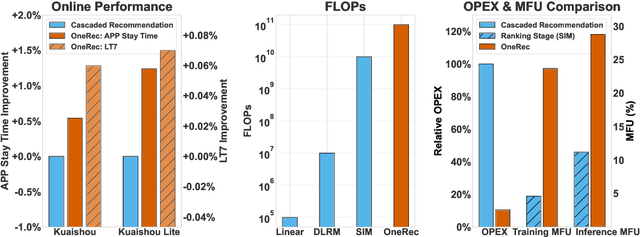

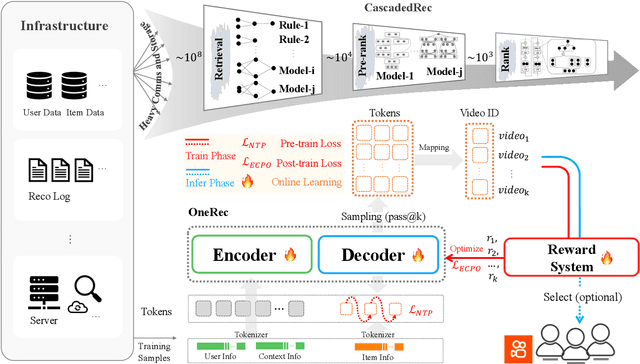
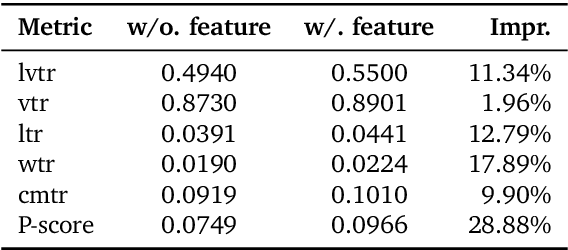
Recommender systems have been widely used in various large-scale user-oriented platforms for many years. However, compared to the rapid developments in the AI community, recommendation systems have not achieved a breakthrough in recent years. For instance, they still rely on a multi-stage cascaded architecture rather than an end-to-end approach, leading to computational fragmentation and optimization inconsistencies, and hindering the effective application of key breakthrough technologies from the AI community in recommendation scenarios. To address these issues, we propose OneRec, which reshapes the recommendation system through an end-to-end generative approach and achieves promising results. Firstly, we have enhanced the computational FLOPs of the current recommendation model by 10 $\times$ and have identified the scaling laws for recommendations within certain boundaries. Secondly, reinforcement learning techniques, previously difficult to apply for optimizing recommendations, show significant potential in this framework. Lastly, through infrastructure optimizations, we have achieved 23.7% and 28.8% Model FLOPs Utilization (MFU) on flagship GPUs during training and inference, respectively, aligning closely with the LLM community. This architecture significantly reduces communication and storage overhead, resulting in operating expense that is only 10.6% of traditional recommendation pipelines. Deployed in Kuaishou/Kuaishou Lite APP, it handles 25% of total queries per second, enhancing overall App Stay Time by 0.54% and 1.24%, respectively. Additionally, we have observed significant increases in metrics such as 7-day Lifetime, which is a crucial indicator of recommendation experience. We also provide practical lessons and insights derived from developing, optimizing, and maintaining a production-scale recommendation system with significant real-world impact.
Biomedical knowledge graph-enhanced prompt generation for large language models
Nov 29, 2023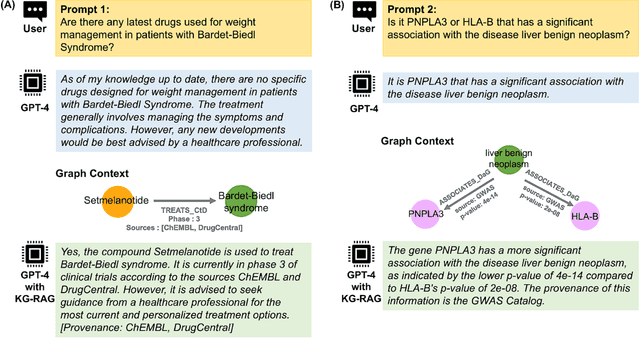
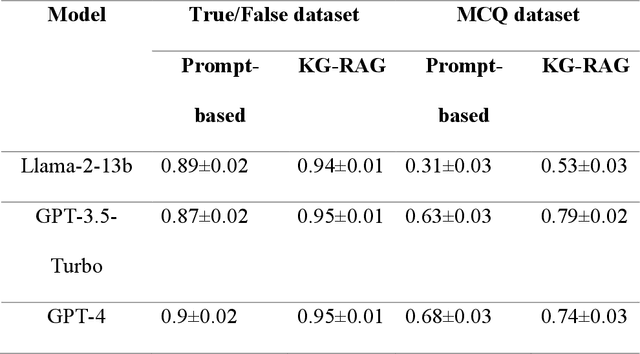


Large Language Models (LLMs) have been driving progress in AI at an unprecedented rate, yet still face challenges in knowledge-intensive domains like biomedicine. Solutions such as pre-training and domain-specific fine-tuning add substantial computational overhead, and the latter require domain-expertise. External knowledge infusion is task-specific and requires model training. Here, we introduce a task-agnostic Knowledge Graph-based Retrieval Augmented Generation (KG-RAG) framework by leveraging the massive biomedical KG SPOKE with LLMs such as Llama-2-13b, GPT-3.5-Turbo and GPT-4, to generate meaningful biomedical text rooted in established knowledge. KG-RAG consistently enhanced the performance of LLMs across various prompt types, including one-hop and two-hop prompts, drug repurposing queries, biomedical true/false questions, and multiple-choice questions (MCQ). Notably, KG-RAG provides a remarkable 71% boost in the performance of the Llama-2 model on the challenging MCQ dataset, demonstrating the framework's capacity to empower open-source models with fewer parameters for domain-specific questions. Furthermore, KG-RAG enhanced the performance of proprietary GPT models, such as GPT-3.5 which exhibited improvement over GPT-4 in context utilization on MCQ data. Our approach was also able to address drug repurposing questions, returning meaningful repurposing suggestions. In summary, the proposed framework combines explicit and implicit knowledge of KG and LLM, respectively, in an optimized fashion, thus enhancing the adaptability of general-purpose LLMs to tackle domain-specific questions in a unified framework.
Explaining Deep Learning Models - A Bayesian Non-parametric Approach
Nov 07, 2018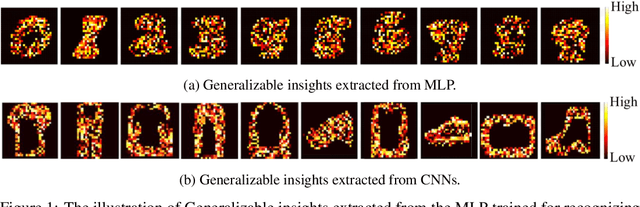

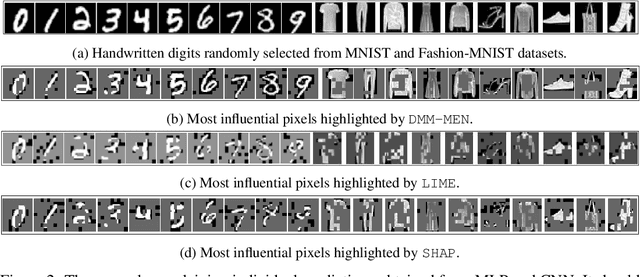
Understanding and interpreting how machine learning (ML) models make decisions have been a big challenge. While recent research has proposed various technical approaches to provide some clues as to how an ML model makes individual predictions, they cannot provide users with an ability to inspect a model as a complete entity. In this work, we propose a novel technical approach that augments a Bayesian non-parametric regression mixture model with multiple elastic nets. Using the enhanced mixture model, we can extract generalizable insights for a target model through a global approximation. To demonstrate the utility of our approach, we evaluate it on different ML models in the context of image recognition. The empirical results indicate that our proposed approach not only outperforms the state-of-the-art techniques in explaining individual decisions but also provides users with an ability to discover the vulnerabilities of the target ML models.
Image Matters: Visually modeling user behaviors using Advanced Model Server
Sep 04, 2018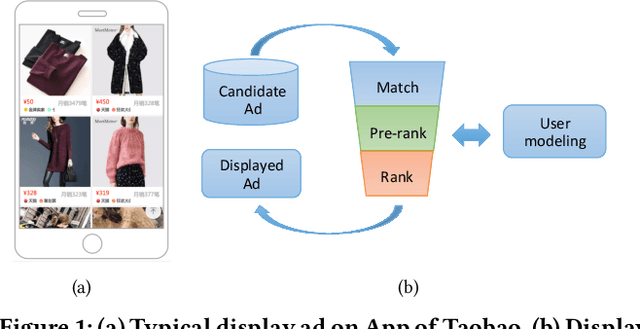
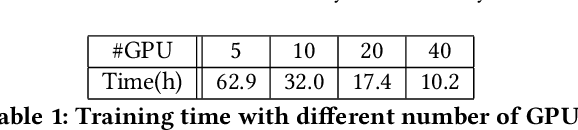
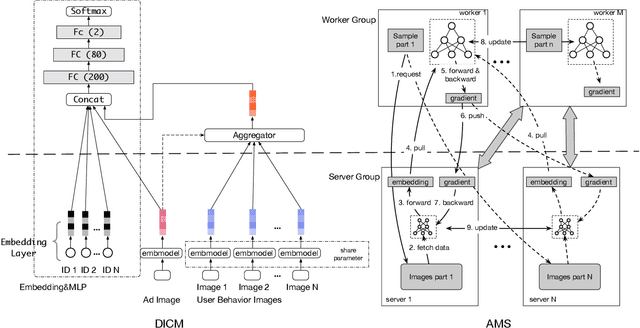
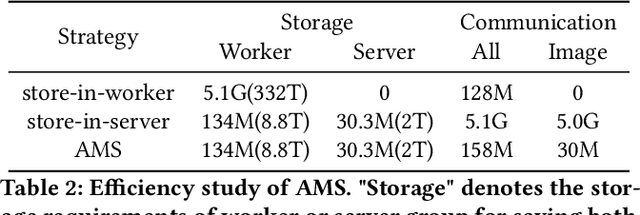
In Taobao, the largest e-commerce platform in China, billions of items are provided and typically displayed with their images. For better user experience and business effectiveness, Click Through Rate (CTR) prediction in online advertising system exploits abundant user historical behaviors to identify whether a user is interested in a candidate ad. Enhancing behavior representations with user behavior images will help understand user's visual preference and improve the accuracy of CTR prediction greatly. So we propose to model user preference jointly with user behavior ID features and behavior images. However, training with user behavior images brings tens to hundreds of images in one sample, giving rise to a great challenge in both communication and computation. To handle these challenges, we propose a novel and efficient distributed machine learning paradigm called Advanced Model Server (AMS). With the well known Parameter Server (PS) framework, each server node handles a separate part of parameters and updates them independently. AMS goes beyond this and is designed to be capable of learning a unified image descriptor model shared by all server nodes which embeds large images into low dimensional high level features before transmitting images to worker nodes. AMS thus dramatically reduces the communication load and enables the arduous joint training process. Based on AMS, the methods of effectively combining the images and ID features are carefully studied, and then we propose a Deep Image CTR Model. Our approach is shown to achieve significant improvements in both online and offline evaluations, and has been deployed in Taobao display advertising system serving the main traffic.