 Add to Chrome
 Add to Firefox
 Add to Edge
Vorch-Omni: Multi-Task Orchestration of Sight and Sound
Aug 06, 2026
Recent advances in generative video modeling have enabled diverse generation, reference-based synthesis, extension, and editing, but existing approaches often rely on fragmented task-specific models. A general model must distinguish heterogeneous target, source, and reference signals to determine what to generate, preserve, or use as guidance, while reducing interference among tasks. Joint audio-visual generation further increases this challenge by introducing diverse conditioning and output configurations across modalities. We present Vorch-Omni, a unified multi-task framework for audio-visual synthesis based on an arbitrary-condition-to-arbitrary-output formulation. It flexibly treats video and audio signals as either conditioning inputs or generation targets. Token-level conditioning masks and task identifiers distinguish targets, source content, and references, while position types separate temporal context from independent conditions. To capture semantic and structural information, Vorch-Omni employs complementary visual conditioning pathways: a vision-language model interprets sampled frames with text instructions, and a video VAE encodes conditions into latent tokens for direct guidance. We further build a distributed data pipeline to curate diverse temporally aligned audio-visual clips, generate structured captions and metadata, and balance heterogeneous task distributions. Built on a single flow-matching diffusion transformer without task-specific architectural changes, Vorch-Omni supports over 10 tasks, including text-to-video, text-to-audio-video, image- and reference-conditioned generation, temporal extension, audio-driven generation, video transformation, and audio-visual editing. This unified framework provides a scalable foundation for general-purpose audio-visual generation and manipulation.

Enabling Robust Cloth Manipulation via Inference-Time Simulator-in-the-Loop Refinement
Jun 23, 2026Simulator-in-the-loop optimization offers a promising inference-time mechanism for robot manipulation. It uses a physical simulator as a backend rollout engine to evaluate candidate trajectories in parallel and refine nominal actions online, a paradigm proven effective in rigid-body manipulation where state and contact are relatively tractable. We bring this paradigm to real-world cloth manipulation from a single RGB input through three pillars. (i) We design a scalable synthetic-data generation and inference-time rollout pipeline built on FLASH, a deformable-object simulator that provides a practical balance among physical fidelity, numerical stability, and rollout efficiency. (ii) We develop a real-to-sim module, trained purely on synthetic data, that maps a single RGB observation to simulation-compatible cloth state by fusing pretrained visual features with learnable canonical tokens. (iii) We perform online planning by coupling a sparse-mesh rollout backend with prior-guided MPPI, anchored at an offline-distilled policy trajectory, preserving manipulation-relevant deformation and contact while enabling sufficient parallel rollout batches. Real-robot experiments show higher success rates and stronger robustness than baseline methods.
ISE: An Execution-Grounded Recipe for Multi-Turn OS-Agent Trajectories
Jun 09, 2026Training capable OS agents requires data that simultaneously captures structured user intents, multi-turn task delegation, and grounded tool execution--properties absent from existing datasets. We propose ISE (Intent -> Simulate -> Execute), a three-stage synthesis paradigm that addresses these gaps jointly. Stage 1 constructs roughly 50000 structured intents via a 4D framework (Persona x Domain x Task x Complexity); after deduplication the pool contains 43956 unique intents and attains a Vendi Score of 61.57 over the entire pool on mpnet-base-v2 embeddings (cosine kernel, q=1). Stage 2 drives multi-turn user-agent interaction through a role-locked user simulator that grounds each user turn in actual execution outcomes, producing 23132 complete trajectories averaging 8.12 user turns and 68.24 total dialogue turns. Stage 3 runs every tool call inside a live, isolated OS workspace, generating authentic failure-recovery dynamics instead of simulated responses. Fine-tuning on ISETrace improves ClawEval pass@1 from 19.3 to 37.7 using Qwen3-8B on agent tool-use tasks with a standard protocol. This result outperforms zero-shot GPT-4o and the larger Qwen3-32B base model which is four times bigger. An ablation on Stage 2 proves multi-turn simulation brings a large portion of the performance gain. We release all source code and dataset at https://github.com/Valiere01/ISE-Trace.
Real-IKEA: Physical Fidelity is the Prerequisite for Robust Manipulation
Jun 07, 2026Robotic manipulation robustness often founders on the physics gap between simplified simulations and the resistance-laden real world. In this work, we emphasize that physical realism in articulated interaction is an important ingredient for robust policy learning. We present Real-IKEA, a dataset and simulation framework designed with physical accuracy as a first-class goal. Real-IKEA provides 1,079 articulated asset configurations, derived from 83 authentic IKEA handles and knobs processed through a meticulous six-step physical workflow. For contact-geometry accuracy, we introduce a bidirectional surface-deviation metric to quantify collision meshes. For dynamics realism, we establish resistance-calibrated configurations that vary damping and friction. Crucially, we demonstrate through a Reinforcement Learning (RL) policy that high-fidelity assets enable the discovery of robust "hooking" and "levering" strategies that prioritize mechanical advantage over fragile friction-pulling. Together, these results position Real-IKEA as a critical benchmark for developing manipulation policies capable of human-level robustness in articulated object tasks.
DiffPhD: A Unified Differentiable Solver for Projective Heterogeneous Materials in Elastodynamics with Contact-Rich GPU-Acceleration
May 14, 2026Differentiable simulation of soft bodies is a foundation for system identification, trajectory optimization, and Real2Sim transfer. Yet, existing methods such as the differentiable Projective Dynamics (DiffPD) struggle when faced with heterogeneous materials with extreme stiffness contrasts, hyperelasticity under large deformations, and contact-rich interactions, which are common scenarios in the real world. We present DiffPhD, a unified GPU-accelerated differentiable Projective Dynamics framework for heterogeneous materials that tackles these intertwined challenges simultaneously. Our key insight is a careful integration of: (i) stiffness-aware projective weights to embed heterogeneity into the global system; (ii) trust-region eigenvalue filtering lifted to the backward pass for stable hyperelastic gradients and a type-II Anderson Acceleration scheme with dual-gate convergence to stabilize forward iteration under large stiffness contrasts; and (iii) a unified GPU pipeline that reuses a single sparse factor across forward, backward, and contact computations, with stiffness-amplified Rayleigh damping folded into the same factor for heterogeneity-aware dissipation at zero recurring cost. DiffPhD achieves strict gradient accuracy while delivering up to an order-of-magnitude speedup over prior differentiable solvers on heterogeneous, hyperelastic, contact-rich benchmarks. Crucially, this speedup does not come at the cost of stability: DiffPhD remains convergent on stiffness contrasts up to 100x where prior PD solvers degrade. This unlocks end-to-end gradient-based optimization on regimes previously bottlenecked by either solver fragility or per-iteration cost -- shell--joint composite creatures, soft characters wielding stiff weapons, and soft-gripper robotic manipulation -- all handled within a single forward--backward pass.
FLASH: Fast Learning via GPU-Accelerated Simulation for High-Fidelity Deformable Manipulation in Minutes
Apr 19, 2026Simulation frameworks such as Isaac Sim have enabled scalable robot learning for locomotion and rigid-body manipulation; however, contact-rich simulation remains a major bottleneck for deformable object manipulation. The continuously changing geometry of soft materials, together with large numbers of vertices and contact constraints, makes it difficult to achieve high accuracy, speed, and stability required for large-scale interactive learning. We present FLASH, a GPU-native simulation framework for contact-rich deformable manipulation, built on an accurate NCP-based solver that enforces strict contact and deformation constraints while being explicitly designed for fine-grained GPU parallelism. Rather than porting conventional single-instruction-multiple-data (SIMD) solvers to GPUs, FLASH redesigns the physics engine from the ground up to leverage modern GPU architectures, including optimized collision handling and memory layouts. As a result, FLASH scales to over 3 million degrees of freedom at 30 FPS on a single RTX 5090, while accurately simulating physical interactions. Policies trained solely on FLASH-generated synthetic data in minutes achieve robust zero-shot sim-to-real transfer, which we validate on physical robots performing challenging deformable manipulation tasks such as towel folding and garment folding, without any real-world demonstration, providing a practical alternative to labor-intensive real-world data collection.
Soft Responsive Materials Enhance Humanoid Safety
Jan 06, 2026Humanoid robots are envisioned as general-purpose platforms in human-centered environments, yet their deployment is limited by vulnerability to falls and the risks posed by rigid metal-plastic structures to people and surroundings. We introduce a soft-rigid co-design framework that leverages non-Newtonian fluid-based soft responsive materials to enhance humanoid safety. The material remains compliant during normal interaction but rapidly stiffens under impact, absorbing and dissipating fall-induced forces. Physics-based simulations guide protector placement and thickness and enable learning of active fall policies. Applied to a 42 kg life-size humanoid, the protector markedly reduces peak impact and allows repeated falls without hardware damage, including drops from 3 m and tumbles down long staircases. Across diverse scenarios, the approach improves robot robustness and environmental safety. By uniting responsive materials, structural co-design, and learning-based control, this work advances interact-safe, industry-ready humanoid robots.
Language-Guided Manipulation with Diffusion Policies and Constrained Inpainting
Jun 14, 2024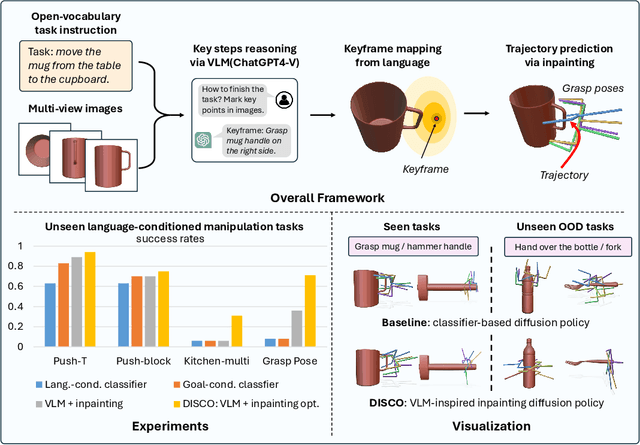
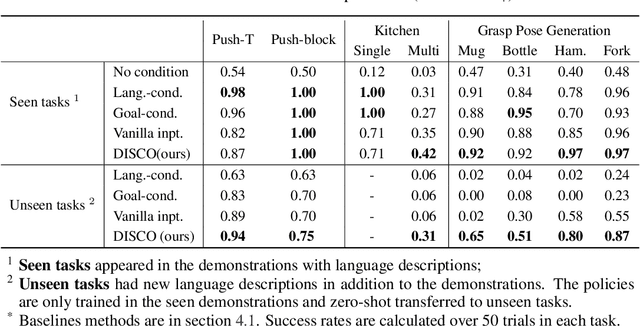
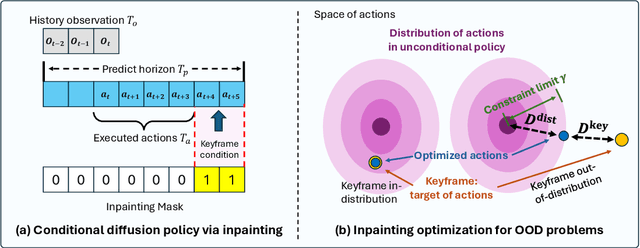
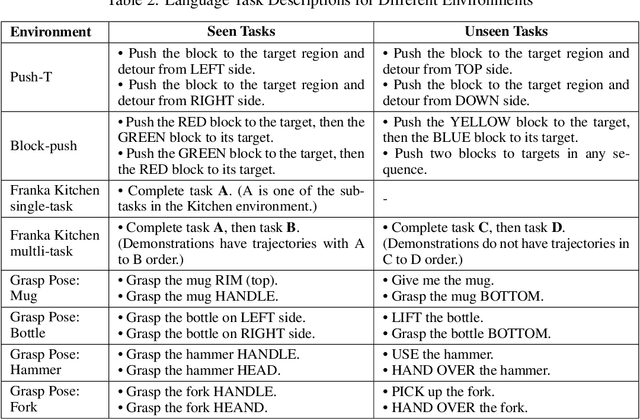
Diffusion policies have demonstrated robust performance in generative modeling, prompting their application in robotic manipulation controlled via language descriptions. In this paper, we introduce a zero-shot, open-vocabulary diffusion policy method for robot manipulation. Using Vision-Language Models (VLMs), our method transforms linguistic task descriptions into actionable keyframes in 3D space. These keyframes serve to guide the diffusion process via inpainting. However, naively enforcing the diffusion process to adhere to the generated keyframes is problematic: the keyframes from the VLMs may be incorrect and lead to out-of-distribution (OOD) action sequences where the diffusion model performs poorly. To address these challenges, we develop an inpainting optimization strategy that balances adherence to the keyframes v.s. the training data distribution. Experimental evaluations demonstrate that our approach surpasses the performance of traditional fine-tuned language-conditioned methods in both simulated and real-world settings.
SoftMAC: Differentiable Soft Body Simulation with Forecast-based Contact Model and Two-way Coupling with Articulated Rigid Bodies and Clothes
Dec 06, 2023
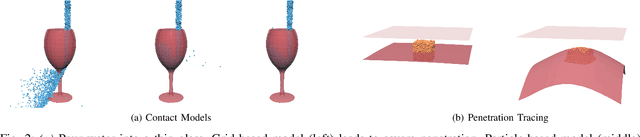


Differentiable physics simulation provides an avenue for tackling previously intractable challenges through gradient-based optimization, thereby greatly improving the efficiency of solving robotics-related problems. To apply differentiable simulation in diverse robotic manipulation scenarios, a key challenge is to integrate various materials in a unified framework. We present SoftMAC, a differentiable simulation framework coupling soft bodies with articulated rigid bodies and clothes. SoftMAC simulates soft bodies with the continuum-mechanics-based Material Point Method (MPM). We provide a forecast-based contact model for MPM, which greatly reduces artifacts like penetration and unnatural rebound. To couple MPM particles with deformable and non-volumetric clothes meshes, we also propose a penetration tracing algorithm that reconstructs the signed distance field in local area. Based on simulators for each modality and the contact model, we develop a differentiable coupling mechanism to simulate the interactions between soft bodies and the other two types of materials. Comprehensive experiments are conducted to validate the effectiveness and accuracy of the proposed differentiable pipeline in downstream robotic manipulation applications. Supplementary materials and videos are available on our project website at https://sites.google.com/view/softmac.
Jade: A Differentiable Physics Engine for Articulated Rigid Bodies with Intersection-Free Frictional Contact
Sep 09, 2023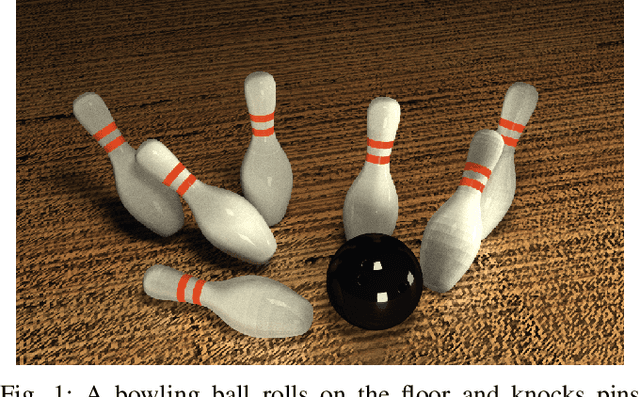
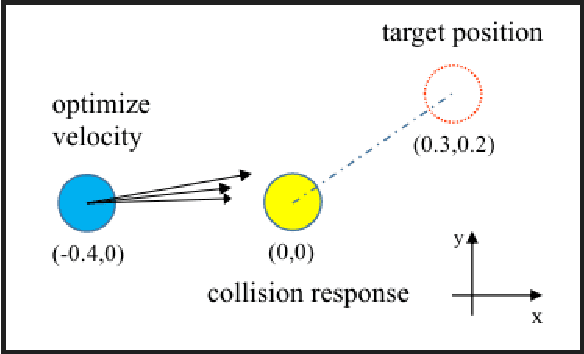
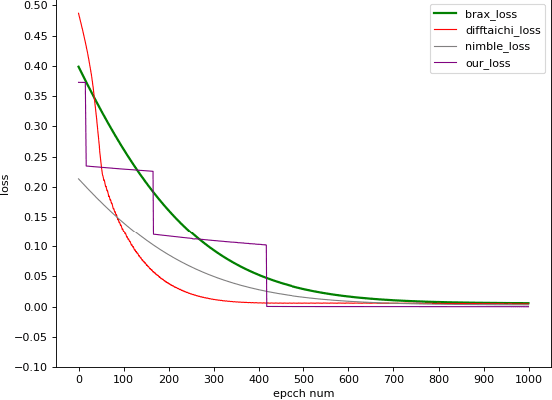
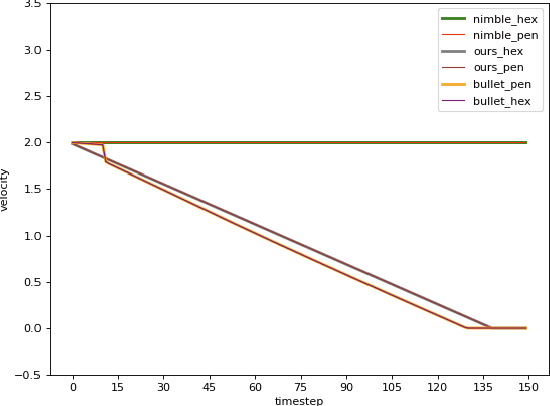
We present Jade, a differentiable physics engine for articulated rigid bodies. Jade models contacts as the Linear Complementarity Problem (LCP). Compared to existing differentiable simulations, Jade offers features including intersection-free collision simulation and stable LCP solutions for multiple frictional contacts. We use continuous collision detection to detect the time of impact and adopt the backtracking strategy to prevent intersection between bodies with complex geometry shapes. We derive the gradient calculation to ensure the whole simulation process is differentiable under the backtracking mechanism. We modify the popular Dantzig algorithm to get valid solutions under multiple frictional contacts. We conduct extensive experiments to demonstrate the effectiveness of our differentiable physics simulation over a variety of contact-rich tasks.