 Add to Chrome
 Add to Firefox
 Add to Edge
ISE: An Execution-Grounded Recipe for Multi-Turn OS-Agent Trajectories
Jun 09, 2026
Training capable OS agents requires data that simultaneously captures structured user intents, multi-turn task delegation, and grounded tool execution--properties absent from existing datasets. We propose ISE (Intent -> Simulate -> Execute), a three-stage synthesis paradigm that addresses these gaps jointly. Stage 1 constructs roughly 50000 structured intents via a 4D framework (Persona x Domain x Task x Complexity); after deduplication the pool contains 43956 unique intents and attains a Vendi Score of 61.57 over the entire pool on mpnet-base-v2 embeddings (cosine kernel, q=1). Stage 2 drives multi-turn user-agent interaction through a role-locked user simulator that grounds each user turn in actual execution outcomes, producing 23132 complete trajectories averaging 8.12 user turns and 68.24 total dialogue turns. Stage 3 runs every tool call inside a live, isolated OS workspace, generating authentic failure-recovery dynamics instead of simulated responses. Fine-tuning on ISETrace improves ClawEval pass@1 from 19.3 to 37.7 using Qwen3-8B on agent tool-use tasks with a standard protocol. This result outperforms zero-shot GPT-4o and the larger Qwen3-32B base model which is four times bigger. An ablation on Stage 2 proves multi-turn simulation brings a large portion of the performance gain. We release all source code and dataset at https://github.com/Valiere01/ISE-Trace.

ICA: Information-Aware Credit Assignment for Visually Grounded Long-Horizon Information-Seeking Agents
Feb 11, 2026Despite the strong performance achieved by reinforcement learning-trained information-seeking agents, learning in open-ended web environments remains severely constrained by low signal-to-noise feedback. Text-based parsers often discard layout semantics and introduce unstructured noise, while long-horizon training typically relies on sparse outcome rewards that obscure which retrieval actions actually matter. We propose a visual-native search framework that represents webpages as visual snapshots, allowing agents to leverage layout cues to quickly localize salient evidence and suppress distractors. To learn effectively from these high-dimensional observations, we introduce Information-Aware Credit Assignment (ICA), a post-hoc method that estimates each retrieved snapshot's contribution to the final outcome via posterior analysis and propagates dense learning signals back to key search turns. Integrated with a GRPO-based training pipeline, our approach consistently outperforms text-based baselines on diverse information-seeking benchmarks, providing evidence that visual snapshot grounding with information-level credit assignment alleviates the credit-assignment bottleneck in open-ended web environments. The code and datasets will be released in https://github.com/pc-inno/ICA_MM_deepsearch.git.
Towards Fine-Grained Recognition with Large Visual Language Models: Benchmark and Optimization Strategies
Dec 11, 2025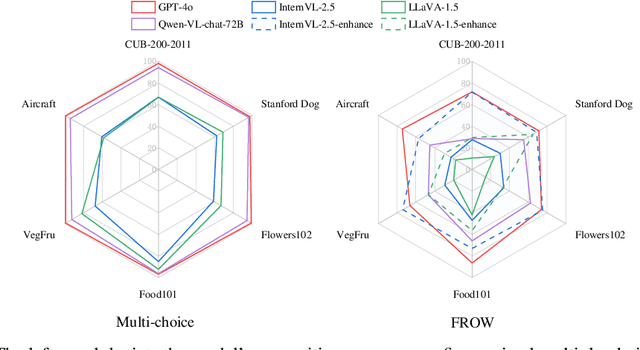
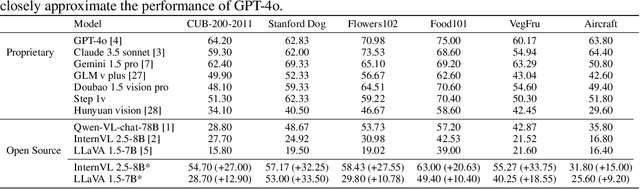
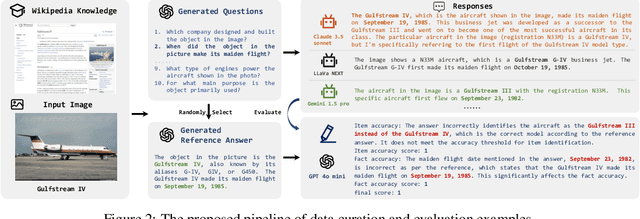
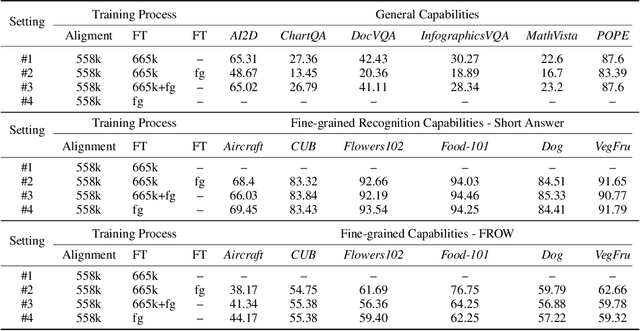
Large Vision Language Models (LVLMs) have made remarkable progress, enabling sophisticated vision-language interaction and dialogue applications. However, existing benchmarks primarily focus on reasoning tasks, often neglecting fine-grained recognition, which is crucial for practical application scenarios. To address this gap, we introduce the Fine-grained Recognition Open World (FROW) benchmark, designed for detailed evaluation of LVLMs with GPT-4o. On the basis of that, we propose a novel optimization strategy from two perspectives: \textit{data construction} and \textit{training process}, to improve the performance of LVLMs. Our dataset includes mosaic data, which combines multiple short-answer responses, and open-world data, generated from real-world questions and answers using GPT-4o, creating a comprehensive framework for evaluating fine-grained recognition in LVLMs. Experiments show that mosaic data improves category recognition accuracy by 1\% and open-world data boosts FROW benchmark accuracy by 10\%-20\% and content accuracy by 6\%-12\%. Meanwhile, incorporating fine-grained data into the pre-training phase can improve the model's category recognition accuracy by up to 10\%. The benchmark will be available at https://github.com/pc-inno/FROW.
Learned Smartphone ISP on Mobile GPUs with Deep Learning, Mobile AI & AIM 2022 Challenge: Report
Nov 07, 2022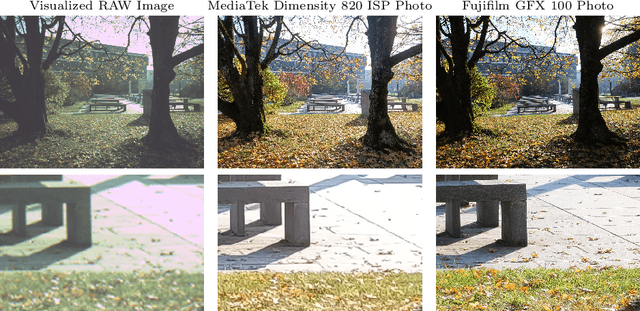
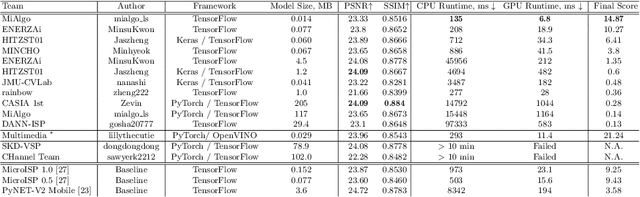
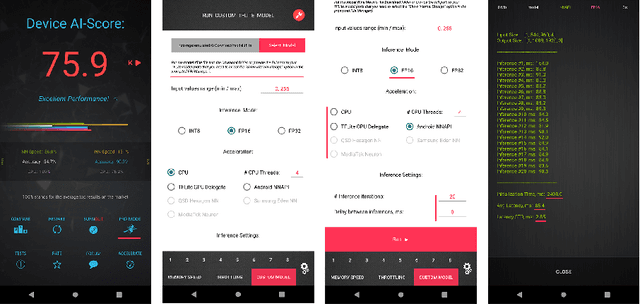
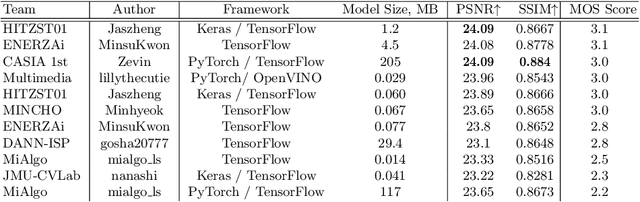
The role of mobile cameras increased dramatically over the past few years, leading to more and more research in automatic image quality enhancement and RAW photo processing. In this Mobile AI challenge, the target was to develop an efficient end-to-end AI-based image signal processing (ISP) pipeline replacing the standard mobile ISPs that can run on modern smartphone GPUs using TensorFlow Lite. The participants were provided with a large-scale Fujifilm UltraISP dataset consisting of thousands of paired photos captured with a normal mobile camera sensor and a professional 102MP medium-format FujiFilm GFX100 camera. The runtime of the resulting models was evaluated on the Snapdragon's 8 Gen 1 GPU that provides excellent acceleration results for the majority of common deep learning ops. The proposed solutions are compatible with all recent mobile GPUs, being able to process Full HD photos in less than 20-50 milliseconds while achieving high fidelity results. A detailed description of all models developed in this challenge is provided in this paper.