 Add to Chrome
 Add to Firefox
 Add to Edge
DiffPhD: A Unified Differentiable Solver for Projective Heterogeneous Materials in Elastodynamics with Contact-Rich GPU-Acceleration
May 14, 2026
Differentiable simulation of soft bodies is a foundation for system identification, trajectory optimization, and Real2Sim transfer. Yet, existing methods such as the differentiable Projective Dynamics (DiffPD) struggle when faced with heterogeneous materials with extreme stiffness contrasts, hyperelasticity under large deformations, and contact-rich interactions, which are common scenarios in the real world. We present DiffPhD, a unified GPU-accelerated differentiable Projective Dynamics framework for heterogeneous materials that tackles these intertwined challenges simultaneously. Our key insight is a careful integration of: (i) stiffness-aware projective weights to embed heterogeneity into the global system; (ii) trust-region eigenvalue filtering lifted to the backward pass for stable hyperelastic gradients and a type-II Anderson Acceleration scheme with dual-gate convergence to stabilize forward iteration under large stiffness contrasts; and (iii) a unified GPU pipeline that reuses a single sparse factor across forward, backward, and contact computations, with stiffness-amplified Rayleigh damping folded into the same factor for heterogeneity-aware dissipation at zero recurring cost. DiffPhD achieves strict gradient accuracy while delivering up to an order-of-magnitude speedup over prior differentiable solvers on heterogeneous, hyperelastic, contact-rich benchmarks. Crucially, this speedup does not come at the cost of stability: DiffPhD remains convergent on stiffness contrasts up to 100x where prior PD solvers degrade. This unlocks end-to-end gradient-based optimization on regimes previously bottlenecked by either solver fragility or per-iteration cost -- shell--joint composite creatures, soft characters wielding stiff weapons, and soft-gripper robotic manipulation -- all handled within a single forward--backward pass.

AutoSketch: VLM-assisted Style-Aware Vector Sketch Completion
Feb 07, 2025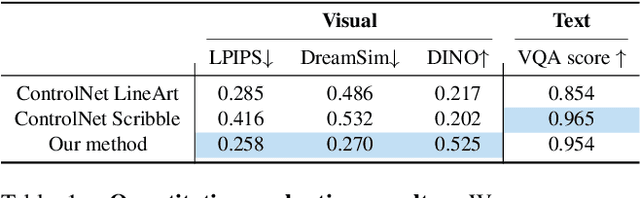
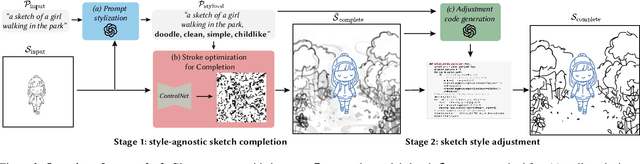
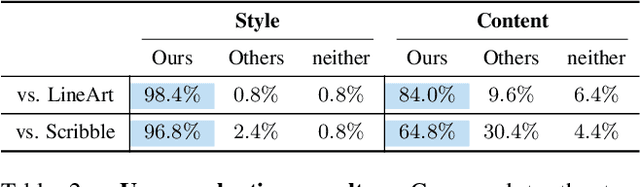
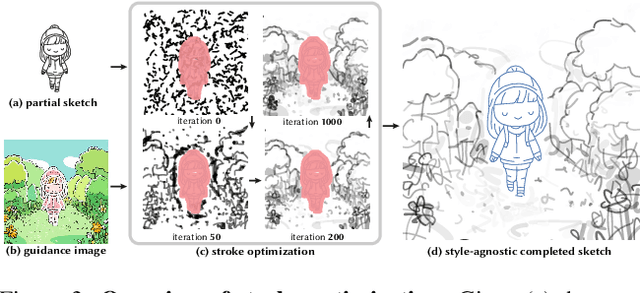
The ability to automatically complete a partial sketch that depicts a complex scene, e.g., "a woman chatting with a man in the park", is very useful. However, existing sketch generation methods create sketches from scratch; they do not complete a partial sketch in the style of the original. To address this challenge, we introduce AutoSketch, a styleaware vector sketch completion method that accommodates diverse sketch styles. Our key observation is that the style descriptions of a sketch in natural language preserve the style during automatic sketch completion. Thus, we use a pretrained vision-language model (VLM) to describe the styles of the partial sketches in natural language and replicate these styles using newly generated strokes. We initially optimize the strokes to match an input prompt augmented by style descriptions extracted from the VLM. Such descriptions allow the method to establish a diffusion prior in close alignment with that of the partial sketch. Next, we utilize the VLM to generate an executable style adjustment code that adjusts the strokes to conform to the desired style. We compare our method with existing methods across various sketch styles and prompts, performed extensive ablation studies and qualitative and quantitative evaluations, and demonstrate that AutoSketch can support various sketch scenarios.