 Add to Chrome
 Add to Firefox
 Add to Edge
Verifier-Guided Twelve-Tone Composition: A Generate-Verify-Repair Harness for Symbolic Music Generation
Jul 13, 2026
Large language models can produce superficially legal twelve-tone scores that collapse into degenerate textures. We introduce a neuro-symbolic harness that wraps a language-model proposer in a generate-verify-repair-trace loop with symbolic verification. The complete pipeline improves event-local consistency without claiming whole-piece legality. Across 40 controlled tasks and four paired models, audited delivery yield rises from 13.3% under raw generation to 48.1% with the harness, which explicitly abstains otherwise. The pass rate of a narrower collision and serialisation-consistency check rises from 33.5% to 58.3%, while degeneracy remains near 0.05, including under exploratory adversarial prompting. A blinded evaluation by five experts also shows a descriptive aggregate preference for harness candidates over raw generation in adherence, perceived legality, coherence, and overall quality.

Rethinking Reward Supervision: Rubric-Conditioned Self-Distillation
Jun 17, 2026Post-training of reasoning language models is commonly driven by supervised distillation and reinforcement learning with verifiable rewards. Distillation often relies on chain-of-thought annotations that are expensive to obtain and may themselves be noisy, incomplete, or partially incorrect; even when the final solution is correct, an imperfect rationale can interfere with learning. Reinforcement learning with verified rewards, on the other hand, typically compresses evaluative feedback into a scalar signal, obscuring which aspects of a response should be improved. We propose \textbf{Rubric-Conditioned Self-Distillation}, a framework that incorporates rubrics as structured, fine-grained feedback for on-policy self-distillation. Our method conditions the teacher model on criterion-level rubrics and uses it to provide token-level guidance on the student's own sampled trajectories. This design avoids treating a single reference rationale as the sole supervision target. Instead, rubrics specify what a strong response should satisfy, enabling more fine-grained credit assignment over the reasoning process than scalar reward optimization. We instantiate this framework with a two-stage pipeline that first learns to generate task-specific rubrics and then trains a rubric-guided reasoner. We evaluate on a diverse suite of science reasoning benchmarks and results show that rubric-conditioned self-distillation effectively converts rubric-level criteria into token-level guidance over the reasoning process, surpassing GRPO by 1.0 points and OPSD by 0.9 points on average.
Benchmarking AI Agents for Addressing Scientific Challenges Across Scales
Jun 10, 2026AI agents are increasingly being developed to accelerate scientific discovery, yet their practical capabilities in real research settings remain poorly understood. Existing benchmarks for AI agents rarely capture the complexity, heterogeneity, and extended reasoning required by scientific work, whereas benchmarks for scientific tasks often reduce research to static, direct problems and provide limited support for interactive evaluation. Here, we introduce SciAgentArena, a systematic benchmark for evaluating AI agents in real-world scientific research scenarios drawn from emerging needs across multiple domains. SciAgentArena comprises approximately 200 tasks with stepwise verification and an interactive, agent-agnostic environment for assessing diverse AI agents. Using this benchmark, we find that current agents can contribute effectively to well-specified data-analysis workflows, particularly when the task structure and evaluation criteria are clear. However, their performance remains uneven across scientific contexts: agents struggle to generate genuinely novel insights, sustain self-directed exploration, and formulate robust solutions for open-ended research questions. We further characterize common failure modes across agents and identify opportunities for improving their reliability, autonomy, and scientific reasoning. Together, SciAgentArena provides a practical framework for measuring progress in AI agents for science and for guiding the design of future agents capable of addressing complex scientific challenges. Full codes, tasks, and datasets can be accessed via this link: https://sciagentarena.github.io/.
Reasoning through Verifiable Forecast Actions: Consistency-Grounded RL for Financial LLMs
May 21, 2026Financial markets are characterized by extreme non-stationarity, low signal-to-noise ratios, and strong dependence on external information such as news, company fundamentals, and macroeconomic signals. Yet, existing approaches either abstract time-series into text or decouple forecasting from language-based reasoning, leading to a fundamental mismatch between qualitative reasoning and quantitative outcomes. To address this, we introduce StockR1, a time-series-enhanced LLM that unifies stock forecasting and financial reasoning through a verifiable forecast action. Based on a tool-call design, the model first emits a forecast action, which is a structured and interpretable representation of its qualitative market outlook. It then invokes a time-series decoder conditioned on this action to generate distributional future trajectories, leading to more informed question answering and financial reasoning. We optimize the full pipeline with reinforcement learning, where rewards jointly reflect answer validity, forecast accuracy, and consistency between generated actions and observed time-series dynamics. In addition, rewards are reweighted by a sample-level uncertainty scalar, encouraging the model to accommodate varying uncertainty in market dynamics. We evaluate StockR1 on financial question answering and stock forecasting over a large-scale 10-year benchmark. Our method consistently outperforms time-series baselines and general-purpose LLMs, improving reasoning accuracy by 17.7% (4B) and 25.9% (8B). These findings demonstrate that structuring the forecast actions establishes a powerful synergy between language reasoning and temporal prediction, enabling LLMs to reason through verifiable, interpretable, and numerically grounded decisions.
GeoAda: Efficiently Finetune Geometric Diffusion Models with Equivariant Adapters
Jul 02, 2025Geometric diffusion models have shown remarkable success in molecular dynamics and structure generation. However, efficiently fine-tuning them for downstream tasks with varying geometric controls remains underexplored. In this work, we propose an SE(3)-equivariant adapter framework ( GeoAda) that enables flexible and parameter-efficient fine-tuning for controlled generative tasks without modifying the original model architecture. GeoAda introduces a structured adapter design: control signals are first encoded through coupling operators, then processed by a trainable copy of selected pretrained model layers, and finally projected back via decoupling operators followed by an equivariant zero-initialized convolution. By fine-tuning only these lightweight adapter modules, GeoAda preserves the model's geometric consistency while mitigating overfitting and catastrophic forgetting. We theoretically prove that the proposed adapters maintain SE(3)-equivariance, ensuring that the geometric inductive biases of the pretrained diffusion model remain intact during adaptation. We demonstrate the wide applicability of GeoAda across diverse geometric control types, including frame control, global control, subgraph control, and a broad range of application domains such as particle dynamics, molecular dynamics, human motion prediction, and molecule generation. Empirical results show that GeoAda achieves state-of-the-art fine-tuning performance while preserving original task accuracy, whereas other baselines experience significant performance degradation due to overfitting and catastrophic forgetting.
LayoutVLM: Differentiable Optimization of 3D Layout via Vision-Language Models
Dec 03, 2024
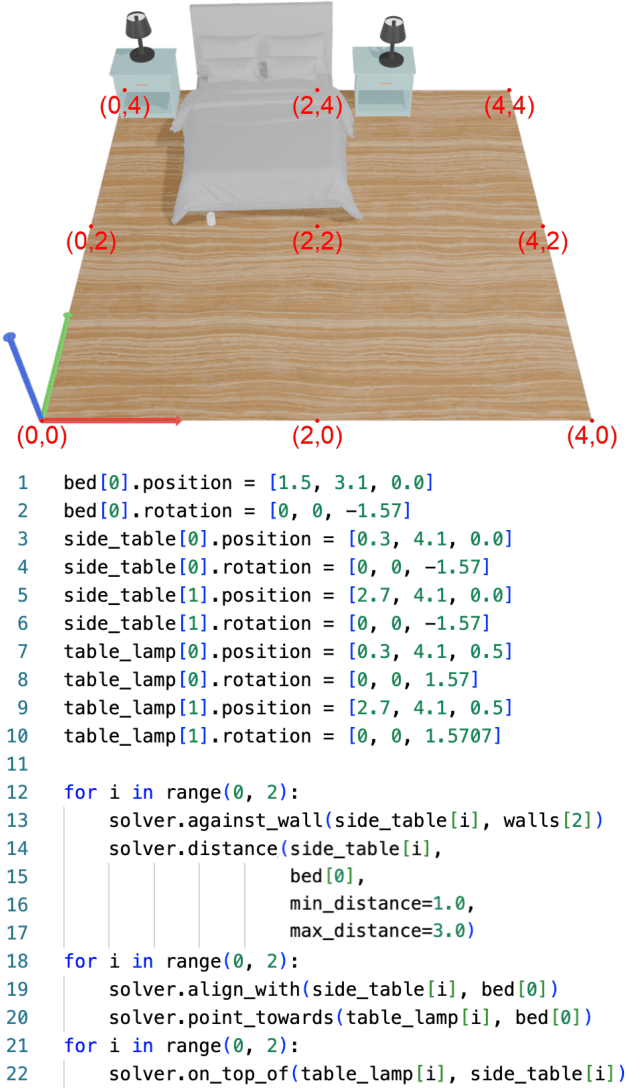
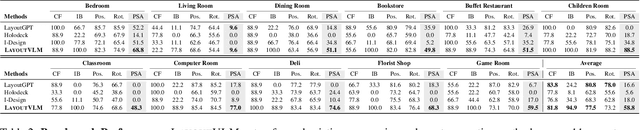
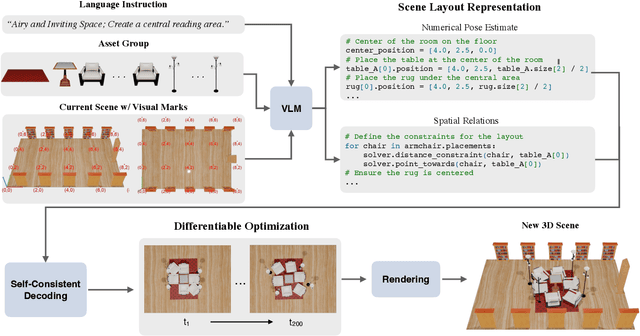
Open-universe 3D layout generation arranges unlabeled 3D assets conditioned on language instruction. Large language models (LLMs) struggle with generating physically plausible 3D scenes and adherence to input instructions, particularly in cluttered scenes. We introduce LayoutVLM, a framework and scene layout representation that exploits the semantic knowledge of Vision-Language Models (VLMs) and supports differentiable optimization to ensure physical plausibility. LayoutVLM employs VLMs to generate two mutually reinforcing representations from visually marked images, and a self-consistent decoding process to improve VLMs spatial planning. Our experiments show that LayoutVLM addresses the limitations of existing LLM and constraint-based approaches, producing physically plausible 3D layouts better aligned with the semantic intent of input language instructions. We also demonstrate that fine-tuning VLMs with the proposed scene layout representation extracted from existing scene datasets can improve performance.
Aligning Target-Aware Molecule Diffusion Models with Exact Energy Optimization
Jul 01, 2024Generating ligand molecules for specific protein targets, known as structure-based drug design, is a fundamental problem in therapeutics development and biological discovery. Recently, target-aware generative models, especially diffusion models, have shown great promise in modeling protein-ligand interactions and generating candidate drugs. However, existing models primarily focus on learning the chemical distribution of all drug candidates, which lacks effective steerability on the chemical quality of model generations. In this paper, we propose a novel and general alignment framework to align pretrained target diffusion models with preferred functional properties, named AliDiff. AliDiff shifts the target-conditioned chemical distribution towards regions with higher binding affinity and structural rationality, specified by user-defined reward functions, via the preference optimization approach. To avoid the overfitting problem in common preference optimization objectives, we further develop an improved Exact Energy Preference Optimization method to yield an exact and efficient alignment of the diffusion models, and provide the closed-form expression for the converged distribution. Empirical studies on the CrossDocked2020 benchmark show that AliDiff can generate molecules with state-of-the-art binding energies with up to -7.07 Avg. Vina Score, while maintaining strong molecular properties.
DUE: Dynamic Uncertainty-Aware Explanation Supervision via 3D Imputation
Mar 16, 2024


Explanation supervision aims to enhance deep learning models by integrating additional signals to guide the generation of model explanations, showcasing notable improvements in both the predictability and explainability of the model. However, the application of explanation supervision to higher-dimensional data, such as 3D medical images, remains an under-explored domain. Challenges associated with supervising visual explanations in the presence of an additional dimension include: 1) spatial correlation changed, 2) lack of direct 3D annotations, and 3) uncertainty varies across different parts of the explanation. To address these challenges, we propose a Dynamic Uncertainty-aware Explanation supervision (DUE) framework for 3D explanation supervision that ensures uncertainty-aware explanation guidance when dealing with sparsely annotated 3D data with diffusion-based 3D interpolation. Our proposed framework is validated through comprehensive experiments on diverse real-world medical imaging datasets. The results demonstrate the effectiveness of our framework in enhancing the predictability and explainability of deep learning models in the context of medical imaging diagnosis applications.
XAI Benchmark for Visual Explanation
Oct 12, 2023


The rise of deep learning algorithms has led to significant advancements in computer vision tasks, but their "black box" nature has raised concerns regarding interpretability. Explainable AI (XAI) has emerged as a critical area of research aiming to open this "black box", and shed light on the decision-making process of AI models. Visual explanations, as a subset of Explainable Artificial Intelligence (XAI), provide intuitive insights into the decision-making processes of AI models handling visual data by highlighting influential areas in an input image. Despite extensive research conducted on visual explanations, most evaluations are model-centered since the availability of corresponding real-world datasets with ground truth explanations is scarce in the context of image data. To bridge this gap, we introduce an XAI Benchmark comprising a dataset collection from diverse topics that provide both class labels and corresponding explanation annotations for images. We have processed data from diverse domains to align with our unified visual explanation framework. We introduce a comprehensive Visual Explanation pipeline, which integrates data loading, preprocessing, experimental setup, and model evaluation processes. This structure enables researchers to conduct fair comparisons of various visual explanation techniques. In addition, we provide a comprehensive review of over 10 evaluation methods for visual explanation to assist researchers in effectively utilizing our dataset collection. To further assess the performance of existing visual explanation methods, we conduct experiments on selected datasets using various model-centered and ground truth-centered evaluation metrics. We envision this benchmark could facilitate the advancement of visual explanation models. The XAI dataset collection and easy-to-use code for evaluation are publicly accessible at https://xaidataset.github.io.
Visual Attention-Prompted Prediction and Learning
Oct 12, 2023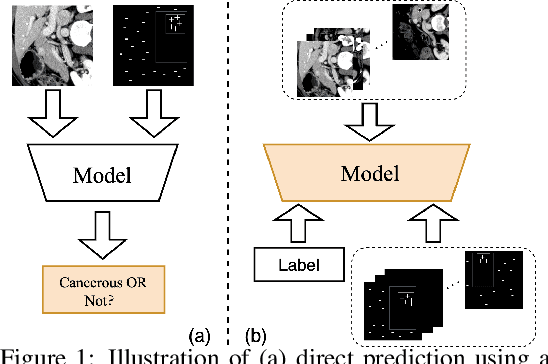


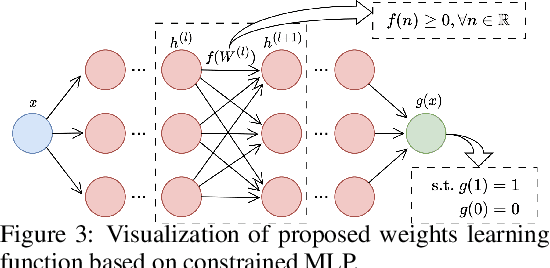
Explanation(attention)-guided learning is a method that enhances a model's predictive power by incorporating human understanding during the training phase. While attention-guided learning has shown promising results, it often involves time-consuming and computationally expensive model retraining. To address this issue, we introduce the attention-prompted prediction technique, which enables direct prediction guided by the attention prompt without the need for model retraining. However, this approach presents several challenges, including: 1) How to incorporate the visual attention prompt into the model's decision-making process and leverage it for future predictions even in the absence of a prompt? and 2) How to handle the incomplete information from the visual attention prompt? To tackle these challenges, we propose a novel framework called Visual Attention-Prompted Prediction and Learning, which seamlessly integrates visual attention prompts into the model's decision-making process and adapts to images both with and without attention prompts for prediction. To address the incomplete information of the visual attention prompt, we introduce a perturbation-based attention map modification method. Additionally, we propose an optimization-based mask aggregation method with a new weight learning function for adaptive perturbed annotation aggregation in the attention map modification process. Our overall framework is designed to learn in an attention-prompt guided multi-task manner to enhance future predictions even for samples without attention prompts and trained in an alternating manner for better convergence. Extensive experiments conducted on two datasets demonstrate the effectiveness of our proposed framework in enhancing predictions for samples, both with and without provided prompts.