 Add to Chrome
 Add to Firefox
 Add to Edge
When Do Graph Foundation Models Transfer? A Data-Centric Theory
May 28, 2026
Graph foundation models (GFMs) aim to reuse a single backbone across diverse graph domains, yet their transfer is often uneven and can exhibit negative transfer. While most prior work improves transfer through architectural or adaptation choices, we ask a data-centric question: which properties of two graph domains determine how much a fixed representation model changes its outputs? Using a graphon-based continuous limit for dense graphs, we show that for both set-based and message-passing tokenizations, any Lipschitz backbone admits an explicit decomposition of cross-domain output shift into (i) graph-specific finite-sample approximation terms and (ii) an intrinsic, relabeling-invariant domain discrepancy capturing structural mismatch. A key ingredient is positional-encoding (PE) stability: we establish stability guarantees for spectral PEs and highlight contrasting behaviors of eigenvector- versus subspace-based PEs. Experiments on synthetic and real graphs validate the theory and translate the decomposition into guidance for data curation in GFM transfer.

Reasoning through Verifiable Forecast Actions: Consistency-Grounded RL for Financial LLMs
May 21, 2026Financial markets are characterized by extreme non-stationarity, low signal-to-noise ratios, and strong dependence on external information such as news, company fundamentals, and macroeconomic signals. Yet, existing approaches either abstract time-series into text or decouple forecasting from language-based reasoning, leading to a fundamental mismatch between qualitative reasoning and quantitative outcomes. To address this, we introduce StockR1, a time-series-enhanced LLM that unifies stock forecasting and financial reasoning through a verifiable forecast action. Based on a tool-call design, the model first emits a forecast action, which is a structured and interpretable representation of its qualitative market outlook. It then invokes a time-series decoder conditioned on this action to generate distributional future trajectories, leading to more informed question answering and financial reasoning. We optimize the full pipeline with reinforcement learning, where rewards jointly reflect answer validity, forecast accuracy, and consistency between generated actions and observed time-series dynamics. In addition, rewards are reweighted by a sample-level uncertainty scalar, encouraging the model to accommodate varying uncertainty in market dynamics. We evaluate StockR1 on financial question answering and stock forecasting over a large-scale 10-year benchmark. Our method consistently outperforms time-series baselines and general-purpose LLMs, improving reasoning accuracy by 17.7% (4B) and 25.9% (8B). These findings demonstrate that structuring the forecast actions establishes a powerful synergy between language reasoning and temporal prediction, enabling LLMs to reason through verifiable, interpretable, and numerically grounded decisions.
Beyond Predefined Schemas: TRACE-KG for Context-Enriched Knowledge Graphs from Complex Documents
Apr 03, 2026Knowledge graph construction typically relies either on predefined ontologies or on schema-free extraction. Ontology-driven pipelines enforce consistent typing but require costly schema design and maintenance, whereas schema-free methods often produce fragmented graphs with weak global organization, especially in long technical documents with dense, context-dependent information. We propose TRACE-KG (Text-dRiven schemA for Context-Enriched Knowledge Graphs), a multimodal framework that jointly constructs a context-enriched knowledge graph and an induced schema without assuming a predefined ontology. TRACE-KG captures conditional relations through structured qualifiers and organizes entities and relations using a data-driven schema that serves as a reusable semantic scaffold while preserving full traceability to the source evidence. Experiments show that TRACE-KG produces structurally coherent, traceable knowledge graphs and offers a practical alternative to both ontology-driven and schema-free construction pipelines.
MentalBlackboard: Evaluating Spatial Visualization via Mathematical Transformations
Feb 22, 2026Spatial visualization is the mental ability to imagine, transform, and manipulate the spatial characteristics of objects and actions. This intelligence is a part of human cognition where actions and perception are connected on a mental level. To explore whether state-of-the-art Vision-Language Models (VLMs) exhibit this ability, we develop MentalBlackboard, an open-ended spatial visualization benchmark for Paper Folding and Hole Punching tests within two core tasks: prediction and planning. Our prediction experiments reveal that models struggle with applying symmetrical transformations, even when they predict the sequence of unfolding steps correctly. Also, rotations introduce a significant challenge to the physical situational awareness for models. The planning task reveals limitations of models in analyzing symmetrical relationships and in implementing the multi-stage symmetry process, with Claude Opus 4.1 achieving the highest planning score at an accuracy of 10\%. The top-performing model, o3, attains a peak performance of 71.6\% on the generalization task, which does not require spatial visualization but transfers spatial data; however, it achieves only 25\% accuracy on text-based prediction tasks.
PGT-I: Scaling Spatiotemporal GNNs with Memory-Efficient Distributed Training
Jul 15, 2025Spatiotemporal graph neural networks (ST-GNNs) are powerful tools for modeling spatial and temporal data dependencies. However, their applications have been limited primarily to small-scale datasets because of memory constraints. While distributed training offers a solution, current frameworks lack support for spatiotemporal models and overlook the properties of spatiotemporal data. Informed by a scaling study on a large-scale workload, we present PyTorch Geometric Temporal Index (PGT-I), an extension to PyTorch Geometric Temporal that integrates distributed data parallel training and two novel strategies: index-batching and distributed-index-batching. Our index techniques exploit spatiotemporal structure to construct snapshots dynamically at runtime, significantly reducing memory overhead, while distributed-index-batching extends this approach by enabling scalable processing across multiple GPUs. Our techniques enable the first-ever training of an ST-GNN on the entire PeMS dataset without graph partitioning, reducing peak memory usage by up to 89\% and achieving up to a 13.1x speedup over standard DDP with 128 GPUs.
Avatar Concept Slider: Manipulate Concepts In Your Human Avatar With Fine-grained Control
Aug 26, 2024Language based editing of 3D human avatars to precisely match user requirements is challenging due to the inherent ambiguity and limited expressiveness of natural language. To overcome this, we propose the Avatar Concept Slider (ACS), a 3D avatar editing method that allows precise manipulation of semantic concepts in human avatars towards a specified intermediate point between two extremes of concepts, akin to moving a knob along a slider track. To achieve this, our ACS has three designs. 1) A Concept Sliding Loss based on Linear Discriminant Analysis to pinpoint the concept-specific axis for precise editing. 2) An Attribute Preserving Loss based on Principal Component Analysis for improved preservation of avatar identity during editing. 3) A 3D Gaussian Splatting primitive selection mechanism based on concept-sensitivity, which updates only the primitives that are the most sensitive to our target concept, to improve efficiency. Results demonstrate that our ACS enables fine-grained 3D avatar editing with efficient feedback, without harming the avatar quality or compromising the avatar's identifying attributes.
IRS-Assisted Lossy Communications Under Correlated Rayleigh Fading: Outage Probability Analysis and Optimization
Aug 13, 2024This paper focuses on an intelligent reflecting surface (IRS)-assisted lossy communication system with correlated Rayleigh fading. We analyze the correlated channel model and derive the outage probability of the system. Then, we design a deep reinforce learning (DRL) method to optimize the phase shift of IRS, in order to maximize the received signal power. Moreover, this paper presents results of the simulations conducted to evaluate the performance of the DRL-based method. The simulation results indicate that the outage probability of the considered system increases significantly with more correlated channel coefficients. Moreover, the performance gap between DRL and theoretical limit increases with higher transmit power and/or larger distortion requirement.
LLMs are Good Sign Language Translators
Apr 01, 2024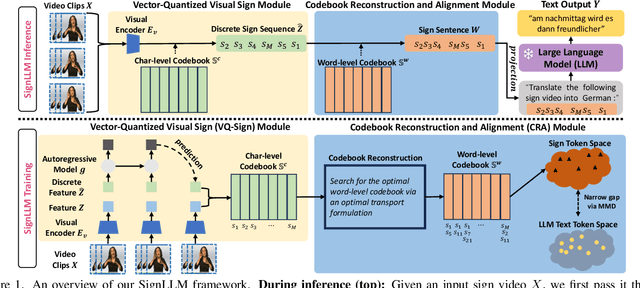
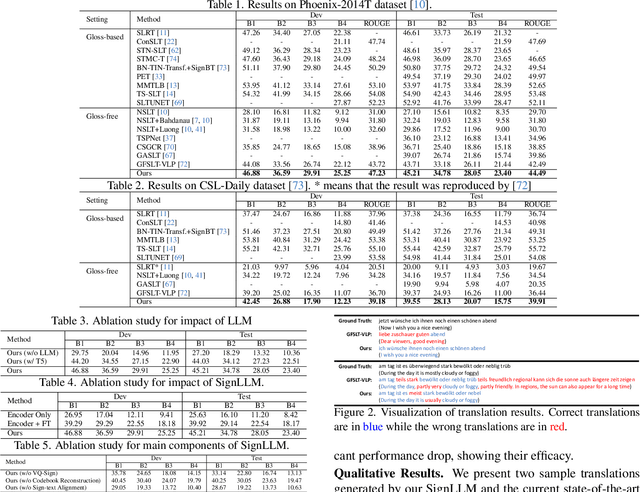
Sign Language Translation (SLT) is a challenging task that aims to translate sign videos into spoken language. Inspired by the strong translation capabilities of large language models (LLMs) that are trained on extensive multilingual text corpora, we aim to harness off-the-shelf LLMs to handle SLT. In this paper, we regularize the sign videos to embody linguistic characteristics of spoken language, and propose a novel SignLLM framework to transform sign videos into a language-like representation for improved readability by off-the-shelf LLMs. SignLLM comprises two key modules: (1) The Vector-Quantized Visual Sign module converts sign videos into a sequence of discrete character-level sign tokens, and (2) the Codebook Reconstruction and Alignment module converts these character-level tokens into word-level sign representations using an optimal transport formulation. A sign-text alignment loss further bridges the gap between sign and text tokens, enhancing semantic compatibility. We achieve state-of-the-art gloss-free results on two widely-used SLT benchmarks.
Generalization Error of Graph Neural Networks in the Mean-field Regime
Feb 10, 2024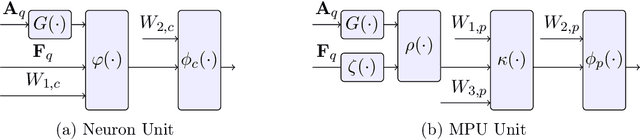
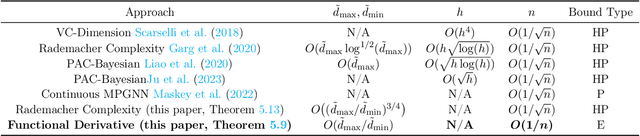

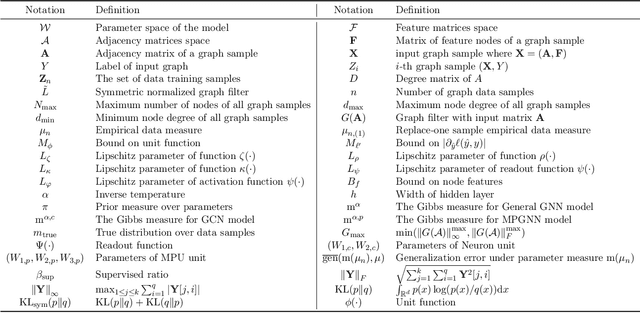
This work provides a theoretical framework for assessing the generalization error of graph classification tasks via graph neural networks in the over-parameterized regime, where the number of parameters surpasses the quantity of data points. We explore two widely utilized types of graph neural networks: graph convolutional neural networks and message passing graph neural networks. Prior to this study, existing bounds on the generalization error in the over-parametrized regime were uninformative, limiting our understanding of over-parameterized network performance. Our novel approach involves deriving upper bounds within the mean-field regime for evaluating the generalization error of these graph neural networks. We establish upper bounds with a convergence rate of $O(1/n)$, where $n$ is the number of graph samples. These upper bounds offer a theoretical assurance of the networks' performance on unseen data in the challenging over-parameterized regime and overall contribute to our understanding of their performance.
Robust Angular Synchronization via Directed Graph Neural Networks
Oct 09, 2023
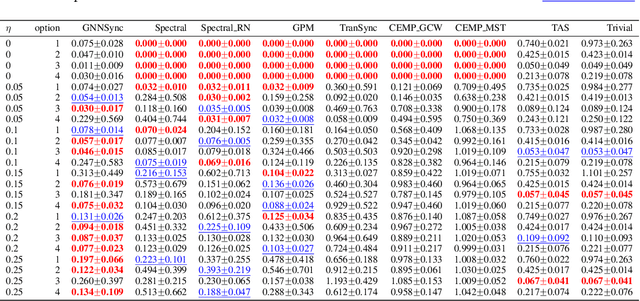


The angular synchronization problem aims to accurately estimate (up to a constant additive phase) a set of unknown angles $\theta_1, \dots, \theta_n\in[0, 2\pi)$ from $m$ noisy measurements of their offsets $\theta_i-\theta_j \;\mbox{mod} \; 2\pi.$ Applications include, for example, sensor network localization, phase retrieval, and distributed clock synchronization. An extension of the problem to the heterogeneous setting (dubbed $k$-synchronization) is to estimate $k$ groups of angles simultaneously, given noisy observations (with unknown group assignment) from each group. Existing methods for angular synchronization usually perform poorly in high-noise regimes, which are common in applications. In this paper, we leverage neural networks for the angular synchronization problem, and its heterogeneous extension, by proposing GNNSync, a theoretically-grounded end-to-end trainable framework using directed graph neural networks. In addition, new loss functions are devised to encode synchronization objectives. Experimental results on extensive data sets demonstrate that GNNSync attains competitive, and often superior, performance against a comprehensive set of baselines for the angular synchronization problem and its extension, validating the robustness of GNNSync even at high noise levels.