 Add to Chrome
 Add to Firefox
 Add to Edge
SG-WAM: Text-Grounded and Spatial-aware Semantic Guidance for World-Action Models
Aug 09, 2026
World-Action Models (WAMs) have emerged as a promising paradigm for robotic manipulation. However, most existing WAMs generate future videos and actions by relying mainly on visual cues rather than language instructions, since off-the-shelf text encoders embed instructions independently of visual observations. As a result, the videos predicted by these WAMs are often semantically misaligned with their corresponding language instructions, which degrades the accuracy of the predicted actions. To overcome this limitation, we propose SG-WAM, a semantic guidance method for world-action models that leverages a vision-language model (VLM) as a semantic planner to enhance the instruction-grounding capacity of world-action models. Specifically, we train a VLM-based planner to predict text-grounded and spatial-aware semantic foresight. The text-grounded semantic foresight grounds the instruction by identifying the correct target objects, and the spatial-aware semantic foresight provides the scene geometry for precise manipulation. We then inject this foresight into the world-action model as high-level semantic guidance, ensuring that both future-video generation and action prediction faithfully follow the language instruction. Extensive experiments in simulation and the real world demonstrate the superiority of our semantic guidance method, showcasing precise manipulation and strong instruction-following capabilities.

Robust-WAM: Bridging Generative Pretraining and Semantic Foresight in World-Action Models
Aug 07, 2026Mainstream World-Action Models (WAMs) adapt pretrained video generation models (VGMs) for robot control, transferring their learned dynamics prior for action prediction. These VGMs are typically trained in a variational autoencoder (VAE) latent space. However, the VAE latent space is optimized for pixel reconstruction, which rewards fine appearance detail and leaves the action prediction fragile under visual shifts. Recent works build WAMs in semantic latent space, which are more robust to appearance shifts. However, these models cannot leverage the large-scale VGM pretraining that exists only in VAE space. To overcome this dilemma, we propose Robust-WAM, a general post-training method for video-generation-based WAMs that preserves the VAE-based generative path and adds a lightweight semantic foresight alignment objective on the action stream. This retains the large-scale VGM pretraining while grounding actions in appearance-invariant dynamics that stay reliable under illumination shifts and other visual out-of-distribution conditions. Specifically, we employ learnable query tokens to bring future-scene semantics into the action stream by aligning their output hidden states with the semantic foresight of future ground-truth frames. To establish the temporal correspondence between each query and the future step it describes, we give it the positional encoding of the matching action tokens. Experiments on out-of-distribution generalization simulation benchmarks and a real-robot setup show that our Robust-WAM consistently improves the success rates of multiple WAM baselines without sacrificing in-distribution performance.
Is Forward Prediction Enough? Physical State Grounding for JEPA World Models
Aug 07, 2026Learning structured and control-relevant latent representations remains a key challenge for world models. Recent JEPA-based world models learn action-conditioned predictive latent dynamics from observation sequences. However, their forward-prediction objectives do not explicitly enforce reliable identifiability of robot-centric physical state from individual latents or state changes from latent pairs, which can limit downstream planning and policy performance. We propose PSG-JEPA, a physically grounded JEPA world model that shapes its latent space with two complementary grounding objectives beyond forward prediction: grounding individual latents in robot proprioceptive state, and grounding latent pairs in multi-horizon joint-angle changes. Both objectives are applied only during training, leaving the inference architecture and computational cost unchanged. To comprehensively evaluate PSG-JEPA, we conduct experiments at three levels: (1) latent identifiability via probing, (2) goal-conditioned planning on frozen latents, and (3) policy learning in simulation and on a real robot. Experiments demonstrate that our PSG-JEPA consistently outperforms state-of-the-art latent world-model baselines at all three levels.
DyPES-VLA: Learning Shared Dynamics Priors and Embodiment-Specific Control for Cross-Embodiment Manipulation
Aug 06, 2026Vision-Language-Action (VLA) models have become a powerful paradigm for robot manipulation, but training a single generalist policy for heterogeneous robot embodiments remains an open problem. Existing methods have two main limitations. First, they underuse dynamics priors shared across diverse visual and interaction data, limiting cross-embodiment transfer. Second, they require extensive manual preprocessing to convert embodiment-specific actions into a common format. To overcome these limitations, we propose DyPES-VLA, a cross-embodiment VLA that learns shared Dynamics Priors and Embodiment-Specific control. First, we learn shared dynamics priors by training the vision-language model (VLM) with a future-prediction objective on cross-embodiment data, driving the shared query representation to capture object motion, contact, and interaction-induced scene changes. Second, an embodiment-specific Mixture-of-Experts (MoE) action head translates these shared dynamics priors into executable controls directly in each embodiment's native action space, without manually pre-aligning heterogeneous actions into a common format. This head shares attention layers to capture common temporal action structures, while its embodiment-specific feed-forward experts resolve the unique kinematic constraints and control semantics of distinct embodiments. As a generalist policy, our \ourmethod achieves state-of-the-art performance across simulation and real-world evaluations, reaching 98.0% success on LIBERO, 59.25% on RoboCasa-GR1, and 89.02% on RoboTwin~2.0.
GD$^2$PO: Mitigating Multi-Reward Conflicts via Group-Dynamic reward-Decoupled Policy Optimization
Jun 15, 2026As LLMs advance, post-training reinforcement learning (RL) increasingly relies on multi-dimensional rewards to cultivate comprehensive capabilities. This shift demands new algorithms capable of optimizing diverse and potentially competing objectives simultaneously. To address this, existing methods such as Group reward-Decoupled Policy Optimization (GDPO) decompose the overall score into independent reward groups, then compute the RL loss separately within each group. However, this strategy still encounters multi-reward conflicts: a single rollout can yield positive advantages on certain reward dimensions but negative ones on others, causing opposing signals to cancel each other out during aggregation, further hindering RL training efficiency. Inspired by Dynamic sAmpling Policy Optimization (DAPO), which improves RL training efficiency by filtering out ineffective rollouts with near-zero advantages, we propose Group-Dynamic reward-Decoupled Policy Optimization (GD$^2$PO). Specifically, GD$^2$PO employs a conflict-aware filtering mechanism to mask out rollouts suffering from severe reward-wise disagreement. By preventing conflicting signals from canceling each other out, this masking strategy preserves and enhances the magnitude of effective RL advantages, thereby significantly accelerating learning efficiency. Furthermore, we introduce query-level reweighting to dynamically adjust the update intensity of each query based on its overall reward consensus. Experiments on various multi-reward scenarios, including tool calling and human preference alignment, demonstrate that GD$^2$PO consistently and significantly outperforms existing baselines. The code is available at https://github.com/Qwen-Applications/GD2PO.
Multigrain-aware Semantic Prototype Scanning and Tri-Token Prompt Learning Embraced High-Order RWKV for Pan-Sharpening
Apr 16, 2026In this work, we propose a Multigrain-aware Semantic Prototype Scanning paradigm for pan-sharpening, built upon a high-order RWKV architecture and a tri-token prompting mechanism derived from semantic clustering. Specifically, our method contains three key components: 1) Multigrain-aware Semantic Prototype Scanning. Although RWKV offers a efficient linear-complexity alternative to Transformers, its conventional bidirectional raster scanning is still semantic-agnostic and prone to positional bias. To address this issue, we introduce a semantic-driven scanning strategy that leverages locality-sensitive hashing to group semantically related regions and construct multi-grain semantic prototypes, enabling context-aware token reordering and more coherent global interaction. 2) Tri-token Prompt Learning. We design a tri-token prompting mechanism consisting of a global token, cluster-derived prototype tokens, and a learnable register token. The global and prototype tokens provide complementary semantic priors for RWKV modeling, while the register token helps suppress noisy and artifact-prone intermediate representations. 3) Invertible Q-Shift. To counteract spatial details, we apply center difference convolution on the value pathway to inject high-frequency information, and introduce an invertible multi-scale Q-shift operation for efficient and lossless feature transformation without parameter-heavy receptive field expansion. Experimental results demonstrate the superiority of our method.
VLA-OPD: Bridging Offline SFT and Online RL for Vision-Language-Action Models via On-Policy Distillation
Mar 27, 2026Although pre-trained Vision-Language-Action (VLA) models exhibit impressive generalization in robotic manipulation, post-training remains crucial to ensure reliable performance during deployment. However, standard offline Supervised Fine-Tuning (SFT) suffers from distribution shifts and catastrophic forgetting of pre-trained capabilities, while online Reinforcement Learning (RL) struggles with sparse rewards and poor sample efficiency. In this paper, we propose On-Policy VLA Distillation (VLA-OPD), a framework bridging the efficiency of SFT with the robustness of RL. Instead of relying on sparse environmental rewards, VLA-OPD leverages an expert teacher to provide dense, token-level supervision on the student's self-generated trajectories. This enables active error correction on policy-induced states while preserving pre-trained general capabilities through gentle alignment. Crucially, we formulate VLA-OPD via a Reverse-KL objective. Unlike standard Forward-KL that induces mode-covering entropy explosion, or Hard-CE that causes premature entropy collapse, our bounded mode-seeking objective ensures stable policy learning by filtering out the teacher's epistemic uncertainty while maintaining action diversity. Experiments on LIBERO and RoboTwin2.0 benchmarks demonstrate that VLA-OPD significantly improves sample efficiency over RL and robustness over SFT, while effectively mitigating catastrophic forgetting during post-training.
DualCoT-VLA: Visual-Linguistic Chain of Thought via Parallel Reasoning for Vision-Language-Action Models
Mar 23, 2026Vision-Language-Action (VLA) models map visual observations and language instructions directly to robotic actions. While effective for simple tasks, standard VLA models often struggle with complex, multi-step tasks requiring logical planning, as well as precise manipulations demanding fine-grained spatial perception. Recent efforts have incorporated Chain-of-Thought (CoT) reasoning to endow VLA models with a ``thinking before acting'' capability. However, current CoT-based VLA models face two critical limitations: 1) an inability to simultaneously capture low-level visual details and high-level logical planning due to their reliance on isolated, single-modal CoT; 2) high inference latency with compounding errors caused by step-by-step autoregressive decoding. To address these limitations, we propose DualCoT-VLA, a visual-linguistic CoT method for VLA models with a parallel reasoning mechanism. To achieve comprehensive multi-modal reasoning, our method integrates a visual CoT for low-level spatial understanding and a linguistic CoT for high-level task planning. Furthermore, to overcome the latency bottleneck, we introduce a parallel CoT mechanism that incorporates two sets of learnable query tokens, shifting autoregressive reasoning to single-step forward reasoning. Extensive experiments demonstrate that our DualCoT-VLA achieves state-of-the-art performance on the LIBERO and RoboCasa GR1 benchmarks, as well as in real-world platforms.
FlowVLA: Thinking in Motion with a Visual Chain of Thought
Aug 25, 2025Many Vision-Language-Action (VLA) models rely on an internal world model trained via next-frame prediction. This approach, however, struggles with physical reasoning as it entangles static appearance with dynamic motion, often resulting in implausible visual forecasts and inefficient policy learning. To address these limitations, we introduce the Visual Chain of Thought (Visual CoT): a pre-training framework that encourages a model to reason about how a scene evolves before predicting what it will look like. We instantiate this principle in FlowVLA, which predicts a future frame ($v_{t+1}$) only after generating an intermediate optical flow representation ($f_t$) that encodes motion dynamics. This ``$v_t \rightarrow f_t \rightarrow v_{t+1}$'' reasoning process is implemented within a single autoregressive Transformer, guiding the model to learn disentangled dynamics. As a result, FlowVLA produces coherent visual predictions and facilitates more efficient policy learning. Experiments on challenging robotics manipulation benchmarks demonstrate state-of-the-art performance with substantially improved sample efficiency, pointing toward a more principled foundation for world modeling. Project page: https://irpn-lab.github.io/FlowVLA/
FinTMMBench: Benchmarking Temporal-Aware Multi-Modal RAG in Finance
Mar 07, 2025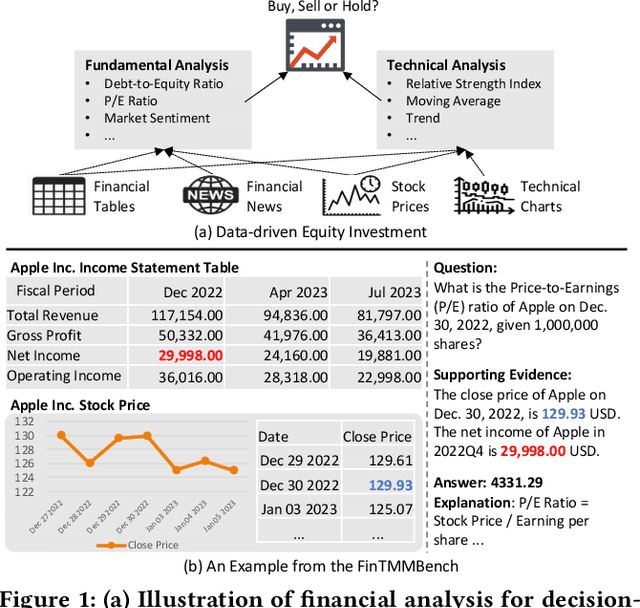
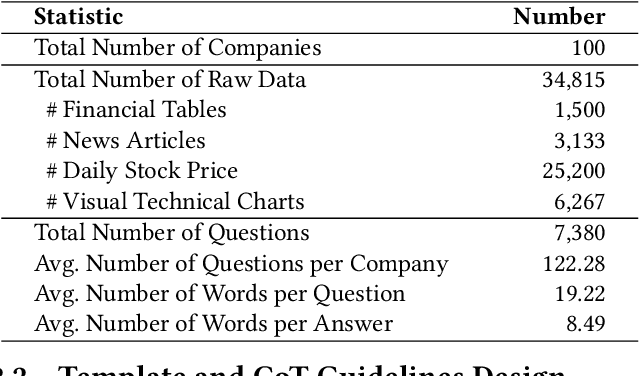
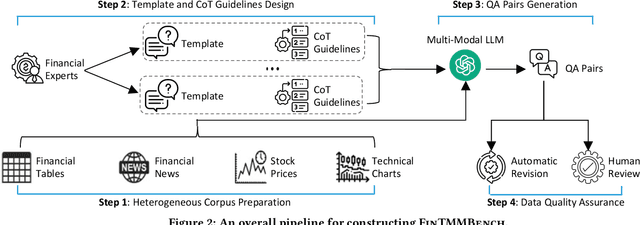
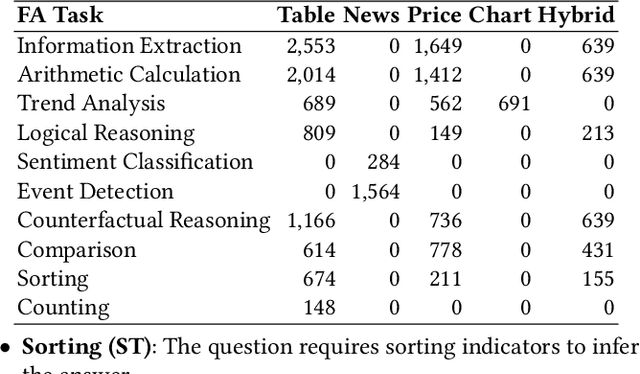
Finance decision-making often relies on in-depth data analysis across various data sources, including financial tables, news articles, stock prices, etc. In this work, we introduce FinTMMBench, the first comprehensive benchmark for evaluating temporal-aware multi-modal Retrieval-Augmented Generation (RAG) systems in finance. Built from heterologous data of NASDAQ 100 companies, FinTMMBench offers three significant advantages. 1) Multi-modal Corpus: It encompasses a hybrid of financial tables, news articles, daily stock prices, and visual technical charts as the corpus. 2) Temporal-aware Questions: Each question requires the retrieval and interpretation of its relevant data over a specific time period, including daily, weekly, monthly, quarterly, and annual periods. 3) Diverse Financial Analysis Tasks: The questions involve 10 different tasks, including information extraction, trend analysis, sentiment analysis and event detection, etc. We further propose a novel TMMHybridRAG method, which first leverages LLMs to convert data from other modalities (e.g., tabular, visual and time-series data) into textual format and then incorporates temporal information in each node when constructing graphs and dense indexes. Its effectiveness has been validated in extensive experiments, but notable gaps remain, highlighting the challenges presented by our FinTMMBench.