 Add to Chrome
 Add to Firefox
 Add to Edge
Towards UAV Detection in the Real World: A New Multispectral Dataset UAVNet-MS and a New Method
May 20, 2026
The proliferation of unmanned aerial vehicles (UAVs) has created urgent demand for precise UAV monitoring. Existing RGB-based systems rely on spatial cues that degrade at small scales, particularly with high inter-type similarity, target-clutter ambiguity, and low contrast. Multispectral imaging (MSI) encodes material-aware spectral signatures, yet MSI-based fine-grained small-UAV detection remains underexplored due to lack of dedicated datasets. We introduce UAVNet-MS, the first multispectral dataset for fine-grained small-UAV detection, comprising 15,618 temporally synchronized RGB-MSI data cubes (1440x1080) with bounding box annotations. The dataset features challenging small objects (93.7% <= 32^2 pixels, average 18^2 pixels, ~0.02% image area) under low contrast. We propose MFDNet, a dual-stream baseline addressing array-induced parallax and spatial-spectral fusion. Extensive evaluation under RGB-only, MSI-only, and RGB+MSI protocols against 20 detectors shows MFDNet achieves +6.2% AP50 improvement over best RGB-only methods, demonstrating spectral cues provide complementary material evidence beyond spatial cues. This work provides foundational dataset, strong baseline, and benchmark for multispectral UAV monitoring research.

Design Your Ad: Personalized Advertising Image and Text Generation with Unified Autoregressive Models
May 12, 2026Generating realistic and user-preferred advertisements is a key challenge in e-commerce. Existing approaches utilize multiple independent models driven by click-through-rate (CTR) to controllably create attractive image or text advertisements. However, their pipelines lack cross-modal perception and rely on CTR that only reflects average preferences. Therefore, we explore jointly generating personalized image-text advertisements from historical click behaviors. We first design a Unified Advertisement Generative model (Uni-AdGen) that employs a single autoregressive framework to produce both advertising images and texts. By incorporating a foreground perception module and instruction tuning, Uni-AdGen enhances the realism of the generated content. To further personalize advertisements, we equip Uni-AdGen with a coarse-to-fine preference understanding module that effectively captures user interests from noisy multimodal historical behaviors to drive personalized generation. Additionally, we construct the first large-scale Personalized Advertising image-text dataset (PAd1M) and introduce a Product Background Similarity (PBS) metric to facilitate training and evaluation. Extensive experiments show that our method outperforms baselines in general and personalized advertisement generation. Our project is available at https://github.com/JD-GenX/Uni-AdGen.
Triple Spectral Fusion for Sensor-based Human Activity Recognition
May 04, 2026The field of sensor-based human activity recognition (HAR) mainly uses posture, motion and context data of Inertial Measurement Units (IMUs) to identify daily activities. Despite the advancements in learning-based methods, it is challenging to perform information fusion from the temporal perspective due to the complexities in fusing heterogeneous sensor data and establishing long-term context correlations. This paper proposes a novel triple spectral fusion framework tailored for HAR. First, we develop an adaptive complementary filtering technique for noise suppression and organize each IMU's sensors into posture and motion modality nodes. Given that IMU nodes form a dynamic heterogeneous graph, we then apply adaptive filtering within the graph Fourier domain to merge both homogeneous and heterogeneous node information. Furthermore, an adaptive wavelet frequency selection approach is implemented to suppress context redundancy and shorten the length of features. This approach enhances both timestamp-based graph aggregation and the correlation of long-term contexts. Our framework uses adaptive filtering in the Fourier, graph Fourier, and wavelet domains, enabling effective multi-sensor fusion and context correlation. Extensive experiments on ten benchmark datasets demonstrate the superior performance of our framework. Project page: https://github.com/crocodilegogogo/TSF-TPAMI2026.
Feature-aligned Motion Transformation for Efficient Dynamic Point Cloud Compression
Sep 18, 2025Dynamic point clouds are widely used in applications such as immersive reality, robotics, and autonomous driving. Efficient compression largely depends on accurate motion estimation and compensation, yet the irregular structure and significant local variations of point clouds make this task highly challenging. Current methods often rely on explicit motion estimation, whose encoded vectors struggle to capture intricate dynamics and fail to fully exploit temporal correlations. To overcome these limitations, we introduce a Feature-aligned Motion Transformation (FMT) framework for dynamic point cloud compression. FMT replaces explicit motion vectors with a spatiotemporal alignment strategy that implicitly models continuous temporal variations, using aligned features as temporal context within a latent-space conditional encoding framework. Furthermore, we design a random access (RA) reference strategy that enables bidirectional motion referencing and layered encoding, thereby supporting frame-level parallel compression. Extensive experiments demonstrate that our method surpasses D-DPCC and AdaDPCC in both encoding and decoding efficiency, while also achieving BD-Rate reductions of 20% and 9.4%, respectively. These results highlight the effectiveness of FMT in jointly improving compression efficiency and processing performance.
Probing Deep into Temporal Profile Makes the Infrared Small Target Detector Much Better
Jun 15, 2025Infrared small target (IRST) detection is challenging in simultaneously achieving precise, universal, robust and efficient performance due to extremely dim targets and strong interference. Current learning-based methods attempt to leverage ``more" information from both the spatial and the short-term temporal domains, but suffer from unreliable performance under complex conditions while incurring computational redundancy. In this paper, we explore the ``more essential" information from a more crucial domain for the detection. Through theoretical analysis, we reveal that the global temporal saliency and correlation information in the temporal profile demonstrate significant superiority in distinguishing target signals from other signals. To investigate whether such superiority is preferentially leveraged by well-trained networks, we built the first prediction attribution tool in this field and verified the importance of the temporal profile information. Inspired by the above conclusions, we remodel the IRST detection task as a one-dimensional signal anomaly detection task, and propose an efficient deep temporal probe network (DeepPro) that only performs calculations in the time dimension for IRST detection. We conducted extensive experiments to fully validate the effectiveness of our method. The experimental results are exciting, as our DeepPro outperforms existing state-of-the-art IRST detection methods on widely-used benchmarks with extremely high efficiency, and achieves a significant improvement on dim targets and in complex scenarios. We provide a new modeling domain, a new insight, a new method, and a new performance, which can promote the development of IRST detection. Codes are available at https://github.com/TinaLRJ/DeepPro.
A Unified Hierarchical Framework for Fine-grained Cross-view Geo-localization over Large-scale Scenarios
May 12, 2025Cross-view geo-localization is a promising solution for large-scale localization problems, requiring the sequential execution of retrieval and metric localization tasks to achieve fine-grained predictions. However, existing methods typically focus on designing standalone models for these two tasks, resulting in inefficient collaboration and increased training overhead. In this paper, we propose UnifyGeo, a novel unified hierarchical geo-localization framework that integrates retrieval and metric localization tasks into a single network. Specifically, we first employ a unified learning strategy with shared parameters to jointly learn multi-granularity representation, facilitating mutual reinforcement between these two tasks. Subsequently, we design a re-ranking mechanism guided by a dedicated loss function, which enhances geo-localization performance by improving both retrieval accuracy and metric localization references. Extensive experiments demonstrate that UnifyGeo significantly outperforms the state-of-the-arts in both task-isolated and task-associated settings. Remarkably, on the challenging VIGOR benchmark, which supports fine-grained localization evaluation, the 1-meter-level localization recall rate improves from 1.53\% to 39.64\% and from 0.43\% to 25.58\% under same-area and cross-area evaluations, respectively. Code will be made publicly available.
DropoutGS: Dropping Out Gaussians for Better Sparse-view Rendering
Apr 13, 2025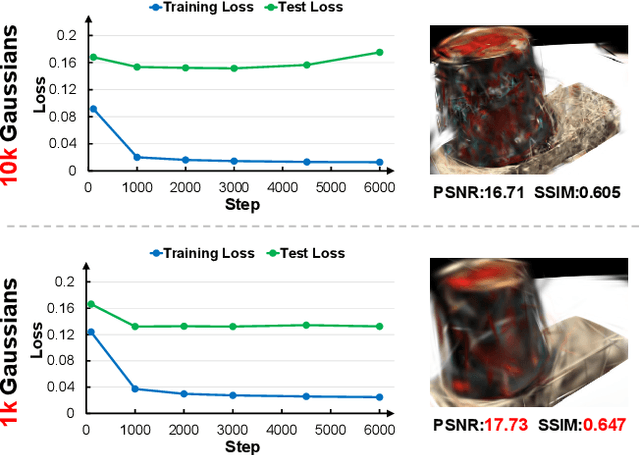
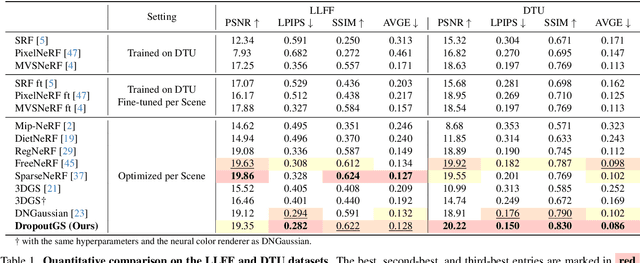
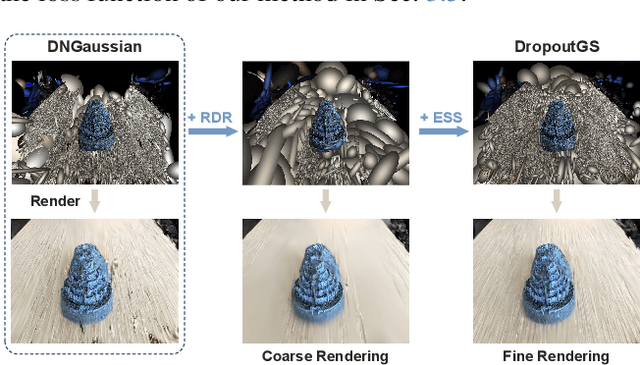
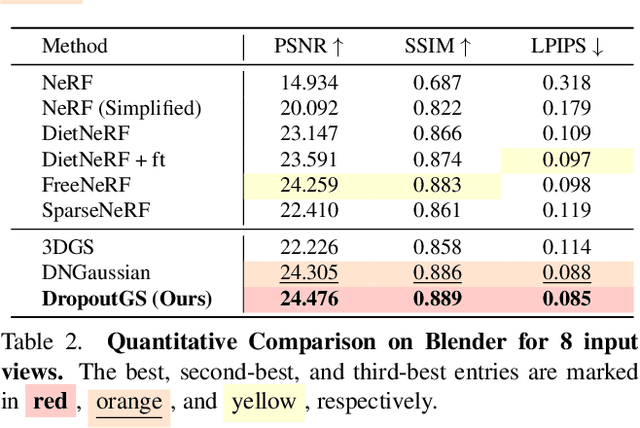
Although 3D Gaussian Splatting (3DGS) has demonstrated promising results in novel view synthesis, its performance degrades dramatically with sparse inputs and generates undesirable artifacts. As the number of training views decreases, the novel view synthesis task degrades to a highly under-determined problem such that existing methods suffer from the notorious overfitting issue. Interestingly, we observe that models with fewer Gaussian primitives exhibit less overfitting under sparse inputs. Inspired by this observation, we propose a Random Dropout Regularization (RDR) to exploit the advantages of low-complexity models to alleviate overfitting. In addition, to remedy the lack of high-frequency details for these models, an Edge-guided Splitting Strategy (ESS) is developed. With these two techniques, our method (termed DropoutGS) provides a simple yet effective plug-in approach to improve the generalization performance of existing 3DGS methods. Extensive experiments show that our DropoutGS produces state-of-the-art performance under sparse views on benchmark datasets including Blender, LLFF, and DTU. The project page is at: https://xuyx55.github.io/DropoutGS/.
Pluggable Style Representation Learning for Multi-Style Transfer
Mar 26, 2025Due to the high diversity of image styles, the scalability to various styles plays a critical role in real-world applications. To accommodate a large amount of styles, previous multi-style transfer approaches rely on enlarging the model size while arbitrary-style transfer methods utilize heavy backbones. However, the additional computational cost introduced by more model parameters hinders these methods to be deployed on resource-limited devices. To address this challenge, in this paper, we develop a style transfer framework by decoupling the style modeling and transferring. Specifically, for style modeling, we propose a style representation learning scheme to encode the style information into a compact representation. Then, for style transferring, we develop a style-aware multi-style transfer network (SaMST) to adapt to diverse styles using pluggable style representations. In this way, our framework is able to accommodate diverse image styles in the learned style representations without introducing additional overhead during inference, thereby maintaining efficiency. Experiments show that our style representation can extract accurate style information. Moreover, qualitative and quantitative results demonstrate that our method achieves state-of-the-art performance in terms of both accuracy and efficiency. The codes are available in https://github.com/The-Learning-And-Vision-Atelier-LAVA/SaMST.
SaMam: Style-aware State Space Model for Arbitrary Image Style Transfer
Mar 20, 2025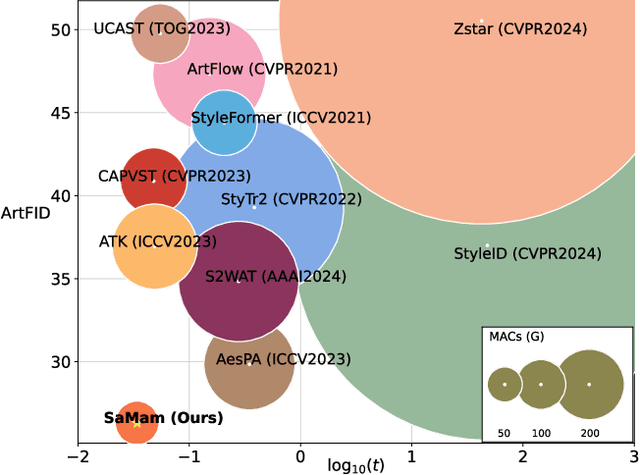

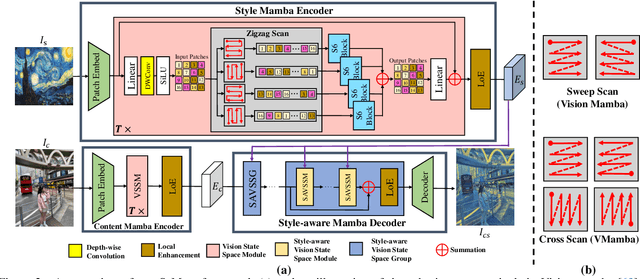
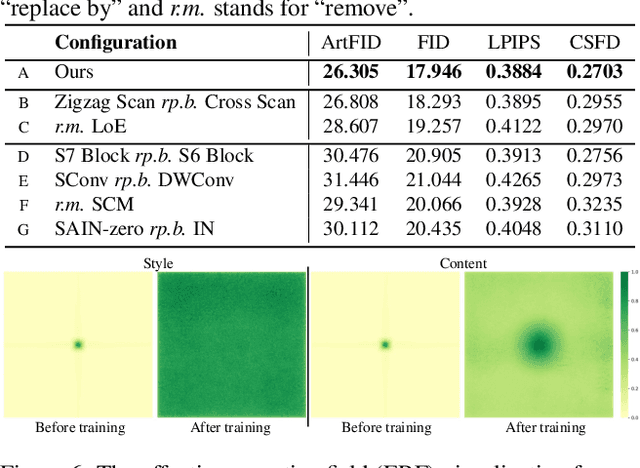
Global effective receptive field plays a crucial role for image style transfer (ST) to obtain high-quality stylized results. However, existing ST backbones (e.g., CNNs and Transformers) suffer huge computational complexity to achieve global receptive fields. Recently, the State Space Model (SSM), especially the improved variant Mamba, has shown great potential for long-range dependency modeling with linear complexity, which offers a approach to resolve the above dilemma. In this paper, we develop a Mamba-based style transfer framework, termed SaMam. Specifically, a mamba encoder is designed to efficiently extract content and style information. In addition, a style-aware mamba decoder is developed to flexibly adapt to various styles. Moreover, to address the problems of local pixel forgetting, channel redundancy and spatial discontinuity of existing SSMs, we introduce both local enhancement and zigzag scan. Qualitative and quantitative results demonstrate that our SaMam outperforms state-of-the-art methods in terms of both accuracy and efficiency.
Simulating the Real World: A Unified Survey of Multimodal Generative Models
Mar 06, 2025


Understanding and replicating the real world is a critical challenge in Artificial General Intelligence (AGI) research. To achieve this, many existing approaches, such as world models, aim to capture the fundamental principles governing the physical world, enabling more accurate simulations and meaningful interactions. However, current methods often treat different modalities, including 2D (images), videos, 3D, and 4D representations, as independent domains, overlooking their interdependencies. Additionally, these methods typically focus on isolated dimensions of reality without systematically integrating their connections. In this survey, we present a unified survey for multimodal generative models that investigate the progression of data dimensionality in real-world simulation. Specifically, this survey starts from 2D generation (appearance), then moves to video (appearance+dynamics) and 3D generation (appearance+geometry), and finally culminates in 4D generation that integrate all dimensions. To the best of our knowledge, this is the first attempt to systematically unify the study of 2D, video, 3D and 4D generation within a single framework. To guide future research, we provide a comprehensive review of datasets, evaluation metrics and future directions, and fostering insights for newcomers. This survey serves as a bridge to advance the study of multimodal generative models and real-world simulation within a unified framework.