 Add to Chrome
 Add to Firefox
 Add to Edge
Skywork: A More Open Bilingual Foundation Model
Oct 30, 2023
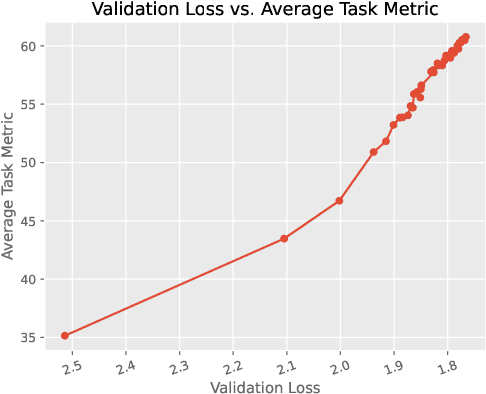


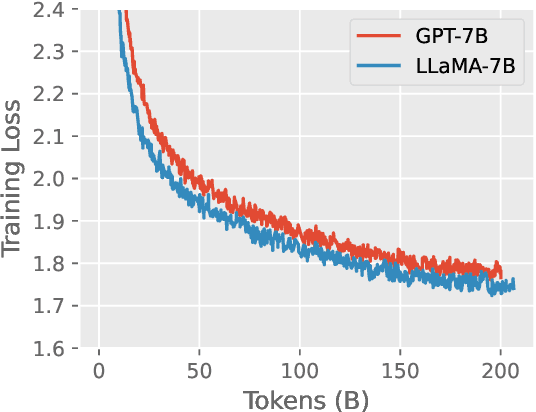
In this technical report, we present Skywork-13B, a family of large language models (LLMs) trained on a corpus of over 3.2 trillion tokens drawn from both English and Chinese texts. This bilingual foundation model is the most extensively trained and openly published LLMs of comparable size to date. We introduce a two-stage training methodology using a segmented corpus, targeting general purpose training and then domain-specific enhancement training, respectively. We show that our model not only excels on popular benchmarks, but also achieves \emph{state of the art} performance in Chinese language modeling on diverse domains. Furthermore, we propose a novel leakage detection method, demonstrating that test data contamination is a pressing issue warranting further investigation by the LLM community. To spur future research, we release Skywork-13B along with checkpoints obtained during intermediate stages of the training process. We are also releasing part of our SkyPile corpus, a collection of over 150 billion tokens of web text, which is the largest high quality open Chinese pre-training corpus to date. We hope Skywork-13B and our open corpus will serve as a valuable open-source resource to democratize access to high-quality LLMs.

ScaleLong: Towards More Stable Training of Diffusion Model via Scaling Network Long Skip Connection
Oct 20, 2023In diffusion models, UNet is the most popular network backbone, since its long skip connects (LSCs) to connect distant network blocks can aggregate long-distant information and alleviate vanishing gradient. Unfortunately, UNet often suffers from unstable training in diffusion models which can be alleviated by scaling its LSC coefficients smaller. However, theoretical understandings of the instability of UNet in diffusion models and also the performance improvement of LSC scaling remain absent yet. To solve this issue, we theoretically show that the coefficients of LSCs in UNet have big effects on the stableness of the forward and backward propagation and robustness of UNet. Specifically, the hidden feature and gradient of UNet at any layer can oscillate and their oscillation ranges are actually large which explains the instability of UNet training. Moreover, UNet is also provably sensitive to perturbed input, and predicts an output distant from the desired output, yielding oscillatory loss and thus oscillatory gradient. Besides, we also observe the theoretical benefits of the LSC coefficient scaling of UNet in the stableness of hidden features and gradient and also robustness. Finally, inspired by our theory, we propose an effective coefficient scaling framework ScaleLong that scales the coefficients of LSC in UNet and better improves the training stability of UNet. Experimental results on four famous datasets show that our methods are superior to stabilize training and yield about 1.5x training acceleration on different diffusion models with UNet or UViT backbones. Code: https://github.com/sail-sg/ScaleLong
Heterogenous Memory Augmented Neural Networks
Oct 17, 2023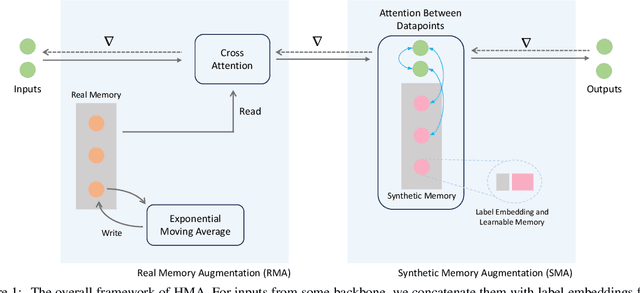
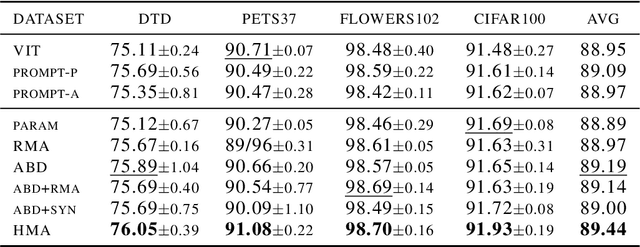

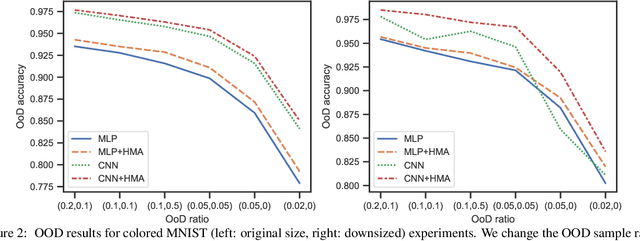
It has been shown that semi-parametric methods, which combine standard neural networks with non-parametric components such as external memory modules and data retrieval, are particularly helpful in data scarcity and out-of-distribution (OOD) scenarios. However, existing semi-parametric methods mostly depend on independent raw data points - this strategy is difficult to scale up due to both high computational costs and the incapacity of current attention mechanisms with a large number of tokens. In this paper, we introduce a novel heterogeneous memory augmentation approach for neural networks which, by introducing learnable memory tokens with attention mechanism, can effectively boost performance without huge computational overhead. Our general-purpose method can be seamlessly combined with various backbones (MLP, CNN, GNN, and Transformer) in a plug-and-play manner. We extensively evaluate our approach on various image and graph-based tasks under both in-distribution (ID) and OOD conditions and show its competitive performance against task-specific state-of-the-art methods. Code is available at \url{https://github.com/qiuzh20/HMA}.
DiffDance: Cascaded Human Motion Diffusion Model for Dance Generation
Aug 05, 2023When hearing music, it is natural for people to dance to its rhythm. Automatic dance generation, however, is a challenging task due to the physical constraints of human motion and rhythmic alignment with target music. Conventional autoregressive methods introduce compounding errors during sampling and struggle to capture the long-term structure of dance sequences. To address these limitations, we present a novel cascaded motion diffusion model, DiffDance, designed for high-resolution, long-form dance generation. This model comprises a music-to-dance diffusion model and a sequence super-resolution diffusion model. To bridge the gap between music and motion for conditional generation, DiffDance employs a pretrained audio representation learning model to extract music embeddings and further align its embedding space to motion via contrastive loss. During training our cascaded diffusion model, we also incorporate multiple geometric losses to constrain the model outputs to be physically plausible and add a dynamic loss weight that adaptively changes over diffusion timesteps to facilitate sample diversity. Through comprehensive experiments performed on the benchmark dataset AIST++, we demonstrate that DiffDance is capable of generating realistic dance sequences that align effectively with the input music. These results are comparable to those achieved by state-of-the-art autoregressive methods.
SimTeG: A Frustratingly Simple Approach Improves Textual Graph Learning
Aug 03, 2023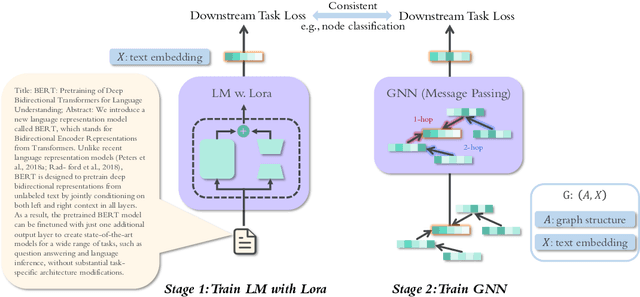
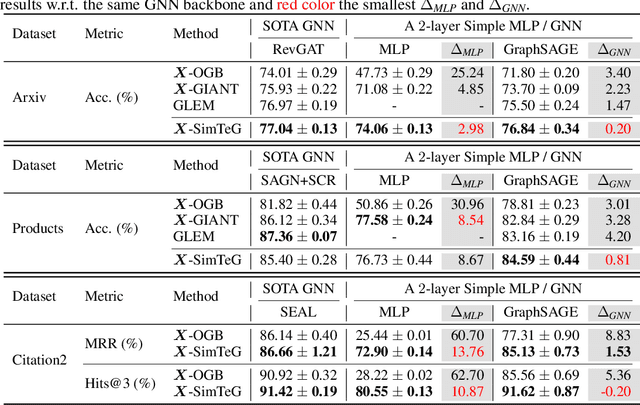
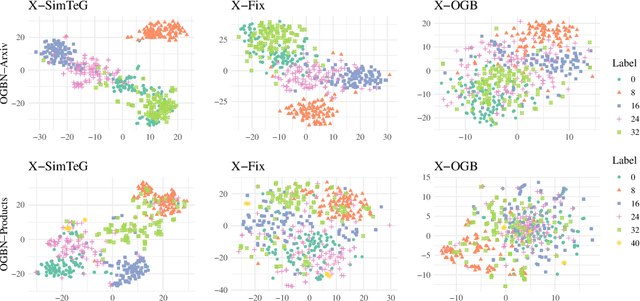
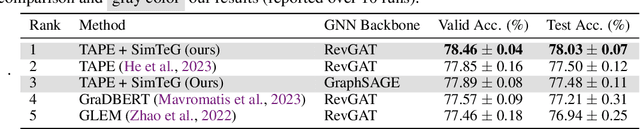
Textual graphs (TGs) are graphs whose nodes correspond to text (sentences or documents), which are widely prevalent. The representation learning of TGs involves two stages: (i) unsupervised feature extraction and (ii) supervised graph representation learning. In recent years, extensive efforts have been devoted to the latter stage, where Graph Neural Networks (GNNs) have dominated. However, the former stage for most existing graph benchmarks still relies on traditional feature engineering techniques. More recently, with the rapid development of language models (LMs), researchers have focused on leveraging LMs to facilitate the learning of TGs, either by jointly training them in a computationally intensive framework (merging the two stages), or designing complex self-supervised training tasks for feature extraction (enhancing the first stage). In this work, we present SimTeG, a frustratingly Simple approach for Textual Graph learning that does not innovate in frameworks, models, and tasks. Instead, we first perform supervised parameter-efficient fine-tuning (PEFT) on a pre-trained LM on the downstream task, such as node classification. We then generate node embeddings using the last hidden states of finetuned LM. These derived features can be further utilized by any GNN for training on the same task. We evaluate our approach on two fundamental graph representation learning tasks: node classification and link prediction. Through extensive experiments, we show that our approach significantly improves the performance of various GNNs on multiple graph benchmarks.
Offline Prioritized Experience Replay
Jun 08, 2023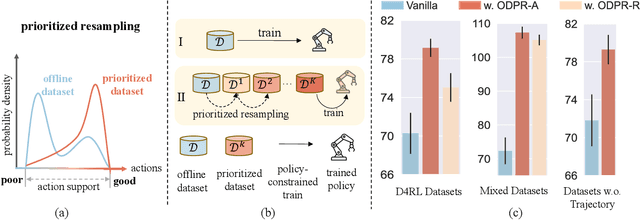


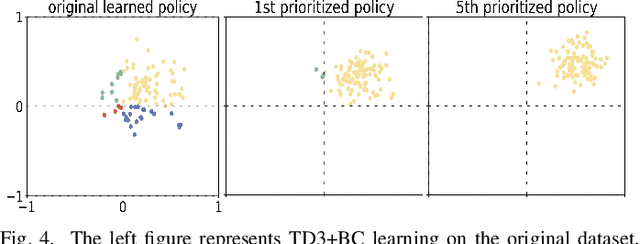
Offline reinforcement learning (RL) is challenged by the distributional shift problem. To address this problem, existing works mainly focus on designing sophisticated policy constraints between the learned policy and the behavior policy. However, these constraints are applied equally to well-performing and inferior actions through uniform sampling, which might negatively affect the learned policy. To alleviate this issue, we propose Offline Prioritized Experience Replay (OPER), featuring a class of priority functions designed to prioritize highly-rewarding transitions, making them more frequently visited during training. Through theoretical analysis, we show that this class of priority functions induce an improved behavior policy, and when constrained to this improved policy, a policy-constrained offline RL algorithm is likely to yield a better solution. We develop two practical strategies to obtain priority weights by estimating advantages based on a fitted value network (OPER-A) or utilizing trajectory returns (OPER-R) for quick computation. OPER is a plug-and-play component for offline RL algorithms. As case studies, we evaluate OPER on five different algorithms, including BC, TD3+BC, Onestep RL, CQL, and IQL. Extensive experiments demonstrate that both OPER-A and OPER-R significantly improve the performance for all baseline methods. Codes and priority weights are availiable at https://github.com/sail-sg/OPER.
ICDAR 2023 Competition on Structured Text Extraction from Visually-Rich Document Images
Jun 05, 2023Structured text extraction is one of the most valuable and challenging application directions in the field of Document AI. However, the scenarios of past benchmarks are limited, and the corresponding evaluation protocols usually focus on the submodules of the structured text extraction scheme. In order to eliminate these problems, we organized the ICDAR 2023 competition on Structured text extraction from Visually-Rich Document images (SVRD). We set up two tracks for SVRD including Track 1: HUST-CELL and Track 2: Baidu-FEST, where HUST-CELL aims to evaluate the end-to-end performance of Complex Entity Linking and Labeling, and Baidu-FEST focuses on evaluating the performance and generalization of Zero-shot / Few-shot Structured Text extraction from an end-to-end perspective. Compared to the current document benchmarks, our two tracks of competition benchmark enriches the scenarios greatly and contains more than 50 types of visually-rich document images (mainly from the actual enterprise applications). The competition opened on 30th December, 2022 and closed on 24th March, 2023. There are 35 participants and 91 valid submissions received for Track 1, and 15 participants and 26 valid submissions received for Track 2. In this report we will presents the motivation, competition datasets, task definition, evaluation protocol, and submission summaries. According to the performance of the submissions, we believe there is still a large gap on the expected information extraction performance for complex and zero-shot scenarios. It is hoped that this competition will attract many researchers in the field of CV and NLP, and bring some new thoughts to the field of Document AI.
Efficient Multi-Grained Knowledge Reuse for Class Incremental Segmentation
Jun 03, 2023Class Incremental Semantic Segmentation (CISS) has been a trend recently due to its great significance in real-world applications. Although the existing CISS methods demonstrate remarkable performance, they either leverage the high-level knowledge (feature) only while neglecting the rich and diverse knowledge in the low-level features, leading to poor old knowledge preservation and weak new knowledge exploration; or use multi-level features for knowledge distillation by retraining a heavy backbone, which is computationally intensive. In this paper, we for the first time propose to efficiently reuse the multi-grained knowledge for CISS by fusing multi-level features with the frozen backbone and show a simple aggregation of varying-level features, i.e., naive feature pyramid, can boost the performance significantly. We further introduce a novel densely-interactive feature pyramid (DEFY) module that enhances the fusion of high- and low-level features by enabling their dense interaction. Specifically, DEFY establishes a per-pixel relationship between pairs of feature maps, allowing for multi-pair outputs to be aggregated. This results in improved semantic segmentation by leveraging the complementary information from multi-level features. We show that DEFY can be effortlessly integrated into three representative methods for performance enhancement. Our method yields a new state-of-the-art performance when combined with the current SOTA by notably averaged mIoU gains on two widely used benchmarks, i.e., 2.5% on PASCAL VOC 2012 and 2.3% on ADE20K.
Improving and Benchmarking Offline Reinforcement Learning Algorithms
Jun 01, 2023Recently, Offline Reinforcement Learning (RL) has achieved remarkable progress with the emergence of various algorithms and datasets. However, these methods usually focus on algorithmic advancements, ignoring that many low-level implementation choices considerably influence or even drive the final performance. As a result, it becomes hard to attribute the progress in Offline RL as these choices are not sufficiently discussed and aligned in the literature. In addition, papers focusing on a dataset (e.g., D4RL) often ignore algorithms proposed on another dataset (e.g., RL Unplugged), causing isolation among the algorithms, which might slow down the overall progress. Therefore, this work aims to bridge the gaps caused by low-level choices and datasets. To this end, we empirically investigate 20 implementation choices using three representative algorithms (i.e., CQL, CRR, and IQL) and present a guidebook for choosing implementations. Following the guidebook, we find two variants CRR+ and CQL+ , achieving new state-of-the-art on D4RL. Moreover, we benchmark eight popular offline RL algorithms across datasets under unified training and evaluation framework. The findings are inspiring: the success of a learning paradigm severely depends on the data distribution, and some previous conclusions are biased by the dataset used. Our code is available at https://github.com/sail-sg/offbench.
Efficient Diffusion Policies for Offline Reinforcement Learning
May 31, 2023Offline reinforcement learning (RL) aims to learn optimal policies from offline datasets, where the parameterization of policies is crucial but often overlooked. Recently, Diffsuion-QL significantly boosts the performance of offline RL by representing a policy with a diffusion model, whose success relies on a parametrized Markov Chain with hundreds of steps for sampling. However, Diffusion-QL suffers from two critical limitations. 1) It is computationally inefficient to forward and backward through the whole Markov chain during training. 2) It is incompatible with maximum likelihood-based RL algorithms (e.g., policy gradient methods) as the likelihood of diffusion models is intractable. Therefore, we propose efficient diffusion policy (EDP) to overcome these two challenges. EDP approximately constructs actions from corrupted ones at training to avoid running the sampling chain. We conduct extensive experiments on the D4RL benchmark. The results show that EDP can reduce the diffusion policy training time from 5 days to 5 hours on gym-locomotion tasks. Moreover, we show that EDP is compatible with various offline RL algorithms (TD3, CRR, and IQL) and achieves new state-of-the-art on D4RL by large margins over previous methods. Our code is available at https://github.com/sail-sg/edp.