 Add to Chrome
 Add to Firefox
 Add to Edge
MedClaw: Heuristic Agent Harness for Long-Horizon Surgical Video Reasoning
Aug 14, 2026
Understanding tens-of-minutes surgical videos requires long-horizon temporal reasoning, answering what happens before, after, or across stages of a procedure by grounding the question in visual evidence spread across time. Existing approaches handle this poorly: a one-shot vision-language model (VLM) compresses the whole procedure to fit its context window and loses the detail a "before" or "after" question depends on, while video agents that train the model where to look are data-hungry and transfer poorly to out-of-domain surgery. We build an agent harness that separates reasoning from perception and improves by evolving context rather than optimizing weights. A text-only orchestrator plans which evidence to gather and issues an auditable sequence of tool calls, while frozen vision-language sub-agents execute each call over the pixels, viewing, cropping, inspecting frames, and retrieving external knowledge. We further propose a gradient-free, reward-gated Heuristic Skill Distillation loop that mines the agent's own low-scoring traces and keeps a candidate skill only when it raises a validation reward, yielding reusable retrieval skills, notably directed re-look. Growing an external skill library rather than tuning weights, the loop adapts from only about 100 labeled examples, far fewer than supervised or reinforcement fine-tuning requires. To evaluate this agent, we introduce MedClawBench, a de-leaked, doctor-grounded benchmark of 1,123 questions over self-built long neurosurgery recordings and a held-out public lecture-video test split. Across both datasets and all four evaluation dimensions, our agent consistently outperforms one-shot VLMs and general video-agent frameworks, with the largest gains on the long, out-of-domain neurosurgery videos. Project page: https://fyycs.github.io/medclaw/.

Cross-Modality Domain Adaptation for Freespace Detection: A Simple yet Effective Baseline
Oct 06, 2022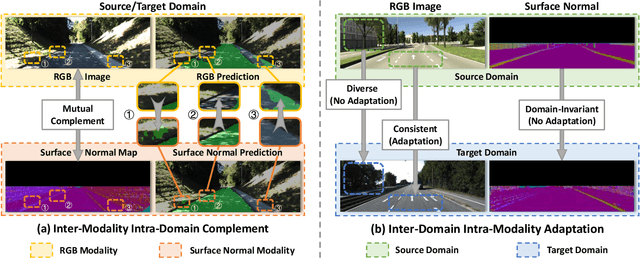
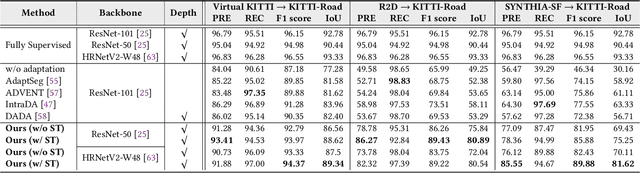
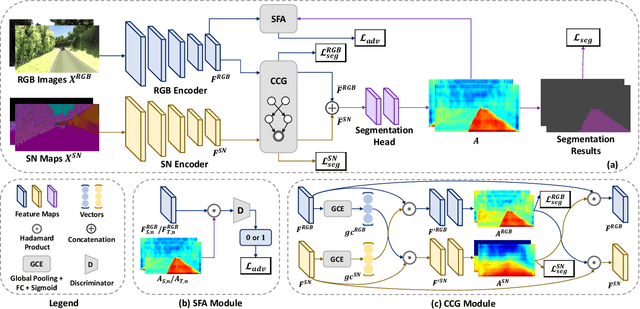
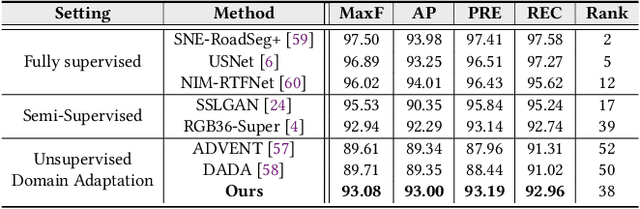
As one of the fundamental functions of autonomous driving system, freespace detection aims at classifying each pixel of the image captured by the camera as drivable or non-drivable. Current works of freespace detection heavily rely on large amount of densely labeled training data for accuracy and robustness, which is time-consuming and laborious to collect and annotate. To the best of our knowledge, we are the first work to explore unsupervised domain adaptation for freespace detection to alleviate the data limitation problem with synthetic data. We develop a cross-modality domain adaptation framework which exploits both RGB images and surface normal maps generated from depth images. A Collaborative Cross Guidance (CCG) module is proposed to leverage the context information of one modality to guide the other modality in a cross manner, thus realizing inter-modality intra-domain complement. To better bridge the domain gap between source domain (synthetic data) and target domain (real-world data), we also propose a Selective Feature Alignment (SFA) module which only aligns the features of consistent foreground area between the two domains, thus realizing inter-domain intra-modality adaptation. Extensive experiments are conducted by adapting three different synthetic datasets to one real-world dataset for freespace detection respectively. Our method performs closely to fully supervised freespace detection methods (93.08 v.s. 97.50 F1 score) and outperforms other general unsupervised domain adaptation methods for semantic segmentation with large margins, which shows the promising potential of domain adaptation for freespace detection.
Video Background Music Generation with Controllable Music Transformer
Nov 16, 2021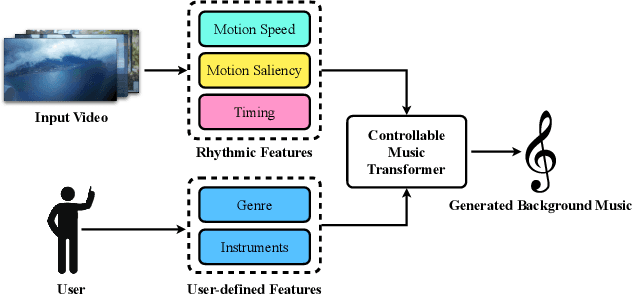
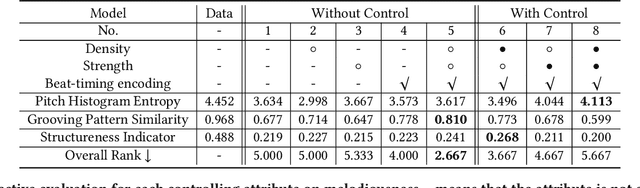
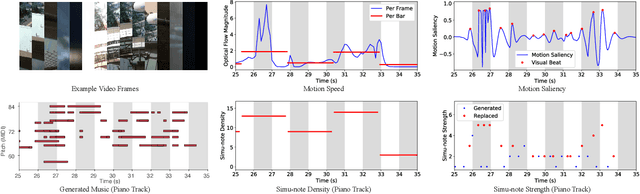
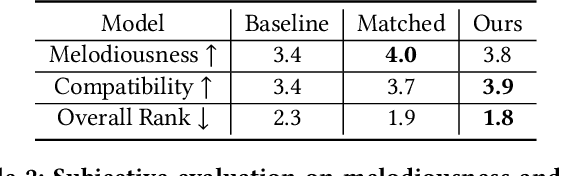
In this work, we address the task of video background music generation. Some previous works achieve effective music generation but are unable to generate melodious music tailored to a particular video, and none of them considers the video-music rhythmic consistency. To generate the background music that matches the given video, we first establish the rhythmic relations between video and background music. In particular, we connect timing, motion speed, and motion saliency from video with beat, simu-note density, and simu-note strength from music, respectively. We then propose CMT, a Controllable Music Transformer that enables local control of the aforementioned rhythmic features and global control of the music genre and instruments. Objective and subjective evaluations show that the generated background music has achieved satisfactory compatibility with the input videos, and at the same time, impressive music quality. Code and models are available at https://github.com/wzk1015/video-bgm-generation.