 Add to Chrome
 Add to Firefox
 Add to Edge
Visual Imitation Learning with Patch Rewards
Feb 10, 2023
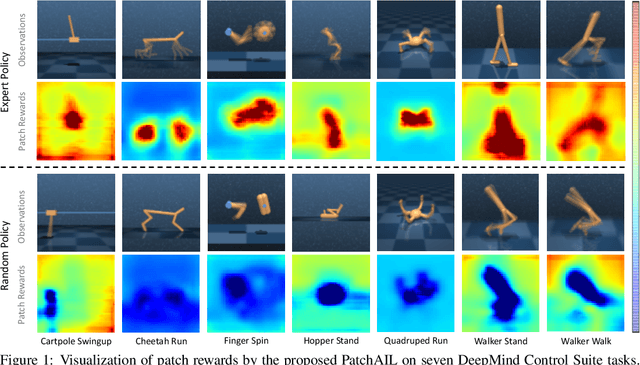
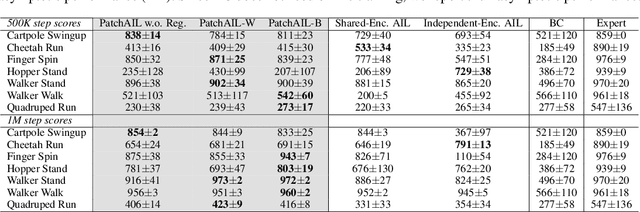
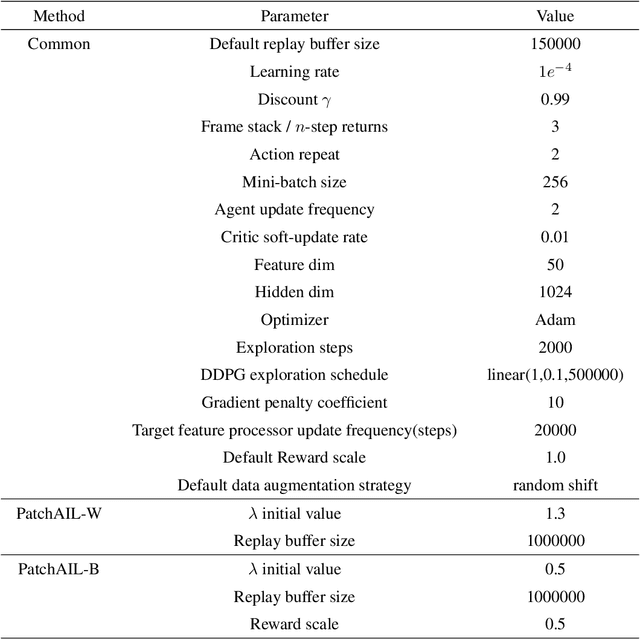
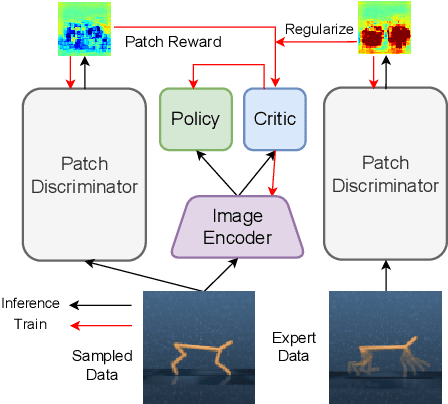
Visual imitation learning enables reinforcement learning agents to learn to behave from expert visual demonstrations such as videos or image sequences, without explicit, well-defined rewards. Previous research either adopted supervised learning techniques or induce simple and coarse scalar rewards from pixels, neglecting the dense information contained in the image demonstrations. In this work, we propose to measure the expertise of various local regions of image samples, or called \textit{patches}, and recover multi-dimensional \textit{patch rewards} accordingly. Patch reward is a more precise rewarding characterization that serves as a fine-grained expertise measurement and visual explainability tool. Specifically, we present Adversarial Imitation Learning with Patch Rewards (PatchAIL), which employs a patch-based discriminator to measure the expertise of different local parts from given images and provide patch rewards. The patch-based knowledge is also used to regularize the aggregated reward and stabilize the training. We evaluate our method on DeepMind Control Suite and Atari tasks. The experiment results have demonstrated that PatchAIL outperforms baseline methods and provides valuable interpretations for visual demonstrations.

Bag of Tricks for Training Data Extraction from Language Models
Feb 09, 2023With the advance of language models, privacy protection is receiving more attention. Training data extraction is therefore of great importance, as it can serve as a potential tool to assess privacy leakage. However, due to the difficulty of this task, most of the existing methods are proof-of-concept and still not effective enough. In this paper, we investigate and benchmark tricks for improving training data extraction using a publicly available dataset. Because most existing extraction methods use a pipeline of generating-then-ranking, i.e., generating text candidates as potential training data and then ranking them based on specific criteria, our research focuses on the tricks for both text generation (e.g., sampling strategy) and text ranking (e.g., token-level criteria). The experimental results show that several previously overlooked tricks can be crucial to the success of training data extraction. Based on the GPT-Neo 1.3B evaluation results, our proposed tricks outperform the baseline by a large margin in most cases, providing a much stronger baseline for future research.
Better Diffusion Models Further Improve Adversarial Training
Feb 09, 2023
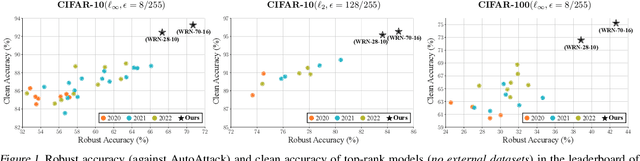
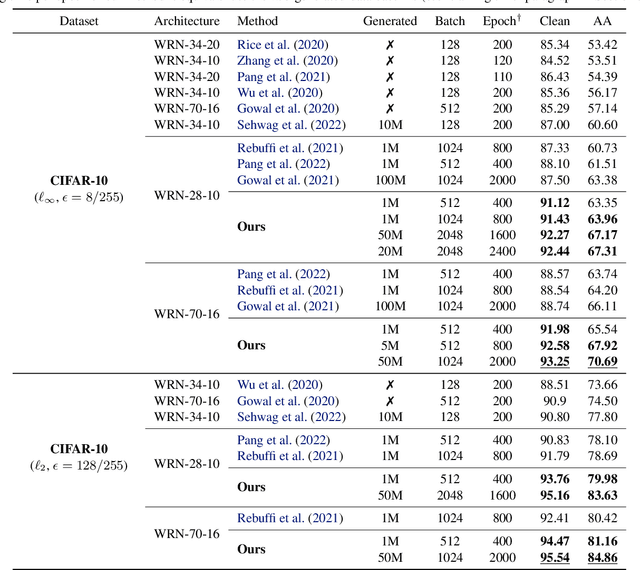

It has been recognized that the data generated by the denoising diffusion probabilistic model (DDPM) improves adversarial training. After two years of rapid development in diffusion models, a question naturally arises: can better diffusion models further improve adversarial training? This paper gives an affirmative answer by employing the most recent diffusion model which has higher efficiency ($\sim 20$ sampling steps) and image quality (lower FID score) compared with DDPM. Our adversarially trained models achieve state-of-the-art performance on RobustBench using only generated data (no external datasets). Under the $\ell_\infty$-norm threat model with $\epsilon=8/255$, our models achieve $70.69\%$ and $42.67\%$ robust accuracy on CIFAR-10 and CIFAR-100, respectively, i.e. improving upon previous state-of-the-art models by $+4.58\%$ and $+8.03\%$. Under the $\ell_2$-norm threat model with $\epsilon=128/255$, our models achieve $84.86\%$ on CIFAR-10 ($+4.44\%$). These results also beat previous works that use external data. Our code is available at https://github.com/wzekai99/DM-Improves-AT.
Learning to Optimize for Reinforcement Learning
Feb 03, 2023In recent years, by leveraging more data, computation, and diverse tasks, learned optimizers have achieved remarkable success in supervised learning optimization, outperforming classical hand-designed optimizers. However, in practice, these learned optimizers fail to generalize to reinforcement learning tasks due to unstable and complex loss landscapes. Moreover, neither hand-designed optimizers nor learned optimizers have been specifically designed to address the unique optimization properties in reinforcement learning. In this work, we take a data-driven approach to learn to optimize for reinforcement learning using meta-learning. We introduce a novel optimizer structure that significantly improves the training efficiency of learned optimizers, making it possible to learn an optimizer for reinforcement learning from scratch. Although trained in toy tasks, our learned optimizer demonstrates its generalization ability to unseen complex tasks. Finally, we design a set of small gridworlds to train the first general-purpose optimizer for reinforcement learning.
Reinforcement Learning from Diverse Human Preferences
Jan 30, 2023The complexity of designing reward functions has been a major obstacle to the wide application of deep reinforcement learning (RL) techniques. Describing an agent's desired behaviors and properties can be difficult, even for experts. A new paradigm called reinforcement learning from human preferences (or preference-based RL) has emerged as a promising solution, in which reward functions are learned from human preference labels among behavior trajectories. However, existing methods for preference-based RL are limited by the need for accurate oracle preference labels. This paper addresses this limitation by developing a method for crowd-sourcing preference labels and learning from diverse human preferences. The key idea is to stabilize reward learning through regularization and correction in a latent space. To ensure temporal consistency, a strong constraint is imposed on the reward model that forces its latent space to be close to the prior distribution. Additionally, a confidence-based reward model ensembling method is designed to generate more stable and reliable predictions. The proposed method is tested on a variety of tasks in DMcontrol and Meta-world and has shown consistent and significant improvements over existing preference-based RL algorithms when learning from diverse feedback, paving the way for real-world applications of RL methods.
Does Federated Learning Really Need Backpropagation?
Jan 28, 2023Federated learning (FL) is a general principle for decentralized clients to train a server model collectively without sharing local data. FL is a promising framework with practical applications, but its standard training paradigm requires the clients to backpropagate through the model to compute gradients. Since these clients are typically edge devices and not fully trusted, executing backpropagation on them incurs computational and storage overhead as well as white-box vulnerability. In light of this, we develop backpropagation-free federated learning, dubbed BAFFLE, in which backpropagation is replaced by multiple forward processes to estimate gradients. BAFFLE is 1) memory-efficient and easily fits uploading bandwidth; 2) compatible with inference-only hardware optimization and model quantization or pruning; and 3) well-suited to trusted execution environments, because the clients in BAFFLE only execute forward propagation and return a set of scalars to the server. Empirically we use BAFFLE to train deep models from scratch or to finetune pretrained models, achieving acceptable results. Code is available in https://github.com/FengHZ/BAFFLE.
MADAv2: Advanced Multi-Anchor Based Active Domain Adaptation Segmentation
Jan 18, 2023Unsupervised domain adaption has been widely adopted in tasks with scarce annotated data. Unfortunately, mapping the target-domain distribution to the source-domain unconditionally may distort the essential structural information of the target-domain data, leading to inferior performance. To address this issue, we firstly propose to introduce active sample selection to assist domain adaptation regarding the semantic segmentation task. By innovatively adopting multiple anchors instead of a single centroid, both source and target domains can be better characterized as multimodal distributions, in which way more complementary and informative samples are selected from the target domain. With only a little workload to manually annotate these active samples, the distortion of the target-domain distribution can be effectively alleviated, achieving a large performance gain. In addition, a powerful semi-supervised domain adaptation strategy is proposed to alleviate the long-tail distribution problem and further improve the segmentation performance. Extensive experiments are conducted on public datasets, and the results demonstrate that the proposed approach outperforms state-of-the-art methods by large margins and achieves similar performance to the fully-supervised upperbound, i.e., 71.4% mIoU on GTA5 and 71.8% mIoU on SYNTHIA. The effectiveness of each component is also verified by thorough ablation studies.
Position-guided Text Prompt for Vision-Language Pre-training
Dec 19, 2022Vision-Language Pre-Training (VLP) has shown promising capabilities to align image and text pairs, facilitating a broad variety of cross-modal learning tasks. However, we observe that VLP models often lack the visual grounding/localization capability which is critical for many downstream tasks such as visual reasoning. In this work, we propose a novel Position-guided Text Prompt (PTP) paradigm to enhance the visual grounding ability of cross-modal models trained with VLP. Specifically, in the VLP phase, PTP divides the image into $N\times N$ blocks, and identifies the objects in each block through the widely used object detector in VLP. It then reformulates the visual grounding task into a fill-in-the-blank problem given a PTP by encouraging the model to predict the objects in the given blocks or regress the blocks of a given object, e.g. filling `P" or ``O" in aPTP ``The block P has a O". This mechanism improves the visual grounding capability of VLP models and thus helps them better handle various downstream tasks. By introducing PTP into several state-of-the-art VLP frameworks, we observe consistently significant improvements across representative cross-modal learning model architectures and several benchmarks, e.g. zero-shot Flickr30K Retrieval (+4.8 in average recall@1) for ViLT \cite{vilt} baseline, and COCO Captioning (+5.3 in CIDEr) for SOTA BLIP \cite{blip} baseline. Moreover, PTP achieves comparable results with object-detector based methods, and much faster inference speed since PTP discards its object detector for inference while the later cannot. Our code and pre-trained weight will be released at \url{https://github.com/sail-sg/ptp}.
Decoupled Cross-Scale Cross-View Interaction for Stereo Image Enhancement in The Dark
Nov 12, 2022Low-light stereo image enhancement (LLSIE) is a relatively new task to enhance the quality of visually unpleasant stereo images captured in dark condition. However, current methods achieve inferior performance on detail recovery and illumination adjustment. We find it is because: 1) the insufficient single-scale inter-view interaction makes the cross-view cues unable to be fully exploited; 2) lacking long-range dependency leads to the inability to deal with the spatial long-range effects caused by illumination degradation. To alleviate such limitations, we propose a LLSIE model termed Decoupled Cross-scale Cross-view Interaction Network (DCI-Net). Specifically, we present a decoupled interaction module (DIM) that aims for sufficient dual-view information interaction. DIM decouples the dual-view information exchange into discovering multi-scale cross-view correlations and further exploring cross-scale information flow. Besides, we present a spatial-channel information mining block (SIMB) for intra-view feature extraction, and the benefits are twofold. One is the long-range dependency capture to build spatial long-range relationship, and the other is expanded channel information refinement that enhances information flow in channel dimension. Extensive experiments on Flickr1024, KITTI 2012, KITTI 2015 and Middlebury datasets show that our method obtains better illumination adjustment and detail recovery, and achieves SOTA performance compared to other related methods. Our codes, datasets and models will be publicly available.
NoiSER: Noise is All You Need for Enhancing Low-Light Images Without Task-Related Data
Nov 09, 2022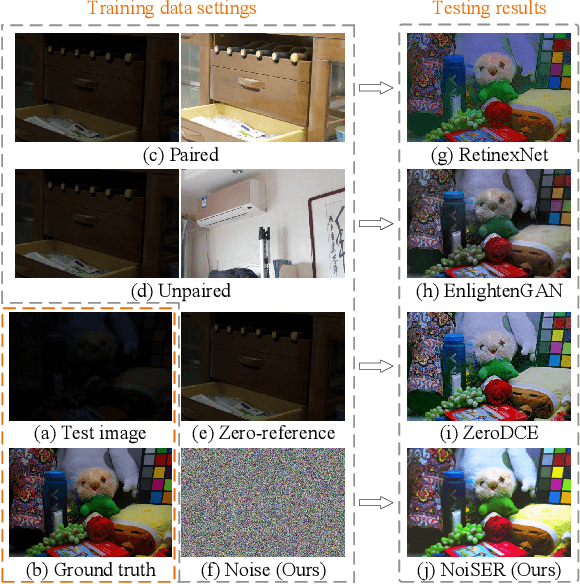
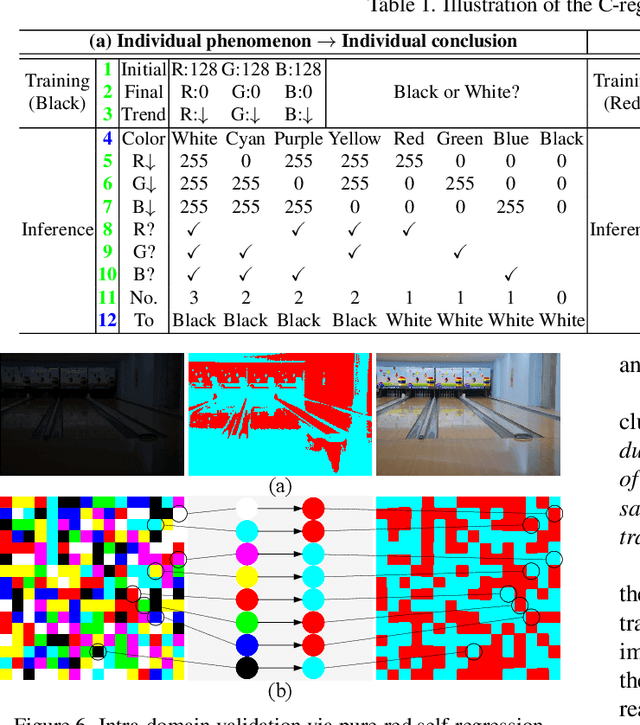
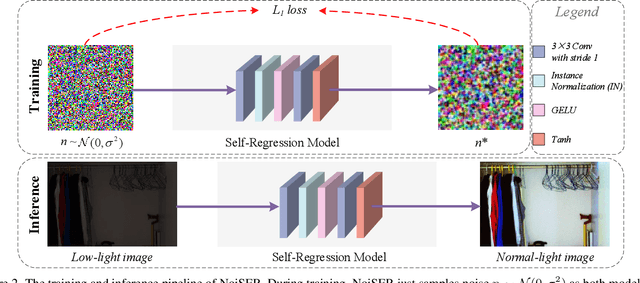
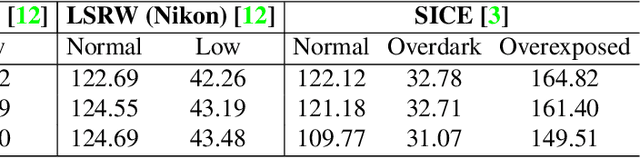
This paper is about an extraordinary phenomenon. Suppose we don't use any low-light images as training data, can we enhance a low-light image by deep learning? Obviously, current methods cannot do this, since deep neural networks require to train their scads of parameters using copious amounts of training data, especially task-related data. In this paper, we show that in the context of fundamental deep learning, it is possible to enhance a low-light image without any task-related training data. Technically, we propose a new, magical, effective and efficient method, termed \underline{Noi}se \underline{SE}lf-\underline{R}egression (NoiSER), which learns a gray-world mapping from Gaussian distribution for low-light image enhancement (LLIE). Specifically, a self-regression model is built as a carrier to learn a gray-world mapping during training, which is performed by simply iteratively feeding random noise. During inference, a low-light image is directly fed into the learned mapping to yield a normal-light one. Extensive experiments show that our NoiSER is highly competitive to current task-related data based LLIE models in terms of quantitative and visual results, while outperforming them in terms of the number of parameters, training time and inference speed. With only about 1K parameters, NoiSER realizes about 1 minute for training and 1.2 ms for inference with 600$\times$400 resolution on RTX 2080 Ti. Besides, NoiSER has an inborn automated exposure suppression capability and can automatically adjust too bright or too dark, without additional manipulations.