 Add to Chrome
 Add to Firefox
 Add to Edge
FDR-Occ: Factorized Dense Routing for Full-Spectrum 3D Occupancy Prediction
Jul 04, 2026
Vision-based 3D occupancy prediction fundamentally relies on the 2D-to-3D view transformation. Current paradigms predominantly utilize explicit physical projection, which artificially restricts the routing matrix to strict, sparse camera rays. While computationally efficient, this imposes a severe Locality Bottleneck, preventing the network from constructing holistic contextual understanding and degrading sharply when camera extrinsics are unreliable or absent. To break this bottleneck, we abstract view transformation as unconstrained bipartite routing and propose Factorized Dense Routing (FDR). By approximating dense 2D-to-3D mixing through hierarchical tensor contractions, FDR guarantees a fully-global receptive field with tractable, sub-quadratic complexity. Crucially, the mandatory spatial contraction in dense routing exposes a fundamental Resolution-Context Trade-off. To address this, we introduce a Resolution-Context Decoupled Architecture. We factorize the 3D space into a global macroscopic topological anchor (via FDR) and precise local geometric planes (via explicit projection). This decoupling enables global semantic inference and exact surface localization to complement each other without mutual compromise. Extensive experiments demonstrate that our framework achieves state-of-the-art performance on the Occ3D-nuScenes and Occ3D-Waymo benchmarks. More notably, in an uncalibrated setting where physical extrinsics are withheld, our global routing internalizes the implicit multi-camera rig topology and exhibits substantially stronger structural robustness than physical-projection baselines under the same protocol.

CausalDrive: Real-time Causal World Models for Autonomous Driving
Jun 13, 2026World models have emerged as a promising paradigm for scaling autonomous driving (AD) data, yet existing video generative models fall short as interactive simulators. Layout-conditioned renderers rely on "oracle" future trajectories of all background agents, rendering them strictly non-reactive. Conversely, pure action-conditioned predictors lack semantic control over complex interactions and suffer from prohibitive diffusion latencies, hindering closed-loop policy learning. To bridge this gap, we present CausalDrive, a controllable, real-time foundation driving world renderer. CausalDrive operates solely on the initial front-view frame, the ego-vehicle's trajectory, and a macroscopic text prompt. By excluding future NPC layouts, we compel the model to intrinsically predict causal interactions, enabling text-driven control over Driving Sociology, allowing users to dynamically orchestrate diverse counterfactual reactions to identical ego-actions. To overcome the efficiency bottleneck and address the covariate shift in autoregressive generation, we propose a novel Context-Forced DMD architecture. This combines continuous flow-matching with a self-correcting distillation objective, achieving interactive speeds of 12 FPS. This breakthrough transforms the passive video generator into a playable neural simulator. We demonstrate its versatility across three downstream applications: (1) generative closed-loop evaluation with significantly mitigated collision artifacts, (2) large-scale Reinforcement Learning (RL) post-training driven by a Video2Reward module, and (3) real-time human-in-the-loop simulation. Extensive experiments validate that policies trained within CausalDrive's reactive scenarios exhibit superior interaction capabilities in the real world.
LoViF 2026 The First Challenge on Holistic Quality Assessment for 4D World Model (PhyScore)
May 06, 2026This paper reports on the LoViF 2026 PhyScore challenge, a competition on holistic quality assessment of world-model-generated videos across both 2D and 4D generation settings. The challenge is motivated by a central gap in current evaluation practice: perceptual quality alone is insufficient to judge whether generated dynamics are physically plausible, temporally coherent, and consistent with input conditions. Participants are required to build a metric that jointly predicts four dimensions, i.e., Video Quality, Physical Realism, Condition-Video Alignment, and Temporal Consistency. Depart from that, participants also need to localize physical anomaly timestamps for fine-grained diagnosis. The benchmark dataset contains 1,554 videos generated by seven representative world generative models, organized into three tracks (text-2D, image-to-4D, and video-to-4D) and spanning 26 categories. These categories explicitly cover physics-relevant scenarios, including dynamics, optics, and thermodynamics, together with diverse real-world and creative content. To ensure label reliability, scores and anomaly timestamps are produced through trained human annotation with an additional automated quality-control pass. Evaluation is based on both score prediction and anomaly localization, with a composite protocol that combines TimeStamp_IOU and SRCC/PLCC. This report summarizes the challenge design and provides method-level insights from submitted solutions.
OccDirector: Language-Guided Behavior and Interaction Generation in 4D Occupancy Space
Apr 24, 2026Generative world models increasingly rely on 4D occupancy for realistic autonomous driving simulation. However, existing generation frameworks depend on rigid geometric conditions (e.g., explicit trajectories) or simplistic attribute-level text, failing to orchestrate complex, sequential multi-agent interactions. To address this semantic-spatiotemporal gap, we propose OccDirector, a pioneering framework that generates 4D occupancy dynamics conditioned solely on natural language. Operating as a ``scenario director'', OccDirector maps natural language scripts into physically plausible voxel dynamics without requiring geometric priors. Technically, it employs a VLM-driven Spatio-Temporal MMDiT equipped with a history-prefix anchoring strategy to ensure long-horizon interaction consistency. Furthermore, we introduce OccInteract-85k, a novel dataset uniquely annotated with multi-level language instructions: ranging from static layouts to intricate multi-agent behaviors, alongside a novel VLM-based evaluation benchmark. Extensive experiments demonstrate that OccDirector achieves state-of-the-art generation quality and unprecedented instruction-following capabilities, successfully shifting the paradigm from appearance synthesis to language-driven behavior orchestration.
Multimodal Large Language Models for Multi-Subject In-Context Image Generation
Apr 08, 2026Recent advances in text-to-image (T2I) generation have enabled visually coherent image synthesis from descriptions, but generating images containing multiple given subjects remains challenging. As the number of reference identities increases, existing methods often suffer from subject missing and semantic drift. To address this problem, we propose MUSIC, the first MLLM specifically designed for \textbf{MU}lti-\textbf{S}ubject \textbf{I}n-\textbf{C}ontext image generation. To overcome the data scarcity, we introduce an automatic and scalable data generation pipeline that eliminates the need for manual annotation. Furthermore, we enhance the model's understanding of multi-subject semantic relationships through a vision chain-of-thought (CoT) mechanism, guiding step-by-step reasoning from subject images to semantics and generation. To mitigate identity entanglement and manage visual complexity, we develop a novel semantics-driven spatial layout planning method and demonstrate its test-time scalability. By incorporating complex subject images during training, we improve the model's capacity for chained reasoning. In addition, we curate MSIC, a new benchmark tailored for multi-subject in-context generation. Experimental results demonstrate that MUSIC significantly surpasses other methods in both multi- and single-subject scenarios.
Clinical Cognition Alignment for Gastrointestinal Diagnosis with Multimodal LLMs
Mar 21, 2026Multimodal Large Language Models (MLLMs) have demonstrated remarkable potential in medical image analysis. However, their application in gastrointestinal endoscopy is currently hindered by two critical limitations: the misalignment between general model reasoning and standardized clinical cognitive pathways, and the lack of causal association between visual features and diagnostic outcomes. In this paper, we propose a novel Clinical-Cognitive-Aligned (CogAlign) framework to address these challenges. First, we endow the model with rigorous clinical analytical capabilities by constructing the hierarchical clinical cognition dataset and employing Supervised Fine-Tuning (SFT). Unlike conventional approaches, this strategy internalizes the hierarchical diagnostic logic of experts, ranging from anatomical localization and morphological evaluation to microvascular analysis, directly into the model. Second, to eliminate visual bias, we provide a theoretical analysis demonstrating that standard supervised tuning inevitably converges to spurious background correlations. Guided by this insight, we propose a counterfactual-driven reinforcement learning strategy to enforce causal rectification. By generating counterfactual normal samples via lesion masking and optimizing through clinical-cognition-centric rewards, we constrain the model to strictly ground its diagnosis in causal lesion features. Extensive experiments demonstrate that our approach achieves State-of-the-Art (SoTA) performance across multiple benchmarks, significantly enhancing diagnostic accuracy in complex clinical scenarios. All source code and datasets will be made publicly available.
Towards Geometry-Aware and Motion-Guided Video Human Mesh Recovery
Jan 29, 2026Existing video-based 3D Human Mesh Recovery (HMR) methods often produce physically implausible results, stemming from their reliance on flawed intermediate 3D pose anchors and their inability to effectively model complex spatiotemporal dynamics. To overcome these deep-rooted architectural problems, we introduce HMRMamba, a new paradigm for HMR that pioneers the use of Structured State Space Models (SSMs) for their efficiency and long-range modeling prowess. Our framework is distinguished by two core contributions. First, the Geometry-Aware Lifting Module, featuring a novel dual-scan Mamba architecture, creates a robust foundation for reconstruction. It directly grounds the 2D-to-3D pose lifting process with geometric cues from image features, producing a highly reliable 3D pose sequence that serves as a stable anchor. Second, the Motion-guided Reconstruction Network leverages this anchor to explicitly process kinematic patterns over time. By injecting this crucial temporal awareness, it significantly enhances the final mesh's coherence and robustness, particularly under occlusion and motion blur. Comprehensive evaluations on 3DPW, MPI-INF-3DHP, and Human3.6M benchmarks confirm that HMRMamba sets a new state-of-the-art, outperforming existing methods in both reconstruction accuracy and temporal consistency while offering superior computational efficiency.
From Human Intention to Action Prediction: A Comprehensive Benchmark for Intention-driven End-to-End Autonomous Driving
Dec 13, 2025Current end-to-end autonomous driving systems operate at a level of intelligence akin to following simple steering commands. However, achieving genuinely intelligent autonomy requires a paradigm shift: moving from merely executing low-level instructions to understanding and fulfilling high-level, abstract human intentions. This leap from a command-follower to an intention-fulfiller, as illustrated in our conceptual framework, is hindered by a fundamental challenge: the absence of a standardized benchmark to measure and drive progress on this complex task. To address this critical gap, we introduce Intention-Drive, the first comprehensive benchmark designed to evaluate the ability to translate high-level human intent into safe and precise driving actions. Intention-Drive features two core contributions: (1) a new dataset of complex scenarios paired with corresponding natural language intentions, and (2) a novel evaluation protocol centered on the Intent Success Rate (ISR), which assesses the semantic fulfillment of the human's goal beyond simple geometric accuracy. Through an extensive evaluation of a spectrum of baseline models on Intention-Drive, we reveal a significant performance deficit, showing that the baseline model struggle to achieve the comprehensive scene and intention understanding required for this advanced task.
Semantic Causality-Aware Vision-Based 3D Occupancy Prediction
Sep 10, 2025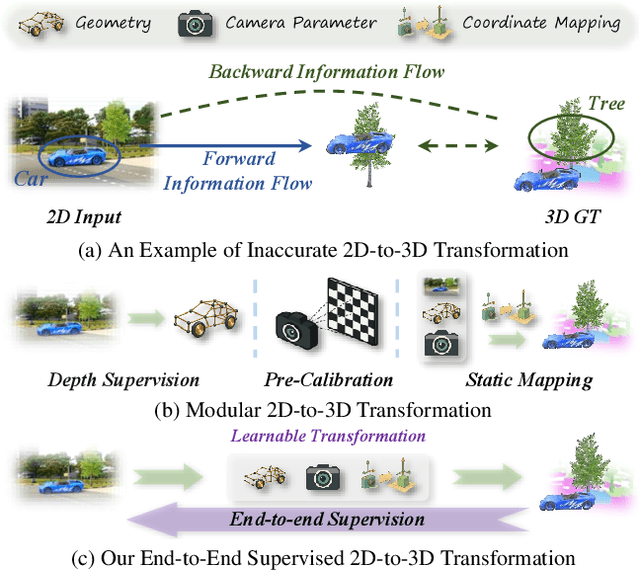
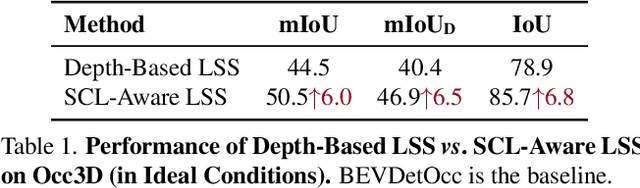
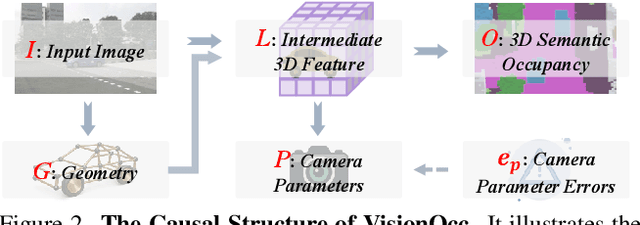
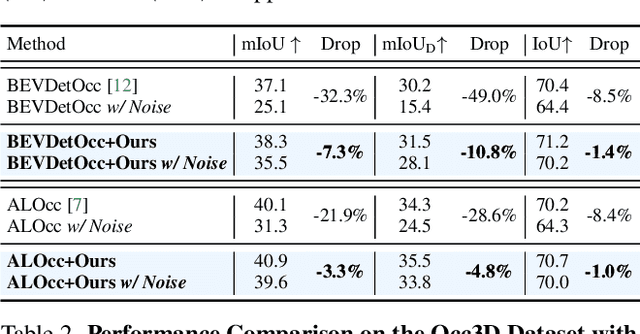
Vision-based 3D semantic occupancy prediction is a critical task in 3D vision that integrates volumetric 3D reconstruction with semantic understanding. Existing methods, however, often rely on modular pipelines. These modules are typically optimized independently or use pre-configured inputs, leading to cascading errors. In this paper, we address this limitation by designing a novel causal loss that enables holistic, end-to-end supervision of the modular 2D-to-3D transformation pipeline. Grounded in the principle of 2D-to-3D semantic causality, this loss regulates the gradient flow from 3D voxel representations back to the 2D features. Consequently, it renders the entire pipeline differentiable, unifying the learning process and making previously non-trainable components fully learnable. Building on this principle, we propose the Semantic Causality-Aware 2D-to-3D Transformation, which comprises three components guided by our causal loss: Channel-Grouped Lifting for adaptive semantic mapping, Learnable Camera Offsets for enhanced robustness against camera perturbations, and Normalized Convolution for effective feature propagation. Extensive experiments demonstrate that our method achieves state-of-the-art performance on the Occ3D benchmark, demonstrating significant robustness to camera perturbations and improved 2D-to-3D semantic consistency.
Geometry-aware Temporal Aggregation Network for Monocular 3D Lane Detection
Apr 29, 2025Monocular 3D lane detection aims to estimate 3D position of lanes from frontal-view (FV) images. However, current monocular 3D lane detection methods suffer from two limitations, including inaccurate geometric information of the predicted 3D lanes and difficulties in maintaining lane integrity. To address these issues, we seek to fully exploit the potential of multiple input frames. First, we aim at enhancing the ability to perceive the geometry of scenes by leveraging temporal geometric consistency. Second, we strive to improve the integrity of lanes by revealing more instance information from temporal sequences. Therefore, we propose a novel Geometry-aware Temporal Aggregation Network (GTA-Net) for monocular 3D lane detection. On one hand, we develop the Temporal Geometry Enhancement Module (TGEM), which exploits geometric consistency across successive frames, facilitating effective geometry perception. On the other hand, we present the Temporal Instance-aware Query Generation (TIQG), which strategically incorporates temporal cues into query generation, thereby enabling the exploration of comprehensive instance information. Experiments demonstrate that our GTA-Net achieves SoTA results, surpassing existing monocular 3D lane detection solutions.