 Add to Chrome
 Add to Firefox
 Add to Edge
PIIGuard: Mitigating PII Harvesting under Adversarial Sanitization
May 04, 2026
Browsing-enabled LLM assistants can fetch webpages and answer contact-seeking queries, creating a practical channel for scraping contact-style personally identifiable information (PII) from public pages. Many prior defenses are deployed at the model, service, or agent layer rather than at the webpage itself, leaving ordinary page owners with limited deployable options. We present PIIGuard, a webpage-level defense that repurposes indirect prompt injection as a protective mechanism: the page owner embeds optimized hidden HTML fragments that steer the model away from verbatim or reconstructible disclosure of contact PII. PIIGuard searches over fragment text and insertion position using rule-based leakage scoring, evolutionary mutation, and final judge-based recoverability assessment. In direct-HTML evaluation on three target models (GPT-5.4-nano, Claude-haiku-4.5, and DeepSeek-chat(latest v3.2)), PIIGuard achieves at least 97.0% defense success rate under both rule-based and judge-based leakage evaluation, often reaching 100.0%, while preserving benign same-page QA utility. We further evaluate two harder settings: public-URL browsing and attacker-side LLM sanitization of fetched webpage. These results show that page-side defensive fragments can remain effective in deployment for some model-position pairs, but robustness varies substantially across browsing interfaces and sanitizer prompts. Overall, PIIGuard demonstrates that page owners can use page-side fragments as a practical mitigation for web-grounded PII leakage.

SMARTFinRAG: Interactive Modularized Financial RAG Benchmark
Apr 25, 2025Financial sectors are rapidly adopting language model technologies, yet evaluating specialized RAG systems in this domain remains challenging. This paper introduces SMARTFinRAG, addressing three critical gaps in financial RAG assessment: (1) a fully modular architecture where components can be dynamically interchanged during runtime; (2) a document-centric evaluation paradigm generating domain-specific QA pairs from newly ingested financial documents; and (3) an intuitive interface bridging research-implementation divides. Our evaluation quantifies both retrieval efficacy and response quality, revealing significant performance variations across configurations. The platform's open-source architecture supports transparent, reproducible research while addressing practical deployment challenges faced by financial institutions implementing RAG systems.
MobileAgentBench: An Efficient and User-Friendly Benchmark for Mobile LLM Agents
Jun 12, 2024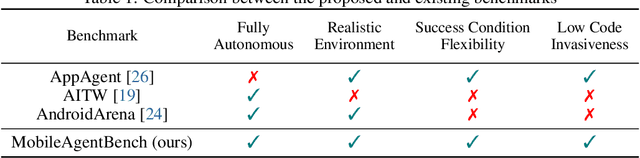
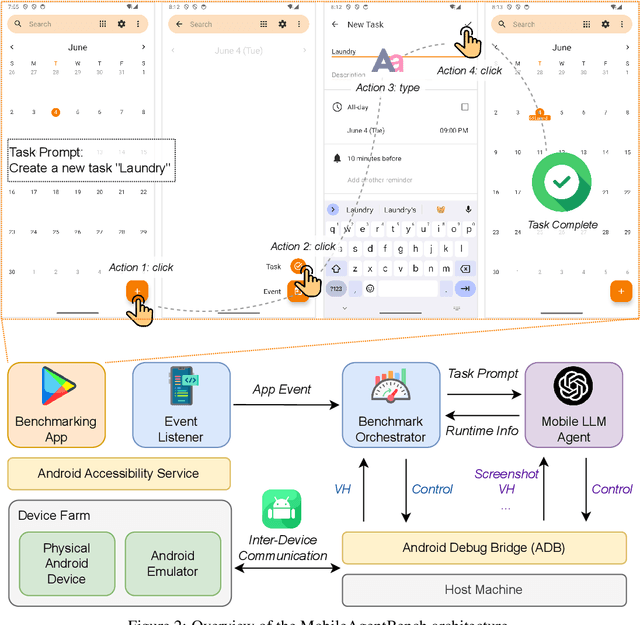
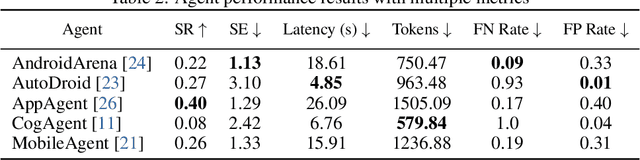
Large language model (LLM)-based mobile agents are increasingly popular due to their capability to interact directly with mobile phone Graphic User Interfaces (GUIs) and their potential to autonomously manage daily tasks. Despite their promising prospects in both academic and industrial sectors, little research has focused on benchmarking the performance of existing mobile agents, due to the inexhaustible states of apps and the vague definition of feasible action sequences. To address this challenge, we propose an efficient and user-friendly benchmark, MobileAgentBench, designed to alleviate the burden of extensive manual testing. We initially define 100 tasks across 10 open-source apps, categorized by multiple levels of difficulty. Subsequently, we evaluate several existing mobile agents, including AppAgent and MobileAgent, to thoroughly and systematically compare their performance. All materials are accessible on our project webpage: https://MobileAgentBench.github.io, contributing to the advancement of both academic and industrial fields.