 Add to Chrome
 Add to Firefox
 Add to Edge
WavFlow: Audio Generation in Waveform Space
May 18, 2026
Modern audio generation predominantly relies on latent-space compression, introducing additional complexity and potential information loss. In this work, we challenge this paradigm with WavFlow, a framework that generates high-fidelity audio directly in raw waveform space without intermediate representations. To overcome the inherent difficulties of modeling high-dimensional and low-energy signals, we reshape audio into 2D token grids through waveform patchify and introduce amplitude lifting to align signal scales, enabling stable optimization via direct x-prediction in flow matching. To capture complex semantic alignment and temporal synchronization, we leverage an automated data pipeline to curate 5 million high-quality video-text-audio triplets, allowing the model to learn fine-grained acoustic patterns from scratch. Experimental results show that WavFlow achieves competitive performance on the video-to-audio benchmark VGGSound (FD_PaSST: 59.98, IS_PANNs: 17.40, DeSync: 0.44) and the text-to-audio benchmark AudioCaps (FD_PANNs: 10.63, IS_PANNs: 12.62), matching or exceeding the performance of established latent-based methods. Our work demonstrates that intermediate compression is not a prerequisite for high-quality synthesis, offering a simpler and more scalable alternative for multimodal audio generation.

MobileAgentBench: An Efficient and User-Friendly Benchmark for Mobile LLM Agents
Jun 12, 2024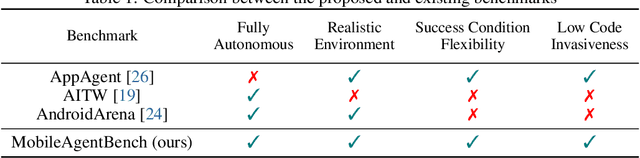
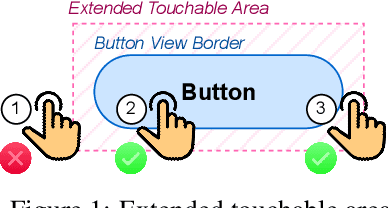
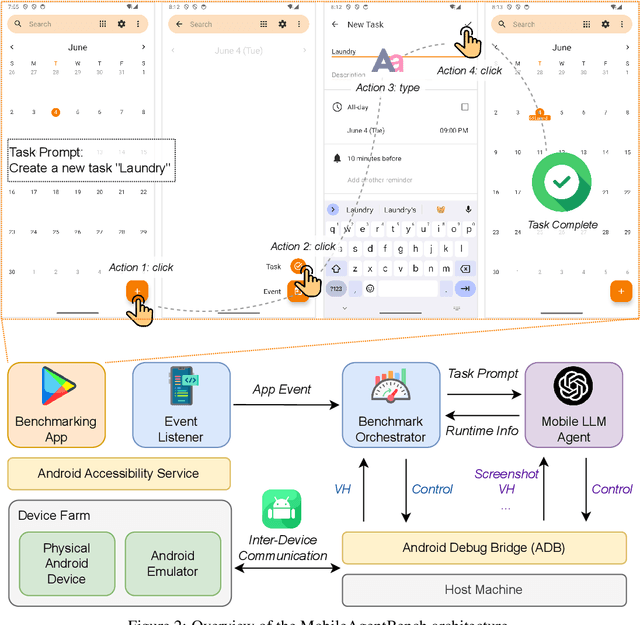
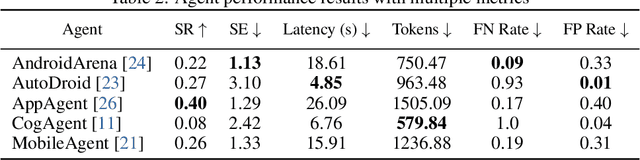
Large language model (LLM)-based mobile agents are increasingly popular due to their capability to interact directly with mobile phone Graphic User Interfaces (GUIs) and their potential to autonomously manage daily tasks. Despite their promising prospects in both academic and industrial sectors, little research has focused on benchmarking the performance of existing mobile agents, due to the inexhaustible states of apps and the vague definition of feasible action sequences. To address this challenge, we propose an efficient and user-friendly benchmark, MobileAgentBench, designed to alleviate the burden of extensive manual testing. We initially define 100 tasks across 10 open-source apps, categorized by multiple levels of difficulty. Subsequently, we evaluate several existing mobile agents, including AppAgent and MobileAgent, to thoroughly and systematically compare their performance. All materials are accessible on our project webpage: https://MobileAgentBench.github.io, contributing to the advancement of both academic and industrial fields.
Enhancing the Authenticity of Rendered Portraits with Identity-Consistent Transfer Learning
Oct 06, 2023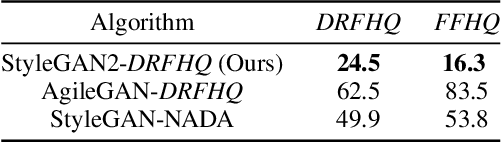
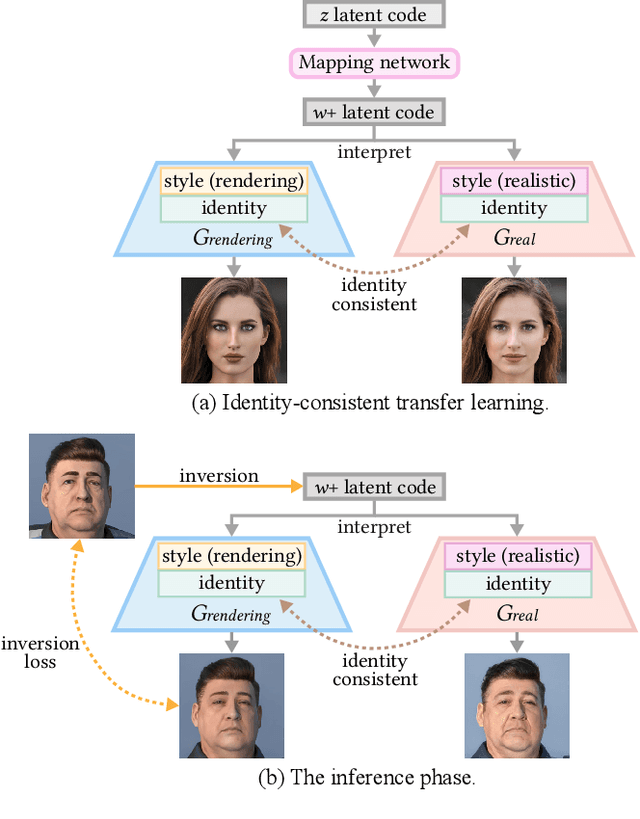
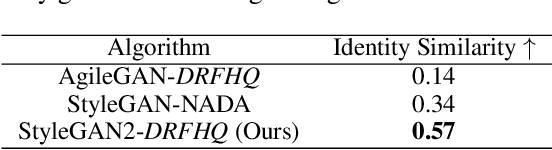
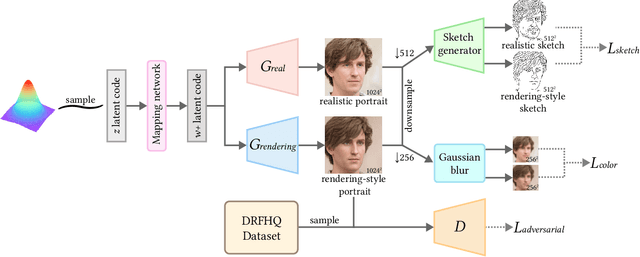
Despite rapid advances in computer graphics, creating high-quality photo-realistic virtual portraits is prohibitively expensive. Furthermore, the well-know ''uncanny valley'' effect in rendered portraits has a significant impact on the user experience, especially when the depiction closely resembles a human likeness, where any minor artifacts can evoke feelings of eeriness and repulsiveness. In this paper, we present a novel photo-realistic portrait generation framework that can effectively mitigate the ''uncanny valley'' effect and improve the overall authenticity of rendered portraits. Our key idea is to employ transfer learning to learn an identity-consistent mapping from the latent space of rendered portraits to that of real portraits. During the inference stage, the input portrait of an avatar can be directly transferred to a realistic portrait by changing its appearance style while maintaining the facial identity. To this end, we collect a new dataset, Daz-Rendered-Faces-HQ (DRFHQ), that is specifically designed for rendering-style portraits. We leverage this dataset to fine-tune the StyleGAN2 generator, using our carefully crafted framework, which helps to preserve the geometric and color features relevant to facial identity. We evaluate our framework using portraits with diverse gender, age, and race variations. Qualitative and quantitative evaluations and ablation studies show the advantages of our method compared to state-of-the-art approaches.