 Add to Chrome
 Add to Firefox
 Add to Edge
NaijaSenti: A Nigerian Twitter Sentiment Corpus for Multilingual Sentiment Analysis
Jan 28, 2022
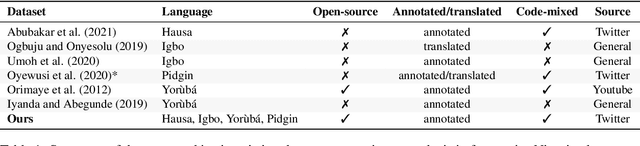
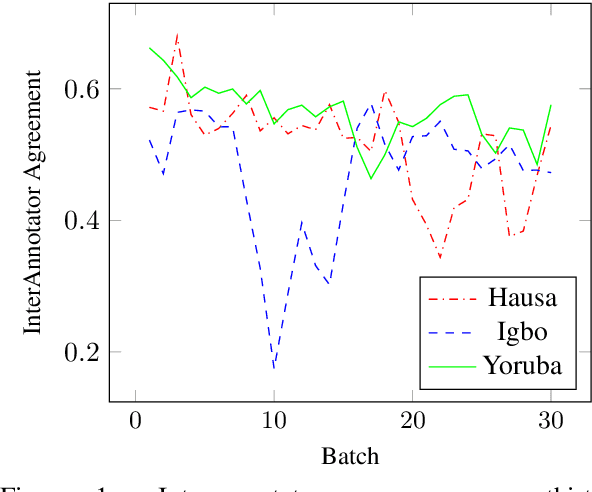
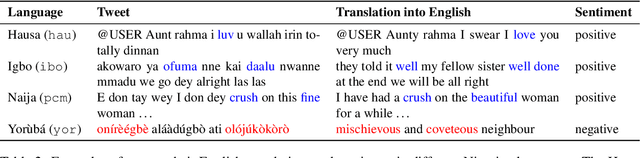
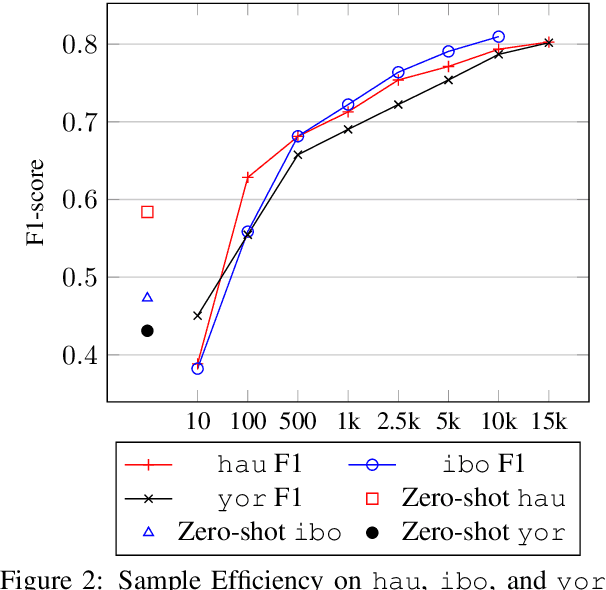
Sentiment analysis is one of the most widely studied applications in NLP, but most work focuses on languages with large amounts of data. We introduce the first large-scale human-annotated Twitter sentiment dataset for the four most widely spoken languages in Nigeria (Hausa, Igbo, Nigerian-Pidgin, and Yor\`ub\'a ) consisting of around 30,000 annotated tweets per language (and 14,000 for Nigerian-Pidgin), including a significant fraction of code-mixed tweets. We propose text collection, filtering, processing and labeling methods that enable us to create datasets for these low-resource languages. We evaluate a rangeof pre-trained models and transfer strategies on the dataset. We find that language-specific models and language-adaptivefine-tuning generally perform best. We release the datasets, trained models, sentiment lexicons, and code to incentivizeresearch on sentiment analysis in under-represented languages.

NL-Augmenter: A Framework for Task-Sensitive Natural Language Augmentation
Dec 06, 2021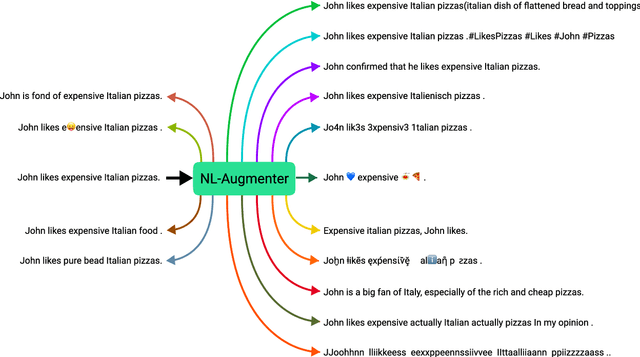
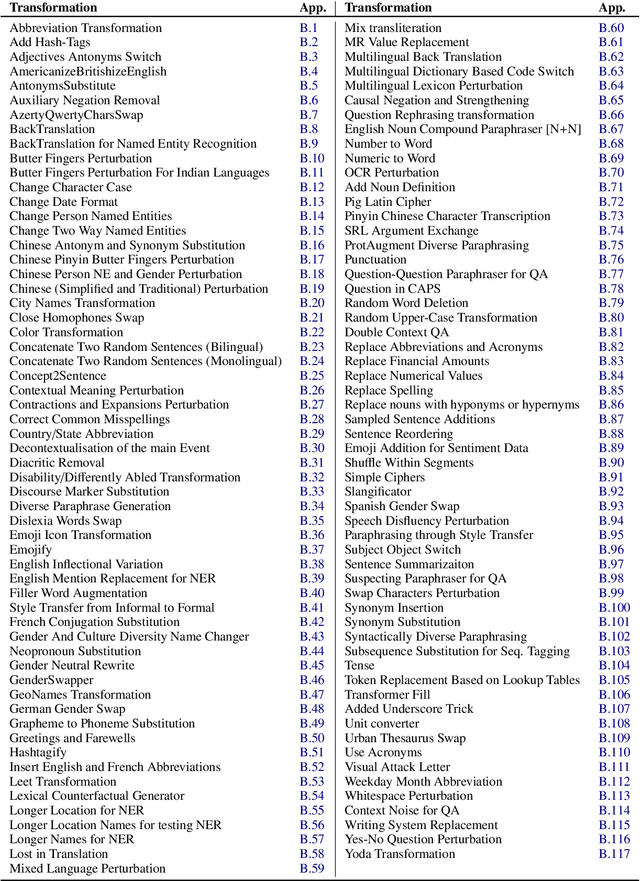
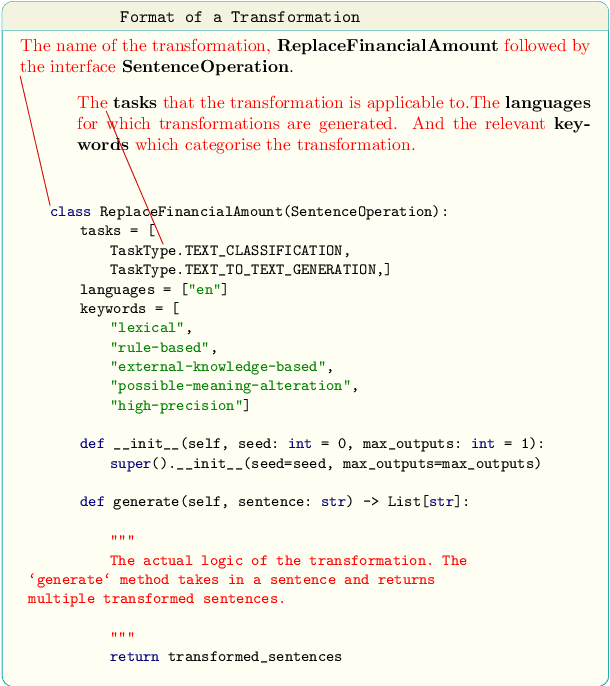
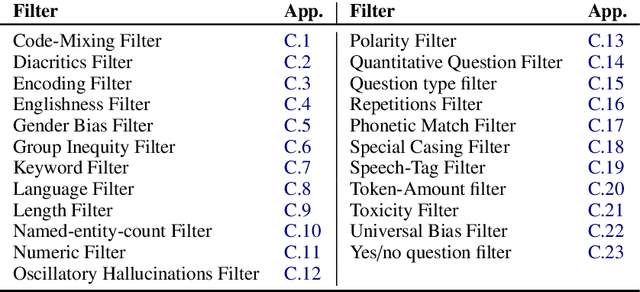
Data augmentation is an important component in the robustness evaluation of models in natural language processing (NLP) and in enhancing the diversity of the data they are trained on. In this paper, we present NL-Augmenter, a new participatory Python-based natural language augmentation framework which supports the creation of both transformations (modifications to the data) and filters (data splits according to specific features). We describe the framework and an initial set of 117 transformations and 23 filters for a variety of natural language tasks. We demonstrate the efficacy of NL-Augmenter by using several of its transformations to analyze the robustness of popular natural language models. The infrastructure, datacards and robustness analysis results are available publicly on the NL-Augmenter repository (\url{https://github.com/GEM-benchmark/NL-Augmenter}).
ExT5: Towards Extreme Multi-Task Scaling for Transfer Learning
Nov 22, 2021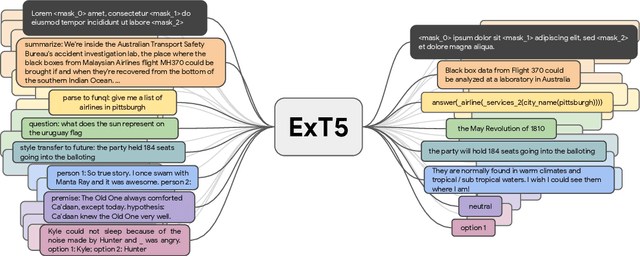
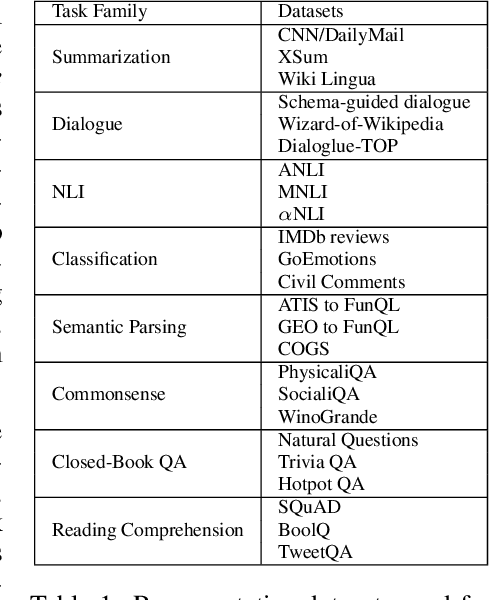
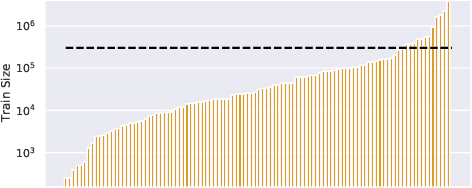
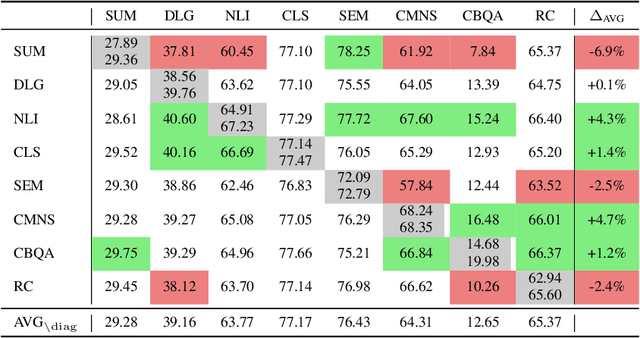
Despite the recent success of multi-task learning and transfer learning for natural language processing (NLP), few works have systematically studied the effect of scaling up the number of tasks during pre-training. Towards this goal, this paper introduces ExMix (Extreme Mixture): a massive collection of 107 supervised NLP tasks across diverse domains and task-families. Using ExMix, we study the effect of multi-task pre-training at the largest scale to date, and analyze co-training transfer amongst common families of tasks. Through this analysis, we show that manually curating an ideal set of tasks for multi-task pre-training is not straightforward, and that multi-task scaling can vastly improve models on its own. Finally, we propose ExT5: a model pre-trained using a multi-task objective of self-supervised span denoising and supervised ExMix. Via extensive experiments, we show that ExT5 outperforms strong T5 baselines on SuperGLUE, GEM, Rainbow, Closed-Book QA tasks, and several tasks outside of ExMix. ExT5 also significantly improves sample efficiency while pre-training.
Balancing Average and Worst-case Accuracy in Multitask Learning
Oct 12, 2021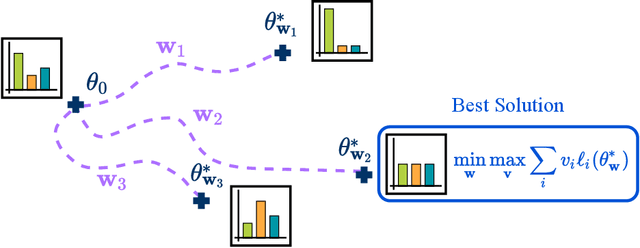
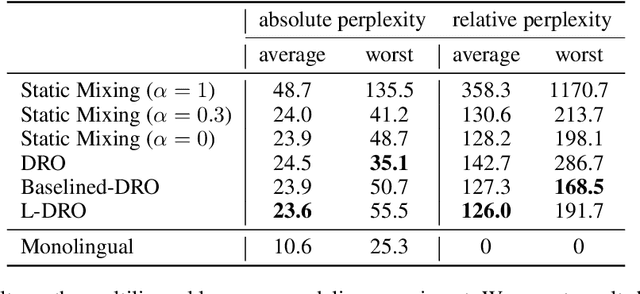
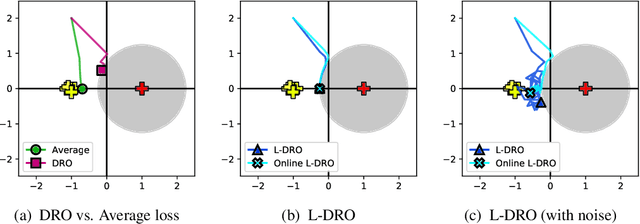
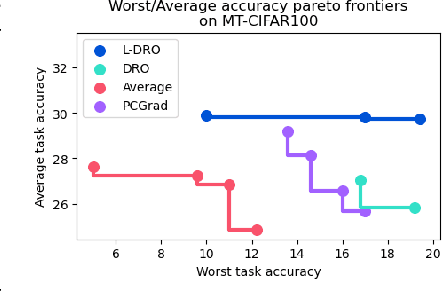
When training and evaluating machine learning models on a large number of tasks, it is important to not only look at average task accuracy -- which may be biased by easy or redundant tasks -- but also worst-case accuracy (i.e. the performance on the task with the lowest accuracy). In this work, we show how to use techniques from the distributionally robust optimization (DRO) literature to improve worst-case performance in multitask learning. We highlight several failure cases of DRO when applied off-the-shelf and present an improved method, Lookahead-DRO (L-DRO), which mitigates these issues. The core idea of L-DRO is to anticipate the interaction between tasks during training in order to choose a dynamic re-weighting of the various task losses, which will (i) lead to minimal worst-case loss and (ii) train on as many tasks as possible. After demonstrating the efficacy of L-DRO on a small controlled synthetic setting, we evaluate it on two realistic benchmarks: a multitask version of the CIFAR-100 image classification dataset and a large-scale multilingual language modeling experiment. Our empirical results show that L-DRO achieves a better trade-off between average and worst-case accuracy with little computational overhead compared to several strong baselines.
FewNLU: Benchmarking State-of-the-Art Methods for Few-Shot Natural Language Understanding
Sep 27, 2021
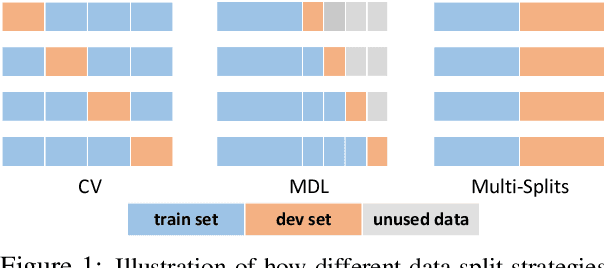
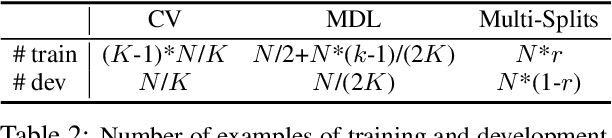
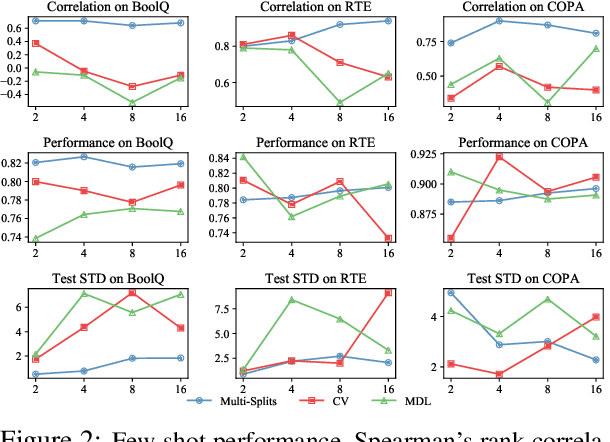
The few-shot natural language understanding (NLU) task has attracted much recent attention. However, prior methods have been evaluated under a disparate set of protocols, which hinders fair comparison and measuring progress of the field. To address this issue, we introduce an evaluation framework that improves previous evaluation procedures in three key aspects, i.e., test performance, dev-test correlation, and stability. Under this new evaluation framework, we re-evaluate several state-of-the-art few-shot methods for NLU tasks. Our framework reveals new insights: (1) both the absolute performance and relative gap of the methods were not accurately estimated in prior literature; (2) no single method dominates most tasks with consistent performance; (3) improvements of some methods diminish with a larger pretrained model; and (4) gains from different methods are often complementary and the best combined model performs close to a strong fully-supervised baseline. We open-source our toolkit, FewNLU, that implements our evaluation framework along with a number of state-of-the-art methods.
Efficient Test Time Adapter Ensembling for Low-resource Language Varieties
Sep 10, 2021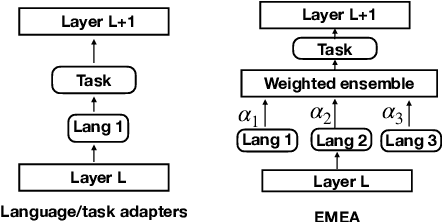
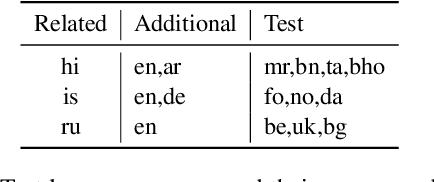
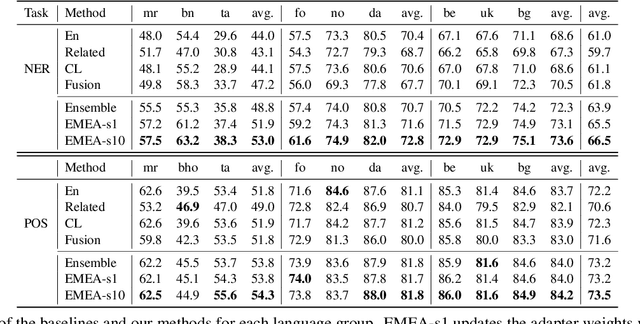
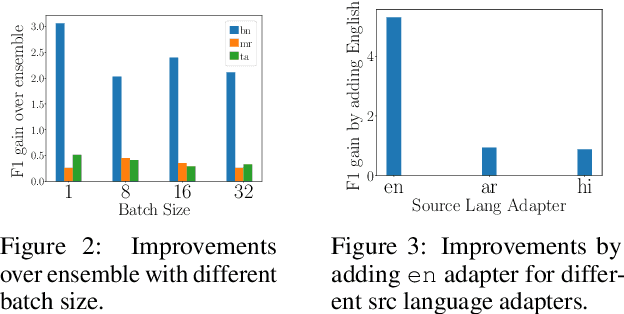
Adapters are light-weight modules that allow parameter-efficient fine-tuning of pretrained models. Specialized language and task adapters have recently been proposed to facilitate cross-lingual transfer of multilingual pretrained models (Pfeiffer et al., 2020b). However, this approach requires training a separate language adapter for every language one wishes to support, which can be impractical for languages with limited data. An intuitive solution is to use a related language adapter for the new language variety, but we observe that this solution can lead to sub-optimal performance. In this paper, we aim to improve the robustness of language adapters to uncovered languages without training new adapters. We find that ensembling multiple existing language adapters makes the fine-tuned model significantly more robust to other language varieties not included in these adapters. Building upon this observation, we propose Entropy Minimized Ensemble of Adapters (EMEA), a method that optimizes the ensemble weights of the pretrained language adapters for each test sentence by minimizing the entropy of its predictions. Experiments on three diverse groups of language varieties show that our method leads to significant improvements on both named entity recognition and part-of-speech tagging across all languages.
Charformer: Fast Character Transformers via Gradient-based Subword Tokenization
Jul 02, 2021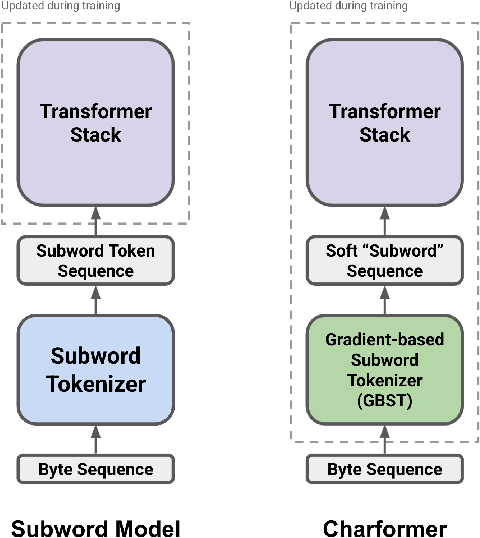
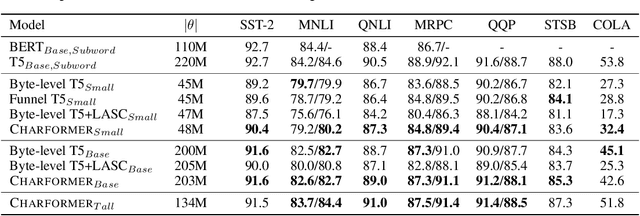
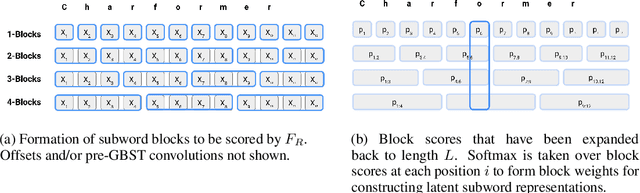
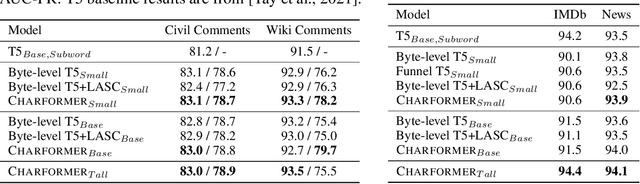
State-of-the-art models in natural language processing rely on separate rigid subword tokenization algorithms, which limit their generalization ability and adaptation to new settings. In this paper, we propose a new model inductive bias that learns a subword tokenization end-to-end as part of the model. To this end, we introduce a soft gradient-based subword tokenization module (GBST) that automatically learns latent subword representations from characters in a data-driven fashion. Concretely, GBST enumerates candidate subword blocks and learns to score them in a position-wise fashion using a block scoring network. We additionally introduce Charformer, a deep Transformer model that integrates GBST and operates on the byte level. Via extensive experiments on English GLUE, multilingual, and noisy text datasets, we show that Charformer outperforms a series of competitive byte-level baselines while generally performing on par and sometimes outperforming subword-based models. Additionally, Charformer is fast, improving the speed of both vanilla byte-level and subword-level Transformers by 28%-100% while maintaining competitive quality. We believe this work paves the way for highly performant token-free models that are trained completely end-to-end.
Compacter: Efficient Low-Rank Hypercomplex Adapter Layers
Jun 08, 2021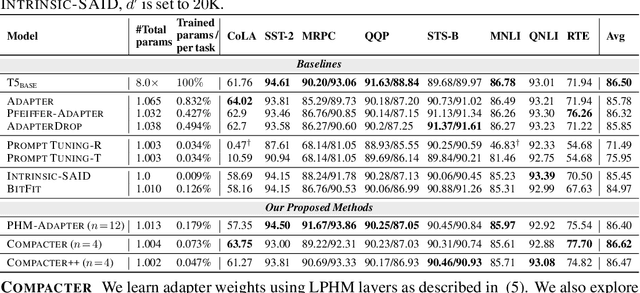
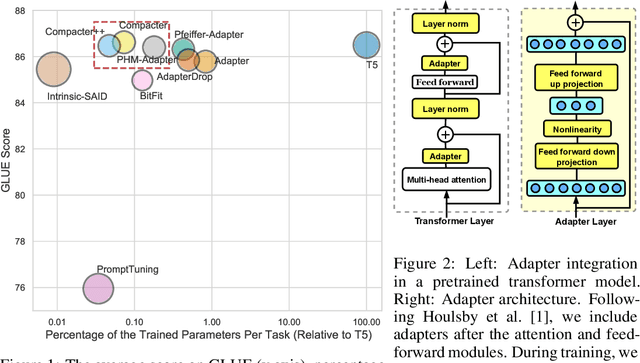
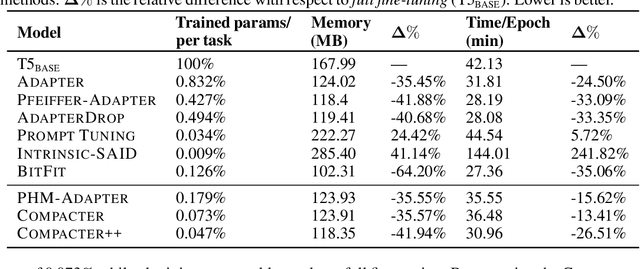
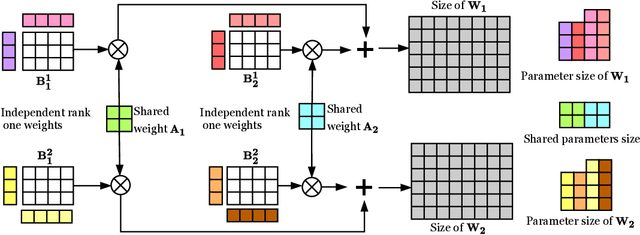
Adapting large-scale pretrained language models to downstream tasks via fine-tuning is the standard method for achieving state-of-the-art performance on NLP benchmarks. However, fine-tuning all weights of models with millions or billions of parameters is sample-inefficient, unstable in low-resource settings, and wasteful as it requires storing a separate copy of the model for each task. Recent work has developed parameter-efficient fine-tuning methods, but these approaches either still require a relatively large number of parameters or underperform standard fine-tuning. In this work, we propose Compacter, a method for fine-tuning large-scale language models with a better trade-off between task performance and the number of trainable parameters than prior work. Compacter accomplishes this by building on top of ideas from adapters, low-rank optimization, and parameterized hypercomplex multiplication layers. Specifically, Compacter inserts task-specific weight matrices into a pretrained model's weights, which are computed efficiently as a sum of Kronecker products between shared ``slow'' weights and ``fast'' rank-one matrices defined per Compacter layer. By only training 0.047% of a pretrained model's parameters, Compacter performs on par with standard fine-tuning on GLUE and outperforms fine-tuning in low-resource settings. Our code is publicly available in https://github.com/rabeehk/compacter/
Parameter-efficient Multi-task Fine-tuning for Transformers via Shared Hypernetworks
Jun 08, 2021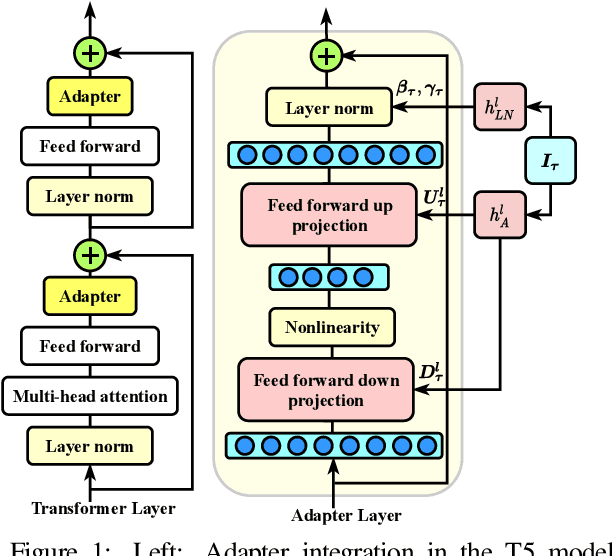
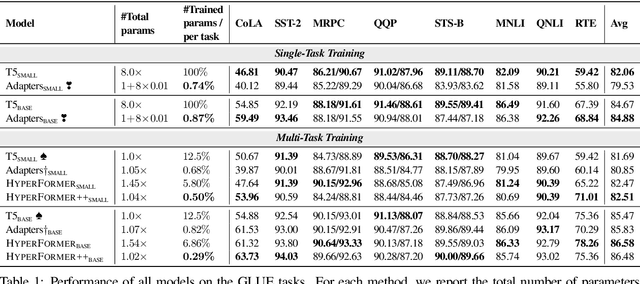
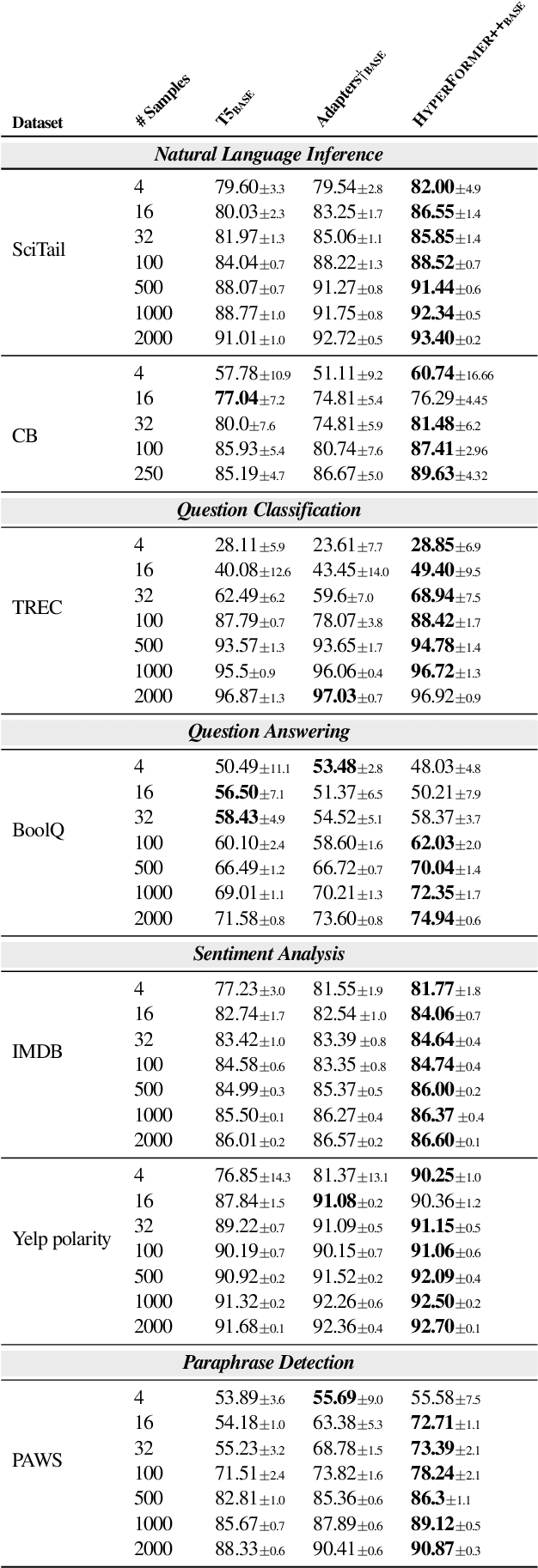
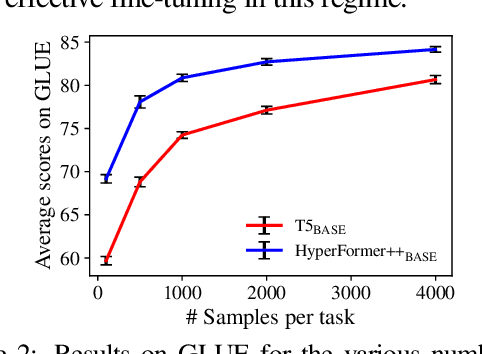
State-of-the-art parameter-efficient fine-tuning methods rely on introducing adapter modules between the layers of a pretrained language model. However, such modules are trained separately for each task and thus do not enable sharing information across tasks. In this paper, we show that we can learn adapter parameters for all layers and tasks by generating them using shared hypernetworks, which condition on task, adapter position, and layer id in a transformer model. This parameter-efficient multi-task learning framework allows us to achieve the best of both worlds by sharing knowledge across tasks via hypernetworks while enabling the model to adapt to each individual task through task-specific adapters. Experiments on the well-known GLUE benchmark show improved performance in multi-task learning while adding only 0.29% parameters per task. We additionally demonstrate substantial performance improvements in few-shot domain generalization across a variety of tasks. Our code is publicly available in https://github.com/rabeehk/hyperformer.
BERT memorisation and pitfalls in low-resource scenarios
Apr 16, 2021State-of-the-art pre-trained models have been shown to memorise facts and perform well with limited amounts of training data. To gain a better understanding of how these models learn, we study their generalisation and memorisation capabilities in noisy and low-resource scenarios. We find that the training of these models is almost unaffected by label noise and that it is possible to reach near-optimal performances even on extremely noisy datasets. Conversely, we also find that they completely fail when tested on low-resource tasks such as few-shot learning and rare entity recognition. To mitigate such limitations, we propose a novel architecture based on BERT and prototypical networks that improves performance in low-resource named entity recognition tasks.