 Add to Chrome
 Add to Firefox
 Add to Edge
AFRILANGTUTOR: Advancing Language Tutoring and Culture Education in Low-Resource Languages with Large Language Models
Apr 22, 2026
How can language learning systems be developed for languages that lack sufficient training resources? This challenge is increasingly faced by developers across the African continent who aim to build AI systems capable of understanding and responding in local languages. To address this gap, we introduce AFRILANGDICT, a collection of 194.7K African language-English dictionary entries designed as seed resources for generating language-learning materials, enabling us to automatically construct large-scale, diverse, and verifiable student-tutor question-answer interactions suitable for training AI-assisted language tutors. Using AFRILANGDICT, we build AFRILANGEDU, a dataset of 78.9K multi-turn training examples for Supervised Fine-Tuning (SFT) and Direct Preference Optimization (DPO). Using AFRILANGEDU, we train language tutoring models collectively referred to as AFRILANGTUTOR. We fine-tune two multilingual LLMs: Llama-3-8B-IT and Gemma-3-12B-IT on AFRILANGEDU across 10 African languages and evaluate their performance. Our results show that models trained on AFRILANGEDU consistently outperform their base counterparts, and combining SFT and DPO yields substantial improvements, with gains ranging from 1.8% to 15.5% under LLM-as-a-judge evaluations across four criteria. To facilitate further research on low-resource languages -- all resources are available at https://huggingface.co/afrilang-edu.

AfrIFact: Cultural Information Retrieval, Evidence Extraction and Fact Checking for African Languages
Apr 01, 2026Assessing the veracity of a claim made online is a complex and important task with real-world implications. When these claims are directed at communities with limited access to information and the content concerns issues such as healthcare and culture, the consequences intensify, especially in low-resource languages. In this work, we introduce AfrIFact, a dataset that covers the necessary steps for automatic fact-checking (i.e., information retrieval, evidence extraction, and fact checking), in ten African languages and English. Our evaluation results show that even the best embedding models lack cross-lingual retrieval capabilities, and that cultural and news documents are easier to retrieve than healthcare-domain documents, both in large corpora and in single documents. We show that LLMs lack robust multilingual fact-verification capabilities in African languages, while few-shot prompting improves performance by up to 43% in AfriqueQwen-14B, and task-specific fine-tuning further improves fact-checking accuracy by up to 26%. These findings, along with our release of the AfrIFact dataset, encourage work on low-resource information retrieval, evidence retrieval, and fact checking.
Ethio-ASR: Joint Multilingual Speech Recognition and Language Identification for Ethiopian Languages
Mar 24, 2026We present Ethio-ASR, a suite of multilingual CTC-based automatic speech recognition (ASR) models jointly trained on five Ethiopian languages: Amharic, Tigrinya, Oromo, Sidaama, and Wolaytta. These languages belong to the Semitic, Cushitic, and Omotic branches of the Afroasiatic family, and remain severely underrepresented in speech technology despite being spoken by the vast majority of Ethiopia's population. We train our models on the recently released WAXAL corpus using several pre-trained speech encoders and evaluate against strong multilingual baselines, including OmniASR. Our best model achieves an average WER of 30.48% on the WAXAL test set, outperforming the best OmniASR model with substantially fewer parameters. We further provide a comprehensive analysis of gender bias, the contribution of vowel length and consonant gemination to ASR errors, and the training dynamics of multilingual CTC models. Our models and codebase are publicly available to the research community.
AmharicStoryQA: A Multicultural Story Question Answering Benchmark in Amharic
Feb 02, 2026With the growing emphasis on multilingual and cultural evaluation benchmarks for large language models, language and culture are often treated as synonymous, and performance is commonly used as a proxy for a models understanding of a given language. In this work, we argue that such evaluations overlook meaningful cultural variation that exists within a single language. We address this gap by focusing on narratives from different regions of Ethiopia and demonstrate that, despite shared linguistic characteristics, region-specific and domain-specific content substantially influences language evaluation outcomes. To this end, we introduce \textbf{\textit{AmharicStoryQA}}, a long-sequence story question answering benchmark grounded in culturally diverse narratives from Amharic-speaking regions. Using this benchmark, we reveal a significant narrative understanding gap in existing LLMs, highlight pronounced regional differences in evaluation results, and show that supervised fine-tuning yields uneven improvements across regions and evaluation settings. Our findings emphasize the need for culturally grounded benchmarks that go beyond language-level evaluation to more accurately assess and improve narrative understanding in low-resource languages.
Afri-MCQA: Multimodal Cultural Question Answering for African Languages
Jan 09, 2026Africa is home to over one-third of the world's languages, yet remains underrepresented in AI research. We introduce Afri-MCQA, the first Multilingual Cultural Question-Answering benchmark covering 7.5k Q&A pairs across 15 African languages from 12 countries. The benchmark offers parallel English-African language Q&A pairs across text and speech modalities and was entirely created by native speakers. Benchmarking large language models (LLMs) on Afri-MCQA shows that open-weight models perform poorly across evaluated cultures, with near-zero accuracy on open-ended VQA when queried in native language or speech. To evaluate linguistic competence, we include control experiments meant to assess this specific aspect separate from cultural knowledge, and we observe significant performance gaps between native languages and English for both text and speech. These findings underscore the need for speech-first approaches, culturally grounded pretraining, and cross-lingual cultural transfer. To support more inclusive multimodal AI development in African languages, we release our Afri-MCQA under academic license or CC BY-NC 4.0 on HuggingFace (https://huggingface.co/datasets/Atnafu/Afri-MCQA)
Accept or Deny? Evaluating LLM Fairness and Performance in Loan Approval across Table-to-Text Serialization Approaches
Aug 29, 2025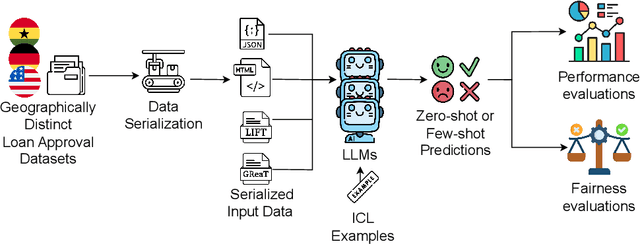
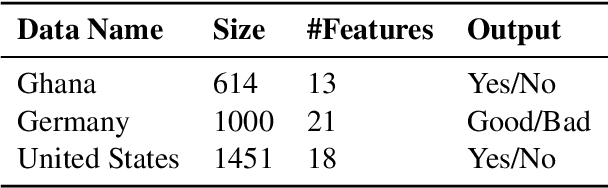
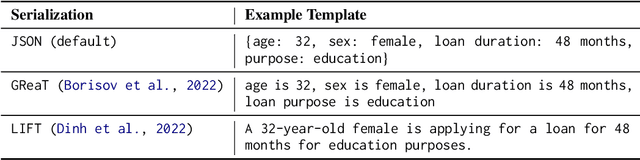
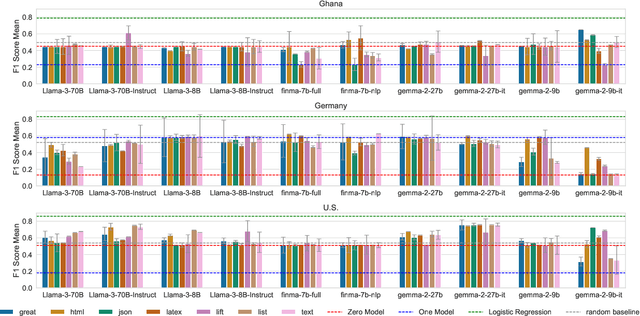
Large Language Models (LLMs) are increasingly employed in high-stakes decision-making tasks, such as loan approvals. While their applications expand across domains, LLMs struggle to process tabular data, ensuring fairness and delivering reliable predictions. In this work, we assess the performance and fairness of LLMs on serialized loan approval datasets from three geographically distinct regions: Ghana, Germany, and the United States. Our evaluation focuses on the model's zero-shot and in-context learning (ICL) capabilities. Our results reveal that the choice of serialization (Serialization refers to the process of converting tabular data into text formats suitable for processing by LLMs.) format significantly affects both performance and fairness in LLMs, with certain formats such as GReat and LIFT yielding higher F1 scores but exacerbating fairness disparities. Notably, while ICL improved model performance by 4.9-59.6% relative to zero-shot baselines, its effect on fairness varied considerably across datasets. Our work underscores the importance of effective tabular data representation methods and fairness-aware models to improve the reliability of LLMs in financial decision-making.
CaMMT: Benchmarking Culturally Aware Multimodal Machine Translation
May 30, 2025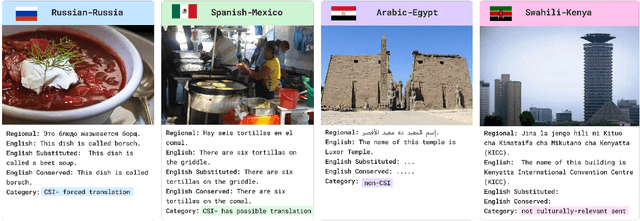
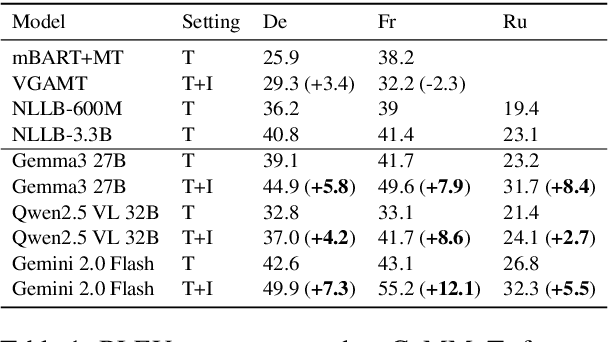
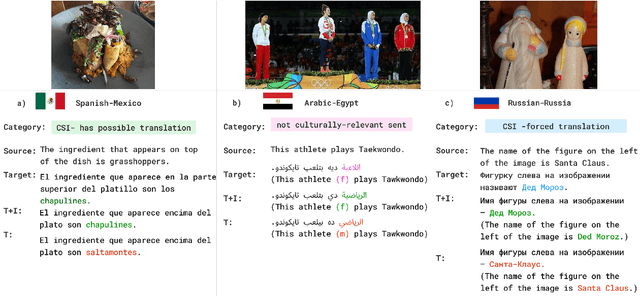
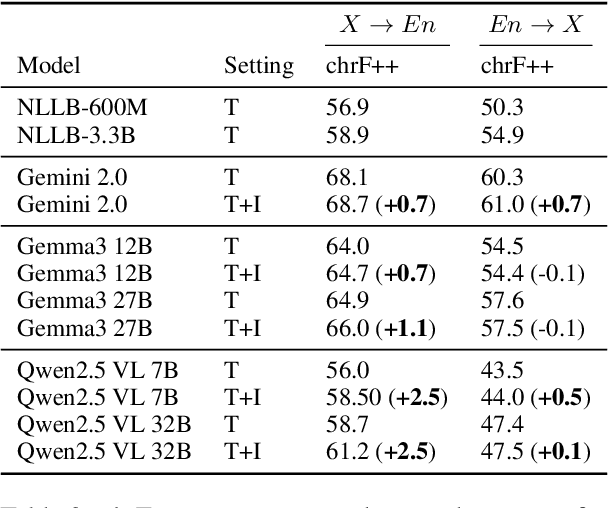
Cultural content poses challenges for machine translation systems due to the differences in conceptualizations between cultures, where language alone may fail to convey sufficient context to capture region-specific meanings. In this work, we investigate whether images can act as cultural context in multimodal translation. We introduce CaMMT, a human-curated benchmark of over 5,800 triples of images along with parallel captions in English and regional languages. Using this dataset, we evaluate five Vision Language Models (VLMs) in text-only and text+image settings. Through automatic and human evaluations, we find that visual context generally improves translation quality, especially in handling Culturally-Specific Items (CSIs), disambiguation, and correct gender usage. By releasing CaMMT, we aim to support broader efforts in building and evaluating multimodal translation systems that are better aligned with cultural nuance and regional variation.
AFRIDOC-MT: Document-level MT Corpus for African Languages
Jan 10, 2025

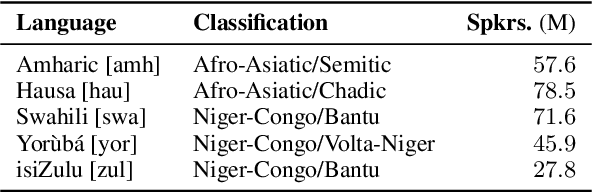

This paper introduces AFRIDOC-MT, a document-level multi-parallel translation dataset covering English and five African languages: Amharic, Hausa, Swahili, Yor\`ub\'a, and Zulu. The dataset comprises 334 health and 271 information technology news documents, all human-translated from English to these languages. We conduct document-level translation benchmark experiments by evaluating neural machine translation (NMT) models and large language models (LLMs) for translations between English and these languages, at both the sentence and pseudo-document levels. These outputs are realigned to form complete documents for evaluation. Our results indicate that NLLB-200 achieved the best average performance among the standard NMT models, while GPT-4o outperformed general-purpose LLMs. Fine-tuning selected models led to substantial performance gains, but models trained on sentences struggled to generalize effectively to longer documents. Furthermore, our analysis reveals that some LLMs exhibit issues such as under-generation, repetition of words or phrases, and off-target translations, especially for African languages.
Evaluating the Capabilities of Large Language Models for Multi-label Emotion Understanding
Dec 17, 2024Large Language Models (LLMs) show promising learning and reasoning abilities. Compared to other NLP tasks, multilingual and multi-label emotion evaluation tasks are under-explored in LLMs. In this paper, we present EthioEmo, a multi-label emotion classification dataset for four Ethiopian languages, namely, Amharic (amh), Afan Oromo (orm), Somali (som), and Tigrinya (tir). We perform extensive experiments with an additional English multi-label emotion dataset from SemEval 2018 Task 1. Our evaluation includes encoder-only, encoder-decoder, and decoder-only language models. We compare zero and few-shot approaches of LLMs to fine-tuning smaller language models. The results show that accurate multi-label emotion classification is still insufficient even for high-resource languages such as English, and there is a large gap between the performance of high-resource and low-resource languages. The results also show varying performance levels depending on the language and model type. EthioEmo is available publicly to further improve the understanding of emotions in language models and how people convey emotions through various languages.
Uhura: A Benchmark for Evaluating Scientific Question Answering and Truthfulness in Low-Resource African Languages
Dec 01, 2024
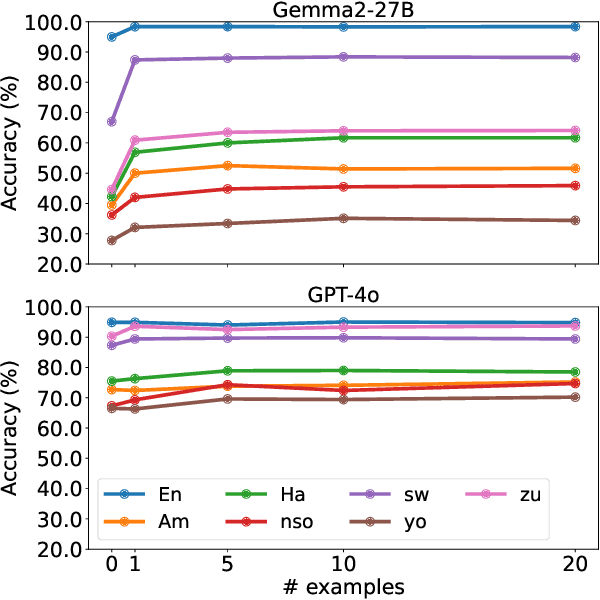
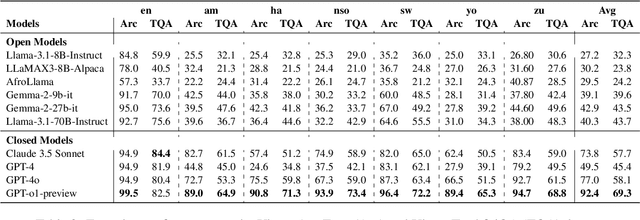

Evaluations of Large Language Models (LLMs) on knowledge-intensive tasks and factual accuracy often focus on high-resource languages primarily because datasets for low-resource languages (LRLs) are scarce. In this paper, we present Uhura -- a new benchmark that focuses on two tasks in six typologically-diverse African languages, created via human translation of existing English benchmarks. The first dataset, Uhura-ARC-Easy, is composed of multiple-choice science questions. The second, Uhura-TruthfulQA, is a safety benchmark testing the truthfulness of models on topics including health, law, finance, and politics. We highlight the challenges creating benchmarks with highly technical content for LRLs and outline mitigation strategies. Our evaluation reveals a significant performance gap between proprietary models such as GPT-4o and o1-preview, and Claude models, and open-source models like Meta's LLaMA and Google's Gemma. Additionally, all models perform better in English than in African languages. These results indicate that LMs struggle with answering scientific questions and are more prone to generating false claims in low-resource African languages. Our findings underscore the necessity for continuous improvement of multilingual LM capabilities in LRL settings to ensure safe and reliable use in real-world contexts. We open-source the Uhura Benchmark and Uhura Platform to foster further research and development in NLP for LRLs.