 Add to Chrome
 Add to Firefox
 Add to Edge
AnyTrans: Translate AnyText in the Image with Large Scale Models
Jun 17, 2024
This paper introduces AnyTrans, an all-encompassing framework for the task-Translate AnyText in the Image (TATI), which includes multilingual text translation and text fusion within images. Our framework leverages the strengths of large-scale models, such as Large Language Models (LLMs) and text-guided diffusion models, to incorporate contextual cues from both textual and visual elements during translation. The few-shot learning capability of LLMs allows for the translation of fragmented texts by considering the overall context. Meanwhile, the advanced inpainting and editing abilities of diffusion models make it possible to fuse translated text seamlessly into the original image while preserving its style and realism. Additionally, our framework can be constructed entirely using open-source models and requires no training, making it highly accessible and easily expandable. To encourage advancement in the TATI task, we have meticulously compiled a test dataset called MTIT6, which consists of multilingual text image translation data from six language pairs.

VEGA: Learning Interleaved Image-Text Comprehension in Vision-Language Large Models
Jun 14, 2024The swift progress of Multi-modal Large Models (MLLMs) has showcased their impressive ability to tackle tasks blending vision and language. Yet, most current models and benchmarks cater to scenarios with a narrow scope of visual and textual contexts. These models often fall short when faced with complex comprehension tasks, which involve navigating through a plethora of irrelevant and potentially misleading information in both text and image forms. To bridge this gap, we introduce a new, more demanding task known as Interleaved Image-Text Comprehension (IITC). This task challenges models to discern and disregard superfluous elements in both images and text to accurately answer questions and to follow intricate instructions to pinpoint the relevant image. In support of this task, we further craft a new VEGA dataset, tailored for the IITC task on scientific content, and devised a subtask, Image-Text Association (ITA), to refine image-text correlation skills. Our evaluation of four leading closed-source models, as well as various open-source models using VEGA, underscores the rigorous nature of IITC. Even the most advanced models, such as Gemini-1.5-pro and GPT4V, only achieved modest success. By employing a multi-task, multi-scale post-training strategy, we have set a robust baseline for MLLMs on the IITC task, attaining an $85.8\%$ accuracy rate in image association and a $0.508$ Rouge score. These results validate the effectiveness of our dataset in improving MLLMs capabilities for nuanced image-text comprehension.
Beat: Bi-directional One-to-Many Embedding Alignment for Text-based Person Retrieval
Jun 09, 2024


Text-based person retrieval (TPR) is a challenging task that involves retrieving a specific individual based on a textual description. Despite considerable efforts to bridge the gap between vision and language, the significant differences between these modalities continue to pose a challenge. Previous methods have attempted to align text and image samples in a modal-shared space, but they face uncertainties in optimization directions due to the movable features of both modalities and the failure to account for one-to-many relationships of image-text pairs in TPR datasets. To address this issue, we propose an effective bi-directional one-to-many embedding paradigm that offers a clear optimization direction for each sample, thus mitigating the optimization problem. Additionally, this embedding scheme generates multiple features for each sample without introducing trainable parameters, making it easier to align with several positive samples. Based on this paradigm, we propose a novel Bi-directional one-to-many Embedding Alignment (Beat) model to address the TPR task. Our experimental results demonstrate that the proposed Beat model achieves state-of-the-art performance on three popular TPR datasets, including CUHK-PEDES (65.61 R@1), ICFG-PEDES (58.25 R@1), and RSTPReID (48.10 R@1). Furthermore, additional experiments on MS-COCO, CUB, and Flowers datasets further demonstrate the potential of Beat to be applied to other image-text retrieval tasks.
SAM as the Guide: Mastering Pseudo-Label Refinement in Semi-Supervised Referring Expression Segmentation
Jun 03, 2024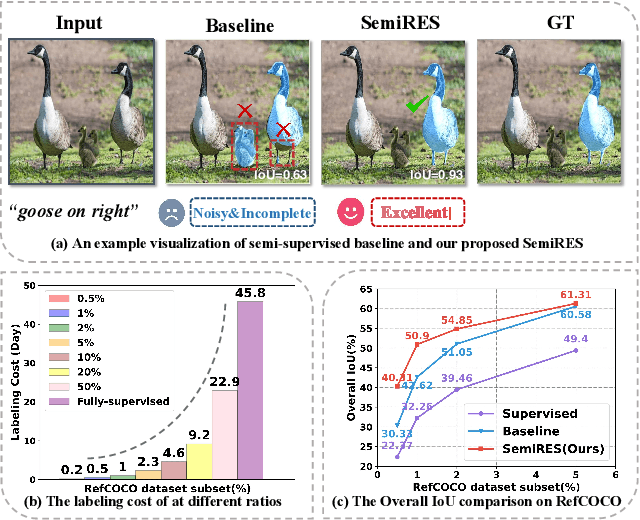
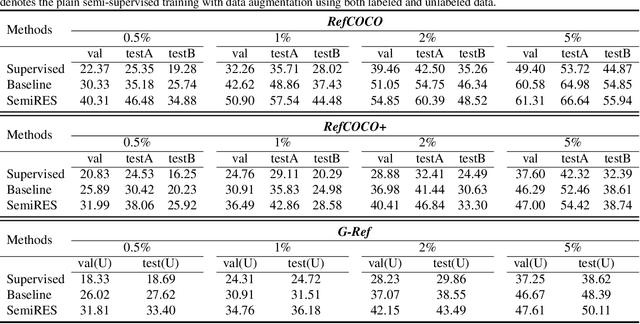
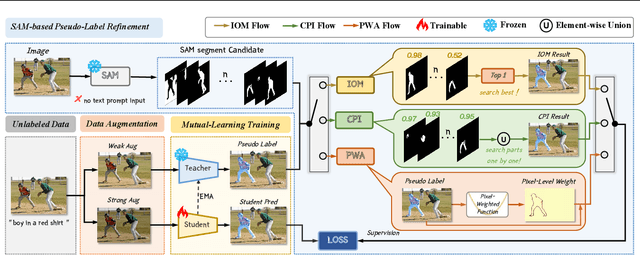
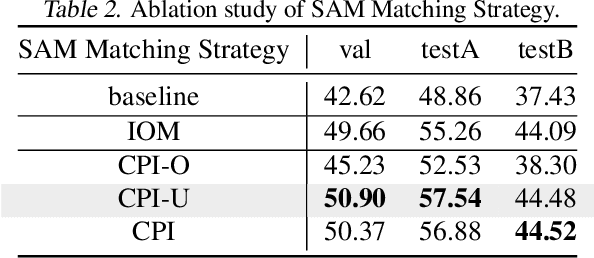
In this paper, we introduce SemiRES, a semi-supervised framework that effectively leverages a combination of labeled and unlabeled data to perform RES. A significant hurdle in applying semi-supervised techniques to RES is the prevalence of noisy pseudo-labels, particularly at the boundaries of objects. SemiRES incorporates the Segment Anything Model (SAM), renowned for its precise boundary demarcation, to improve the accuracy of these pseudo-labels. Within SemiRES, we offer two alternative matching strategies: IoU-based Optimal Matching (IOM) and Composite Parts Integration (CPI). These strategies are designed to extract the most accurate masks from SAM's output, thus guiding the training of the student model with enhanced precision. In instances where a precise mask cannot be matched from the available candidates, we develop the Pixel-Wise Adjustment (PWA) strategy, guiding the student model's training directly by the pseudo-labels. Extensive experiments on three RES benchmarks--RefCOCO, RefCOCO+, and G-Ref reveal its superior performance compared to fully supervised methods. Remarkably, with only 1% labeled data, our SemiRES outperforms the supervised baseline by a large margin, e.g. +18.64% gains on RefCOCO val set. The project code is available at \url{https://github.com/nini0919/SemiRES}.
Image Captioning via Dynamic Path Customization
Jun 01, 2024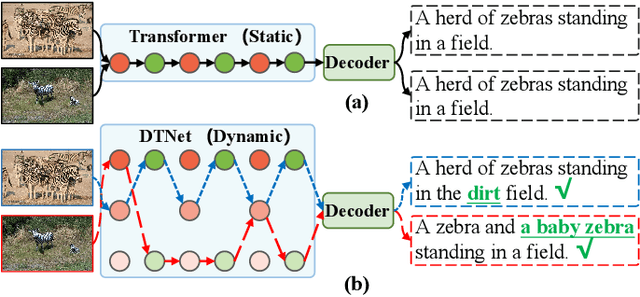
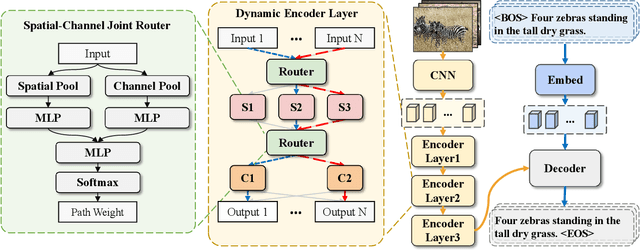
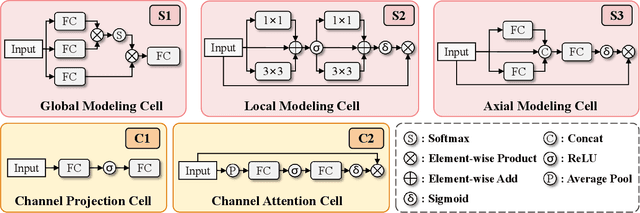
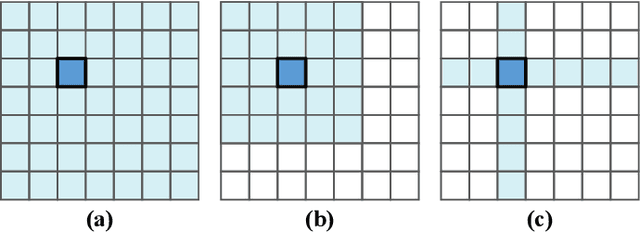
This paper explores a novel dynamic network for vision and language tasks, where the inferring structure is customized on the fly for different inputs. Most previous state-of-the-art approaches are static and hand-crafted networks, which not only heavily rely on expert knowledge, but also ignore the semantic diversity of input samples, therefore resulting in suboptimal performance. To address these issues, we propose a novel Dynamic Transformer Network (DTNet) for image captioning, which dynamically assigns customized paths to different samples, leading to discriminative yet accurate captions. Specifically, to build a rich routing space and improve routing efficiency, we introduce five types of basic cells and group them into two separate routing spaces according to their operating domains, i.e., spatial and channel. Then, we design a Spatial-Channel Joint Router (SCJR), which endows the model with the capability of path customization based on both spatial and channel information of the input sample. To validate the effectiveness of our proposed DTNet, we conduct extensive experiments on the MS-COCO dataset and achieve new state-of-the-art performance on both the Karpathy split and the online test server.
Video-MME: The First-Ever Comprehensive Evaluation Benchmark of Multi-modal LLMs in Video Analysis
May 31, 2024


In the quest for artificial general intelligence, Multi-modal Large Language Models (MLLMs) have emerged as a focal point in recent advancements. However, the predominant focus remains on developing their capabilities in static image understanding. The potential of MLLMs in processing sequential visual data is still insufficiently explored, highlighting the absence of a comprehensive, high-quality assessment of their performance. In this paper, we introduce Video-MME, the first-ever full-spectrum, Multi-Modal Evaluation benchmark of MLLMs in Video analysis. Our work distinguishes from existing benchmarks through four key features: 1) Diversity in video types, spanning 6 primary visual domains with 30 subfields to ensure broad scenario generalizability; 2) Duration in temporal dimension, encompassing both short-, medium-, and long-term videos, ranging from 11 seconds to 1 hour, for robust contextual dynamics; 3) Breadth in data modalities, integrating multi-modal inputs besides video frames, including subtitles and audios, to unveil the all-round capabilities of MLLMs; 4) Quality in annotations, utilizing rigorous manual labeling by expert annotators to facilitate precise and reliable model assessment. 900 videos with a total of 256 hours are manually selected and annotated by repeatedly viewing all the video content, resulting in 2,700 question-answer pairs. With Video-MME, we extensively evaluate various state-of-the-art MLLMs, including GPT-4 series and Gemini 1.5 Pro, as well as open-source image models like InternVL-Chat-V1.5 and video models like LLaVA-NeXT-Video. Our experiments reveal that Gemini 1.5 Pro is the best-performing commercial model, significantly outperforming the open-source models. Our dataset along with these findings underscores the need for further improvements in handling longer sequences and multi-modal data. Project Page: https://video-mme.github.io
FocSAM: Delving Deeply into Focused Objects in Segmenting Anything
May 29, 2024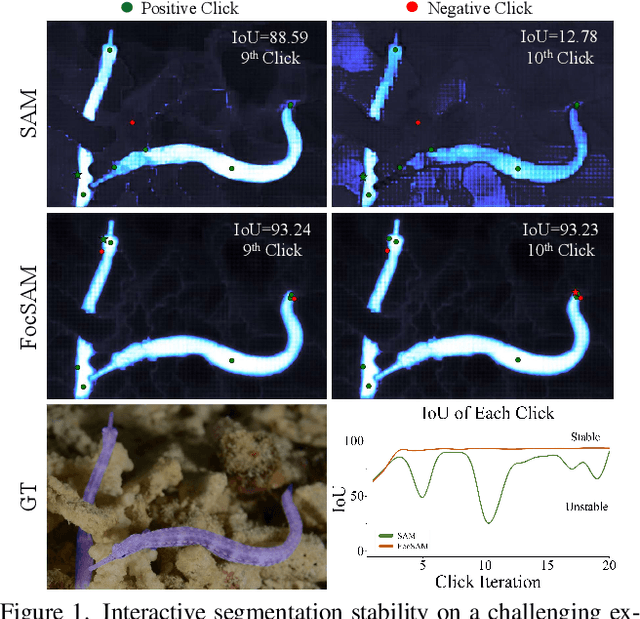
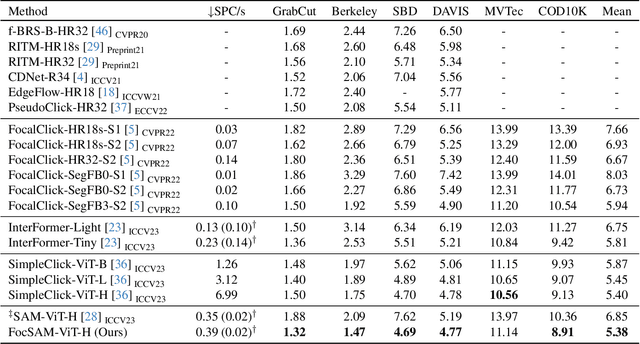
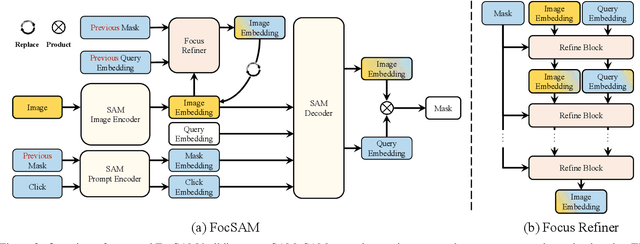

The Segment Anything Model (SAM) marks a notable milestone in segmentation models, highlighted by its robust zero-shot capabilities and ability to handle diverse prompts. SAM follows a pipeline that separates interactive segmentation into image preprocessing through a large encoder and interactive inference via a lightweight decoder, ensuring efficient real-time performance. However, SAM faces stability issues in challenging samples upon this pipeline. These issues arise from two main factors. Firstly, the image preprocessing disables SAM from dynamically using image-level zoom-in strategies to refocus on the target object during interaction. Secondly, the lightweight decoder struggles to sufficiently integrate interactive information with image embeddings. To address these two limitations, we propose FocSAM with a pipeline redesigned on two pivotal aspects. First, we propose Dynamic Window Multi-head Self-Attention (Dwin-MSA) to dynamically refocus SAM's image embeddings on the target object. Dwin-MSA localizes attention computations around the target object, enhancing object-related embeddings with minimal computational overhead. Second, we propose Pixel-wise Dynamic ReLU (P-DyReLU) to enable sufficient integration of interactive information from a few initial clicks that have significant impacts on the overall segmentation results. Experimentally, FocSAM augments SAM's interactive segmentation performance to match the existing state-of-the-art method in segmentation quality, requiring only about 5.6% of this method's inference time on CPUs.
UniPTS: A Unified Framework for Proficient Post-Training Sparsity
May 29, 2024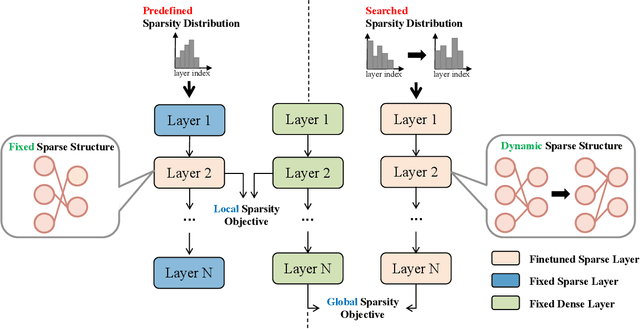
Post-training Sparsity (PTS) is a recently emerged avenue that chases efficient network sparsity with limited data in need. Existing PTS methods, however, undergo significant performance degradation compared with traditional methods that retrain the sparse networks via the whole dataset, especially at high sparsity ratios. In this paper, we attempt to reconcile this disparity by transposing three cardinal factors that profoundly alter the performance of conventional sparsity into the context of PTS. Our endeavors particularly comprise (1) A base-decayed sparsity objective that promotes efficient knowledge transferring from dense network to the sparse counterpart. (2) A reducing-regrowing search algorithm designed to ascertain the optimal sparsity distribution while circumventing overfitting to the small calibration set in PTS. (3) The employment of dynamic sparse training predicated on the preceding aspects, aimed at comprehensively optimizing the sparsity structure while ensuring training stability. Our proposed framework, termed UniPTS, is validated to be much superior to existing PTS methods across extensive benchmarks. As an illustration, it amplifies the performance of POT, a recently proposed recipe, from 3.9% to 68.6% when pruning ResNet-50 at 90% sparsity ratio on ImageNet. We release the code of our paper at https://github.com/xjjxmu/UniPTS.
GOI: Find 3D Gaussians of Interest with an Optimizable Open-vocabulary Semantic-space Hyperplane
May 27, 2024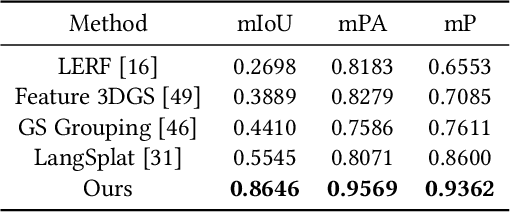
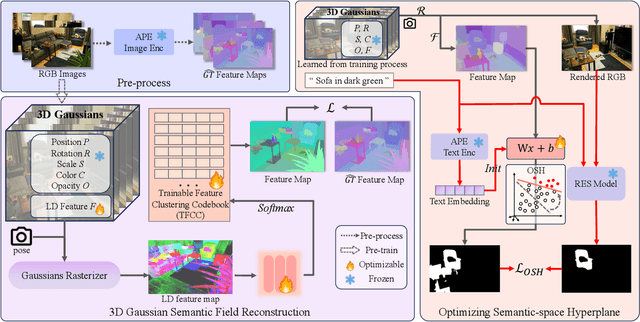
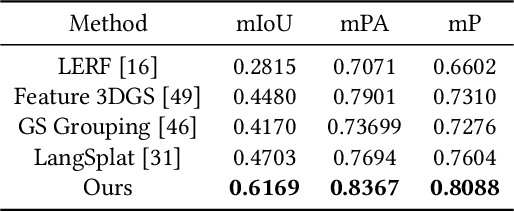
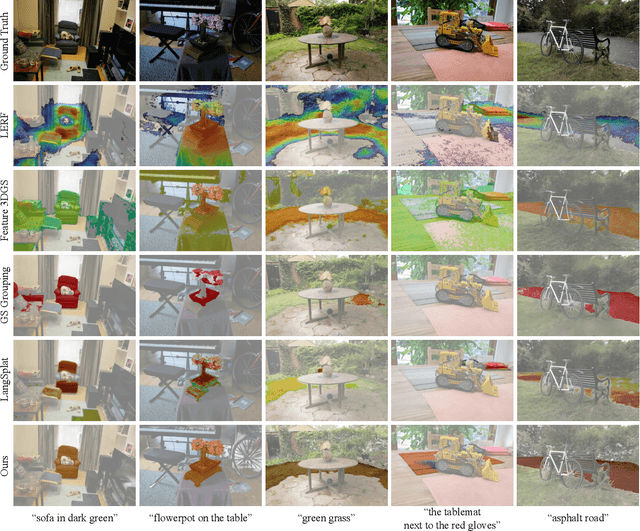
3D open-vocabulary scene understanding, crucial for advancing augmented reality and robotic applications, involves interpreting and locating specific regions within a 3D space as directed by natural language instructions. To this end, we introduce GOI, a framework that integrates semantic features from 2D vision-language foundation models into 3D Gaussian Splatting (3DGS) and identifies 3D Gaussians of Interest using an Optimizable Semantic-space Hyperplane. Our approach includes an efficient compression method that utilizes scene priors to condense noisy high-dimensional semantic features into compact low-dimensional vectors, which are subsequently embedded in 3DGS. During the open-vocabulary querying process, we adopt a distinct approach compared to existing methods, which depend on a manually set fixed empirical threshold to select regions based on their semantic feature distance to the query text embedding. This traditional approach often lacks universal accuracy, leading to challenges in precisely identifying specific target areas. Instead, our method treats the feature selection process as a hyperplane division within the feature space, retaining only those features that are highly relevant to the query. We leverage off-the-shelf 2D Referring Expression Segmentation (RES) models to fine-tune the semantic-space hyperplane, enabling a more precise distinction between target regions and others. This fine-tuning substantially improves the accuracy of open-vocabulary queries, ensuring the precise localization of pertinent 3D Gaussians. Extensive experiments demonstrate GOI's superiority over previous state-of-the-art methods. Our project page is available at https://goi-hyperplane.github.io/ .
Dual3D: Efficient and Consistent Text-to-3D Generation with Dual-mode Multi-view Latent Diffusion
May 16, 2024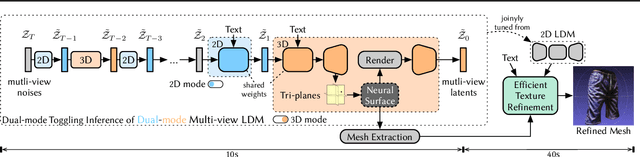

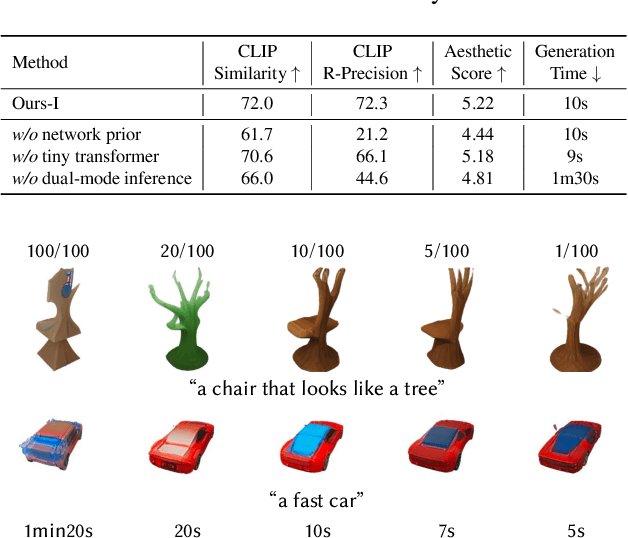
We present Dual3D, a novel text-to-3D generation framework that generates high-quality 3D assets from texts in only $1$ minute.The key component is a dual-mode multi-view latent diffusion model. Given the noisy multi-view latents, the 2D mode can efficiently denoise them with a single latent denoising network, while the 3D mode can generate a tri-plane neural surface for consistent rendering-based denoising. Most modules for both modes are tuned from a pre-trained text-to-image latent diffusion model to circumvent the expensive cost of training from scratch. To overcome the high rendering cost during inference, we propose the dual-mode toggling inference strategy to use only $1/10$ denoising steps with 3D mode, successfully generating a 3D asset in just $10$ seconds without sacrificing quality. The texture of the 3D asset can be further enhanced by our efficient texture refinement process in a short time. Extensive experiments demonstrate that our method delivers state-of-the-art performance while significantly reducing generation time. Our project page is available at https://dual3d.github.io