 Add to Chrome
 Add to Firefox
 Add to Edge
Active-SAOOD: Active Sparsely Annotated Oriented Object Detection in Remote Sensing Images
May 11, 2026
Reducing the annotation cost of oriented object detection in remote sensing remains a major challenge. Recently, sparse annotation has gained attention for effectively reducing annotation redundancy in densely remote sensing scenes. However, (1) the sparse data reliance on class-dependent sampling, and (2) the lack of in-depth investigation into the characteristics of sparse samples hinders its further development. This paper proposes an active learning-based sparsely annotated oriented object detection (SAOOD) method, termed Active-SAOOD. Based on a model state observation module, Active-SAOOD actively selects the most valuable sparse samples at the instance level that are best suited to the current model state, by jointly considering orientation, classification, and localization uncertainty, as well as inter- and intra-class diversity. This design enables SAOOD to operate stably under completely randomly initialized sparse annotations and extends its applicability to broader real-world. Experiments on multiple datasets demonstrate that Active-SAOOD significantly improves both performance and stability of existing SAOOD methods under various random sparse annotation. In particular, with only 1\% annotated ratios, it achieves a 9\% performance gain over the baseline, further enhancing the practical value of SAOOD in remote sensing. The code will be public.

Learning from Medical Entity Trees: An Entity-Centric Medical Data Engineering Framework for MLLMs
Apr 28, 2026Multimodal Large Language Models (MLLMs) have shown transformative potential in medical applications, yet their performance is hindered by conventional data curation strategies that rely on coarse-grained partitioning by modality or department. Such fragmented approaches fail to capture the hierarchical and interconnected nature of clinical medical knowledge, limiting the models' ability to perform fine-grained recognition and complex reasoning. In this paper, we propose a novel Entity-Centric Medical Data Engineering framework. We automatically extract entities from authoritative medical literature to construct a Medical Entity Tree (MET), a hierarchical structure that systematically encodes diseases, anatomical structures, modalities, and symptoms into a unified knowledge repository. Building upon the MET, we propose an advanced data engine that includes: (1) node-guided retrieval to anchor raw data to specific medical concepts, (2) a two-stage hybrid filtering and alignment pipeline to ensure precise visual-semantic correspondence, and (3) knowledge-aware data synthesis to generate enriched captions and targeted reasoning VQA pairs, leveraging structural constraints. Extensive evaluations across six medical benchmarks demonstrate that our approach significantly enhances the medical capabilities of general-purpose MLLMs, improving their ability to handle complex clinical queries and achieve state-of-the-art performance in diverse medical contexts.
HieraVid: Hierarchical Token Pruning for Fast Video Large Language Models
Apr 02, 2026Video Large Language Models (VideoLLMs) have demonstrated impressive capabilities in video understanding, yet the massive number of input video tokens incurs a significant computational burden for deployment. Existing methods mainly prune video tokens at input level while neglecting the inherent information structure embedded in videos and large language models (LLMs). To address this, we propose HieraVid, a hierarchical pruning framework that progressively and dynamically reduces visual redundancy. Based on two observations that videos possess the segment-frame structure and LLMs internally propagate multi-modal information unidirectionally, we decompose pruning into three levels: 1) segment-level, where video tokens are first temporally segmented and spatially merged; 2) frame-level, where similar frames within the same segment are jointly pruned to preserve diversity; 3) layer-level, redundancy gradually shrinks as LLM layer increases w/o compromising performance. We conduct extensive experiments on four widely used video understanding benchmarks to comprehensively evaluate the effectiveness of HieraVid. Remarkably, with only 30% of tokens retained, HieraVid achieves new state-of-the-art performance, while maintaining over 98% and 99% of the performance of LLaVA-Video-7B and LLaVA-OneVision-7B, respectively.
SEA-Vision: A Multilingual Benchmark for Comprehensive Document and Scene Text Understanding in Southeast Asia
Mar 16, 2026Multilingual document and scene text understanding plays an important role in applications such as search, finance, and public services. However, most existing benchmarks focus on high-resource languages and fail to evaluate models in realistic multilingual environments. In Southeast Asia, the diversity of languages, complex writing systems, and highly varied document types make this challenge even greater. We introduce SEA-Vision, a benchmark that jointly evaluates Document Parsing and Text-Centric Visual Question Answering (TEC-VQA) across 11 Southeast Asian languages. SEA-Vision contains 15,234 document parsing pages from nine representative document types, annotated with hierarchical page-, block-, and line-level labels. It also provides 7,496 TEC-VQA question-answer pairs that probe text recognition, numerical calculation, comparative analysis, logical reasoning, and spatial understanding. To make such multilingual, multi-task annotation feasible, we design a hybrid pipeline for Document Parsing and TEC-VQA. It combines automated filtering and scoring with MLLM-assisted labeling and lightweight native-speaker verification, greatly reducing manual labeling while maintaining high quality. We evaluate several leading multimodal models and observe pronounced performance degradation on low-resource Southeast Asian languages, highlighting substantial remaining gaps in multilingual document and scene text understanding. We believe SEA-Vision will help drive global progress in document and scene text understanding.
Referring Industrial Anomaly Segmentation
Feb 03, 2026Industrial Anomaly Detection (IAD) is vital for manufacturing, yet traditional methods face significant challenges: unsupervised approaches yield rough localizations requiring manual thresholds, while supervised methods overfit due to scarce, imbalanced data. Both suffer from the "One Anomaly Class, One Model" limitation. To address this, we propose Referring Industrial Anomaly Segmentation (RIAS), a paradigm leveraging language to guide detection. RIAS generates precise masks from text descriptions without manual thresholds and uses universal prompts to detect diverse anomalies with a single model. We introduce the MVTec-Ref dataset to support this, designed with diverse referring expressions and focusing on anomaly patterns, notably with 95% small anomalies. We also propose the Dual Query Token with Mask Group Transformer (DQFormer) benchmark, enhanced by Language-Gated Multi-Level Aggregation (LMA) to improve multi-scale segmentation. Unlike traditional methods using redundant queries, DQFormer employs only "Anomaly" and "Background" tokens for efficient visual-textual integration. Experiments demonstrate RIAS's effectiveness in advancing IAD toward open-set capabilities. Code: https://github.com/swagger-coder/RIAS-MVTec-Ref.
Evolving, Not Training: Zero-Shot Reasoning Segmentation via Evolutionary Prompting
Dec 31, 2025Reasoning Segmentation requires models to interpret complex, context-dependent linguistic queries to achieve pixel-level localization. Current dominant approaches rely heavily on Supervised Fine-Tuning (SFT) or Reinforcement Learning (RL). However, SFT suffers from catastrophic forgetting and domain dependency, while RL is often hindered by training instability and rigid reliance on predefined reward functions. Although recent training-free methods circumvent these training burdens, they are fundamentally limited by a static inference paradigm. These methods typically rely on a single-pass "generate-then-segment" chain, which suffers from insufficient reasoning depth and lacks the capability to self-correct linguistic hallucinations or spatial misinterpretations. In this paper, we challenge these limitations and propose EVOL-SAM3, a novel zero-shot framework that reformulates reasoning segmentation as an inference-time evolutionary search process. Instead of relying on a fixed prompt, EVOL-SAM3 maintains a population of prompt hypotheses and iteratively refines them through a "Generate-Evaluate-Evolve" loop. We introduce a Visual Arena to assess prompt fitness via reference-free pairwise tournaments, and a Semantic Mutation operator to inject diversity and correct semantic errors. Furthermore, a Heterogeneous Arena module integrates geometric priors with semantic reasoning to ensure robust final selection. Extensive experiments demonstrate that EVOL-SAM3 not only substantially outperforms static baselines but also significantly surpasses fully supervised state-of-the-art methods on the challenging ReasonSeg benchmark in a zero-shot setting. The code is available at https://github.com/AHideoKuzeA/Evol-SAM3.
Understanding What Is Not Said:Referring Remote Sensing Image Segmentation with Scarce Expressions
Oct 26, 2025Referring Remote Sensing Image Segmentation (RRSIS) aims to segment instances in remote sensing images according to referring expressions. Unlike Referring Image Segmentation on general images, acquiring high-quality referring expressions in the remote sensing domain is particularly challenging due to the prevalence of small, densely distributed objects and complex backgrounds. This paper introduces a new learning paradigm, Weakly Referring Expression Learning (WREL) for RRSIS, which leverages abundant class names as weakly referring expressions together with a small set of accurate ones to enable efficient training under limited annotation conditions. Furthermore, we provide a theoretical analysis showing that mixed-referring training yields a provable upper bound on the performance gap relative to training with fully annotated referring expressions, thereby establishing the validity of this new setting. We also propose LRB-WREL, which integrates a Learnable Reference Bank (LRB) to refine weakly referring expressions through sample-specific prompt embeddings that enrich coarse class-name inputs. Combined with a teacher-student optimization framework using dynamically scheduled EMA updates, LRB-WREL stabilizes training and enhances cross-modal generalization under noisy weakly referring supervision. Extensive experiments on our newly constructed benchmark with varying weakly referring data ratios validate both the theoretical insights and the practical effectiveness of WREL and LRB-WREL, demonstrating that they can approach or even surpass models trained with fully annotated referring expressions.
What You Perceive Is What You Conceive: A Cognition-Inspired Framework for Open Vocabulary Image Segmentation
May 26, 2025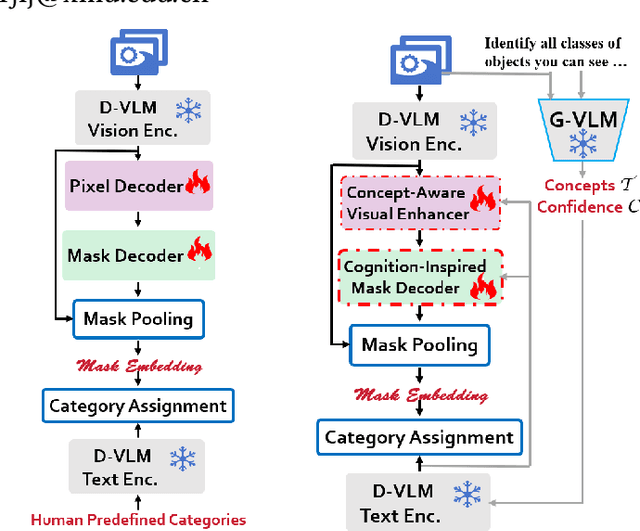
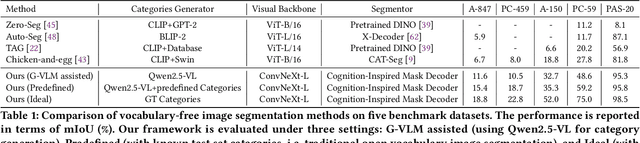
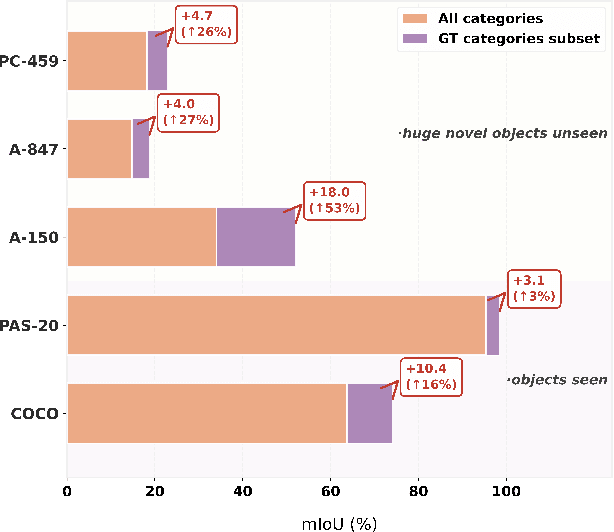
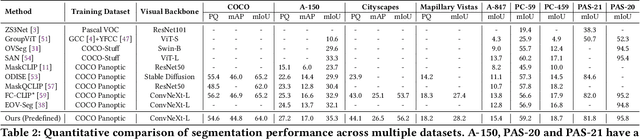
Open vocabulary image segmentation tackles the challenge of recognizing dynamically adjustable, predefined novel categories at inference time by leveraging vision-language alignment. However, existing paradigms typically perform class-agnostic region segmentation followed by category matching, which deviates from the human visual system's process of recognizing objects based on semantic concepts, leading to poor alignment between region segmentation and target concepts. To bridge this gap, we propose a novel Cognition-Inspired Framework for open vocabulary image segmentation that emulates the human visual recognition process: first forming a conceptual understanding of an object, then perceiving its spatial extent. The framework consists of three core components: (1) A Generative Vision-Language Model (G-VLM) that mimics human cognition by generating object concepts to provide semantic guidance for region segmentation. (2) A Concept-Aware Visual Enhancer Module that fuses textual concept features with global visual representations, enabling adaptive visual perception based on target concepts. (3) A Cognition-Inspired Decoder that integrates local instance features with G-VLM-provided semantic cues, allowing selective classification over a subset of relevant categories. Extensive experiments demonstrate that our framework achieves significant improvements, reaching $27.2$ PQ, $17.0$ mAP, and $35.3$ mIoU on A-150. It further attains $56.2$, $28.2$, $15.4$, $59.2$, $18.7$, and $95.8$ mIoU on Cityscapes, Mapillary Vistas, A-847, PC-59, PC-459, and PAS-20, respectively. In addition, our framework supports vocabulary-free segmentation, offering enhanced flexibility in recognizing unseen categories. Code will be public.
Pseudo-Label Quality Decoupling and Correction for Semi-Supervised Instance Segmentation
May 16, 2025Semi-Supervised Instance Segmentation (SSIS) involves classifying and grouping image pixels into distinct object instances using limited labeled data. This learning paradigm usually faces a significant challenge of unstable performance caused by noisy pseudo-labels of instance categories and pixel masks. We find that the prevalent practice of filtering instance pseudo-labels assessing both class and mask quality with a single score threshold, frequently leads to compromises in the trade-off between the qualities of class and mask labels. In this paper, we introduce a novel Pseudo-Label Quality Decoupling and Correction (PL-DC) framework for SSIS to tackle the above challenges. Firstly, at the instance level, a decoupled dual-threshold filtering mechanism is designed to decouple class and mask quality estimations for instance-level pseudo-labels, thereby independently controlling pixel classifying and grouping qualities. Secondly, at the category level, we introduce a dynamic instance category correction module to dynamically correct the pseudo-labels of instance categories, effectively alleviating category confusion. Lastly, we introduce a pixel-level mask uncertainty-aware mechanism at the pixel level to re-weight the mask loss for different pixels, thereby reducing the impact of noise introduced by pixel-level mask pseudo-labels. Extensive experiments on the COCO and Cityscapes datasets demonstrate that the proposed PL-DC achieves significant performance improvements, setting new state-of-the-art results for SSIS. Notably, our PL-DC shows substantial gains even with minimal labeled data, achieving an improvement of +11.6 mAP with just 1% COCO labeled data and +15.5 mAP with 5% Cityscapes labeled data. The code will be public.
S$^2$Teacher: Step-by-step Teacher for Sparsely Annotated Oriented Object Detection
Apr 15, 2025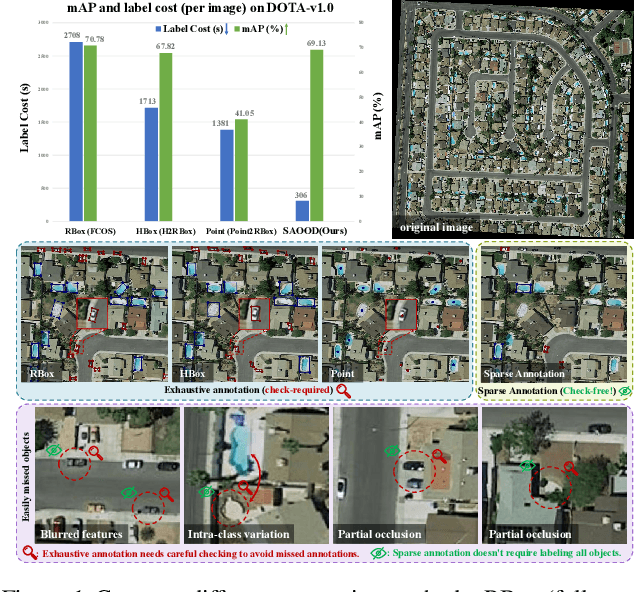
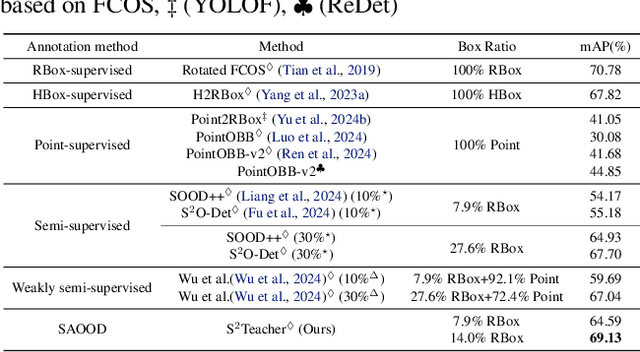
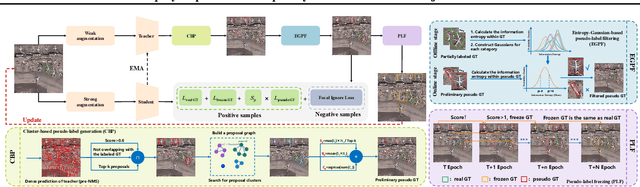
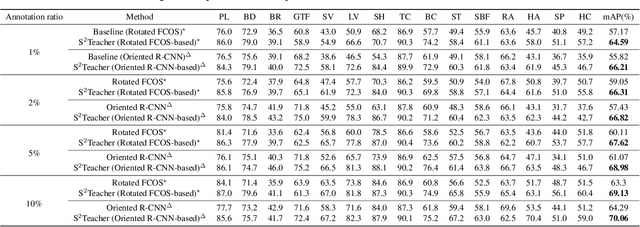
Although fully-supervised oriented object detection has made significant progress in multimodal remote sensing image understanding, it comes at the cost of labor-intensive annotation. Recent studies have explored weakly and semi-supervised learning to alleviate this burden. However, these methods overlook the difficulties posed by dense annotations in complex remote sensing scenes. In this paper, we introduce a novel setting called sparsely annotated oriented object detection (SAOOD), which only labels partial instances, and propose a solution to address its challenges. Specifically, we focus on two key issues in the setting: (1) sparse labeling leading to overfitting on limited foreground representations, and (2) unlabeled objects (false negatives) confusing feature learning. To this end, we propose the S$^2$Teacher, a novel method that progressively mines pseudo-labels for unlabeled objects, from easy to hard, to enhance foreground representations. Additionally, it reweights the loss of unlabeled objects to mitigate their impact during training. Extensive experiments demonstrate that S$^2$Teacher not only significantly improves detector performance across different sparse annotation levels but also achieves near-fully-supervised performance on the DOTA dataset with only 10% annotation instances, effectively balancing detection accuracy with annotation efficiency. The code will be public.