 Add to Chrome
 Add to Firefox
 Add to Edge
Rational-WENO: A lightweight, physically-consistent three-point weighted essentially non-oscillatory scheme
Sep 13, 2024

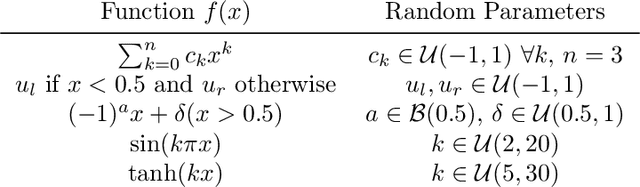
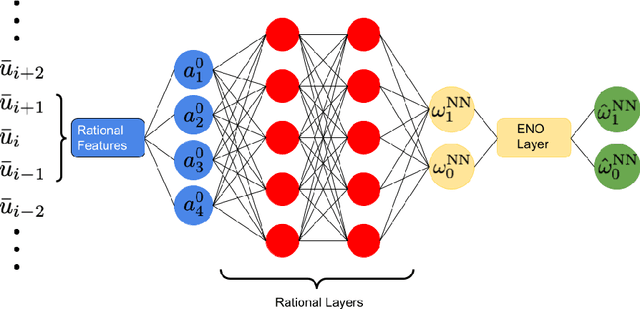
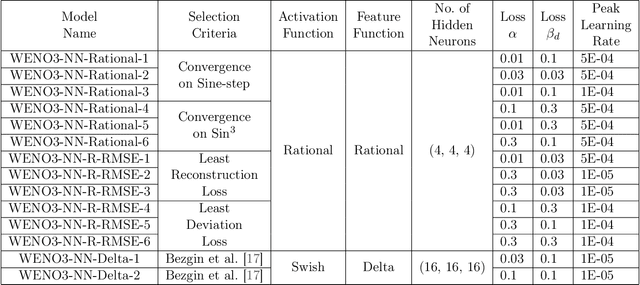
Conventional WENO3 methods are known to be highly dissipative at lower resolutions, introducing significant errors in the pre-asymptotic regime. In this paper, we employ a rational neural network to accurately estimate the local smoothness of the solution, dynamically adapting the stencil weights based on local solution features. As rational neural networks can represent fast transitions between smooth and sharp regimes, this approach achieves a granular reconstruction with significantly reduced dissipation, improving the accuracy of the simulation. The network is trained offline on a carefully chosen dataset of analytical functions, bypassing the need for differentiable solvers. We also propose a robust model selection criterion based on estimates of the interpolation's convergence order on a set of test functions, which correlates better with the model performance in downstream tasks. We demonstrate the effectiveness of our approach on several one-, two-, and three-dimensional fluid flow problems: our scheme generalizes across grid resolutions while handling smooth and discontinuous solutions. In most cases, our rational network-based scheme achieves higher accuracy than conventional WENO3 with the same stencil size, and in a few of them, it achieves accuracy comparable to WENO5, which uses a larger stencil.

NPU-NTU System for Voice Privacy 2024 Challenge
Sep 06, 2024

Speaker anonymization is an effective privacy protection solution that conceals the speaker's identity while preserving the linguistic content and paralinguistic information of the original speech. To establish a fair benchmark and facilitate comparison of speaker anonymization systems, the VoicePrivacy Challenge (VPC) was held in 2020 and 2022, with a new edition planned for 2024. In this paper, we describe our proposed speaker anonymization system for VPC 2024. Our system employs a disentangled neural codec architecture and a serial disentanglement strategy to gradually disentangle the global speaker identity and time-variant linguistic content and paralinguistic information. We introduce multiple distillation methods to disentangle linguistic content, speaker identity, and emotion. These methods include semantic distillation, supervised speaker distillation, and frame-level emotion distillation. Based on these distillations, we anonymize the original speaker identity using a weighted sum of a set of candidate speaker identities and a randomly generated speaker identity. Our system achieves the best trade-off of privacy protection and emotion preservation in VPC 2024.
BFA-YOLO: Balanced multiscale object detection network for multi-view building facade attachments detection
Sep 06, 2024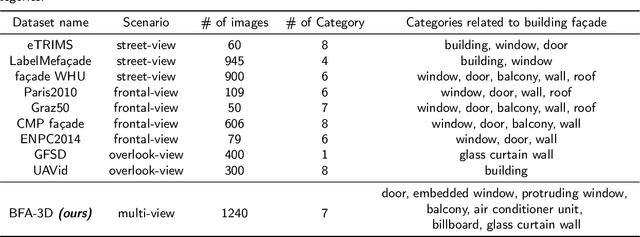
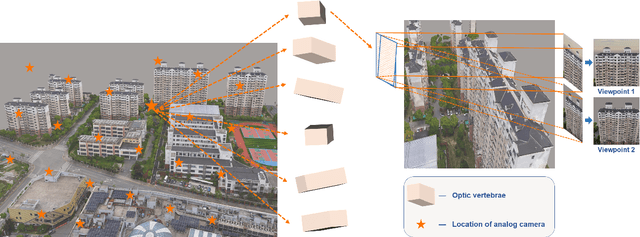
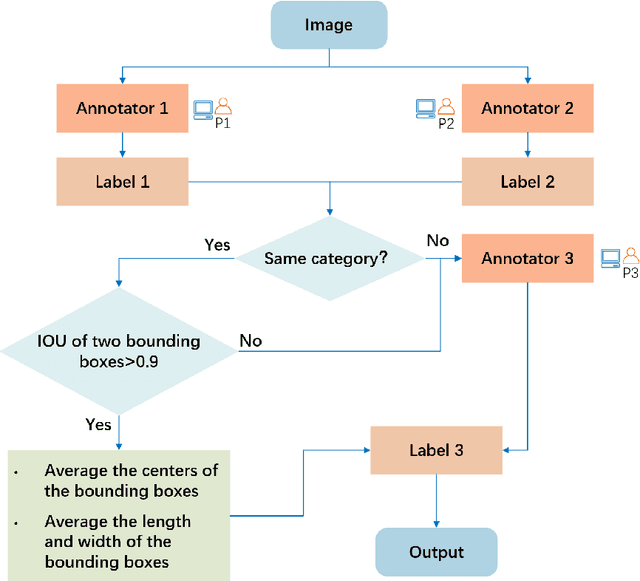
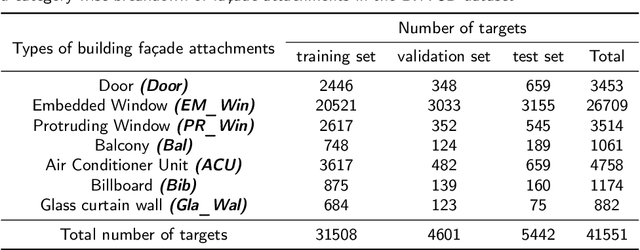
Detection of building facade attachments such as doors, windows, balconies, air conditioner units, billboards, and glass curtain walls plays a pivotal role in numerous applications. Building facade attachments detection aids in vbuilding information modeling (BIM) construction and meeting Level of Detail 3 (LOD3) standards. Yet, it faces challenges like uneven object distribution, small object detection difficulty, and background interference. To counter these, we propose BFA-YOLO, a model for detecting facade attachments in multi-view images. BFA-YOLO incorporates three novel innovations: the Feature Balanced Spindle Module (FBSM) for addressing uneven distribution, the Target Dynamic Alignment Task Detection Head (TDATH) aimed at improving small object detection, and the Position Memory Enhanced Self-Attention Mechanism (PMESA) to combat background interference, with each component specifically designed to solve its corresponding challenge. Detection efficacy of deep network models deeply depends on the dataset's characteristics. Existing open source datasets related to building facades are limited by their single perspective, small image pool, and incomplete category coverage. We propose a novel method for building facade attachments detection dataset construction and construct the BFA-3D dataset for facade attachments detection. The BFA-3D dataset features multi-view, accurate labels, diverse categories, and detailed classification. BFA-YOLO surpasses YOLOv8 by 1.8% and 2.9% in mAP@0.5 on the multi-view BFA-3D and street-view Facade-WHU datasets, respectively. These results underscore BFA-YOLO's superior performance in detecting facade attachments.
Cross-sectional imaging of speed-of-sound distribution using photoacoustic reversal beacons
Aug 26, 2024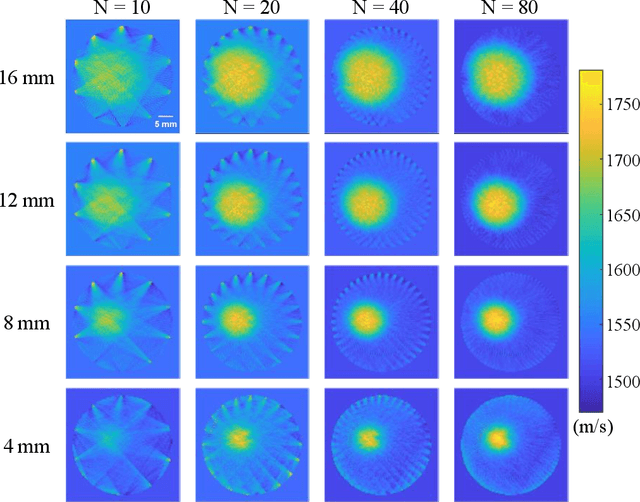
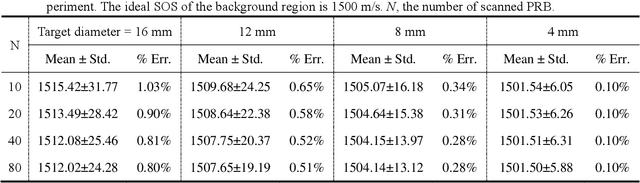
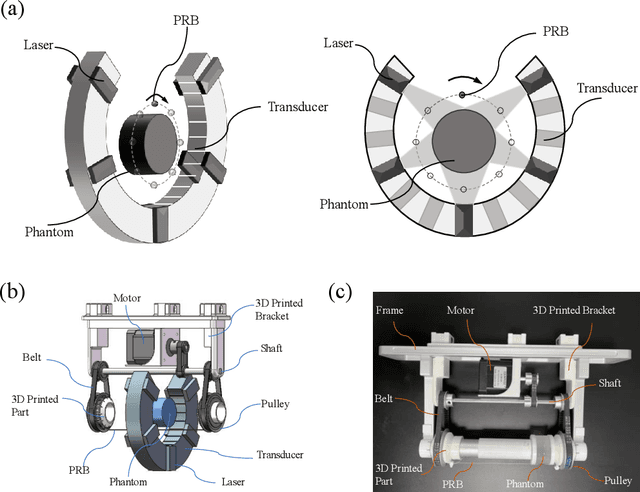
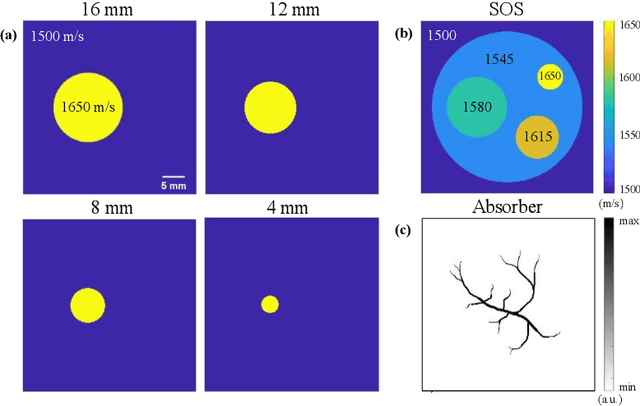
Photoacoustic tomography (PAT) enables non-invasive cross-sectional imaging of biological tissues, but it fails to map the spatial variation of speed-of-sound (SOS) within tissues. While SOS is intimately linked to density and elastic modulus of tissues, the imaging of SOS distri-bution serves as a complementary imaging modality to PAT. Moreover, an accurate SOS map can be leveraged to correct for PAT image degradation arising from acoustic heterogene-ities. Herein, we propose a novel approach for SOS reconstruction using only PAT imaging modality. Our method is based on photoacoustic reversal beacons (PRBs), which are small light-absorbing targets with strong photoacoustic contrast. We excite and scan a number of PRBs positioned at the periphery of the target, and the generated photoacoustic waves prop-agate through the target from various directions, thereby achieve spatial sampling of the internal SOS. We formulate a linear inverse model for pixel-wise SOS reconstruction and solve it with iterative optimization technique. We validate the feasibility of the proposed method through simulations, phantoms, and ex vivo biological tissue tests. Experimental results demonstrate that our approach can achieve accurate reconstruction of SOS distribu-tion. Leveraging the obtained SOS map, we further demonstrate significantly enhanced PAT image reconstruction with acoustic correction.
PatUntrack: Automated Generating Patch Examples for Issue Reports without Tracked Insecure Code
Aug 16, 2024Security patches are essential for enhancing the stability and robustness of projects in the software community. While vulnerabilities are officially expected to be patched before being disclosed, patching vulnerabilities is complicated and remains a struggle for many organizations. To patch vulnerabilities, security practitioners typically track vulnerable issue reports (IRs), and analyze their relevant insecure code to generate potential patches. However, the relevant insecure code may not be explicitly specified and practitioners cannot track the insecure code in the repositories, thus limiting their ability to generate patches. In such cases, providing examples of insecure code and the corresponding patches would benefit the security developers to better locate and fix the insecure code. In this paper, we propose PatUntrack to automatically generating patch examples from IRs without tracked insecure code. It auto-prompts Large Language Models (LLMs) to make them applicable to analyze the vulnerabilities. It first generates the completed description of the Vulnerability-Triggering Path (VTP) from vulnerable IRs. Then, it corrects hallucinations in the VTP description with external golden knowledge. Finally, it generates Top-K pairs of Insecure Code and Patch Example based on the corrected VTP description. To evaluate the performance, we conducted experiments on 5,465 vulnerable IRs. The experimental results show that PatUntrack can obtain the highest performance and improve the traditional LLM baselines by +14.6% (Fix@10) on average in patch example generation. Furthermore, PatUntrack was applied to generate patch examples for 76 newly disclosed vulnerable IRs. 27 out of 37 replies from the authors of these IRs confirmed the usefulness of the patch examples generated by PatUntrack, indicating that they can benefit from these examples for patching the vulnerabilities.
MUSA: Multi-lingual Speaker Anonymization via Serial Disentanglement
Jul 16, 2024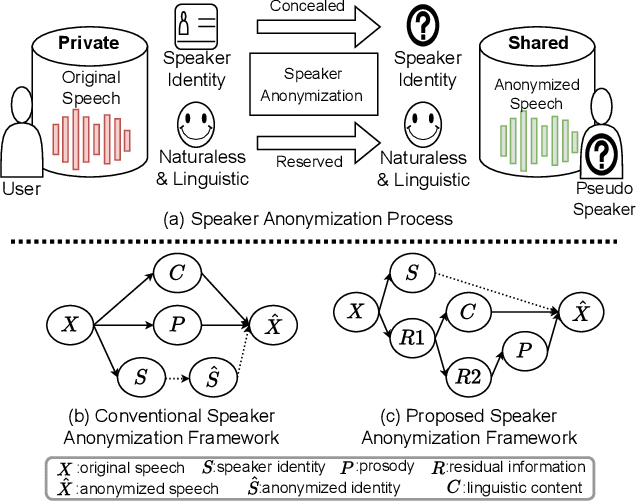

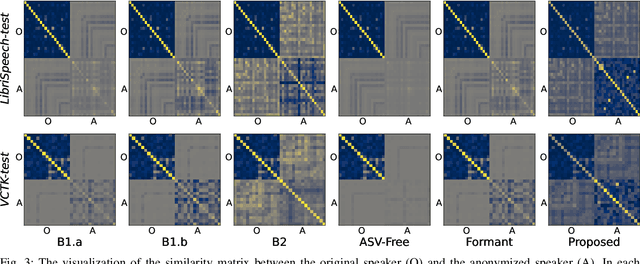

Speaker anonymization is an effective privacy protection solution designed to conceal the speaker's identity while preserving the linguistic content and para-linguistic information of the original speech. While most prior studies focus solely on a single language, an ideal speaker anonymization system should be capable of handling multiple languages. This paper proposes MUSA, a Multi-lingual Speaker Anonymization approach that employs a serial disentanglement strategy to perform a step-by-step disentanglement from a global time-invariant representation to a temporal time-variant representation. By utilizing semantic distillation and self-supervised speaker distillation, the serial disentanglement strategy can avoid strong inductive biases and exhibit superior generalization performance across different languages. Meanwhile, we propose a straightforward anonymization strategy that employs empty embedding with zero values to simulate the speaker identity concealment process, eliminating the need for conversion to a pseudo-speaker identity and thereby reducing the complexity of speaker anonymization process. Experimental results on VoicePrivacy official datasets and multi-lingual datasets demonstrate that MUSA can effectively protect speaker privacy while preserving linguistic content and para-linguistic information.
Whisper-SV: Adapting Whisper for Low-data-resource Speaker Verification
Jul 14, 2024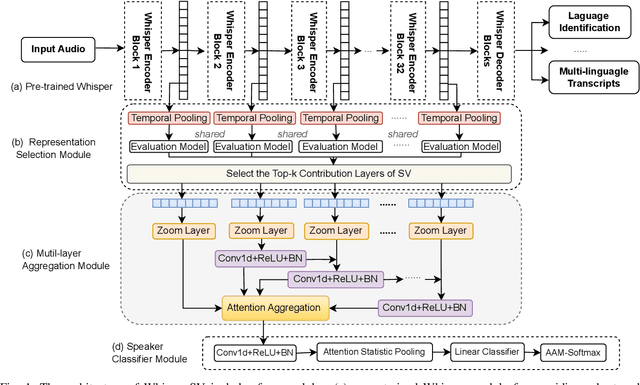
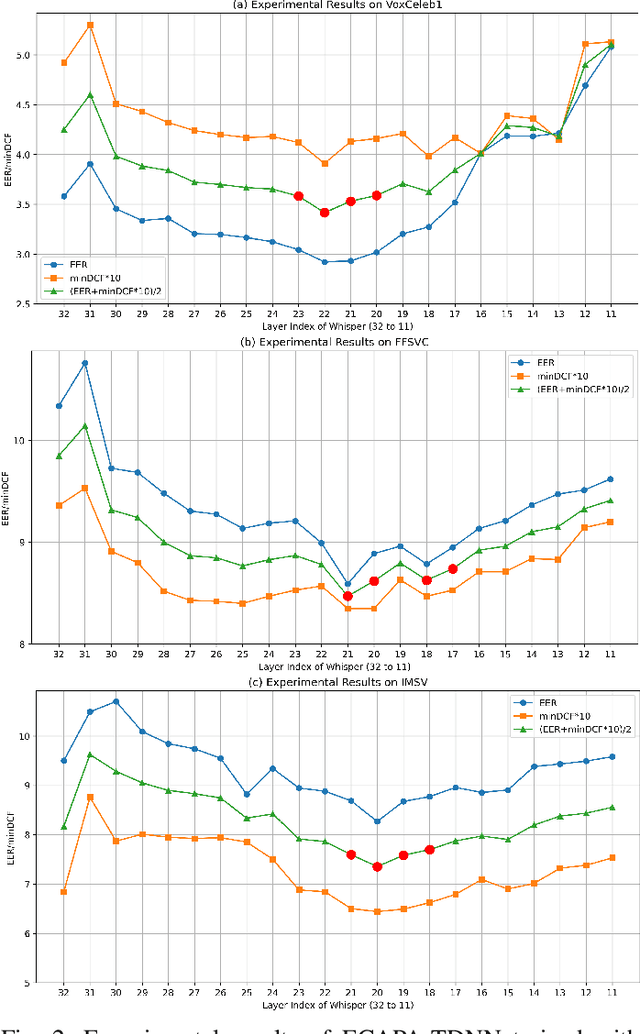
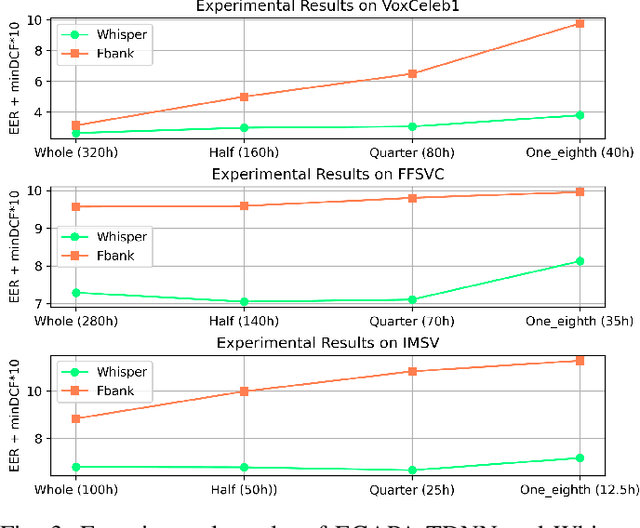
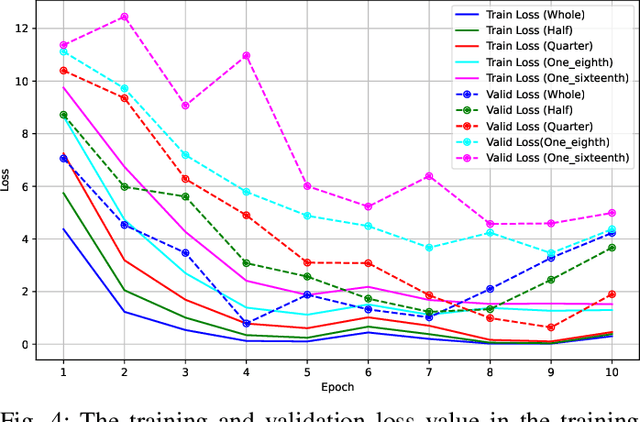
Trained on 680,000 hours of massive speech data, Whisper is a multitasking, multilingual speech foundation model demonstrating superior performance in automatic speech recognition, translation, and language identification. However, its applicability in speaker verification (SV) tasks remains unexplored, particularly in low-data-resource scenarios where labeled speaker data in specific domains are limited. To fill this gap, we propose a lightweight adaptor framework to boost SV with Whisper, namely Whisper-SV. Given that Whisper is not specifically optimized for SV tasks, we introduce a representation selection module to quantify the speaker-specific characteristics contained in each layer of Whisper and select the top-k layers with prominent discriminative speaker features. To aggregate pivotal speaker-related features while diminishing non-speaker redundancies across the selected top-k distinct layers of Whisper, we design a multi-layer aggregation module in Whisper-SV to integrate multi-layer representations into a singular, compacted representation for SV. In the multi-layer aggregation module, we employ convolutional layers with shortcut connections among different layers to refine speaker characteristics derived from multi-layer representations from Whisper. In addition, an attention aggregation layer is used to reduce non-speaker interference and amplify speaker-specific cues for SV tasks. Finally, a simple classification module is used for speaker classification. Experiments on VoxCeleb1, FFSVC, and IMSV datasets demonstrate that Whisper-SV achieves EER/minDCF of 2.22%/0.307, 6.14%/0.488, and 7.50%/0.582, respectively, showing superior performance in low-data-resource SV scenarios.
Repairing Catastrophic-Neglect in Text-to-Image Diffusion Models via Attention-Guided Feature Enhancement
Jun 24, 2024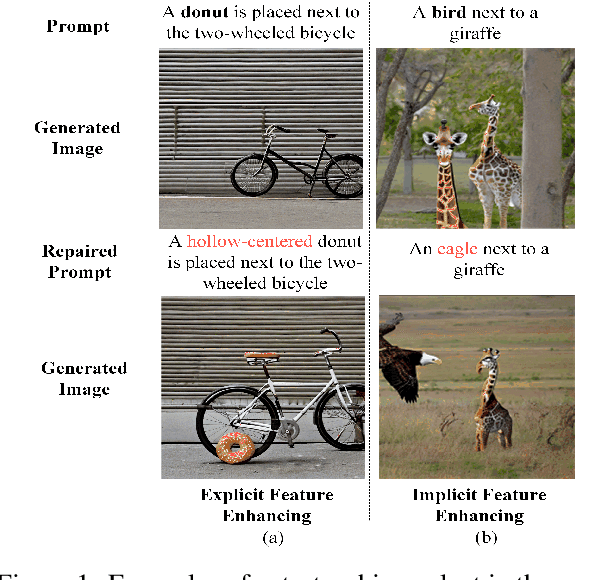
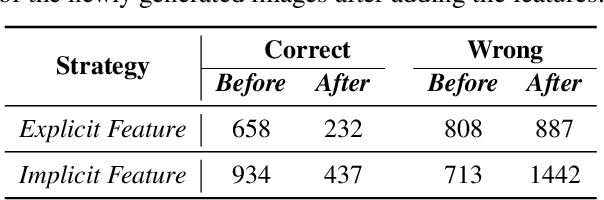
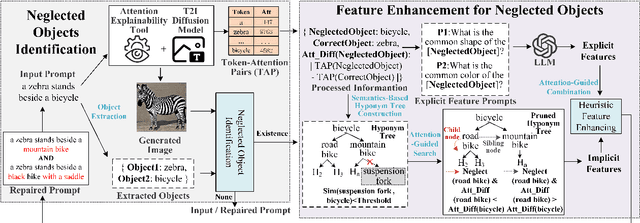
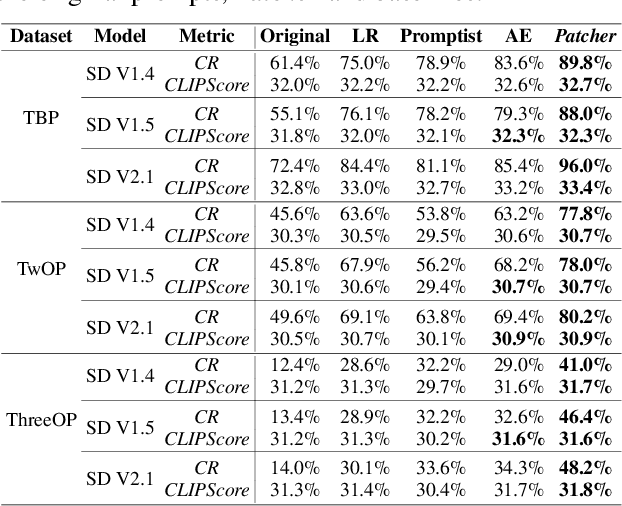
Text-to-Image Diffusion Models (T2I DMs) have garnered significant attention for their ability to generate high-quality images from textual descriptions. However, these models often produce images that do not fully align with the input prompts, resulting in semantic inconsistencies. The most prominent issue among these semantic inconsistencies is catastrophic-neglect, where the images generated by T2I DMs miss key objects mentioned in the prompt. We first conduct an empirical study on this issue, exploring the prevalence of catastrophic-neglect, potential mitigation strategies with feature enhancement, and the insights gained. Guided by the empirical findings, we propose an automated repair approach named Patcher to address catastrophic-neglect in T2I DMs. Specifically, Patcher first determines whether there are any neglected objects in the prompt, and then applies attention-guided feature enhancement to these neglected objects, resulting in a repaired prompt. Experimental results on three versions of Stable Diffusion demonstrate that Patcher effectively repairs the issue of catastrophic-neglect, achieving 10.1%-16.3% higher Correct Rate in image generation compared to baselines.
Exploring Audio-Visual Information Fusion for Sound Event Localization and Detection In Low-Resource Realistic Scenarios
Jun 21, 2024This study presents an audio-visual information fusion approach to sound event localization and detection (SELD) in low-resource scenarios. We aim at utilizing audio and video modality information through cross-modal learning and multi-modal fusion. First, we propose a cross-modal teacher-student learning (TSL) framework to transfer information from an audio-only teacher model, trained on a rich collection of audio data with multiple data augmentation techniques, to an audio-visual student model trained with only a limited set of multi-modal data. Next, we propose a two-stage audio-visual fusion strategy, consisting of an early feature fusion and a late video-guided decision fusion to exploit synergies between audio and video modalities. Finally, we introduce an innovative video pixel swapping (VPS) technique to extend an audio channel swapping (ACS) method to an audio-visual joint augmentation. Evaluation results on the Detection and Classification of Acoustic Scenes and Events (DCASE) 2023 Challenge data set demonstrate significant improvements in SELD performances. Furthermore, our submission to the SELD task of the DCASE 2023 Challenge ranks first place by effectively integrating the proposed techniques into a model ensemble.
SRFUND: A Multi-Granularity Hierarchical Structure Reconstruction Benchmark in Form Understanding
Jun 13, 2024Accurately identifying and organizing textual content is crucial for the automation of document processing in the field of form understanding. Existing datasets, such as FUNSD and XFUND, support entity classification and relationship prediction tasks but are typically limited to local and entity-level annotations. This limitation overlooks the hierarchically structured representation of documents, constraining comprehensive understanding of complex forms. To address this issue, we present the SRFUND, a hierarchically structured multi-task form understanding benchmark. SRFUND provides refined annotations on top of the original FUNSD and XFUND datasets, encompassing five tasks: (1) word to text-line merging, (2) text-line to entity merging, (3) entity category classification, (4) item table localization, and (5) entity-based full-document hierarchical structure recovery. We meticulously supplemented the original dataset with missing annotations at various levels of granularity and added detailed annotations for multi-item table regions within the forms. Additionally, we introduce global hierarchical structure dependencies for entity relation prediction tasks, surpassing traditional local key-value associations. The SRFUND dataset includes eight languages including English, Chinese, Japanese, German, French, Spanish, Italian, and Portuguese, making it a powerful tool for cross-lingual form understanding. Extensive experimental results demonstrate that the SRFUND dataset presents new challenges and significant opportunities in handling diverse layouts and global hierarchical structures of forms, thus providing deep insights into the field of form understanding. The original dataset and implementations of baseline methods are available at https://sprateam-ustc.github.io/SRFUND