 Add to Chrome
 Add to Firefox
 Add to Edge
Multi-Agent Autonomous Driving Systems with Large Language Models: A Survey of Recent Advances
Feb 24, 2025
Autonomous Driving Systems (ADSs) are revolutionizing transportation by reducing human intervention, improving operational efficiency, and enhancing safety. Large Language Models (LLMs), known for their exceptional planning and reasoning capabilities, have been integrated into ADSs to assist with driving decision-making. However, LLM-based single-agent ADSs face three major challenges: limited perception, insufficient collaboration, and high computational demands. To address these issues, recent advancements in LLM-based multi-agent ADSs have focused on improving inter-agent communication and cooperation. This paper provides a frontier survey of LLM-based multi-agent ADSs. We begin with a background introduction to related concepts, followed by a categorization of existing LLM-based approaches based on different agent interaction modes. We then discuss agent-human interactions in scenarios where LLM-based agents engage with humans. Finally, we summarize key applications, datasets, and challenges in this field to support future research (https://anonymous.4open.science/r/LLM-based_Multi-agent_ADS-3A5C/README.md).

TabGen-ICL: Residual-Aware In-Context Example Selection for Tabular Data Generation
Feb 23, 2025Large Language models (LLMs) have achieved encouraging results in tabular data generation. However, existing approaches require fine-tuning, which is computationally expensive. This paper explores an alternative: prompting a fixed LLM with in-context examples. We observe that using randomly selected in-context examples hampers the LLM's performance, resulting in sub-optimal generation quality. To address this, we propose a novel in-context learning framework: TabGen-ICL, to enhance the in-context learning ability of LLMs for tabular data generation. TabGen-ICL operates iteratively, retrieving a subset of real samples that represent the residual between currently generated samples and true data distributions. This approach serves two purposes: locally, it provides more effective in-context learning examples for the LLM in each iteration; globally, it progressively narrows the gap between generated and real data. Extensive experiments on five real-world tabular datasets demonstrate that TabGen-ICL significantly outperforms the random selection strategy. Specifically, it reduces the error rate by a margin of $3.5\%-42.2\%$ on fidelity metrics. We demonstrate for the first time that prompting a fixed LLM can yield high-quality synthetic tabular data. The code is provided in the \href{https://github.com/fangliancheng/TabGEN-ICL}{link}.
Recurrent Knowledge Identification and Fusion for Language Model Continual Learning
Feb 22, 2025Continual learning (CL) is crucial for deploying large language models (LLMs) in dynamic real-world environments without costly retraining. While recent model ensemble and model merging methods guided by parameter importance have gained popularity, they often struggle to balance knowledge transfer and forgetting, mainly due to the reliance on static importance estimates during sequential training. In this paper, we present Recurrent-KIF, a novel CL framework for Recurrent Knowledge Identification and Fusion, which enables dynamic estimation of parameter importance distributions to enhance knowledge transfer. Inspired by human continual learning, Recurrent-KIF employs an inner loop that rapidly adapts to new tasks while identifying important parameters, coupled with an outer loop that globally manages the fusion of new and historical knowledge through redundant knowledge pruning and key knowledge merging. These inner-outer loops iteratively perform multiple rounds of fusion, allowing Recurrent-KIF to leverage intermediate training information and adaptively adjust fusion strategies based on evolving importance distributions. Extensive experiments on two CL benchmarks with various model sizes (from 770M to 13B) demonstrate that Recurrent-KIF effectively mitigates catastrophic forgetting and enhances knowledge transfer.
Can LLM Watermarks Robustly Prevent Unauthorized Knowledge Distillation?
Feb 17, 2025The radioactive nature of Large Language Model (LLM) watermarking enables the detection of watermarks inherited by student models when trained on the outputs of watermarked teacher models, making it a promising tool for preventing unauthorized knowledge distillation. However, the robustness of watermark radioactivity against adversarial actors remains largely unexplored. In this paper, we investigate whether student models can acquire the capabilities of teacher models through knowledge distillation while avoiding watermark inheritance. We propose two categories of watermark removal approaches: pre-distillation removal through untargeted and targeted training data paraphrasing (UP and TP), and post-distillation removal through inference-time watermark neutralization (WN). Extensive experiments across multiple model pairs, watermarking schemes and hyper-parameter settings demonstrate that both TP and WN thoroughly eliminate inherited watermarks, with WN achieving this while maintaining knowledge transfer efficiency and low computational overhead. Given the ongoing deployment of watermarking techniques in production LLMs, these findings emphasize the urgent need for more robust defense strategies. Our code is available at https://github.com/THU-BPM/Watermark-Radioactivity-Attack.
Graph Diffusion Network for Drug-Gene Prediction
Feb 13, 2025Predicting drug-gene associations is crucial for drug development and disease treatment. While graph neural networks (GNN) have shown effectiveness in this task, they face challenges with data sparsity and efficient contrastive learning implementation. We introduce a graph diffusion network for drug-gene prediction (GDNDGP), a framework that addresses these limitations through two key innovations. First, it employs meta-path-based homogeneous graph learning to capture drug-drug and gene-gene relationships, ensuring similar entities share embedding spaces. Second, it incorporates a parallel diffusion network that generates hard negative samples during training, eliminating the need for exhaustive negative sample retrieval. Our model achieves superior performance on the DGIdb 4.0 dataset and demonstrates strong generalization capability on tripartite drug-gene-disease networks. Results show significant improvements over existing methods in drug-gene prediction tasks, particularly in handling complex heterogeneous relationships. The source code is publicly available at https://github.com/csjywu1/GDNDGP.
ProjectTest: A Project-level LLM Unit Test Generation Benchmark and Impact of Error Fixing Mechanisms
Feb 11, 2025
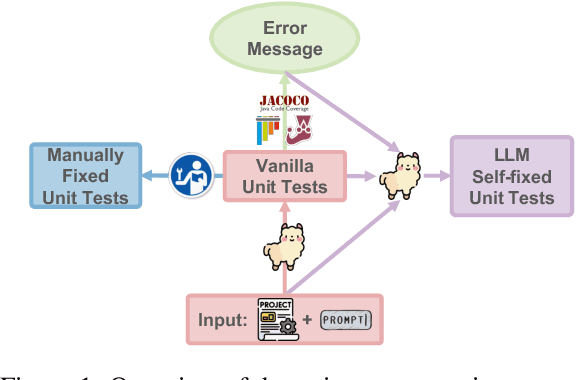


Unit test generation has become a promising and important use case of LLMs. However, existing evaluation benchmarks for assessing LLM unit test generation capabilities focus on function- or class-level code rather than more practical and challenging project-level codebases. To address such limitation, we propose ProjectTest, a project-level benchmark for unit test generation covering Python, Java, and JavaScript. ProjectTest features 20 moderate-sized and high-quality projects per language. We evaluate nine frontier LLMs on ProjectTest and the results show that all frontier LLMs tested exhibit moderate performance on ProjectTest on Python and Java, highlighting the difficulty of ProjectTest. We also conduct a thorough error analysis, which shows that even frontier LLMs, such as Claude-3.5-Sonnet, have significant simple errors, including compilation and cascade errors. Motivated by this observation, we further evaluate all frontier LLMs under manual error-fixing and self-error-fixing scenarios to assess their potential when equipped with error-fixing mechanisms.
Refine Knowledge of Large Language Models via Adaptive Contrastive Learning
Feb 11, 2025How to alleviate the hallucinations of Large Language Models (LLMs) has always been the fundamental goal pursued by the LLMs research community. Looking through numerous hallucination-related studies, a mainstream category of methods is to reduce hallucinations by optimizing the knowledge representation of LLMs to change their output. Considering that the core focus of these works is the knowledge acquired by models, and knowledge has long been a central theme in human societal progress, we believe that the process of models refining knowledge can greatly benefit from the way humans learn. In our work, by imitating the human learning process, we design an Adaptive Contrastive Learning strategy. Our method flexibly constructs different positive and negative samples for contrastive learning based on LLMs' actual mastery of knowledge. This strategy helps LLMs consolidate the correct knowledge they already possess, deepen their understanding of the correct knowledge they have encountered but not fully grasped, forget the incorrect knowledge they previously learned, and honestly acknowledge the knowledge they lack. Extensive experiments and detailed analyses on widely used datasets demonstrate the effectiveness of our method.
ProjectTest: A Project-level Unit Test Generation Benchmark and Impact of Error Fixing Mechanisms
Feb 10, 2025Unit test generation has become a promising and important use case of LLMs. However, existing evaluation benchmarks for assessing LLM unit test generation capabilities focus on function- or class-level code rather than more practical and challenging project-level codebases. To address such limitation, we propose ProjectTest, a project-level benchmark for unit test generation covering Python, Java, and JavaScript. ProjectTest features 20 moderate-sized and high-quality projects per language. We evaluate nine frontier LLMs on ProjectTest and the results show that all frontier LLMs tested exhibit moderate performance on ProjectTest on Python and Java, highlighting the difficulty of ProjectTest. We also conduct a thorough error analysis, which shows that even frontier LLMs, such as Claude-3.5-Sonnet, have significant simple errors, including compilation and cascade errors. Motivated by this observation, we further evaluate all frontier LLMs under manual error-fixing and self-error-fixing scenarios to assess their potential when equipped with error-fixing mechanisms.
Position: LLMs Can be Good Tutors in Foreign Language Education
Feb 08, 2025While recent efforts have begun integrating large language models (LLMs) into foreign language education (FLE), they often rely on traditional approaches to learning tasks without fully embracing educational methodologies, thus lacking adaptability to language learning. To address this gap, we argue that LLMs have the potential to serve as effective tutors in FLE. Specifically, LLMs can play three critical roles: (1) as data enhancers, improving the creation of learning materials or serving as student simulations; (2) as task predictors, serving as learner assessment or optimizing learning pathway; and (3) as agents, enabling personalized and inclusive education. We encourage interdisciplinary research to explore these roles, fostering innovation while addressing challenges and risks, ultimately advancing FLE through the thoughtful integration of LLMs.
Position: Multimodal Large Language Models Can Significantly Advance Scientific Reasoning
Feb 05, 2025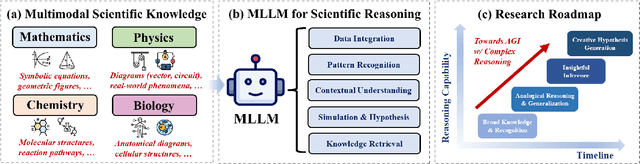

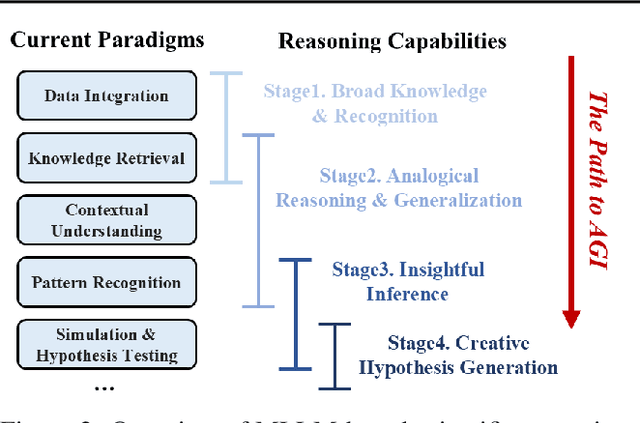

Scientific reasoning, the process through which humans apply logic, evidence, and critical thinking to explore and interpret scientific phenomena, is essential in advancing knowledge reasoning across diverse fields. However, despite significant progress, current scientific reasoning models still struggle with generalization across domains and often fall short of multimodal perception. Multimodal Large Language Models (MLLMs), which integrate text, images, and other modalities, present an exciting opportunity to overcome these limitations and enhance scientific reasoning. Therefore, this position paper argues that MLLMs can significantly advance scientific reasoning across disciplines such as mathematics, physics, chemistry, and biology. First, we propose a four-stage research roadmap of scientific reasoning capabilities, and highlight the current state of MLLM applications in scientific reasoning, noting their ability to integrate and reason over diverse data types. Second, we summarize the key challenges that remain obstacles to achieving MLLM's full potential. To address these challenges, we propose actionable insights and suggestions for the future. Overall, our work offers a novel perspective on MLLM integration with scientific reasoning, providing the LLM community with a valuable vision for achieving Artificial General Intelligence (AGI).