 Add to Chrome
 Add to Firefox
 Add to Edge
EasyInstruct: An Easy-to-use Instruction Processing Framework for Large Language Models
Feb 06, 2024


In recent years, instruction tuning has gained increasing attention and emerged as a crucial technique to enhance the capabilities of Large Language Models (LLMs). To construct high-quality instruction datasets, many instruction processing approaches have been proposed, aiming to achieve a delicate balance between data quantity and data quality. Nevertheless, due to inconsistencies that persist among various instruction processing methods, there is no standard open-source instruction processing implementation framework available for the community, which hinders practitioners from further developing and advancing. To facilitate instruction processing research and development, we present EasyInstruct, an easy-to-use instruction processing framework for LLMs, which modularizes instruction generation, selection, and prompting, while also considering their combination and interaction. EasyInstruct is publicly released and actively maintained at https://github.com/zjunlp/EasyInstruct, along with a running demo App at https://huggingface.co/spaces/zjunlp/EasyInstruct for quick-start, calling for broader research centered on instruction data.

Neighboring Perturbations of Knowledge Editing on Large Language Models
Jan 31, 2024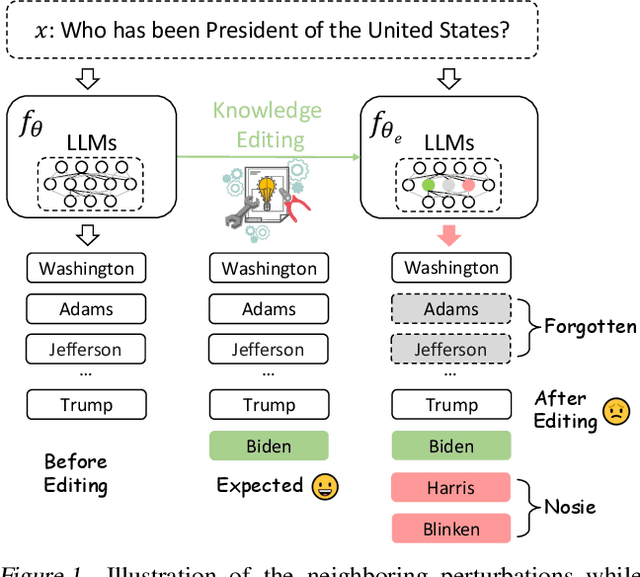
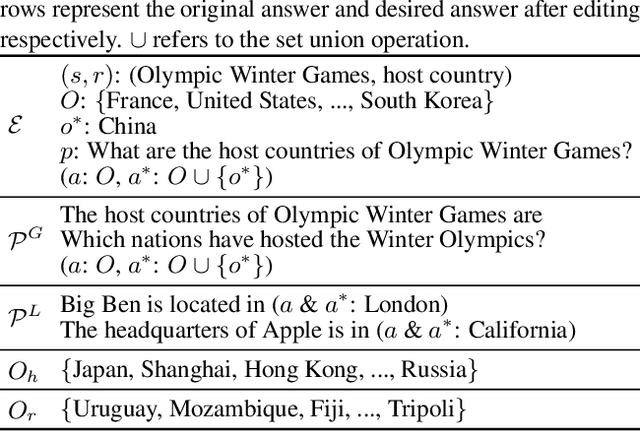
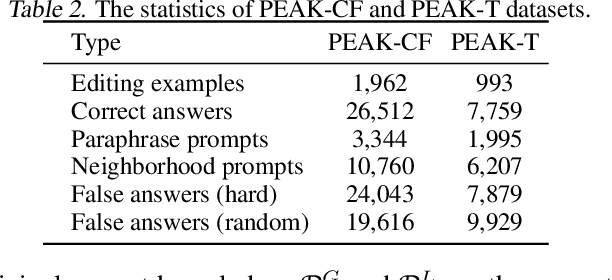
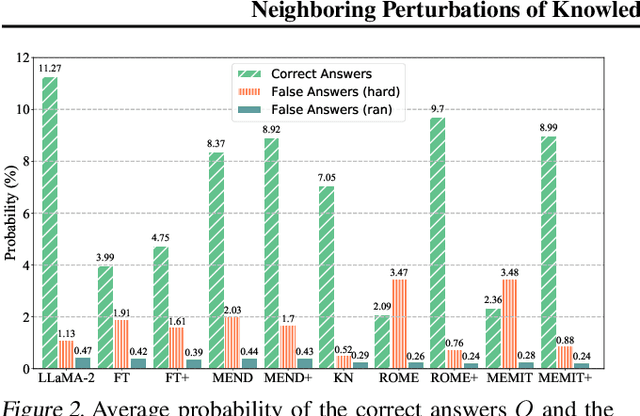
Despite their exceptional capabilities, large language models (LLMs) are prone to generating unintended text due to false or outdated knowledge. Given the resource-intensive nature of retraining LLMs, there has been a notable increase in the development of knowledge editing. However, current approaches and evaluations rarely explore the perturbation of editing on neighboring knowledge. This paper studies whether updating new knowledge to LLMs perturbs the neighboring knowledge encapsulated within them. Specifically, we seek to figure out whether appending a new answer into an answer list to a factual question leads to catastrophic forgetting of original correct answers in this list, as well as unintentional inclusion of incorrect answers. A metric of additivity is introduced and a benchmark dubbed as Perturbation Evaluation of Appending Knowledge (PEAK) is constructed to evaluate the degree of perturbation to neighboring knowledge when appending new knowledge. Besides, a plug-and-play framework termed Appending via Preservation and Prevention (APP) is proposed to mitigate the neighboring perturbation by maintaining the integrity of the answer list. Experiments demonstrate the effectiveness of APP coupling with four editing methods on three LLMs.
Weaver: Foundation Models for Creative Writing
Jan 30, 2024
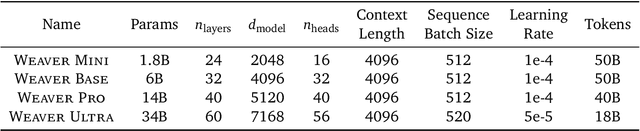
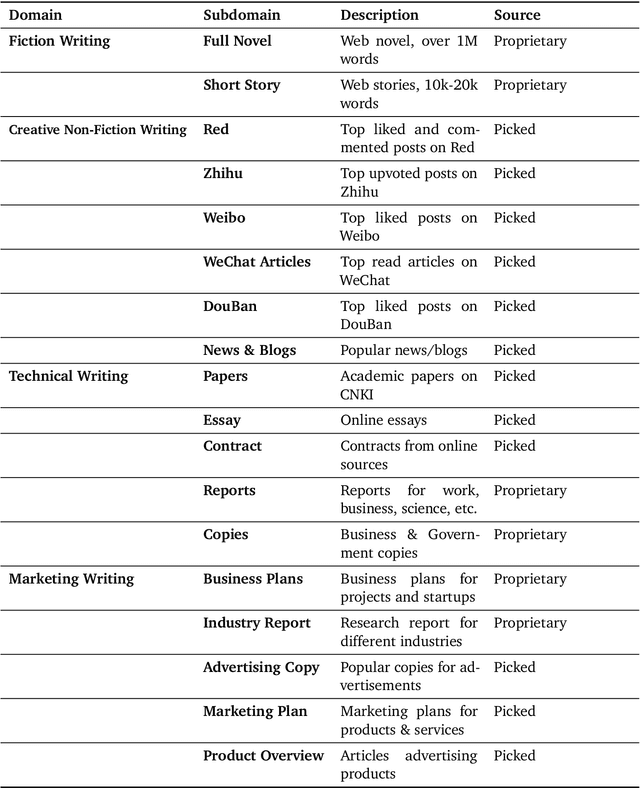
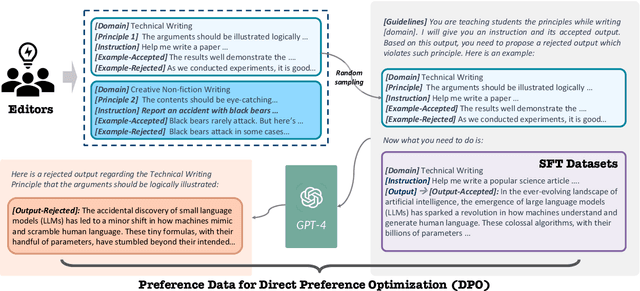
This work introduces Weaver, our first family of large language models (LLMs) dedicated to content creation. Weaver is pre-trained on a carefully selected corpus that focuses on improving the writing capabilities of large language models. We then fine-tune Weaver for creative and professional writing purposes and align it to the preference of professional writers using a suit of novel methods for instruction data synthesis and LLM alignment, making it able to produce more human-like texts and follow more diverse instructions for content creation. The Weaver family consists of models of Weaver Mini (1.8B), Weaver Base (6B), Weaver Pro (14B), and Weaver Ultra (34B) sizes, suitable for different applications and can be dynamically dispatched by a routing agent according to query complexity to balance response quality and computation cost. Evaluation on a carefully curated benchmark for assessing the writing capabilities of LLMs shows Weaver models of all sizes outperform generalist LLMs several times larger than them. Notably, our most-capable Weaver Ultra model surpasses GPT-4, a state-of-the-art generalist LLM, on various writing scenarios, demonstrating the advantage of training specialized LLMs for writing purposes. Moreover, Weaver natively supports retrieval-augmented generation (RAG) and function calling (tool usage). We present various use cases of these abilities for improving AI-assisted writing systems, including integration of external knowledge bases, tools, or APIs, and providing personalized writing assistance. Furthermore, we discuss and summarize a guideline and best practices for pre-training and fine-tuning domain-specific LLMs.
AUTOACT: Automatic Agent Learning from Scratch via Self-Planning
Jan 17, 2024
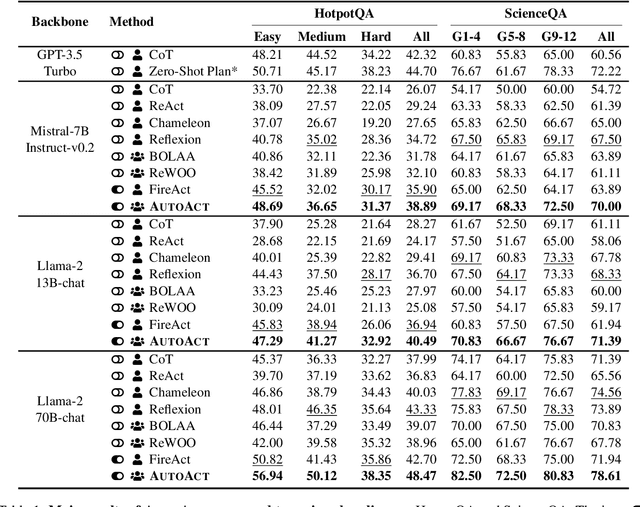
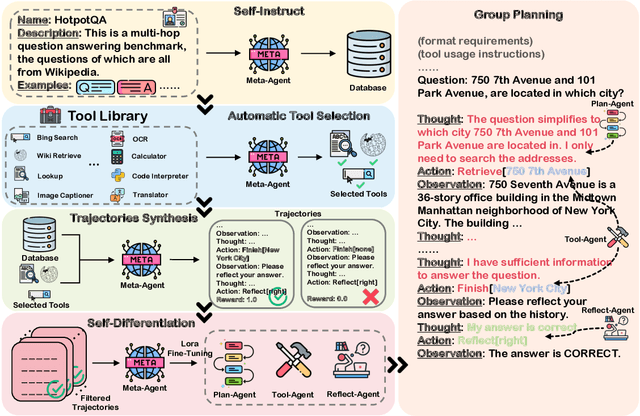
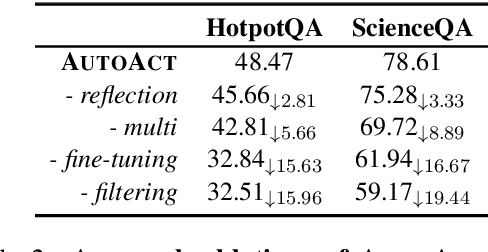
Language agents have achieved considerable performance on various complex tasks. Despite the incessant exploration in this field, existing language agent systems still struggle with costly, non-reproducible data reliance and face the challenge of compelling a single model for multiple functions. To this end, we introduce AutoAct, an automatic agent learning framework that does not rely on large-scale annotated data and synthetic trajectories from closed-source models (e.g., GPT-4). Given limited data with a tool library, AutoAct first automatically synthesizes planning trajectories without any assistance from humans or strong closed-source models. Then, AutoAct leverages a division-of-labor strategy to automatically differentiate based on the target task information and synthesized trajectories, producing a sub-agent group to complete the task. We conduct comprehensive experiments with different LLMs, which demonstrates that AutoAct yields better or parallel performance compared to various strong baselines. We even notice that AutoAct, when using the Llama-2-13b model, can achieve performance comparable to that of the zero-shot GPT-3.5-Turbo agent. Code will be available at https://github.com/zjunlp/AutoAct.
A Comprehensive Study of Knowledge Editing for Large Language Models
Jan 09, 2024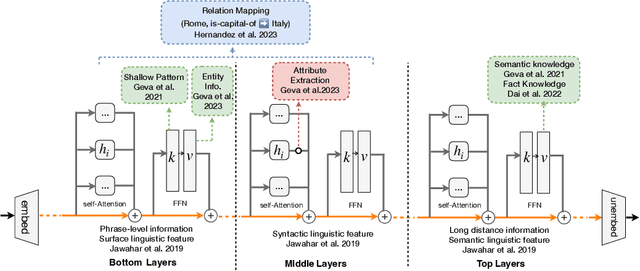
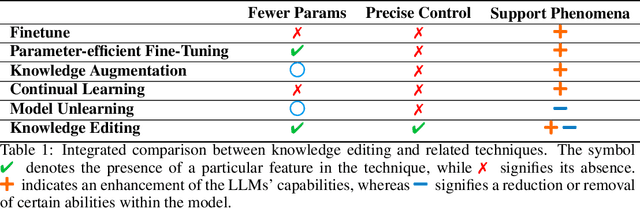
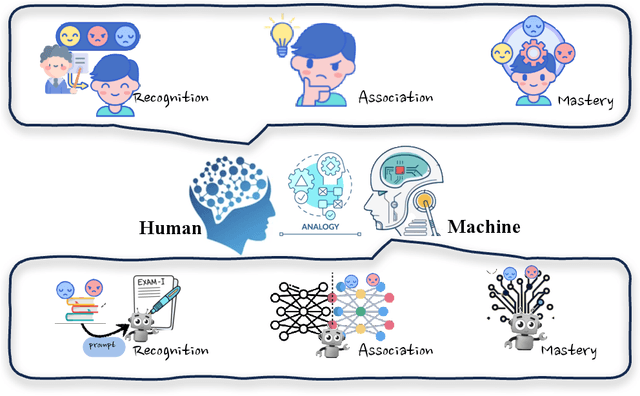
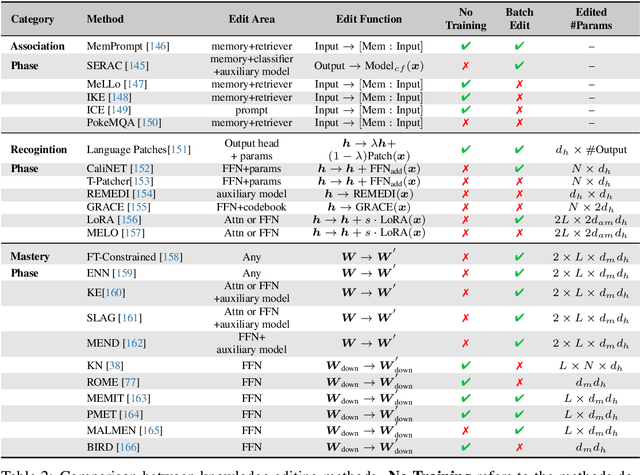
Large Language Models (LLMs) have shown extraordinary capabilities in understanding and generating text that closely mirrors human communication. However, a primary limitation lies in the significant computational demands during training, arising from their extensive parameterization. This challenge is further intensified by the dynamic nature of the world, necessitating frequent updates to LLMs to correct outdated information or integrate new knowledge, thereby ensuring their continued relevance. Note that many applications demand continual model adjustments post-training to address deficiencies or undesirable behaviors. There is an increasing interest in efficient, lightweight methods for on-the-fly model modifications. To this end, recent years have seen a burgeoning in the techniques of knowledge editing for LLMs, which aim to efficiently modify LLMs' behaviors within specific domains while preserving overall performance across various inputs. In this paper, we first define the knowledge editing problem and then provide a comprehensive review of cutting-edge approaches. Drawing inspiration from educational and cognitive research theories, we propose a unified categorization criterion that classifies knowledge editing methods into three groups: resorting to external knowledge, merging knowledge into the model, and editing intrinsic knowledge. Furthermore, we introduce a new benchmark, KnowEdit, for a comprehensive empirical evaluation of representative knowledge editing approaches. Additionally, we provide an in-depth analysis of knowledge location, which can give a deeper understanding of the knowledge structures inherent within LLMs. Finally, we discuss several potential applications of knowledge editing, outlining its broad and impactful implications.
Towards A Unified View of Answer Calibration for Multi-Step Reasoning
Nov 15, 2023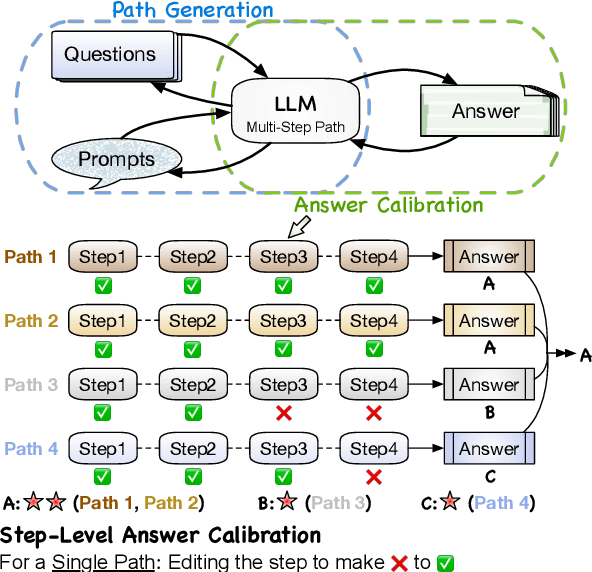
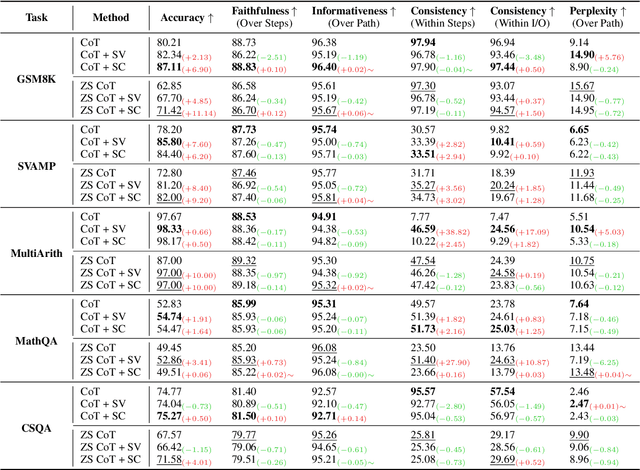
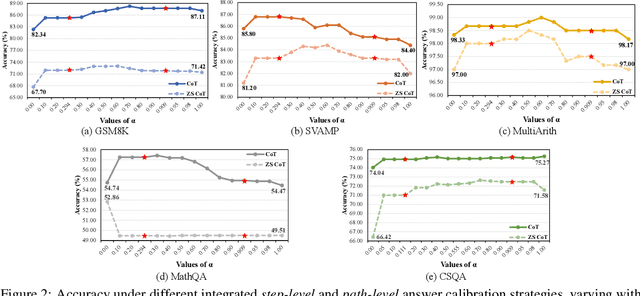
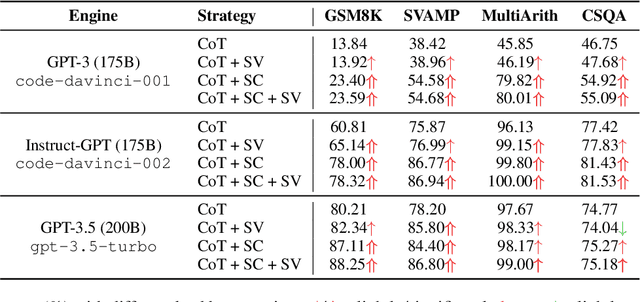
Large Language Models (LLMs) employing Chain-of-Thought (CoT) prompting have broadened the scope for improving multi-step reasoning capabilities. Usually, answer calibration strategies such as step-level or path-level calibration play a vital role in multi-step reasoning. While effective, there remains a significant gap in our understanding of the key factors that drive their success. In this paper, we break down the design of recent answer calibration strategies and present a unified view which establishes connections between them. We then conduct a thorough evaluation on these strategies from a unified view, systematically scrutinizing step-level and path-level answer calibration across multiple paths. Our study holds the potential to illuminate key insights for optimizing multi-step reasoning with answer calibration.
OceanGPT: A Large Language Model for Ocean Science Tasks
Oct 19, 2023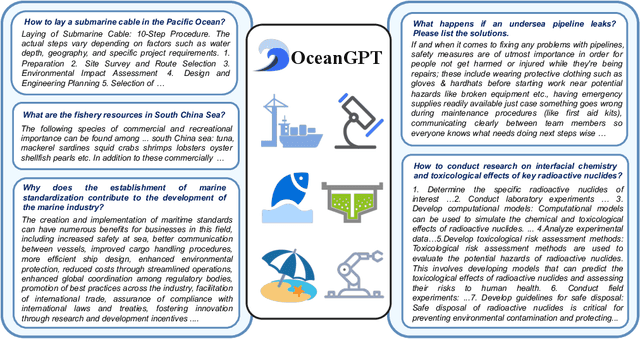
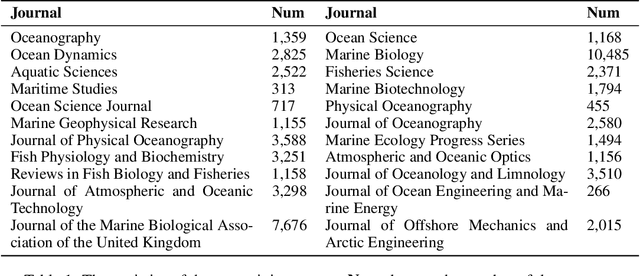
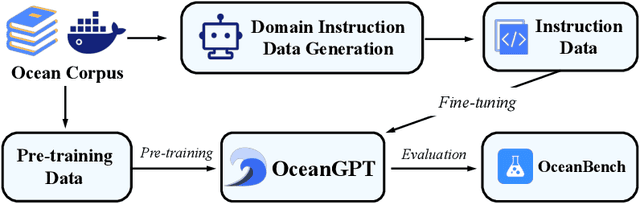

Ocean science, which delves into the oceans that are reservoirs of life and biodiversity, is of great significance given that oceans cover over 70% of our planet's surface. Recently, advances in Large Language Models (LLMs) have transformed the paradigm in science. Despite the success in other domains, current LLMs often fall short in catering to the needs of domain experts like oceanographers, and the potential of LLMs for ocean science is under-explored. The intrinsic reason may be the immense and intricate nature of ocean data as well as the necessity for higher granularity and richness in knowledge. To alleviate these issues, we introduce OceanGPT, the first-ever LLM in the ocean domain, which is expert in various ocean science tasks. We propose DoInstruct, a novel framework to automatically obtain a large volume of ocean domain instruction data, which generates instructions based on multi-agent collaboration. Additionally, we construct the first oceanography benchmark, OceanBench, to evaluate the capabilities of LLMs in the ocean domain. Though comprehensive experiments, OceanGPT not only shows a higher level of knowledge expertise for oceans science tasks but also gains preliminary embodied intelligence capabilities in ocean technology. Codes, data and checkpoints will soon be available at https://github.com/zjunlp/KnowLM.
Unveiling the Siren's Song: Towards Reliable Fact-Conflicting Hallucination Detection
Oct 18, 2023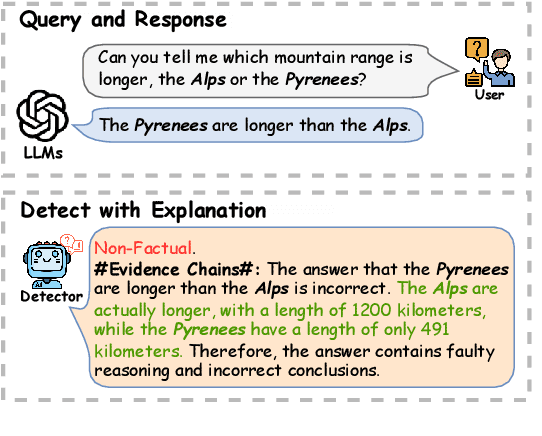


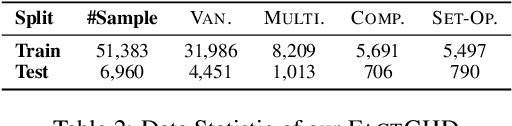
Large Language Models (LLMs), such as ChatGPT/GPT-4, have garnered widespread attention owing to their myriad of practical applications, yet their adoption has been constrained by issues of fact-conflicting hallucinations across web platforms. The assessment of factuality in text, produced by LLMs, remains inadequately explored, extending not only to the judgment of vanilla facts but also encompassing the evaluation of factual errors emerging in complex inferential tasks like multi-hop, and etc. In response, we introduce FactCHD, a fact-conflicting hallucination detection benchmark meticulously designed for LLMs. Functioning as a pivotal tool in evaluating factuality within "Query-Respons" contexts, our benchmark assimilates a large-scale dataset, encapsulating a broad spectrum of factuality patterns, such as vanilla, multi-hops, comparison, and set-operation patterns. A distinctive feature of our benchmark is its incorporation of fact-based chains of evidence, thereby facilitating comprehensive and conducive factual reasoning throughout the assessment process. We evaluate multiple LLMs, demonstrating the effectiveness of the benchmark and current methods fall short of faithfully detecting factual errors. Furthermore, we present TRUTH-TRIANGULATOR that synthesizes reflective considerations by tool-enhanced ChatGPT and LoRA-tuning based on Llama2, aiming to yield more credible detection through the amalgamation of predictive results and evidence. The benchmark dataset and source code will be made available in https://github.com/zjunlp/FactCHD.
Can We Edit Multimodal Large Language Models?
Oct 13, 2023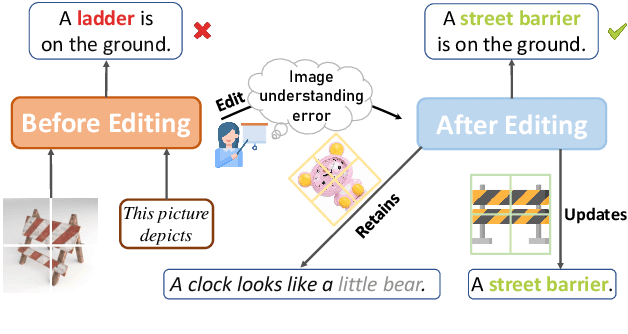
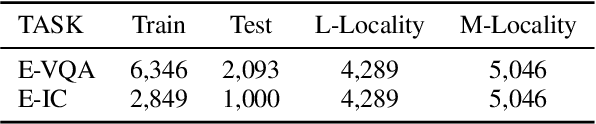
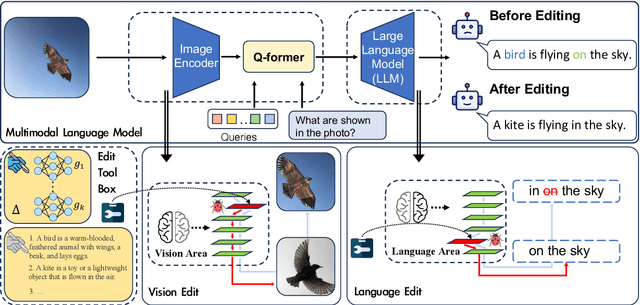
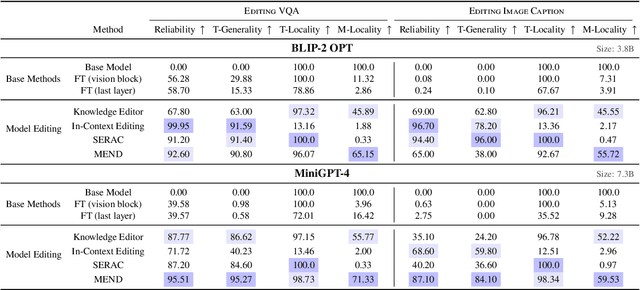
In this paper, we focus on editing Multimodal Large Language Models (MLLMs). Compared to editing single-modal LLMs, multimodal model editing is more challenging, which demands a higher level of scrutiny and careful consideration in the editing process. To facilitate research in this area, we construct a new benchmark, dubbed MMEdit, for editing multimodal LLMs and establishing a suite of innovative metrics for evaluation. We conduct comprehensive experiments involving various model editing baselines and analyze the impact of editing different components for multimodal LLMs. Empirically, we notice that previous baselines can implement editing multimodal LLMs to some extent, but the effect is still barely satisfactory, indicating the potential difficulty of this task. We hope that our work can provide the NLP community with insights. Code and dataset are available in https://github.com/zjunlp/EasyEdit.
Editing Personality for LLMs
Oct 03, 2023This paper introduces an innovative task focused on editing the personality traits of Large Language Models (LLMs). This task seeks to adjust the models' responses to opinion-related questions on specified topics since an individual's personality often manifests in the form of their expressed opinions, thereby showcasing different personality traits. Specifically, we construct a new benchmark dataset PersonalityEdit to address this task. Drawing on the theory in Social Psychology, we isolate three representative traits, namely Neuroticism, Extraversion, and Agreeableness, as the foundation for our benchmark. We then gather data using GPT-4, generating responses that not only align with a specified topic but also embody the targeted personality trait. We conduct comprehensive experiments involving various baselines and discuss the representation of personality behavior in LLMs. Our intriguing findings uncover potential challenges of the proposed task, illustrating several remaining issues. We anticipate that our work can provide the NLP community with insights. Code and datasets will be released at https://github.com/zjunlp/EasyEdit.