 Add to Chrome
 Add to Firefox
 Add to Edge
AgentStream: How Well Do Self-Evolving LLM Agents Perform Under Streaming Tasks?
Jul 31, 2026
Large language model (LLM) agents can self-evolve by continually improving from their own accumulated experience. However, existing studies predominantly adopt independent evaluation. Consequently, the behavior of self-evolving agents in realistic streaming settings, where agents adapt to diverse and complex task streams, remains poorly understood. To address this gap, we introduce AgentStream, a unified framework that evaluates self-evolving agents spanning diverse evolution components by organizing agentic benchmarks into a configurable task stream and instantiating the \texttt{Isolated}, \texttt{Sequential}, and \texttt{Interleaved} streaming scenarios at test time, which progressively vary the scope and domain composition of the stream. Over these scenarios, we combinatorially evaluate five representative self-evolving methods across three frontier foundation models, disentangling how model capability, method architecture, and streaming scenario jointly shape self-evolution. Our results show that self-evolution reliability varies across streaming scenarios, the benefit of self-evolution is gated by model capability and non-monotonic in model strength, and no single method dominates across models and scenarios. These findings offer concrete guidance for selecting self-evolving methods across models and streaming scenarios. Overall, we advocate that self-evolving agents should be evaluated under realistic task streams rather than isolated single-task settings.

SocialCoach: Personalized Social Skill Learning with RL-based Agentic Tutoring and Practice
Jun 02, 2026Social skills such as negotiation and leadership are crucial for personal and professional success in today's interconnected world. However, scalable and effective training remains a significant challenge due to the scarcity of expert coaching. In this paper, we introduce SocialCoach, a holistic LLM-powered agentic tutoring system for personalized social skill development at scale. First, SocialCoach automatically constructs a pedagogically-grounded, theory-to-practice knowledge corpus from diverse expert sources, leveraging a multi-agent pipeline. Second, to personalize the learning journey, it employs an adaptive practice scheduling module that follows a prescription-retrieval-adaptation process. To maximize the long-term learning experience while overcoming the cold-start problem, this policy is optimized within a learner simulation environment through reinforcement learning. Finally, SocialCoach integrates immersive, goal-driven practice, causality-driven proficiency assessment and knowledge-grounded, reflective tutoring to help address the knowing-doing gap. We deploy it in our product, EQoach, and conduct extensive experiments. The results show that SocialCoach improves simulated pathway quality and judge-rated tutoring quality over baseline approaches, while early user feedback indicates strong perceived engagement and usefulness. These findings suggest a practical architecture for personalized and gamified pedagogical platforms on soft skill learning.
Scaling Human-AI Coding Collaboration Requires a Governable Consensus Layer
Apr 20, 2026Vibe coding produces correct, executable code at speed, but leaves no record of the structural commitments, dependencies, or evidence behind it. Reviewers cannot determine what invariants were assumed, what changed, or why a regression occurred. This is not a generation failure but a control failure: the dominant artifact of AI-assisted development (code plus chat history) performs dimension collapse, flattening complex system topology into low-dimensional text and making systems opaque and fragile under change. We propose Agentic Consensus: a paradigm in which the consensus layer C, an operable world model represented as a typed property graph, replaces code as the primary artifact of engineering. Executable artifacts are derived from C and kept in correspondence via synchronization operators Phi (realize) and Psi (rehydrate). Evidence links directly to structural claims in C, making every commitment auditable and under-specification explicit as measurable consensus entropy rather than a silent guess. Evaluation must move beyond code correctness toward alignment fidelity, consensus entropy, and intervention distance. We propose benchmark task families designed to measure whether consensus-based workflows reduce human intervention compared to chat-driven baselines.
Beyond Voxel 3D Editing: Learning from 3D Masks and Self-Constructed Data
Apr 15, 20263D editing refers to the ability to apply local or global modifications to 3D assets. Effective 3D editing requires maintaining semantic consistency by performing localized changes according to prompts, while also preserving local invariance so that unchanged regions remain consistent with the original. However, existing approaches have significant limitations: multi-view editing methods incur losses when projecting back to 3D, while voxel-based editing is constrained in both the regions that can be modified and the scale of modifications. Moreover, the lack of sufficiently large editing datasets for training and evaluation remains a challenge. To address these challenges, we propose a Beyond Voxel 3D Editing (BVE) framework with a self-constructed large-scale dataset specifically tailored for 3D editing. Building upon this dataset, our model enhances a foundational image-to-3D generative architecture with lightweight, trainable modules, enabling efficient injection of textual semantics without the need for expensive full-model retraining. Furthermore, we introduce an annotation-free 3D masking strategy to preserve local invariance, maintaining the integrity of unchanged regions during editing. Extensive experiments demonstrate that BVE achieves superior performance in generating high-quality, text-aligned 3D assets, while faithfully retaining the visual characteristics of the original input.
Native and Compact Structured Latents for 3D Generation
Dec 16, 2025Recent advancements in 3D generative modeling have significantly improved the generation realism, yet the field is still hampered by existing representations, which struggle to capture assets with complex topologies and detailed appearance. This paper present an approach for learning a structured latent representation from native 3D data to address this challenge. At its core is a new sparse voxel structure called O-Voxel, an omni-voxel representation that encodes both geometry and appearance. O-Voxel can robustly model arbitrary topology, including open, non-manifold, and fully-enclosed surfaces, while capturing comprehensive surface attributes beyond texture color, such as physically-based rendering parameters. Based on O-Voxel, we design a Sparse Compression VAE which provides a high spatial compression rate and a compact latent space. We train large-scale flow-matching models comprising 4B parameters for 3D generation using diverse public 3D asset datasets. Despite their scale, inference remains highly efficient. Meanwhile, the geometry and material quality of our generated assets far exceed those of existing models. We believe our approach offers a significant advancement in 3D generative modeling.
Unveiling the Learning Mind of Language Models: A Cognitive Framework and Empirical Study
Jun 16, 2025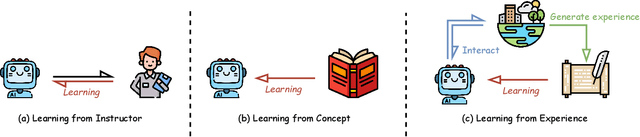
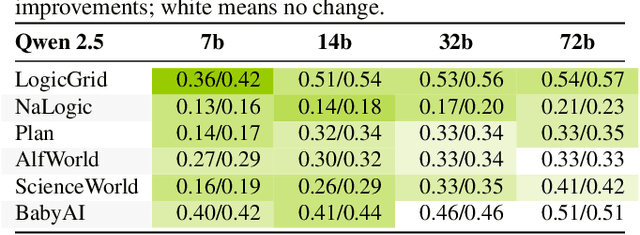
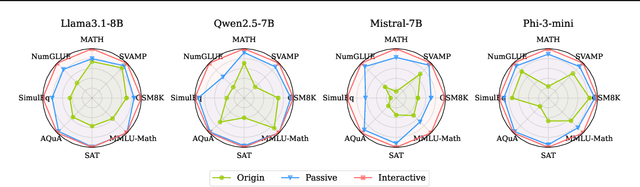
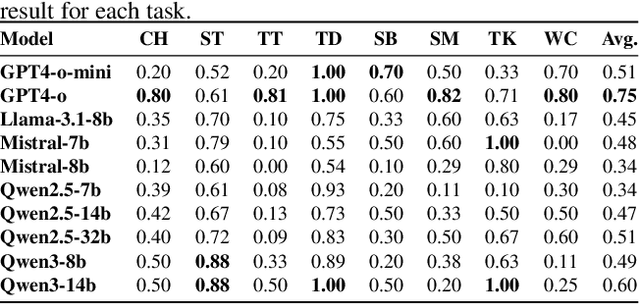
Large language models (LLMs) have shown impressive capabilities across tasks such as mathematics, coding, and reasoning, yet their learning ability, which is crucial for adapting to dynamic environments and acquiring new knowledge, remains underexplored. In this work, we address this gap by introducing a framework inspired by cognitive psychology and education. Specifically, we decompose general learning ability into three distinct, complementary dimensions: Learning from Instructor (acquiring knowledge via explicit guidance), Learning from Concept (internalizing abstract structures and generalizing to new contexts), and Learning from Experience (adapting through accumulated exploration and feedback). We conduct a comprehensive empirical study across the three learning dimensions and identify several insightful findings, such as (i) interaction improves learning; (ii) conceptual understanding is scale-emergent and benefits larger models; and (iii) LLMs are effective few-shot learners but not many-shot learners. Based on our framework and empirical findings, we introduce a benchmark that provides a unified and realistic evaluation of LLMs' general learning abilities across three learning cognition dimensions. It enables diagnostic insights and supports evaluation and development of more adaptive and human-like models.
LLM-powered Multi-agent Framework for Goal-oriented Learning in Intelligent Tutoring System
Jan 27, 2025


Intelligent Tutoring Systems (ITSs) have revolutionized education by offering personalized learning experiences. However, as goal-oriented learning, which emphasizes efficiently achieving specific objectives, becomes increasingly important in professional contexts, existing ITSs often struggle to deliver this type of targeted learning experience. In this paper, we propose GenMentor, an LLM-powered multi-agent framework designed to deliver goal-oriented, personalized learning within ITS. GenMentor begins by accurately mapping learners' goals to required skills using a fine-tuned LLM trained on a custom goal-to-skill dataset. After identifying the skill gap, it schedules an efficient learning path using an evolving optimization approach, driven by a comprehensive and dynamic profile of learners' multifaceted status. Additionally, GenMentor tailors learning content with an exploration-drafting-integration mechanism to align with individual learner needs. Extensive automated and human evaluations demonstrate GenMentor's effectiveness in learning guidance and content quality. Furthermore, we have deployed it in practice and also implemented it as an application. Practical human study with professional learners further highlights its effectiveness in goal alignment and resource targeting, leading to enhanced personalization. Supplementary resources are available at https://github.com/GeminiLight/gen-mentor.
FlagVNE: A Flexible and Generalizable Reinforcement Learning Framework for Network Resource Allocation
Apr 19, 2024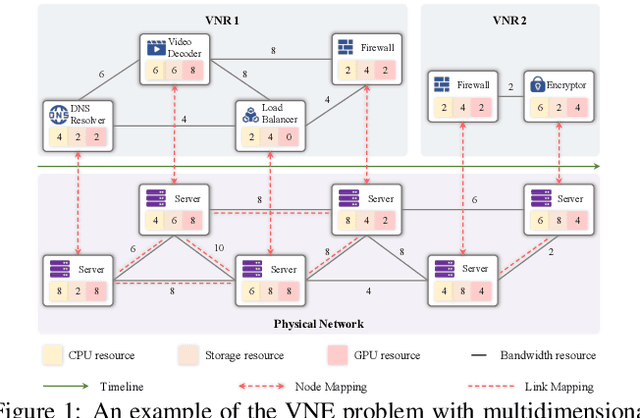

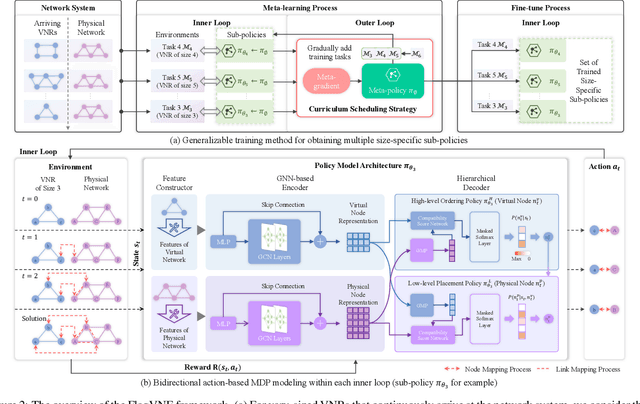

Virtual network embedding (VNE) is an essential resource allocation task in network virtualization, aiming to map virtual network requests (VNRs) onto physical infrastructure. Reinforcement learning (RL) has recently emerged as a promising solution to this problem. However, existing RL-based VNE methods are limited by the unidirectional action design and one-size-fits-all training strategy, resulting in restricted searchability and generalizability. In this paper, we propose a FLexible And Generalizable RL framework for VNE, named FlagVNE. Specifically, we design a bidirectional action-based Markov decision process model that enables the joint selection of virtual and physical nodes, thus improving the exploration flexibility of solution space. To tackle the expansive and dynamic action space, we design a hierarchical decoder to generate adaptive action probability distributions and ensure high training efficiency. Furthermore, to overcome the generalization issue for varying VNR sizes, we propose a meta-RL-based training method with a curriculum scheduling strategy, facilitating specialized policy training for each VNR size. Finally, extensive experimental results show the effectiveness of FlagVNE across multiple key metrics. Our code is available at GitHub (https://github.com/GeminiLight/flag-vne).
Recognizing Unseen Objects via Multimodal Intensive Knowledge Graph Propagation
Jun 21, 2023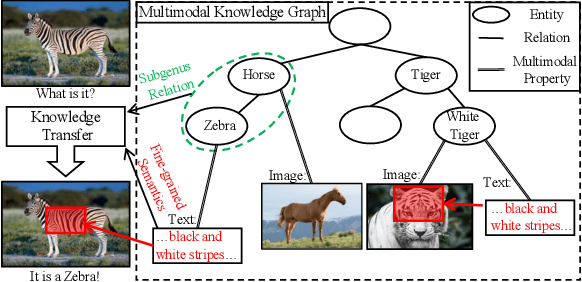
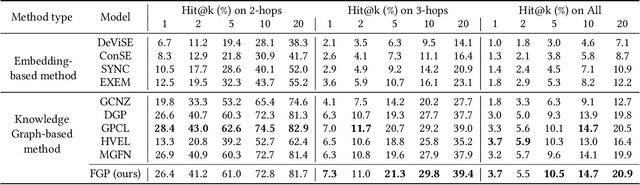
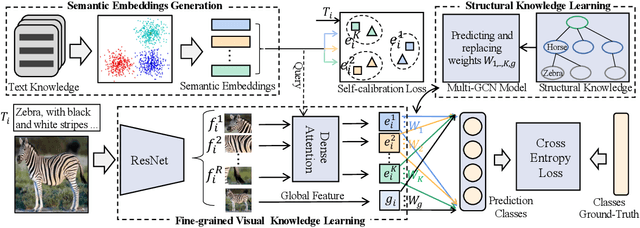
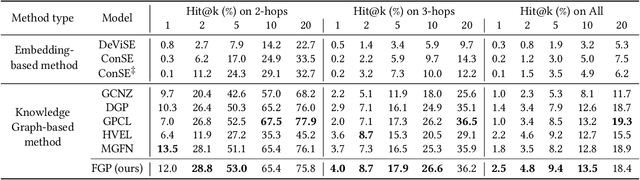
Zero-Shot Learning (ZSL), which aims at automatically recognizing unseen objects, is a promising learning paradigm to understand new real-world knowledge for machines continuously. Recently, the Knowledge Graph (KG) has been proven as an effective scheme for handling the zero-shot task with large-scale and non-attribute data. Prior studies always embed relationships of seen and unseen objects into visual information from existing knowledge graphs to promote the cognitive ability of the unseen data. Actually, real-world knowledge is naturally formed by multimodal facts. Compared with ordinary structural knowledge from a graph perspective, multimodal KG can provide cognitive systems with fine-grained knowledge. For example, the text description and visual content can depict more critical details of a fact than only depending on knowledge triplets. Unfortunately, this multimodal fine-grained knowledge is largely unexploited due to the bottleneck of feature alignment between different modalities. To that end, we propose a multimodal intensive ZSL framework that matches regions of images with corresponding semantic embeddings via a designed dense attention module and self-calibration loss. It makes the semantic transfer process of our ZSL framework learns more differentiated knowledge between entities. Our model also gets rid of the performance limitation of only using rough global features. We conduct extensive experiments and evaluate our model on large-scale real-world data. The experimental results clearly demonstrate the effectiveness of the proposed model in standard zero-shot classification tasks.
Learning Profitable NFT Image Diffusions via Multiple Visual-Policy Guided Reinforcement Learning
Jun 20, 2023


We study the task of generating profitable Non-Fungible Token (NFT) images from user-input texts. Recent advances in diffusion models have shown great potential for image generation. However, existing works can fall short in generating visually-pleasing and highly-profitable NFT images, mainly due to the lack of 1) plentiful and fine-grained visual attribute prompts for an NFT image, and 2) effective optimization metrics for generating high-quality NFT images. To solve these challenges, we propose a Diffusion-based generation framework with Multiple Visual-Policies as rewards (i.e., Diffusion-MVP) for NFT images. The proposed framework consists of a large language model (LLM), a diffusion-based image generator, and a series of visual rewards by design. First, the LLM enhances a basic human input (such as "panda") by generating more comprehensive NFT-style prompts that include specific visual attributes, such as "panda with Ninja style and green background." Second, the diffusion-based image generator is fine-tuned using a large-scale NFT dataset to capture fine-grained image styles and accessory compositions of popular NFT elements. Third, we further propose to utilize multiple visual-policies as optimization goals, including visual rarity levels, visual aesthetic scores, and CLIP-based text-image relevances. This design ensures that our proposed Diffusion-MVP is capable of minting NFT images with high visual quality and market value. To facilitate this research, we have collected the largest publicly available NFT image dataset to date, consisting of 1.5 million high-quality images with corresponding texts and market values. Extensive experiments including objective evaluations and user studies demonstrate that our framework can generate NFT images showing more visually engaging elements and higher market value, compared with SOTA approaches.