 Add to Chrome
 Add to Firefox
 Add to Edge
Robust Contrastive Graph Clustering with Adaptive Local-Global Integration
May 27, 2026
Graph clustering is essential in graph analysis for revealing structural patterns and node communities. Despite recent advances in self-supervised contrastive learning that have improved clustering via structural and attribute signals, existing methods still struggle to flexibly capture high-order local structures and often overlook global semantics in complex graphs. These limitations lead to suboptimal node representations, especially in real-world graphs with fragmented structures and ambiguous cluster boundaries. To address these limitations, a contrastive graph clustering framework is proposed to jointly integrate multi-scale local structures with global semantics via attention mechanisms. At the local level, GNN-based topological signals extracted from multiple propagation depths are adaptively fused through attention-based weighting to capture multi-scale neighborhood features. At the global level, semantic prototypes derived from dynamically evolving cluster centers are adaptively aggregated through attention to guide node representations and enhance inter-cluster separability. The model is trained under a dual-view contrastive learning paradigm with a hybrid objective that combines instance-level and structure-aware losses to improve representation robustness and discrimination. Experiments on eight real-world graph datasets demonstrate that our method achieves competitive clustering performance. Code is available at https://github.com/vege12138/w2.

GCIB: Graph Contrastive Information Bottleneck for Multi-Behavior Recommendation
May 25, 2026With the rapid emergence of multi-behavior learning in recommender systems, leveraging auxiliary user behaviors has proven effective for mitigating target-behavior data sparsity. Yet auxiliary behavior graphs frequently contain noisy or irrelevant interactions that do not align with the target task, impeding the learning of accurate user and item embeddings. Moreover, the scarcity of direct supervision from the target behavior complicates the extraction of informative collaborative signals. In this paper, we introduce GCIB (Graph Contrastive Information Bottleneck), a novel framework that denoises auxiliary behavior information and enriches target behavior representations at both the structural and feature levels. At the structural level, GCIB employs a Graph Information Bottleneck (GIB) objective to maximize mutual information between the denoised auxiliary graph and the target-behavior graph while minimizing mutual information with the original auxiliary graph. This formulation preserves task-relevant structural patterns and suppresses spurious interactions. At the feature level, we propose a cross-behavior Graph Contrastive Learning (GCL) scheme in which denoised auxiliary features and target-behavior features serve as complementary views for both users and items. By contrasting these views, GCIB enriches sparse target-behavior representations with semantics distilled from auxiliary behaviors. Extensive experiments demonstrate that GCIB outperforms state-of-the-art baselines, highlighting its ability to learn noise-resilient and target-aware representations for multi-behavior recommendation.
Missing Old Logits in Asynchronous Agentic RL: Semantic Mismatch and Repair Methods for Off-Policy Correction
May 12, 2026Asynchronous reinforcement learning improves rollout throughput for large language model agents by decoupling sample generation from policy optimization, but it also introduces a critical failure mode for PPO-style off-policy correction. In heterogeneous training systems, the total importance ratio should ideally be decomposed into two semantically distinct factors: a \emph{training--inference discrepancy term} that aligns inference-side and training-side distributions at the same behavior-policy version, and a \emph{policy-staleness term} that constrains the update from the historical policy to the current policy. We show that practical asynchronous pipelines with delayed updates and partial rollouts often lose the required historical training-side logits, or old logits. This missing-old-logit problem entangles discrepancy repair with staleness correction, breaks the intended semantics of decoupled correction, and makes clipping and masking thresholds interact undesirably. To address this issue, we study both exact and approximate correction routes. We propose three exact old-logit acquisition strategies: snapshot-based version tracking, a dedicated old-logit model, and synchronization via partial rollout interruption, and compare their system trade-offs. From the perspective of approximate correction, we focus on preserving the benefits of decoupled correction through a more appropriate approximate policy when exact old logits cannot be recovered at low cost, without incurring extra system overhead. Following this analysis, we adopt a revised PPO-EWMA method, which achieves significant gains in both training speed and optimization performance. Code at https://github.com/millioniron/ROLL.
RL-VLA$^3$: Reinforcement Learning VLA Accelerating via Full Asynchronism
Feb 05, 2026In recent years, Vision-Language-Action (VLA) models have emerged as a crucial pathway towards general embodied intelligence, yet their training efficiency has become a key bottleneck. Although existing reinforcement learning (RL)-based training frameworks like RLinf can enhance model generalization, they still rely on synchronous execution, leading to severe resource underutilization and throughput limitations during environment interaction, policy generation (rollout), and model update phases (actor). To overcome this challenge, this paper, for the first time, proposes and implements a fully-asynchronous policy training framework encompassing the entire pipeline from environment interaction, rollout generation, to actor policy updates. Systematically drawing inspiration from asynchronous optimization ideas in large model RL, our framework designs a multi-level decoupled architecture. This includes asynchronous parallelization of environment interaction and trajectory collection, streaming execution for policy generation, and decoupled scheduling for training updates. We validated the effectiveness of our method across diverse VLA models and environments. On the LIBERO benchmark, the framework achieves throughput improvements of up to 59.25\% compared to existing synchronous strategies. When deeply optimizing separation strategies, throughput can be increased by as much as 126.67\%. We verified the effectiveness of each asynchronous component via ablation studies. Scaling law validation across 8 to 256 GPUs demonstrates our method's excellent scalability under most conditions.
ReInAgent: A Context-Aware GUI Agent Enabling Human-in-the-Loop Mobile Task Navigation
Oct 09, 2025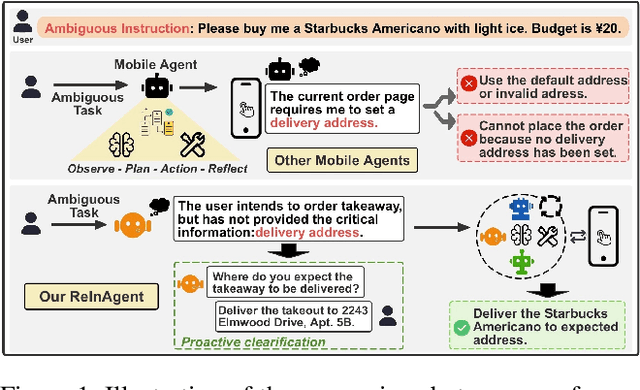
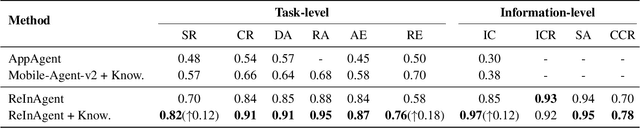
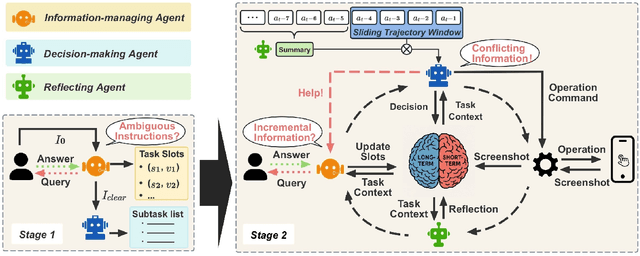
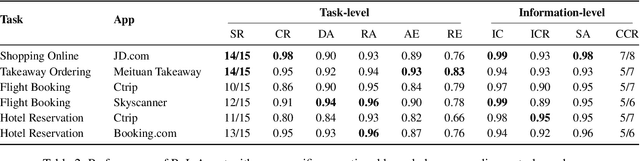
Mobile GUI agents exhibit substantial potential to facilitate and automate the execution of user tasks on mobile phones. However, exist mobile GUI agents predominantly privilege autonomous operation and neglect the necessity of active user engagement during task execution. This omission undermines their adaptability to information dilemmas including ambiguous, dynamically evolving, and conflicting task scenarios, leading to execution outcomes that deviate from genuine user requirements and preferences. To address these shortcomings, we propose ReInAgent, a context-aware multi-agent framework that leverages dynamic information management to enable human-in-the-loop mobile task navigation. ReInAgent integrates three specialized agents around a shared memory module: an information-managing agent for slot-based information management and proactive interaction with the user, a decision-making agent for conflict-aware planning, and a reflecting agent for task reflection and information consistency validation. Through continuous contextual information analysis and sustained user-agent collaboration, ReInAgent overcomes the limitation of existing approaches that rely on clear and static task assumptions. Consequently, it enables more adaptive and reliable mobile task navigation in complex, real-world scenarios. Experimental results demonstrate that ReInAgent effectively resolves information dilemmas and produces outcomes that are more closely aligned with genuine user preferences. Notably, on complex tasks involving information dilemmas, ReInAgent achieves a 25% higher success rate than Mobile-Agent-v2.
Bridging the Last Mile of Prediction: Enhancing Time Series Forecasting with Conditional Guided Flow Matching
Jul 09, 2025Diffusion models, a type of generative model, have shown promise in time series forecasting. But they face limitations like rigid source distributions and limited sampling paths, which hinder their performance. Flow matching offers faster generation, higher-quality outputs, and greater flexibility, while also possessing the ability to utilize valuable information from the prediction errors of prior models, which were previously inaccessible yet critically important. To address these challenges and fully unlock the untapped potential of flow matching, we propose Conditional Guided Flow Matching (CGFM). CGFM extends flow matching by incorporating the outputs of an auxiliary model, enabling a previously unattainable capability in the field: learning from the errors of the auxiliary model. For time series forecasting tasks, it integrates historical data as conditions and guidance, constructs two-sided conditional probability paths, and uses a general affine path to expand the space of probability paths, ultimately leading to improved predictions. Extensive experiments show that CGFM consistently enhances and outperforms state-of-the-art models, highlighting its effectiveness in advancing forecasting methods.
Attention Mechanisms Perspective: Exploring LLM Processing of Graph-Structured Data
May 04, 2025Attention mechanisms are critical to the success of large language models (LLMs), driving significant advancements in multiple fields. However, for graph-structured data, which requires emphasis on topological connections, they fall short compared to message-passing mechanisms on fixed links, such as those employed by Graph Neural Networks (GNNs). This raises a question: ``Does attention fail for graphs in natural language settings?'' Motivated by these observations, we embarked on an empirical study from the perspective of attention mechanisms to explore how LLMs process graph-structured data. The goal is to gain deeper insights into the attention behavior of LLMs over graph structures. We uncovered unique phenomena regarding how LLMs apply attention to graph-structured data and analyzed these findings to improve the modeling of such data by LLMs. The primary findings of our research are: 1) While LLMs can recognize graph data and capture text-node interactions, they struggle to model inter-node relationships within graph structures due to inherent architectural constraints. 2) The attention distribution of LLMs across graph nodes does not align with ideal structural patterns, indicating a failure to adapt to graph topology nuances. 3) Neither fully connected attention nor fixed connectivity is optimal; each has specific limitations in its application scenarios. Instead, intermediate-state attention windows improve LLM training performance and seamlessly transition to fully connected windows during inference. Source code: \href{https://github.com/millioniron/LLM_exploration}{LLM4Exploration}
Instruct-of-Reflection: Enhancing Large Language Models Iterative Reflection Capabilities via Dynamic-Meta Instruction
Mar 02, 2025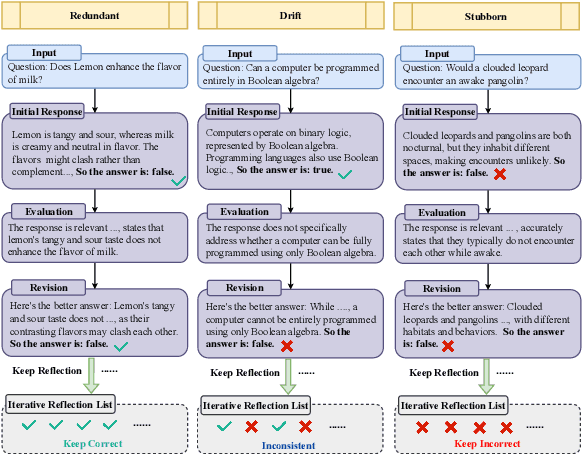
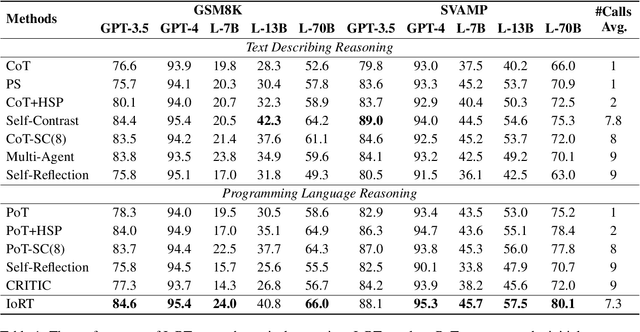
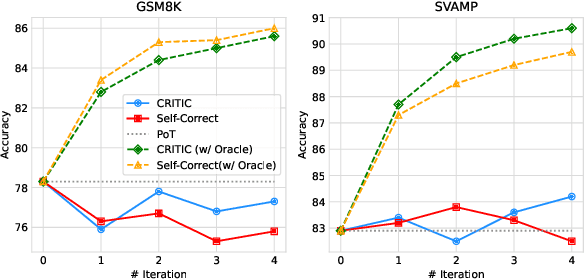
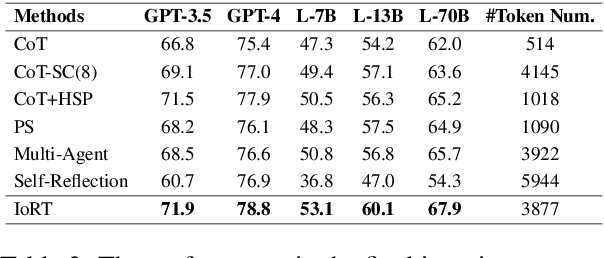
Self-reflection for Large Language Models (LLMs) has gained significant attention. Existing approaches involve models iterating and improving their previous responses based on LLMs' internal reflection ability or external feedback. However, recent research has raised doubts about whether intrinsic self-correction without external feedback may even degrade performance. Based on our empirical evidence, we find that current static reflection methods may lead to redundant, drift, and stubborn issues. To mitigate this, we introduce Instruct-of-Reflection (IoRT), a novel and general reflection framework that leverages dynamic-meta instruction to enhance the iterative reflection capability of LLMs. Specifically, we propose the instructor driven by the meta-thoughts and self-consistency classifier, generates various instructions, including refresh, stop, and select, to guide the next reflection iteration. Our experiments demonstrate that IoRT achieves an average improvement of 10.1% over established baselines in mathematical and commonsense reasoning tasks, highlighting its efficacy and applicability.
GANPrompt: Enhancing Robustness in LLM-Based Recommendations with GAN-Enhanced Diversity Prompts
Aug 19, 2024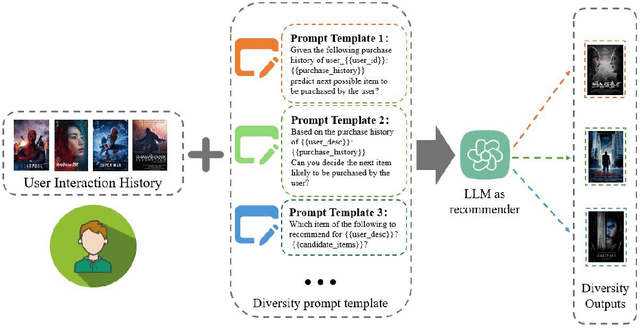
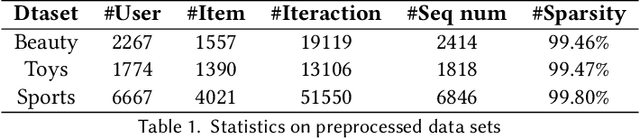
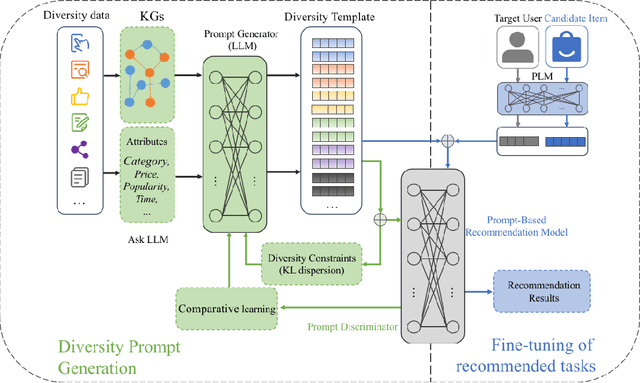

In recent years, LLM has demonstrated remarkable proficiency in comprehending and generating natural language, with a growing prevalence in the domain of recommender systems. However, LLM continues to face a significant challenge in that it is highly susceptible to the influence of prompt words. This inconsistency in response to minor alterations in prompt input may compromise the accuracy and resilience of recommendation models. To address this issue, this paper proposes GANPrompt, a multi-dimensional large language model prompt diversity framework based on Generative Adversarial Networks (GANs). The framework enhances the model's adaptability and stability to diverse prompts by integrating GAN generation techniques with the deep semantic understanding capabilities of LLMs. GANPrompt first trains a generator capable of producing diverse prompts by analysing multidimensional user behavioural data. These diverse prompts are then used to train the LLM to improve its performance in the face of unseen prompts. Furthermore, to ensure a high degree of diversity and relevance of the prompts, this study introduces a mathematical theory-based diversity constraint mechanism that optimises the generated prompts to ensure that they are not only superficially distinct, but also semantically cover a wide range of user intentions. Through extensive experiments on multiple datasets, we demonstrate the effectiveness of the proposed framework, especially in improving the adaptability and robustness of recommender systems in complex and dynamic environments. The experimental results demonstrate that GANPrompt yields substantial enhancements in accuracy and robustness relative to existing state-of-the-art methodologies.
An Efficient Continuous Control Perspective for Reinforcement-Learning-based Sequential Recommendation
Aug 15, 2024Sequential recommendation, where user preference is dynamically inferred from sequential historical behaviors, is a critical task in recommender systems (RSs). To further optimize long-term user engagement, offline reinforcement-learning-based RSs have become a mainstream technique as they provide an additional advantage in avoiding global explorations that may harm online users' experiences. However, previous studies mainly focus on discrete action and policy spaces, which might have difficulties in handling dramatically growing items efficiently. To mitigate this issue, in this paper, we aim to design an algorithmic framework applicable to continuous policies. To facilitate the control in the low-dimensional but dense user preference space, we propose an \underline{\textbf{E}}fficient \underline{\textbf{Co}}ntinuous \underline{\textbf{C}}ontrol framework (ECoC). Based on a statistically tested assumption, we first propose the novel unified action representation abstracted from normalized user and item spaces. Then, we develop the corresponding policy evaluation and policy improvement procedures. During this process, strategic exploration and directional control in terms of unified actions are carefully designed and crucial to final recommendation decisions. Moreover, beneficial from unified actions, the conservatism regularization for policies and value functions are combined and perfectly compatible with the continuous framework. The resulting dual regularization ensures the successful offline training of RL-based recommendation policies. Finally, we conduct extensive experiments to validate the effectiveness of our framework. The results show that compared to the discrete baselines, our ECoC is trained far more efficiently. Meanwhile, the final policies outperform baselines in both capturing the offline data and gaining long-term rewards.