 Add to Chrome
 Add to Firefox
 Add to Edge
Variable-Width Transformers
Jun 16, 2026
Scaling model size, specifically depth and width, has driven significant progress in transformer-based language models. However, most architectures maintain a constant width across all layers, allocating a fixed parameter and computation budget evenly despite different layers potentially playing distinct computational roles. In this work, we empirically investigate nonuniform capacity allocation across network depth by proposing a $\times$-shaped > <former architecture. This design maintains wider early and late layers while narrowing the middle layers, utilizing a parameter-free residual resizing mechanism. Across decoder-only language models ranging from 200M to 2B parameters (dense) and 3B parameters (MoE), our > <former consistently outperforms parameter-matched uniform baselines on language modeling loss. By reducing the average layer width, this architecture also requires fewer overall FLOPs (22% reduction under fitted loss-matched scaling curves) and smaller KV cache memory and I/O cost (15% reduction). In analysis, we show that this bottleneck structure results in qualitatively different representations in residual streams. Overall, our results demonstrate that nonuniform width allocation can result in more resource-optimal scaling of language models.

CodeAlchemy: Synthetic Code Rewriting at Scale
Jun 08, 2026Pre-training on raw code teaches syntax but provides sparse signal for diverse real-world task formats. While synthetic data has proven transformative for language models, code remains largely unexplored beyond limited quality improvements. We present CodeAlchemy, a synthetic data generation framework that transforms publicly sourced code into semantically-rich training data through 5 strategies: CodeEnhance (quality-aware rewriting), CodeQA (template-based problems), CodeDev (developer tasks), CodeDialogue (multi-turn conversations), and CodeTrace (execution traces). We process 3 corpora across 15 languages to generate 500B+ tokens of synthetic data plus 350B reasoning tokens, orders of magnitude more than prior efforts. CodeTrace instruments and executes 1.3M+ files across 14 languages and 5K libraries, capturing control flow, state tracking, and library knowledge. We introduce DevEval (developer tasks) and TraceEval (execution prediction) benchmarks; frontier models like Claude Sonnet 4.5 achieve only 5.6% exact match on TraceEval, revealing critical gaps in semantic understanding. Our 3B models achieve 83.5% on HumanEval, 63.2% on MBPP, 8.09% win rate on DevEval, and 15.36 ROUGE-2 on TraceEval, outperforming frontier models 10x the size including 27B Gemma-3 and 32B Granite-4.0.
Dynamic Short Convolutions Improve Transformers
Jun 02, 2026Transformers have become the dominant architecture for large language models, largely due to the scalability and flexibility of attention, feed-forward layers, residual connections, and normalization. This paper introduces dynamic short convolutions as an additional neural network primitive for improving Transformers. Unlike static short convolutions, dynamic convolutions use input-dependent filters, which preserves the locality bias of convolution while increasing expressivity. Motivating experiments show that applying dynamic short convolutions to key, query, and value representations improves performance on challenging associative recall tasks compared with static convolutional variants. Across language-modeling experiments ranging from 150M to 2B parameters, dynamic convolutions consistently outperform standard Transformers and Transformers augmented with static short convolutions. Fitting scaling laws indicates a 1.33$\times$ compute advantage over compute-matched Transformers when dynamic convolutions are applied to the key, query, and value vectors, and a 1.60$\times$ advantage when adding dynamic convolutions after every linear layer. Dynamic convolutions also offer improvements on linear RNNs (Mamba-2/Gated DeltaNet) and mixture-of-experts architectures. We make these gains practical with custom Triton kernels that enable efficient training with a manageable end-to-end slowdown. These results suggest that dynamic short convolutions are a scalable, hardware-efficient, and expressive primitive for advancing Transformer-based language models.
PRISM: Demystifying Retention and Interaction in Mid-Training
Mar 17, 2026We present PRISM, a comprehensive empirical study of mid-training design choices for large language models. Through controlled experiments across seven base models spanning four families (Granite, LLaMA, Mistral, Nemotron-H), two architecture types (dense Transformer and attention-Mamba hybrid), and scales from 3B to 24B parameters, we show that mid-training on approximately 27B high-quality tokens yields consistent gains of +15 to +40 points on math, +5 to +12 points on code, and +6 to +13 points on science benchmarks while preserving general performance. The full PRISM to RL pipeline improves macro-average across six reasoning benchmarks from under 12 to 29-42 (a 3-4x improvement), whereas RL applied directly to most of the base models remains substantially less effective, with AIME scores near zero. Data composition matters most at mid-training, not RL: including science data during mid-training unlocks +17 to +28 point GPQA-Diamond gains during RL, while changing the RL mix produces less than 2 point differences. Mechanistically, mid-training densely restructures over 90% of model weights, while RL makes sparse, front-loaded refinements to approximately 5% of parameters. Representation analysis (CKA) confirms that RL consistently preserves mid-training's representational geometry (over 0.998 CKA) across architectures. Crucially, RL applies identical weight changes regardless of starting point, yet only succeeds on mid-trained models, consistent with mid-training placing the model in a configuration from which RL can effectively improve performance. Our results demonstrate that retention-aware mid-training is highly effective for reliable reasoning enhancement and provide practical guidance for designing robust mid-training pipelines.
Distilling to Hybrid Attention Models via KL-Guided Layer Selection
Dec 23, 2025Distilling pretrained softmax attention Transformers into more efficient hybrid architectures that interleave softmax and linear attention layers is a promising approach for improving the inference efficiency of LLMs without requiring expensive pretraining from scratch. A critical factor in the conversion process is layer selection, i.e., deciding on which layers to convert to linear attention variants. This paper describes a simple and efficient recipe for layer selection that uses layer importance scores derived from a small amount of training on generic text data. Once the layers have been selected we use a recent pipeline for the distillation process itself \citep[RADLADS;][]{goldstein2025radlads}, which consists of attention weight transfer, hidden state alignment, KL-based distribution matching, followed by a small amount of finetuning. We find that this approach is more effective than existing approaches for layer selection, including heuristics that uniformly interleave linear attentions based on a fixed ratio, as well as more involved approaches that rely on specialized diagnostic datasets.
FlashFormer: Whole-Model Kernels for Efficient Low-Batch Inference
May 28, 2025The size and compute characteristics of modern large language models have led to an increased interest in developing specialized kernels tailored for training and inference. Existing kernels primarily optimize for compute utilization, targeting the large-batch training and inference settings. However, low-batch inference, where memory bandwidth and kernel launch overheads contribute are significant factors, remains important for many applications of interest such as in edge deployment and latency-sensitive applications. This paper describes FlashFormer, a proof-of-concept kernel for accelerating single-batch inference for transformer-based large language models. Across various model sizes and quantizations settings, we observe nontrivial speedups compared to existing state-of-the-art inference kernels.
PaTH Attention: Position Encoding via Accumulating Householder Transformations
May 22, 2025The attention mechanism is a core primitive in modern large language models (LLMs) and AI more broadly. Since attention by itself is permutation-invariant, position encoding is essential for modeling structured domains such as language. Rotary position encoding (RoPE) has emerged as the de facto standard approach for position encoding and is part of many modern LLMs. However, in RoPE the key/query transformation between two elements in a sequence is only a function of their relative position and otherwise independent of the actual input. This limits the expressivity of RoPE-based transformers. This paper describes PaTH, a flexible data-dependent position encoding scheme based on accumulated products of Householder(like) transformations, where each transformation is data-dependent, i.e., a function of the input. We derive an efficient parallel algorithm for training through exploiting a compact representation of products of Householder matrices, and implement a FlashAttention-style blockwise algorithm that minimizes I/O cost. Across both targeted synthetic benchmarks and moderate-scale real-world language modeling experiments, we find that PaTH demonstrates superior performance compared to RoPE and other recent baselines.
Do Larger Language Models Imply Better Reasoning? A Pretraining Scaling Law for Reasoning
Apr 04, 2025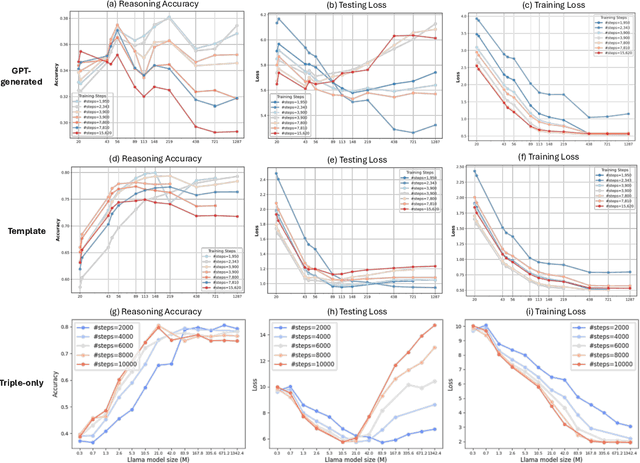
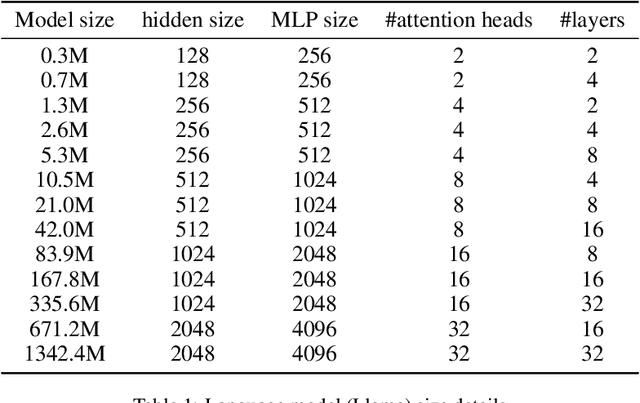
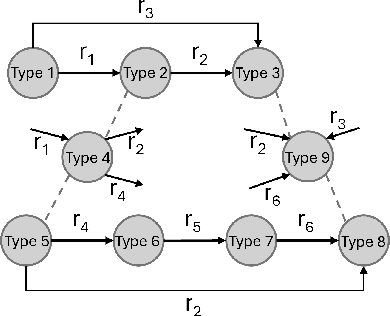

Large Language Models (LLMs) have demonstrated remarkable capabilities across a wide range of tasks requiring complex reasoning. However, the effects of scaling on their reasoning abilities remain insufficiently understood. In this paper, we introduce a synthetic multihop reasoning environment designed to closely replicate the structure and distribution of real-world large-scale knowledge graphs. Our reasoning task involves completing missing edges in the graph, which requires advanced multi-hop reasoning and mimics real-world reasoning scenarios. To evaluate this, we pretrain language models (LMs) from scratch solely on triples from the incomplete graph and assess their ability to infer the missing edges. Interestingly, we observe that overparameterization can impair reasoning performance due to excessive memorization. We investigate different factors that affect this U-shaped loss curve, including graph structure, model size, and training steps. To predict the optimal model size for a specific knowledge graph, we find an empirical scaling that linearly maps the knowledge graph search entropy to the optimal model size. This work provides new insights into the relationship between scaling and reasoning in LLMs, shedding light on possible ways to optimize their performance for reasoning tasks.
Stick-breaking Attention
Oct 23, 2024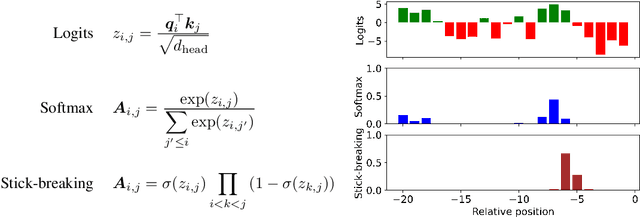

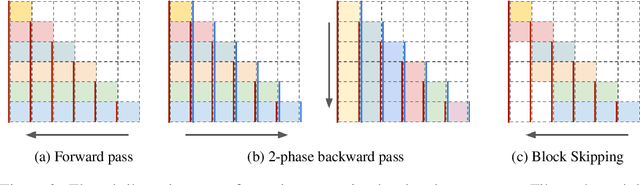

The self-attention mechanism traditionally relies on the softmax operator, necessitating positional embeddings like RoPE, or position biases to account for token order. But current methods using still face length generalisation challenges. We propose an alternative attention mechanism based on the stick-breaking process: For each token before the current, we determine a break point $\beta_{i,j}$, which represents the proportion of the remaining stick to allocate to the current token. We repeat the process until the stick is fully allocated, resulting in a sequence of attention weights. This process naturally incorporates recency bias, which has linguistic motivations for grammar parsing (Shen et. al., 2017). We study the implications of replacing the conventional softmax-based attention mechanism with stick-breaking attention. We then discuss implementation of numerically stable stick-breaking attention and adapt Flash Attention to accommodate this mechanism. When used as a drop-in replacement for current softmax+RoPE attention systems, we find that stick-breaking attention performs competitively with current methods on length generalisation and downstream tasks. Stick-breaking also performs well at length generalisation, allowing a model trained with $2^{11}$ context window to perform well at $2^{14}$ with perplexity improvements.
Calibrating Expressions of Certainty
Oct 06, 2024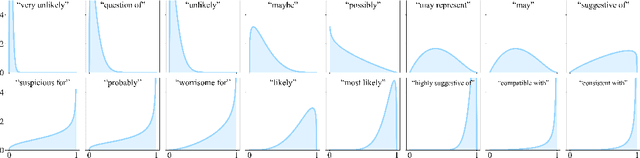
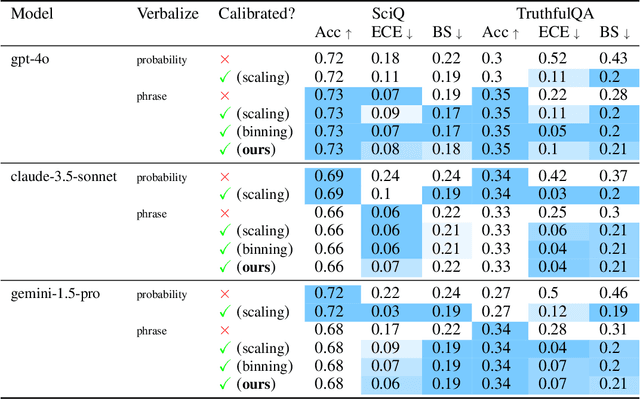
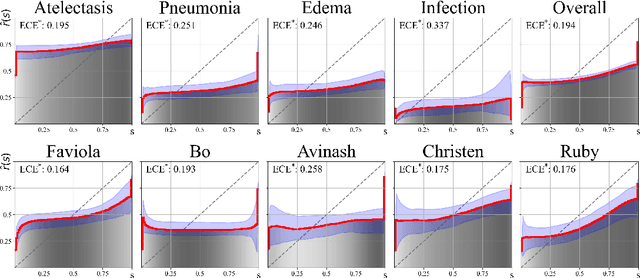
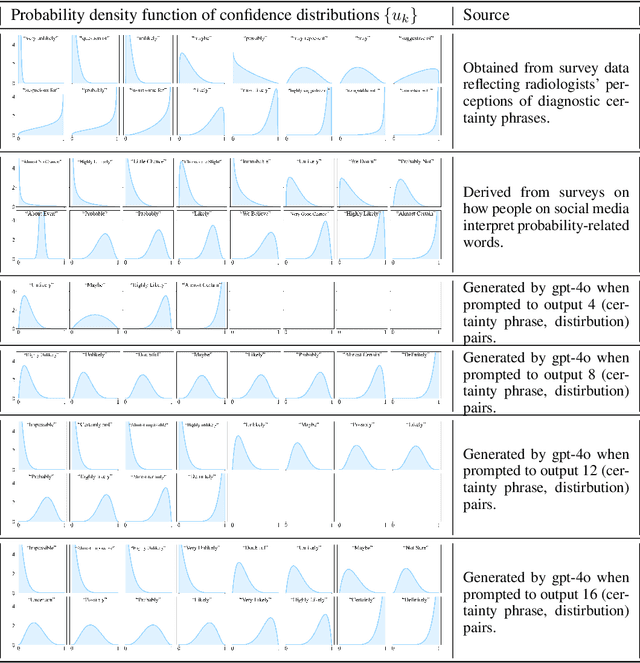
We present a novel approach to calibrating linguistic expressions of certainty, e.g., "Maybe" and "Likely". Unlike prior work that assigns a single score to each certainty phrase, we model uncertainty as distributions over the simplex to capture their semantics more accurately. To accommodate this new representation of certainty, we generalize existing measures of miscalibration and introduce a novel post-hoc calibration method. Leveraging these tools, we analyze the calibration of both humans (e.g., radiologists) and computational models (e.g., language models) and provide interpretable suggestions to improve their calibration.