 Add to Chrome
 Add to Firefox
 Add to Edge
LMGQS: A Large-scale Dataset for Query-focused Summarization
May 22, 2023
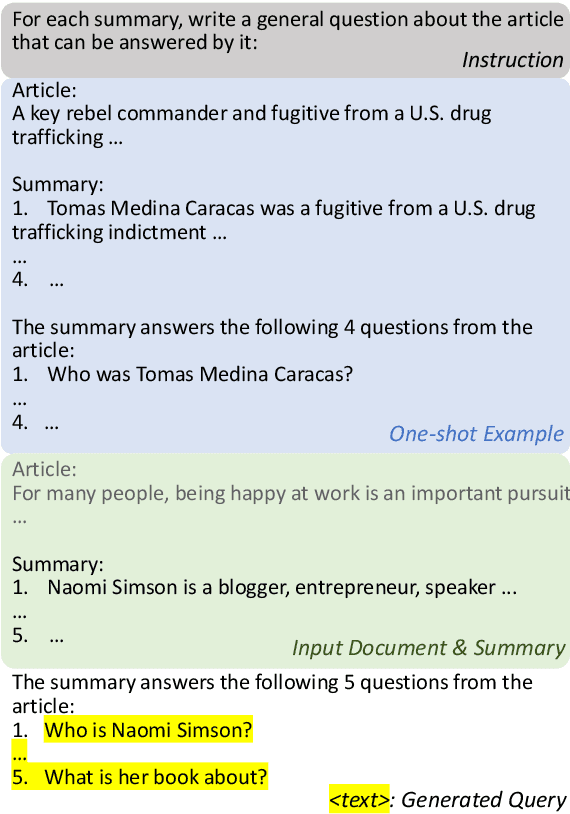
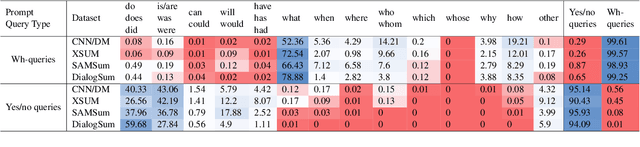
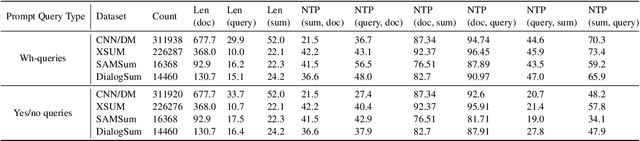
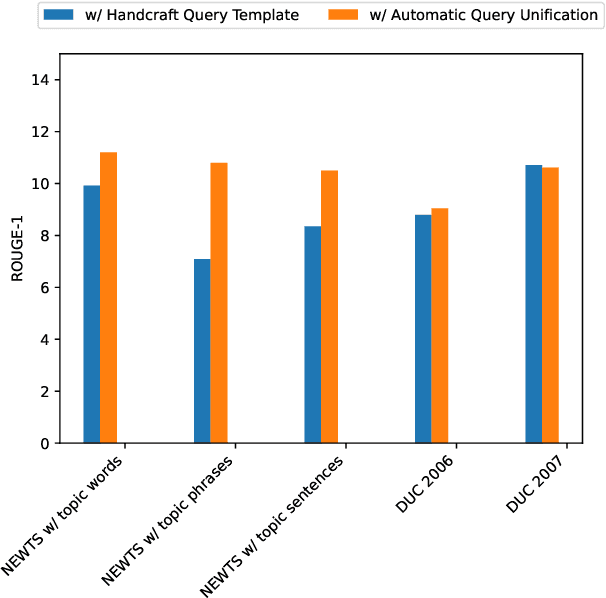
Query-focused summarization (QFS) aims to extract or generate a summary of an input document that directly answers or is relevant to a given query. The lack of large-scale datasets in the form of documents, queries, and summaries has hindered model development in this area. In contrast, multiple large-scale high-quality datasets for generic summarization exist. We hypothesize that there is a hidden query for each summary sentence in a generic summarization annotation, and we utilize a large-scale pretrained language model to recover it. In this way, we convert four generic summarization benchmarks into a new QFS benchmark dataset, LMGQS, which consists of over 1 million document-query-summary samples. We thoroughly investigate the properties of our proposed dataset and establish baselines with state-of-the-art summarization models. By fine-tuning a language model on LMGQS, we achieve state-of-the-art zero-shot and supervised performance on multiple existing QFS benchmarks, demonstrating the high quality and diversity of LMGQS.

InheritSumm: A General, Versatile and Compact Summarizer by Distilling from GPT
May 22, 2023While large models such as GPT-3 demonstrate exceptional performance in zeroshot and fewshot summarization tasks, their extensive serving and fine-tuning costs hinder their utilization in various applications. Conversely, previous studies have found that although automatic metrics tend to favor smaller fine-tuned models, the quality of the summaries they generate is inferior to that of larger models like GPT-3 when assessed by human evaluators. To address this issue, we propose InheritSumm, a versatile and compact summarization model derived from GPT-3.5 through distillation. InheritSumm not only exhibits comparable zeroshot and fewshot summarization capabilities to GPT-3.5 but is also sufficiently compact for fine-tuning purposes. Experimental results demonstrate that InheritSumm achieves similar or superior performance to GPT-3.5 in zeroshot and fewshot settings. Furthermore, it outperforms the previously established best small models in both prefix-tuning and full-data fine-tuning scenarios.
i-Code V2: An Autoregressive Generation Framework over Vision, Language, and Speech Data
May 21, 2023
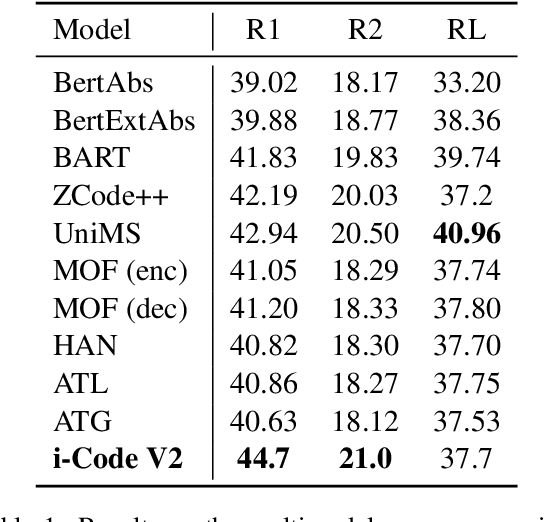
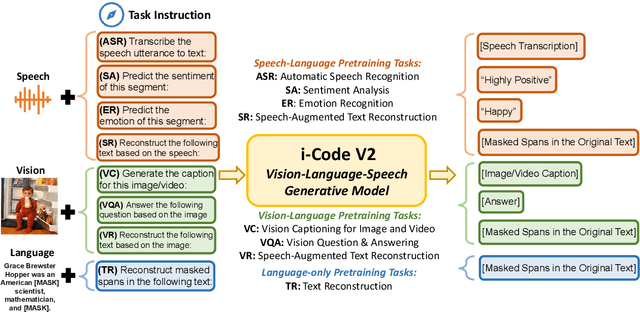
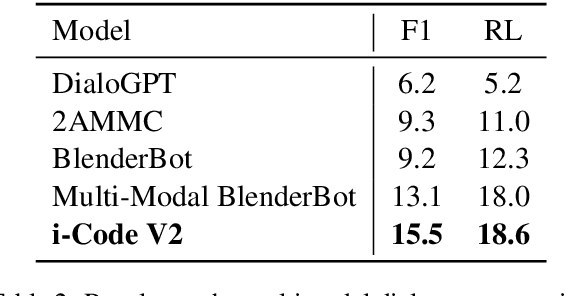
The convergence of text, visual, and audio data is a key step towards human-like artificial intelligence, however the current Vision-Language-Speech landscape is dominated by encoder-only models which lack generative abilities. We propose closing this gap with i-Code V2, the first model capable of generating natural language from any combination of Vision, Language, and Speech data. i-Code V2 is an integrative system that leverages state-of-the-art single-modality encoders, combining their outputs with a new modality-fusing encoder in order to flexibly project combinations of modalities into a shared representational space. Next, language tokens are generated from these representations via an autoregressive decoder. The whole framework is pretrained end-to-end on a large collection of dual- and single-modality datasets using a novel text completion objective that can be generalized across arbitrary combinations of modalities. i-Code V2 matches or outperforms state-of-the-art single- and dual-modality baselines on 7 multimodal tasks, demonstrating the power of generative multimodal pretraining across a diversity of tasks and signals.
Any-to-Any Generation via Composable Diffusion
May 19, 2023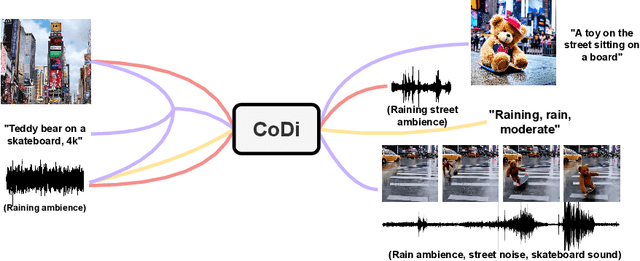
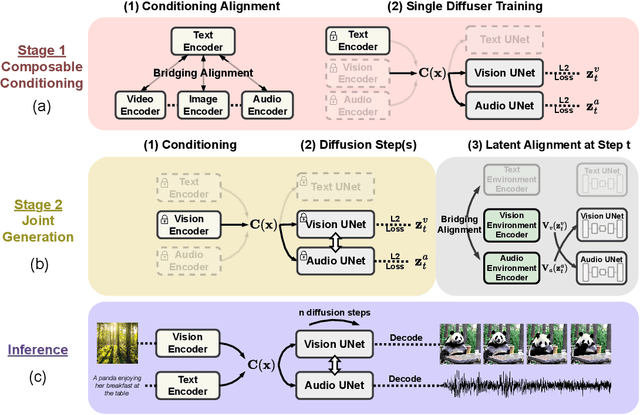
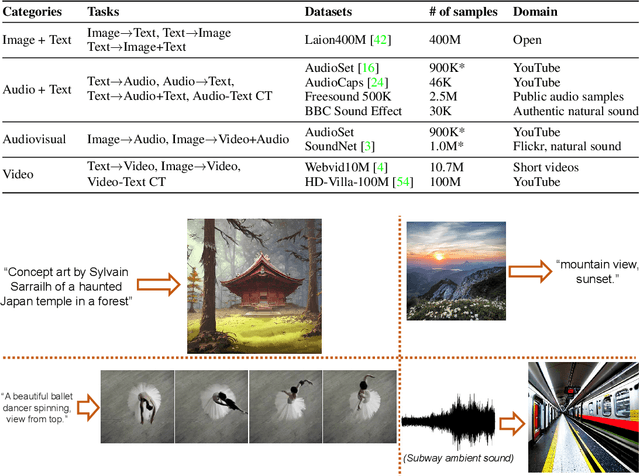
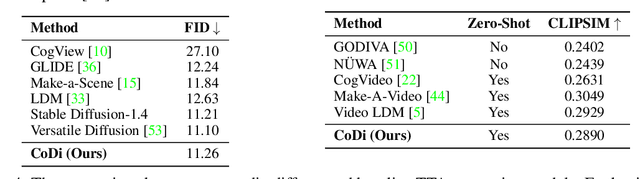
We present Composable Diffusion (CoDi), a novel generative model capable of generating any combination of output modalities, such as language, image, video, or audio, from any combination of input modalities. Unlike existing generative AI systems, CoDi can generate multiple modalities in parallel and its input is not limited to a subset of modalities like text or image. Despite the absence of training datasets for many combinations of modalities, we propose to align modalities in both the input and output space. This allows CoDi to freely condition on any input combination and generate any group of modalities, even if they are not present in the training data. CoDi employs a novel composable generation strategy which involves building a shared multimodal space by bridging alignment in the diffusion process, enabling the synchronized generation of intertwined modalities, such as temporally aligned video and audio. Highly customizable and flexible, CoDi achieves strong joint-modality generation quality, and outperforms or is on par with the unimodal state-of-the-art for single-modality synthesis. The project page with demonstrations and code is at https://codi-gen.github.io
Automatic Prompt Optimization with "Gradient Descent" and Beam Search
May 04, 2023Large Language Models (LLMs) have shown impressive performance as general purpose agents, but their abilities remain highly dependent on prompts which are hand written with onerous trial-and-error effort. We propose a simple and nonparametric solution to this problem, Automatic Prompt Optimization (APO), which is inspired by numerical gradient descent to automatically improve prompts, assuming access to training data and an LLM API. The algorithm uses minibatches of data to form natural language ``gradients'' that criticize the current prompt. The gradients are then ``propagated'' into the prompt by editing the prompt in the opposite semantic direction of the gradient. These gradient descent steps are guided by a beam search and bandit selection procedure which significantly improves algorithmic efficiency. Preliminary results across three benchmark NLP tasks and the novel problem of LLM jailbreak detection suggest that Automatic Prompt Optimization can outperform prior prompt editing techniques and improve an initial prompt's performance by up to 31\%, by using data to rewrite vague task descriptions into more precise annotation instructions.
Code-Switching Text Generation and Injection in Mandarin-English ASR
Mar 20, 2023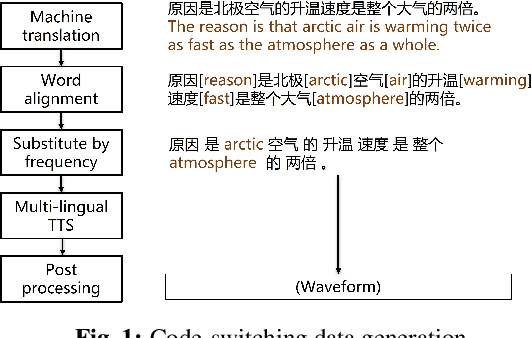
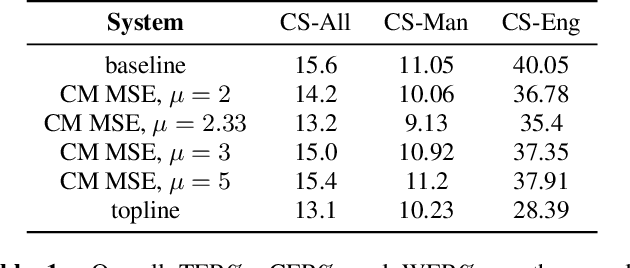
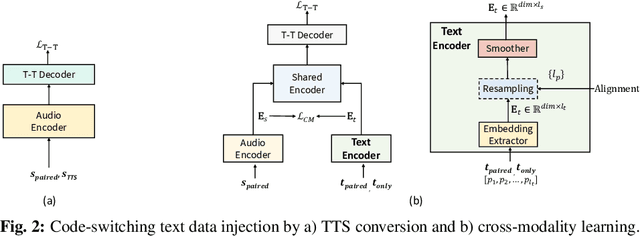

Code-switching speech refers to a means of expression by mixing two or more languages within a single utterance. Automatic Speech Recognition (ASR) with End-to-End (E2E) modeling for such speech can be a challenging task due to the lack of data. In this study, we investigate text generation and injection for improving the performance of an industry commonly-used streaming model, Transformer-Transducer (T-T), in Mandarin-English code-switching speech recognition. We first propose a strategy to generate code-switching text data and then investigate injecting generated text into T-T model explicitly by Text-To-Speech (TTS) conversion or implicitly by tying speech and text latent spaces. Experimental results on the T-T model trained with a dataset containing 1,800 hours of real Mandarin-English code-switched speech show that our approaches to inject generated code-switching text significantly boost the performance of T-T models, i.e., 16% relative Token-based Error Rate (TER) reduction averaged on three evaluation sets, and the approach of tying speech and text latent spaces is superior to that of TTS conversion on the evaluation set which contains more homogeneous data with the training set.
MM-REACT: Prompting ChatGPT for Multimodal Reasoning and Action
Mar 20, 2023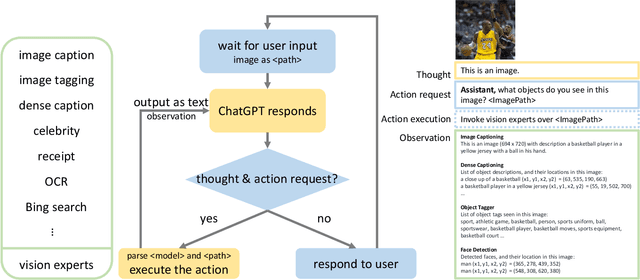
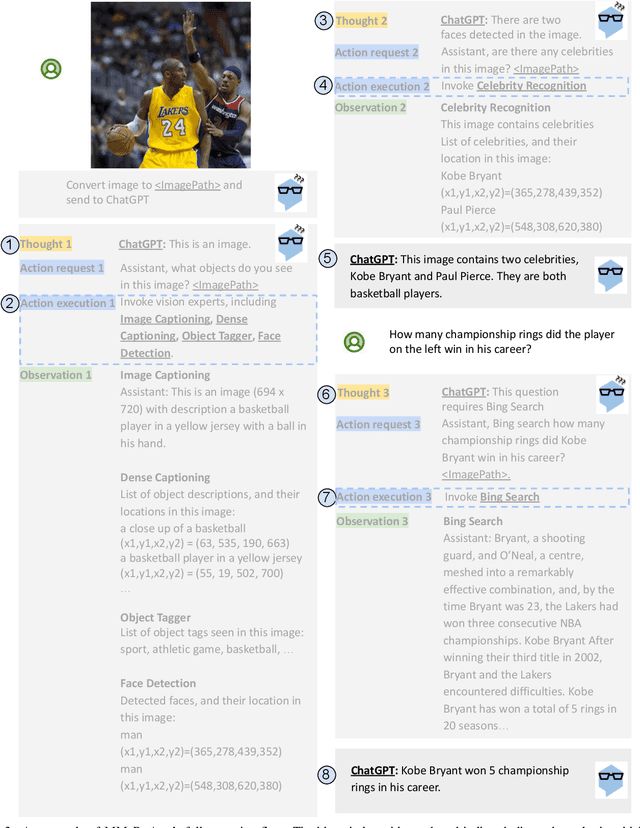
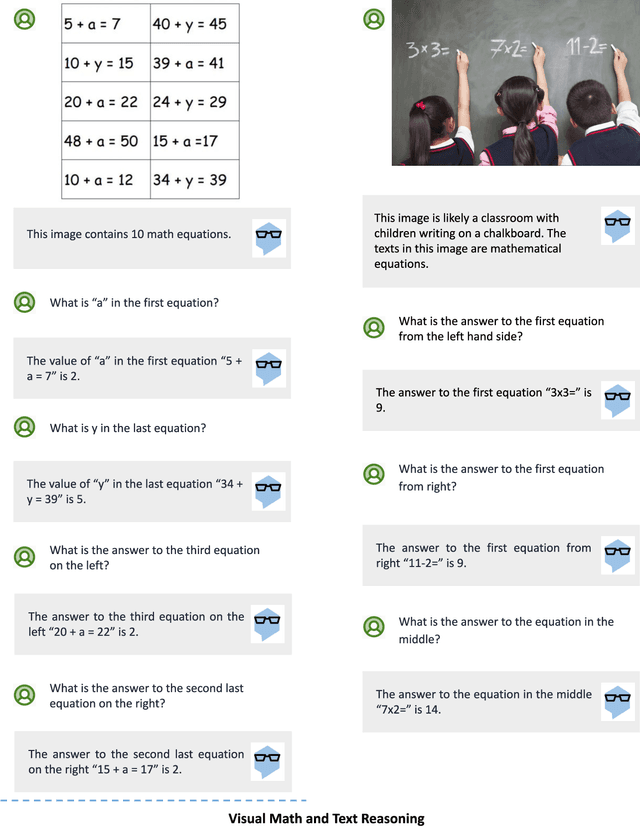
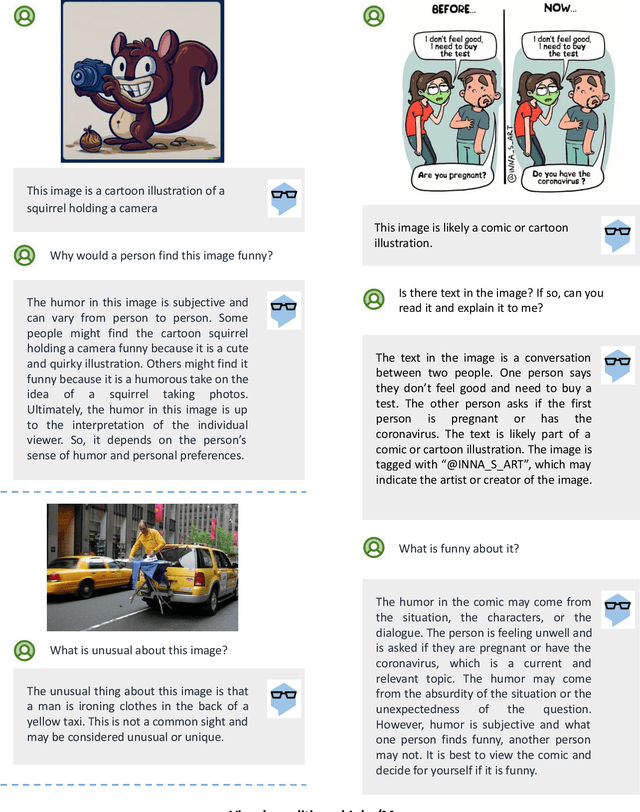
We propose MM-REACT, a system paradigm that integrates ChatGPT with a pool of vision experts to achieve multimodal reasoning and action. In this paper, we define and explore a comprehensive list of advanced vision tasks that are intriguing to solve, but may exceed the capabilities of existing vision and vision-language models. To achieve such advanced visual intelligence, MM-REACT introduces a textual prompt design that can represent text descriptions, textualized spatial coordinates, and aligned file names for dense visual signals such as images and videos. MM-REACT's prompt design allows language models to accept, associate, and process multimodal information, thereby facilitating the synergetic combination of ChatGPT and various vision experts. Zero-shot experiments demonstrate MM-REACT's effectiveness in addressing the specified capabilities of interests and its wide application in different scenarios that require advanced visual understanding. Furthermore, we discuss and compare MM-REACT's system paradigm with an alternative approach that extends language models for multimodal scenarios through joint finetuning. Code, demo, video, and visualization are available at https://multimodal-react.github.io/
Target Sound Extraction with Variable Cross-modality Clues
Mar 15, 2023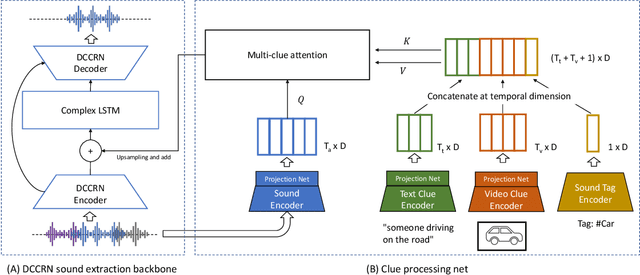
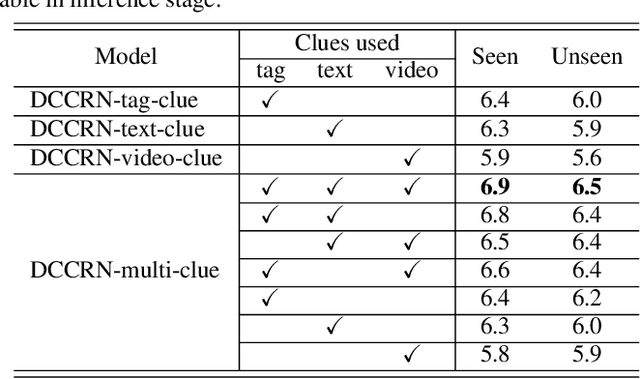
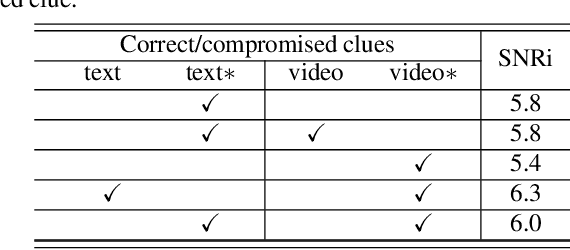
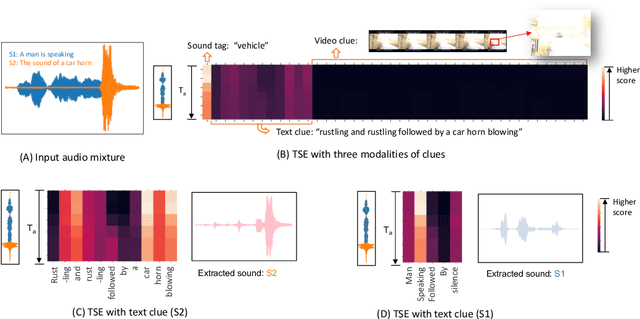
Automatic target sound extraction (TSE) is a machine learning approach to mimic the human auditory perception capability of attending to a sound source of interest from a mixture of sources. It often uses a model conditioned on a fixed form of target sound clues, such as a sound class label, which limits the ways in which users can interact with the model to specify the target sounds. To leverage variable number of clues cross modalities available in the inference phase, including a video, a sound event class, and a text caption, we propose a unified transformer-based TSE model architecture, where a multi-clue attention module integrates all the clues across the modalities. Since there is no off-the-shelf benchmark to evaluate our proposed approach, we build a dataset based on public corpora, Audioset and AudioCaps. Experimental results for seen and unseen target-sound evaluation sets show that our proposed TSE model can effectively deal with a varying number of clues which improves the TSE performance and robustness against partially compromised clues.
Unifying Vision, Text, and Layout for Universal Document Processing
Dec 20, 2022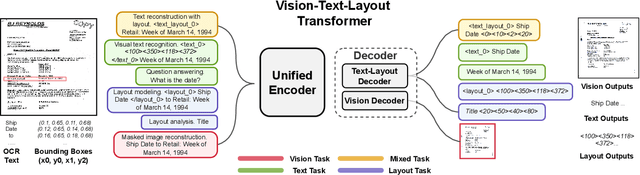
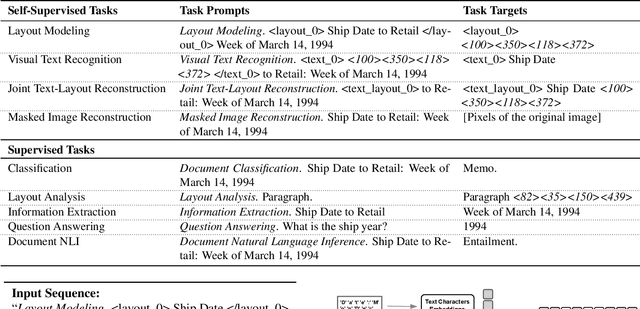
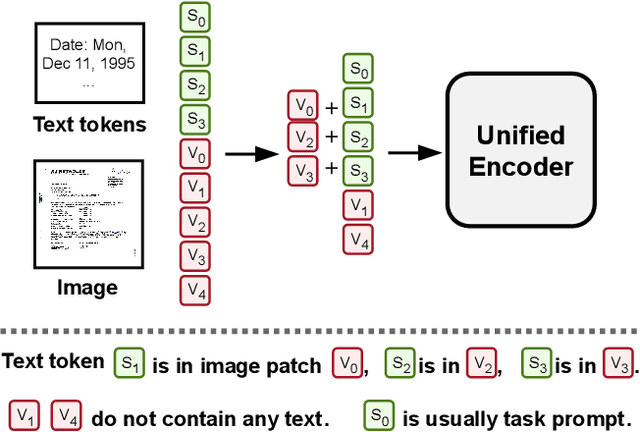
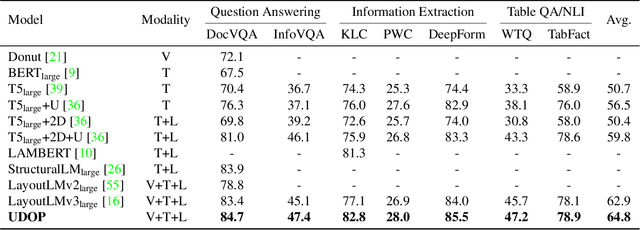
We propose Universal Document Processing (UDOP), a foundation Document AI model which unifies text, image, and layout modalities together with varied task formats, including document understanding and generation. UDOP leverages the spatial correlation between textual content and document image to model image, text, and layout modalities with one uniform representation. With a novel Vision-Text-Layout Transformer, UDOP unifies pretraining and multi-domain downstream tasks into a prompt-based sequence generation scheme. UDOP is pretrained on both large-scale unlabeled document corpora using innovative self-supervised objectives and diverse labeled data. UDOP also learns to generate document images from text and layout modalities via masked image reconstruction. To the best of our knowledge, this is the first time in the field of document AI that one model simultaneously achieves high-quality neural document editing and content customization. Our method sets the state-of-the-art on 9 Document AI tasks, e.g., document understanding and QA, across diverse data domains like finance reports, academic papers, and websites. UDOP ranks first on the leaderboard of the Document Understanding Benchmark (DUE).
UniSumm: Unified Few-shot Summarization with Multi-Task Pre-Training and Prefix-Tuning
Dec 06, 2022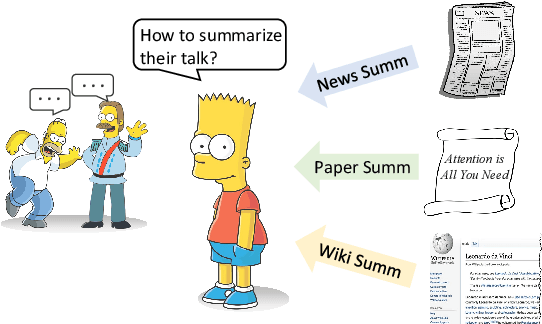
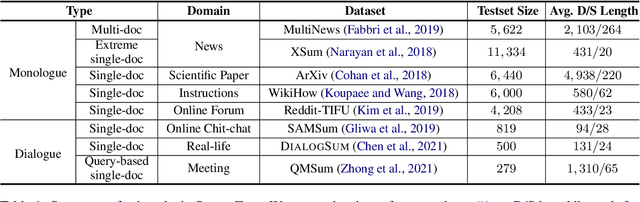
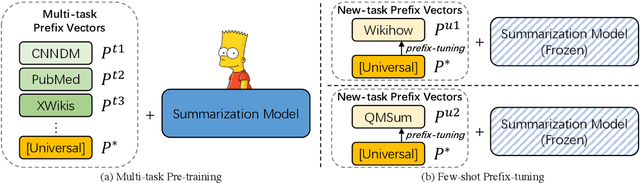
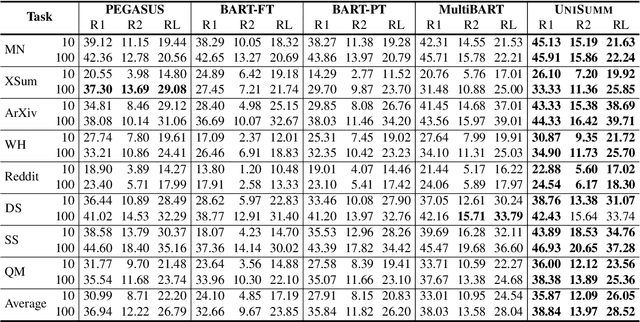
The diverse demands of different summarization tasks and their high annotation costs are driving a need for few-shot summarization. However, despite the emergence of many summarization tasks and datasets, the current training paradigm for few-shot summarization systems ignores potentially shareable knowledge in heterogeneous datasets. To this end, we propose \textsc{UniSumm}, a unified few-shot summarization model pre-trained with multiple summarization tasks and can be prefix-tuned to excel at any few-shot summarization datasets. Meanwhile, to better evaluate few-shot summarization systems, under the principles of diversity and robustness, we assemble and publicize a new benchmark \textsc{SummZoo}. It consists of $8$ diverse summarization tasks with multiple sets of few-shot samples for each task, covering both monologue and dialogue domains. Experimental results and ablation studies show that \textsc{UniSumm} outperforms strong baseline systems by a large margin across all tasks in \textsc{SummZoo} under both automatic and human evaluations. We release our code and benchmark at \url{https://github.com/microsoft/UniSumm}.