 Add to Chrome
 Add to Firefox
 Add to Edge
Symmetry Considerations for Learning Task Symmetric Robot Policies
Mar 07, 2024
Symmetry is a fundamental aspect of many real-world robotic tasks. However, current deep reinforcement learning (DRL) approaches can seldom harness and exploit symmetry effectively. Often, the learned behaviors fail to achieve the desired transformation invariances and suffer from motion artifacts. For instance, a quadruped may exhibit different gaits when commanded to move forward or backward, even though it is symmetrical about its torso. This issue becomes further pronounced in high-dimensional or complex environments, where DRL methods are prone to local optima and fail to explore regions of the state space equally. Past methods on encouraging symmetry for robotic tasks have studied this topic mainly in a single-task setting, where symmetry usually refers to symmetry in the motion, such as the gait patterns. In this paper, we revisit this topic for goal-conditioned tasks in robotics, where symmetry lies mainly in task execution and not necessarily in the learned motions themselves. In particular, we investigate two approaches to incorporate symmetry invariance into DRL -- data augmentation and mirror loss function. We provide a theoretical foundation for using augmented samples in an on-policy setting. Based on this, we show that the corresponding approach achieves faster convergence and improves the learned behaviors in various challenging robotic tasks, from climbing boxes with a quadruped to dexterous manipulation.

SpaceHopper: A Small-Scale Legged Robot for Exploring Low-Gravity Celestial Bodies
Mar 05, 2024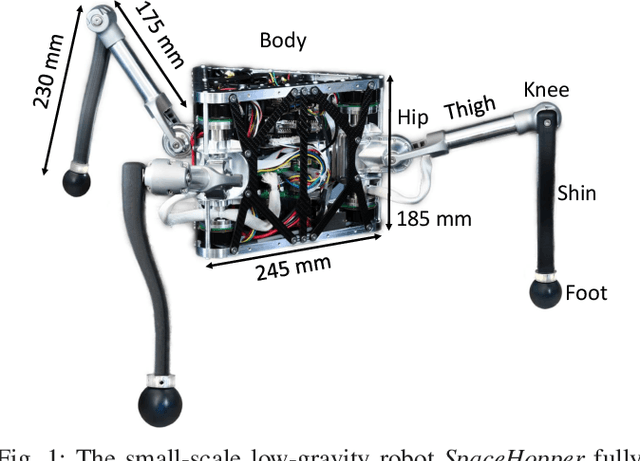
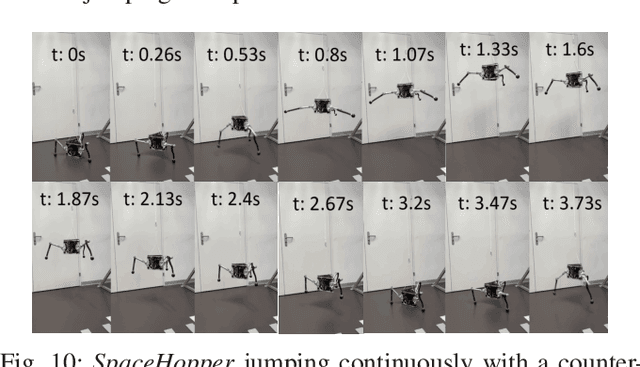
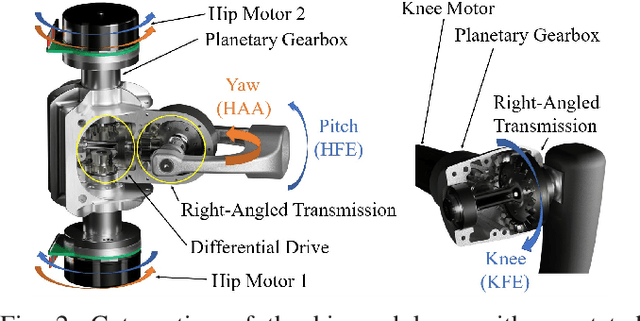
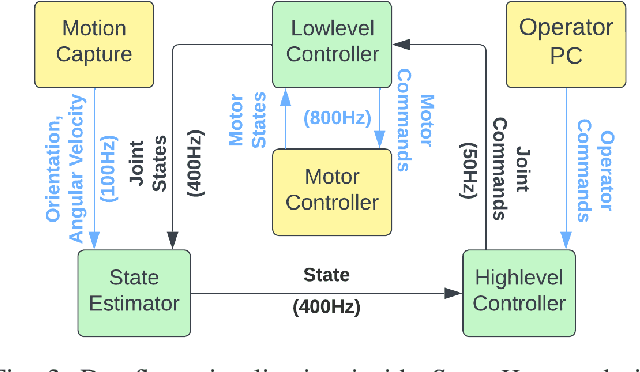
We present SpaceHopper, a three-legged, small-scale robot designed for future mobile exploration of asteroids and moons. The robot weighs 5.2kg and has a body size of 245mm while using space-qualifiable components. Furthermore, SpaceHopper's design and controls make it well-adapted for investigating dynamic locomotion modes with extended flight-phases. Instead of gyroscopes or fly-wheels, the system uses its three legs to reorient the body during flight in preparation for landing. We control the leg motion for reorientation using Deep Reinforcement Learning policies. In a simulation of Ceres' gravity (0.029g), the robot can reliably jump to commanded positions up to 6m away. Our real-world experiments show that SpaceHopper can successfully reorient to a safe landing orientation within 9.7 degree inside a rotational gimbal and jump in a counterweight setup in Earth's gravity. Overall, we consider SpaceHopper an important step towards controlled jumping locomotion in low-gravity environments.
RoadRunner - Learning Traversability Estimation for Autonomous Off-road Driving
Mar 03, 2024
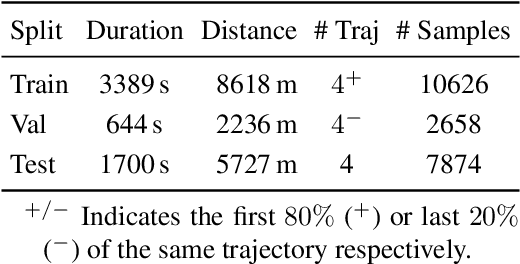

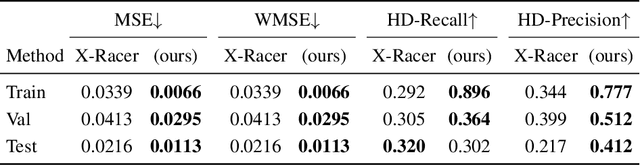
Autonomous navigation at high speeds in off-road environments necessitates robots to comprehensively understand their surroundings using onboard sensing only. The extreme conditions posed by the off-road setting can cause degraded camera image quality due to poor lighting and motion blur, as well as limited sparse geometric information available from LiDAR sensing when driving at high speeds. In this work, we present RoadRunner, a novel framework capable of predicting terrain traversability and an elevation map directly from camera and LiDAR sensor inputs. RoadRunner enables reliable autonomous navigation, by fusing sensory information, handling of uncertainty, and generation of contextually informed predictions about the geometry and traversability of the terrain while operating at low latency. In contrast to existing methods relying on classifying handcrafted semantic classes and using heuristics to predict traversability costs, our method is trained end-to-end in a self-supervised fashion. The RoadRunner network architecture builds upon popular sensor fusion network architectures from the autonomous driving domain, which embed LiDAR and camera information into a common Bird's Eye View perspective. Training is enabled by utilizing an existing traversability estimation stack to generate training data in hindsight in a scalable manner from real-world off-road driving datasets. Furthermore, RoadRunner improves the system latency by a factor of roughly 4, from 500 ms to 140 ms, while improving the accuracy for traversability costs and elevation map predictions. We demonstrate the effectiveness of RoadRunner in enabling safe and reliable off-road navigation at high speeds in multiple real-world driving scenarios through unstructured desert environments.
Learning to walk in confined spaces using 3D representation
Feb 29, 2024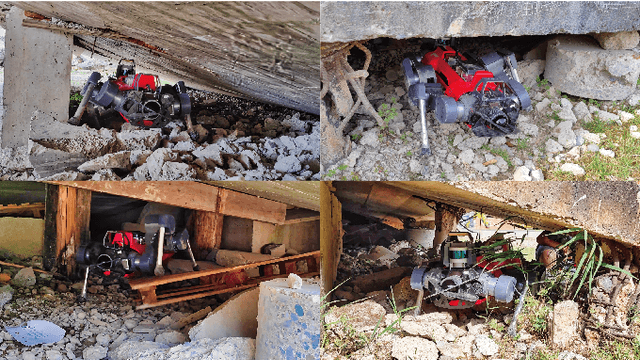
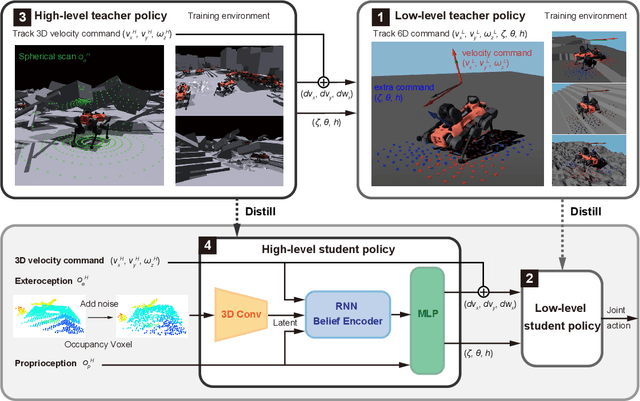
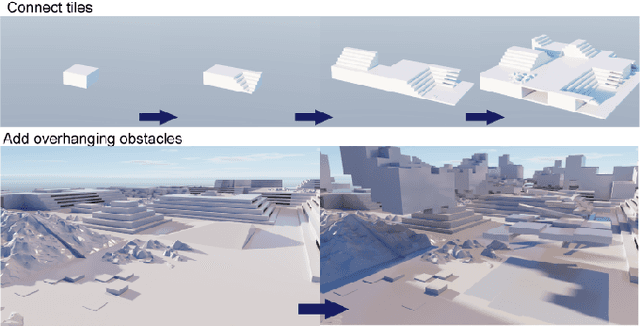
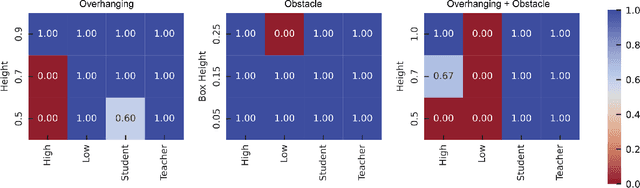
Legged robots have the potential to traverse complex terrain and access confined spaces beyond the reach of traditional platforms thanks to their ability to carefully select footholds and flexibly adapt their body posture while walking. However, robust deployment in real-world applications is still an open challenge. In this paper, we present a method for legged locomotion control using reinforcement learning and 3D volumetric representations to enable robust and versatile locomotion in confined and unstructured environments. By employing a two-layer hierarchical policy structure, we exploit the capabilities of a highly robust low-level policy to follow 6D commands and a high-level policy to enable three-dimensional spatial awareness for navigating under overhanging obstacles. Our study includes the development of a procedural terrain generator to create diverse training environments. We present a series of experimental evaluations in both simulation and real-world settings, demonstrating the effectiveness of our approach in controlling a quadruped robot in confined, rough terrain. By achieving this, our work extends the applicability of legged robots to a broader range of scenarios.
Solving Multi-Entity Robotic Problems Using Permutation Invariant Neural Networks
Feb 28, 2024Challenges in real-world robotic applications often stem from managing multiple, dynamically varying entities such as neighboring robots, manipulable objects, and navigation goals. Existing multi-agent control strategies face scalability limitations, struggling to handle arbitrary numbers of entities. Additionally, they often rely on engineered heuristics for assigning entities among agents. We propose a data driven approach to address these limitations by introducing a decentralized control system using neural network policies trained in simulation. Leveraging permutation invariant neural network architectures and model-free reinforcement learning, our approach allows control agents to autonomously determine the relative importance of different entities without being biased by ordering or limited by a fixed capacity. We validate our approach through both simulations and real-world experiments involving multiple wheeled-legged quadrupedal robots, demonstrating their collaborative control capabilities. We prove the effectiveness of our architectural choice through experiments with three exemplary multi-entity problems. Our analysis underscores the pivotal role of the end-to-end trained permutation invariant encoders in achieving scalability and improving the task performance in multi-object manipulation or multi-goal navigation problems. The adaptability of our policy is further evidenced by its ability to manage varying numbers of entities in a zero-shot manner, showcasing near-optimal autonomous task distribution and collision avoidance behaviors.
Pedipulate: Enabling Manipulation Skills using a Quadruped Robot's Leg
Feb 16, 2024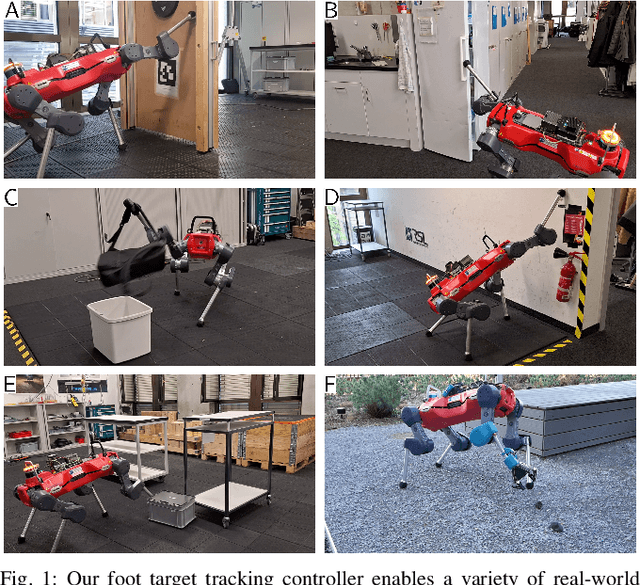


Legged robots have the potential to become vital in maintenance, home support, and exploration scenarios. In order to interact with and manipulate their environments, most legged robots are equipped with a dedicated robot arm, which means additional mass and mechanical complexity compared to standard legged robots. In this work, we explore pedipulation - using the legs of a legged robot for manipulation. By training a reinforcement learning policy that tracks position targets for one foot, we enable a dedicated pedipulation controller that is robust to disturbances, has a large workspace through whole-body behaviors, and can reach far-away targets with gait emergence, enabling loco-pedipulation. By deploying our controller on a quadrupedal robot using teleoperation, we demonstrate various real-world tasks such as door opening, sample collection, and pushing obstacles. We demonstrate load carrying of more than 2.0 kg at the foot. Additionally, the controller is robust to interaction forces at the foot, disturbances at the base, and slippery contact surfaces. Videos of the experiments are available at https://sites.google.com/leggedrobotics.com/pedipulate.
Dense 3D Reconstruction Through Lidar: A Comparative Study on Ex-vivo Porcine Tissue
Jan 19, 2024New sensing technologies and more advanced processing algorithms are transforming computer-integrated surgery. While researchers are actively investigating depth sensing and 3D reconstruction for vision-based surgical assistance, it remains difficult to achieve real-time, accurate, and robust 3D representations of the abdominal cavity for minimally invasive surgery. Thus, this work uses quantitative testing on fresh ex-vivo porcine tissue to thoroughly characterize the quality with which a 3D laser-based time-of-flight sensor (lidar) can perform anatomical surface reconstruction. Ground-truth surface shapes are captured with a commercial laser scanner, and the resulting signed error fields are analyzed using rigorous statistical tools. When compared to modern learning-based stereo matching from endoscopic images, time-of-flight sensing demonstrates higher precision, lower processing delay, higher frame rate, and superior robustness against sensor distance and poor illumination. Furthermore, we report on the potential negative effect of near-infrared light penetration on the accuracy of lidar measurements across different tissue samples, identifying a significant measured depth offset for muscle in contrast to fat and liver. Our findings highlight the potential of lidar for intraoperative 3D perception and point toward new methods that combine complementary time-of-flight and spectral imaging.
ICGNet: A Unified Approach for Instance-Centric Grasping
Jan 18, 2024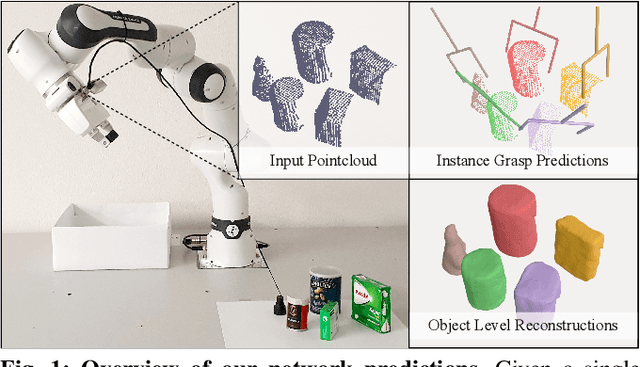
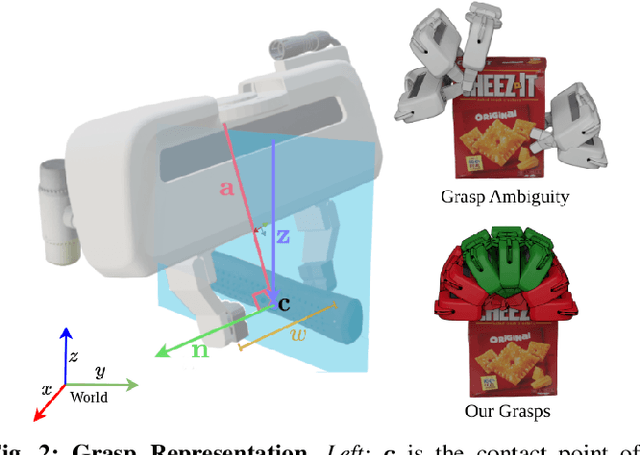
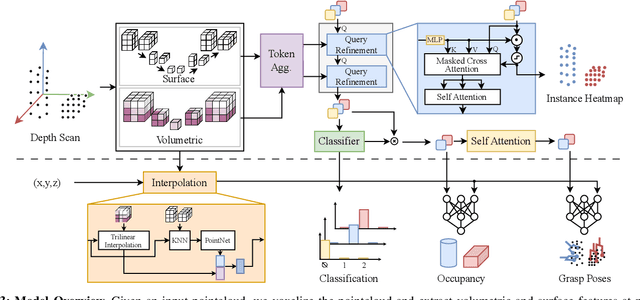
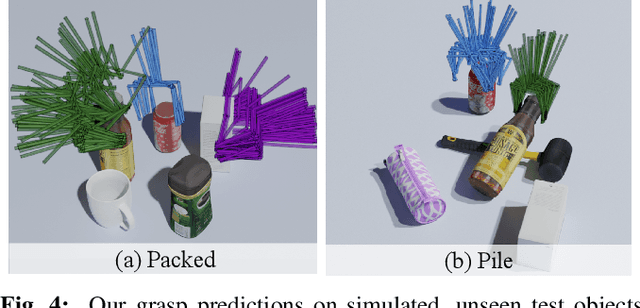
Accurate grasping is the key to several robotic tasks including assembly and household robotics. Executing a successful grasp in a cluttered environment requires multiple levels of scene understanding: First, the robot needs to analyze the geometric properties of individual objects to find feasible grasps. These grasps need to be compliant with the local object geometry. Second, for each proposed grasp, the robot needs to reason about the interactions with other objects in the scene. Finally, the robot must compute a collision-free grasp trajectory while taking into account the geometry of the target object. Most grasp detection algorithms directly predict grasp poses in a monolithic fashion, which does not capture the composability of the environment. In this paper, we introduce an end-to-end architecture for object-centric grasping. The method uses pointcloud data from a single arbitrary viewing direction as an input and generates an instance-centric representation for each partially observed object in the scene. This representation is further used for object reconstruction and grasp detection in cluttered table-top scenes. We show the effectiveness of the proposed method by extensively evaluating it against state-of-the-art methods on synthetic datasets, indicating superior performance for grasping and reconstruction. Additionally, we demonstrate real-world applicability by decluttering scenes with varying numbers of objects.
TULIP: Transformer for Upsampling of LiDAR Point Cloud
Dec 14, 2023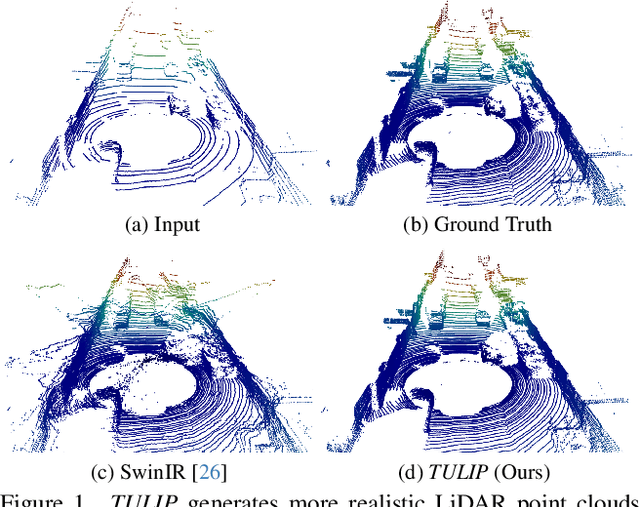
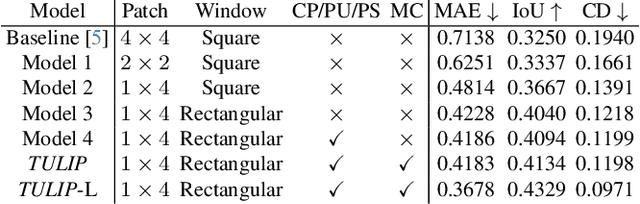
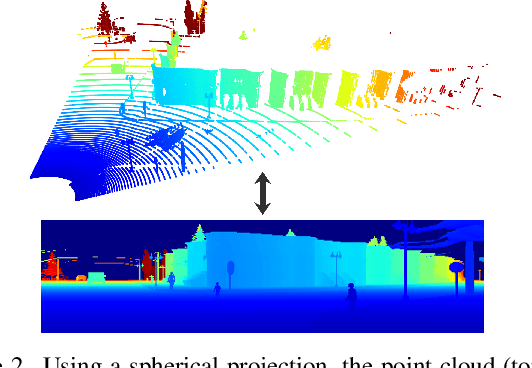
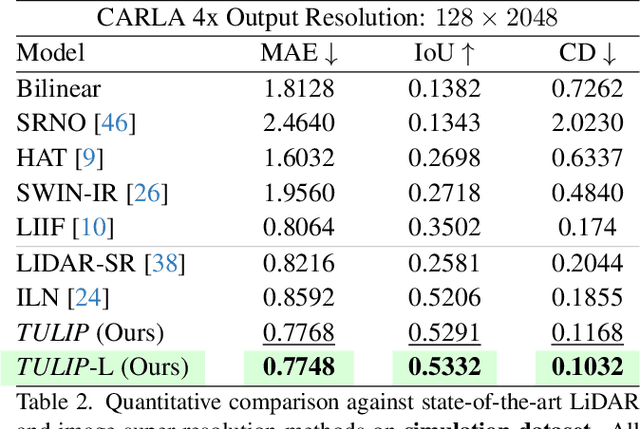
LiDAR Upsampling is a challenging task for the perception systems of robots and autonomous vehicles, due to the sparse and irregular structure of large-scale scene contexts. Recent works propose to solve this problem by converting LiDAR data from 3D Euclidean space into an image super-resolution problem in 2D image space. Although their methods can generate high-resolution range images with fine-grained details, the resulting 3D point clouds often blur out details and predict invalid points. In this paper, we propose TULIP, a new method to reconstruct high-resolution LiDAR point clouds from low-resolution LiDAR input. We also follow a range image-based approach but specifically modify the patch and window geometries of a Swin-Transformer-based network to better fit the characteristics of range images. We conducted several experiments on three different public real-world and simulated datasets. TULIP outperforms state-of-the-art methods in all relevant metrics and generates robust and more realistic point clouds than prior works.
Learning Agile Locomotion on Risky Terrains
Nov 17, 2023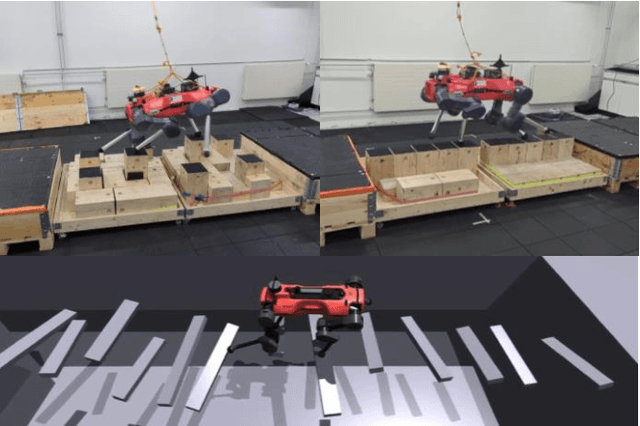
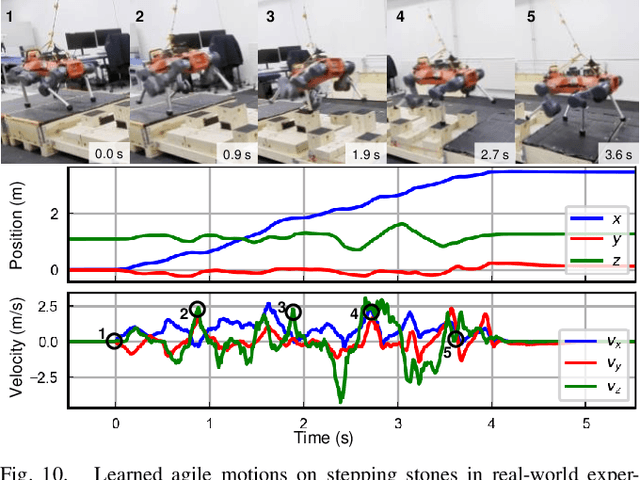
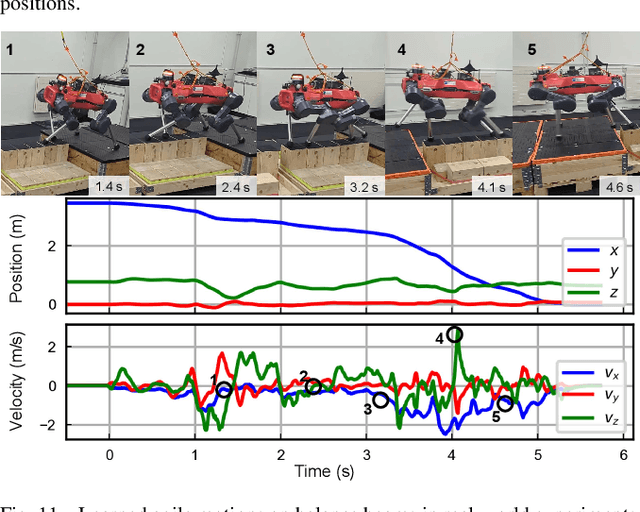

Quadruped robots have shown remarkable mobility on various terrains through reinforcement learning. Yet, in the presence of sparse footholds and risky terrains such as stepping stones and balance beams, which require precise foot placement to avoid falls, model-based approaches are often used. In this paper, we show that end-to-end reinforcement learning can also enable the robot to traverse risky terrains with dynamic motions. To this end, our approach involves training a generalist policy for agile locomotion on disorderly and sparse stepping stones before transferring its reusable knowledge to various more challenging terrains by finetuning specialist policies from it. Given that the robot needs to rapidly adapt its velocity on these terrains, we formulate the task as a navigation task instead of the commonly used velocity tracking which constrains the robot's behavior and propose an exploration strategy to overcome sparse rewards and achieve high robustness. We validate our proposed method through simulation and real-world experiments on an ANYmal-D robot achieving peak forward velocity of >= 2.5 m/s on sparse stepping stones and narrow balance beams. Video: youtu.be/Z5X0J8OH6z4