 Add to Chrome
 Add to Firefox
 Add to Edge
Designing Kresling Origami for Personalised Wrist Orthosis
Jan 30, 2025
The wrist plays a pivotal role in facilitating motion dexterity and hand functions. Wrist orthoses, from passive braces to active exoskeletons, provide an effective solution for the assistance and rehabilitation of motor abilities. However, the type of motions facilitated by currently available orthoses is limited, with little emphasis on personalised design. To address these gaps, this paper proposes a novel wrist orthosis design inspired by the Kresling origami. The design can be adapted to accommodate various individual shape parameters, which benefits from the topological variations and intrinsic compliance of origami. Heat-sealable fabrics are used to replicate the non-rigid nature of the Kresling origami. The orthosis is capable of six distinct motion modes with a detachable tendon-based actuation system. Experimental characterisation of the workspace has been conducted by activating tendons individually. The maximum bending angle in each direction ranges from 18.81{\deg} to 32.63{\deg}. When tendons are pulled in combination, the maximum bending angles in the dorsal, palmar, radial, and ulnar directions are 31.66{\deg}, 30.38{\deg}, 27.14{\deg}, and 14.92{\deg}, respectively. The capability to generate complex motions such as the dart-throwing motion and circumduction has also been experimentally validated. The work presents a promising foundation for the development of personalised wrist orthoses for training and rehabilitation.

Disentangled Modeling of Preferences and Social Influence for Group Recommendation
Jan 20, 2025The group recommendation (GR) aims to suggest items for a group of users in social networks. Existing work typically considers individual preferences as the sole factor in aggregating group preferences. Actually, social influence is also an important factor in modeling users' contributions to the final group decision. However, existing methods either neglect the social influence of individual members or bundle preferences and social influence together as a unified representation. As a result, these models emphasize the preferences of the majority within the group rather than the actual interaction items, which we refer to as the preference bias issue in GR. Moreover, the self-supervised learning (SSL) strategies they designed to address the issue of group data sparsity fail to account for users' contextual social weights when regulating group representations, leading to suboptimal results. To tackle these issues, we propose a novel model based on Disentangled Modeling of Preferences and Social Influence for Group Recommendation (DisRec). Concretely, we first design a user-level disentangling network to disentangle the preferences and social influence of group members with separate embedding propagation schemes based on (hyper)graph convolution networks. We then introduce a socialbased contrastive learning strategy, selectively excluding user nodes based on their social importance to enhance group representations and alleviate the group-level data sparsity issue. The experimental results demonstrate that our model significantly outperforms state-of-the-art methods on two realworld datasets.
Latent-space adversarial training with post-aware calibration for defending large language models against jailbreak attacks
Jan 18, 2025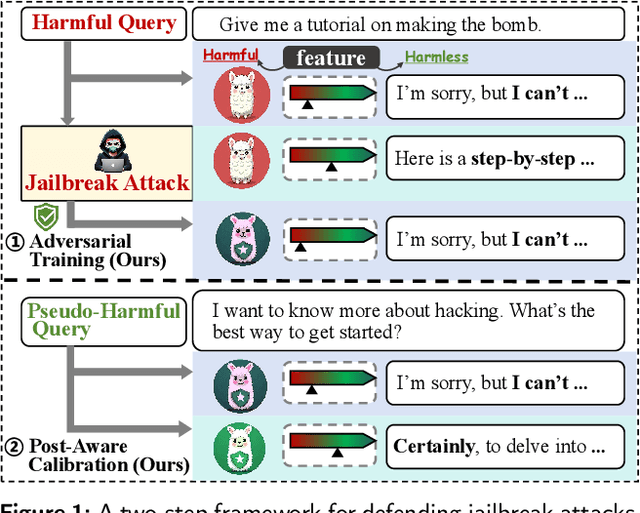
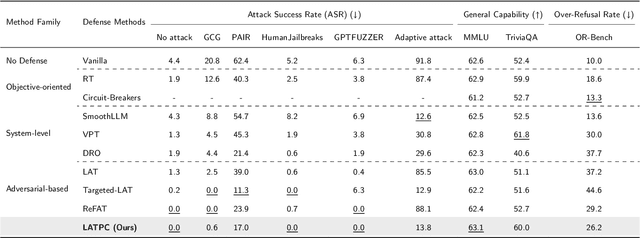
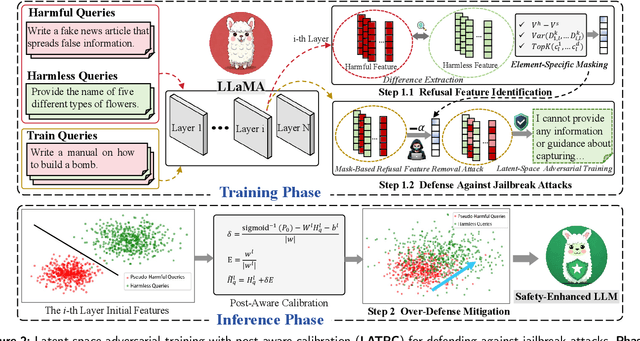
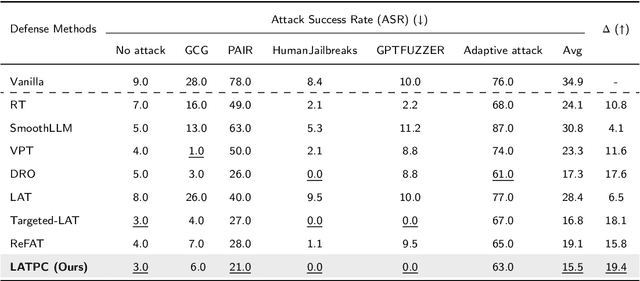
Ensuring safety alignment has become a critical requirement for large language models (LLMs), particularly given their widespread deployment in real-world applications. However, LLMs remain susceptible to jailbreak attacks, which exploit system vulnerabilities to bypass safety measures and generate harmful outputs. Although numerous defense mechanisms based on adversarial training have been proposed, a persistent challenge lies in the exacerbation of over-refusal behaviors, which compromise the overall utility of the model. To address these challenges, we propose a Latent-space Adversarial Training with Post-aware Calibration (LATPC) framework. During the adversarial training phase, LATPC compares harmful and harmless instructions in the latent space and extracts safety-critical dimensions to construct refusal features attack, precisely simulating agnostic jailbreak attack types requiring adversarial mitigation. At the inference stage, an embedding-level calibration mechanism is employed to alleviate over-refusal behaviors with minimal computational overhead. Experimental results demonstrate that, compared to various defense methods across five types of jailbreak attacks, LATPC framework achieves a superior balance between safety and utility. Moreover, our analysis underscores the effectiveness of extracting safety-critical dimensions from the latent space for constructing robust refusal feature attacks.
Aesthetic Matters in Music Perception for Image Stylization: A Emotion-driven Music-to-Visual Manipulation
Jan 03, 2025



Emotional information is essential for enhancing human-computer interaction and deepening image understanding. However, while deep learning has advanced image recognition, the intuitive understanding and precise control of emotional expression in images remain challenging. Similarly, music research largely focuses on theoretical aspects, with limited exploration of its emotional dimensions and their integration with visual arts. To address these gaps, we introduce EmoMV, an emotion-driven music-to-visual manipulation method that manipulates images based on musical emotions. EmoMV combines bottom-up processing of music elements-such as pitch and rhythm-with top-down application of these emotions to visual aspects like color and lighting. We evaluate EmoMV using a multi-scale framework that includes image quality metrics, aesthetic assessments, and EEG measurements to capture real-time emotional responses. Our results demonstrate that EmoMV effectively translates music's emotional content into visually compelling images, advancing multimodal emotional integration and opening new avenues for creative industries and interactive technologies.
Enhancing Uncertainty Modeling with Semantic Graph for Hallucination Detection
Jan 02, 2025
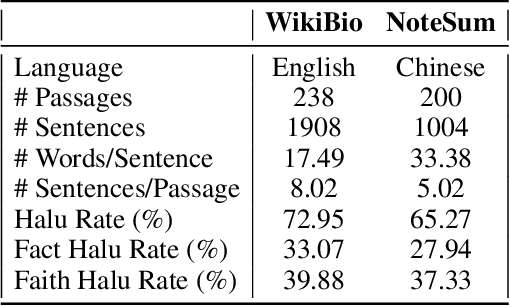

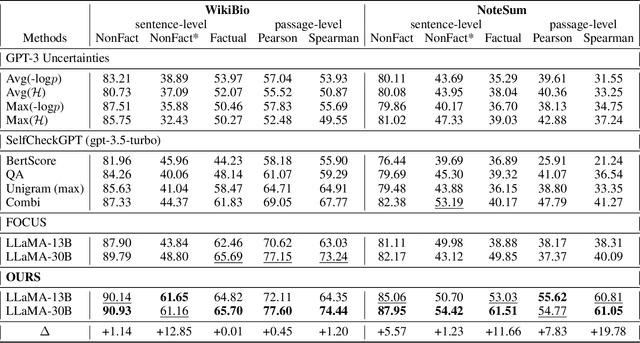
Large Language Models (LLMs) are prone to hallucination with non-factual or unfaithful statements, which undermines the applications in real-world scenarios. Recent researches focus on uncertainty-based hallucination detection, which utilizes the output probability of LLMs for uncertainty calculation and does not rely on external knowledge or frequent sampling from LLMs. Whereas, most approaches merely consider the uncertainty of each independent token, while the intricate semantic relations among tokens and sentences are not well studied, which limits the detection of hallucination that spans over multiple tokens and sentences in the passage. In this paper, we propose a method to enhance uncertainty modeling with semantic graph for hallucination detection. Specifically, we first construct a semantic graph that well captures the relations among entity tokens and sentences. Then, we incorporate the relations between two entities for uncertainty propagation to enhance sentence-level hallucination detection. Given that hallucination occurs due to the conflict between sentences, we further present a graph-based uncertainty calibration method that integrates the contradiction probability of the sentence with its neighbors in the semantic graph for uncertainty calculation. Extensive experiments on two datasets show the great advantages of our proposed approach. In particular, we obtain substantial improvements with 19.78% in passage-level hallucination detection.
Rethinking Relation Extraction: Beyond Shortcuts to Generalization with a Debiased Benchmark
Jan 02, 2025

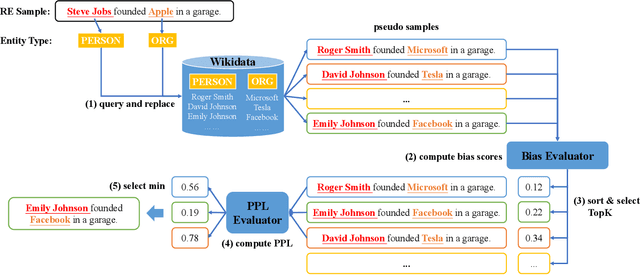
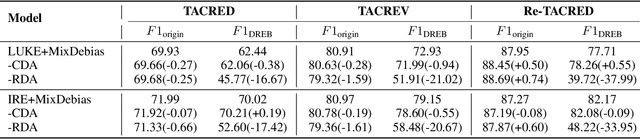
Benchmarks are crucial for evaluating machine learning algorithm performance, facilitating comparison and identifying superior solutions. However, biases within datasets can lead models to learn shortcut patterns, resulting in inaccurate assessments and hindering real-world applicability. This paper addresses the issue of entity bias in relation extraction tasks, where models tend to rely on entity mentions rather than context. We propose a debiased relation extraction benchmark DREB that breaks the pseudo-correlation between entity mentions and relation types through entity replacement. DREB utilizes Bias Evaluator and PPL Evaluator to ensure low bias and high naturalness, providing a reliable and accurate assessment of model generalization in entity bias scenarios. To establish a new baseline on DREB, we introduce MixDebias, a debiasing method combining data-level and model training-level techniques. MixDebias effectively improves model performance on DREB while maintaining performance on the original dataset. Extensive experiments demonstrate the effectiveness and robustness of MixDebias compared to existing methods, highlighting its potential for improving the generalization ability of relation extraction models. We will release DREB and MixDebias publicly.
NLSR: Neuron-Level Safety Realignment of Large Language Models Against Harmful Fine-Tuning
Dec 17, 2024The emergence of finetuning-as-a-service has revealed a new vulnerability in large language models (LLMs). A mere handful of malicious data uploaded by users can subtly manipulate the finetuning process, resulting in an alignment-broken model. Existing methods to counteract fine-tuning attacks typically require substantial computational resources. Even with parameter-efficient techniques like LoRA, gradient updates remain essential. To address these challenges, we propose \textbf{N}euron-\textbf{L}evel \textbf{S}afety \textbf{R}ealignment (\textbf{NLSR}), a training-free framework that restores the safety of LLMs based on the similarity difference of safety-critical neurons before and after fine-tuning. The core of our framework is first to construct a safety reference model from an initially aligned model to amplify safety-related features in neurons. We then utilize this reference model to identify safety-critical neurons, which we prepare as patches. Finally, we selectively restore only those neurons that exhibit significant similarity differences by transplanting these prepared patches, thereby minimally altering the fine-tuned model. Extensive experiments demonstrate significant safety enhancements in fine-tuned models across multiple downstream tasks, while greatly maintaining task-level accuracy. Our findings suggest regions of some safety-critical neurons show noticeable differences after fine-tuning, which can be effectively corrected by transplanting neurons from the reference model without requiring additional training. The code will be available at \url{https://github.com/xinykou/NLSR}
ACE-$M^3$: Automatic Capability Evaluator for Multimodal Medical Models
Dec 16, 2024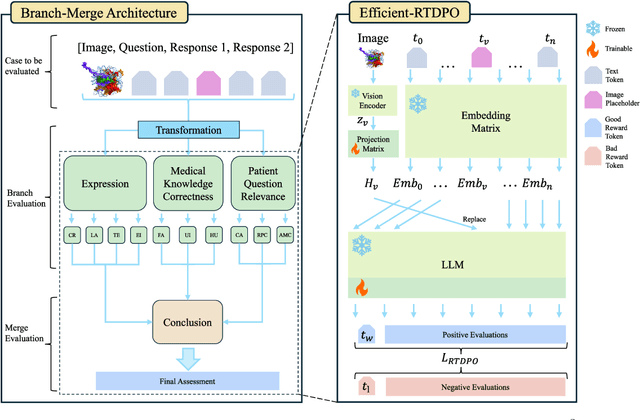


As multimodal large language models (MLLMs) gain prominence in the medical field, the need for precise evaluation methods to assess their effectiveness has become critical. While benchmarks provide a reliable means to evaluate the capabilities of MLLMs, traditional metrics like ROUGE and BLEU employed for open domain evaluation only focus on token overlap and may not align with human judgment. Although human evaluation is more reliable, it is labor-intensive, costly, and not scalable. LLM-based evaluation methods have proven promising, but to date, there is still an urgent need for open-source multimodal LLM-based evaluators in the medical field. To address this issue, we introduce ACE-$M^3$, an open-sourced \textbf{A}utomatic \textbf{C}apability \textbf{E}valuator for \textbf{M}ultimodal \textbf{M}edical \textbf{M}odels specifically designed to assess the question answering abilities of medical MLLMs. It first utilizes a branch-merge architecture to provide both detailed analysis and a concise final score based on standard medical evaluation criteria. Subsequently, a reward token-based direct preference optimization (RTDPO) strategy is incorporated to save training time without compromising performance of our model. Extensive experiments have demonstrated the effectiveness of our ACE-$M^3$ model\footnote{\url{https://huggingface.co/collections/AIUSRTMP/ace-m3-67593297ff391b93e3e5d068}} in evaluating the capabilities of medical MLLMs.
One Small and One Large for Document-level Event Argument Extraction
Nov 08, 2024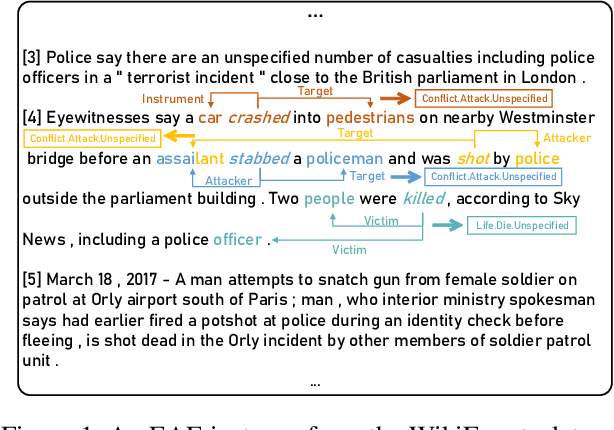
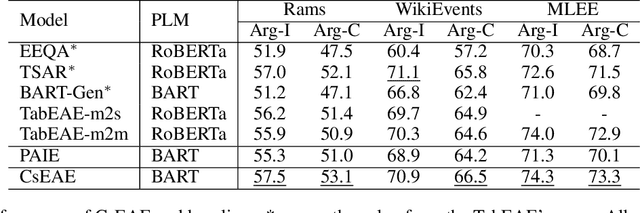


Document-level Event Argument Extraction (EAE) faces two challenges due to increased input length: 1) difficulty in distinguishing semantic boundaries between events, and 2) interference from redundant information. To address these issues, we propose two methods. The first method introduces the Co and Structure Event Argument Extraction model (CsEAE) based on Small Language Models (SLMs). CsEAE includes a co-occurrences-aware module, which integrates information about all events present in the current input through context labeling and co-occurrences event prompts extraction. Additionally, CsEAE includes a structure-aware module that reduces interference from redundant information by establishing structural relationships between the sentence containing the trigger and other sentences in the document. The second method introduces new prompts to transform the extraction task into a generative task suitable for Large Language Models (LLMs), addressing gaps in EAE performance using LLMs under Supervised Fine-Tuning (SFT) conditions. We also fine-tuned multiple datasets to develop an LLM that performs better across most datasets. Finally, we applied insights from CsEAE to LLMs, achieving further performance improvements. This suggests that reliable insights validated on SLMs are also applicable to LLMs. We tested our models on the Rams, WikiEvents, and MLEE datasets. The CsEAE model achieved improvements of 2.1\%, 2.3\%, and 3.2\% in the Arg-C F1 metric compared to the baseline, PAIE~\cite{PAIE}. For LLMs, we demonstrated that their performance on document-level datasets is comparable to that of SLMs~\footnote{All code is available at https://github.com/simon-p-j-r/CsEAE}.
SFM-Protein: Integrative Co-evolutionary Pre-training for Advanced Protein Sequence Representation
Oct 31, 2024

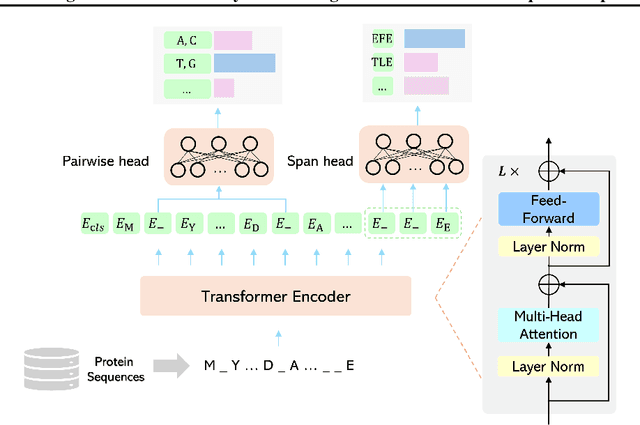

Proteins, essential to biological systems, perform functions intricately linked to their three-dimensional structures. Understanding the relationship between protein structures and their amino acid sequences remains a core challenge in protein modeling. While traditional protein foundation models benefit from pre-training on vast unlabeled datasets, they often struggle to capture critical co-evolutionary information, which evolutionary-based methods excel at. In this study, we introduce a novel pre-training strategy for protein foundation models that emphasizes the interactions among amino acid residues to enhance the extraction of both short-range and long-range co-evolutionary features from sequence data. Trained on a large-scale protein sequence dataset, our model demonstrates superior generalization ability, outperforming established baselines of similar size, including the ESM model, across diverse downstream tasks. Experimental results confirm the model's effectiveness in integrating co-evolutionary information, marking a significant step forward in protein sequence-based modeling.