 Add to Chrome
 Add to Firefox
 Add to Edge
A multi-stage soft computing framework for complex disease modelling and decision support: A liver cirrhosis case study
Apr 26, 2026
Liver cirrhosis is a major global health problem causing millions of deaths annually, and timely detection with aggressive treatment can significantly improve patients' quality of life. Modelling complex diseases from biomedical data is computationally challenging due to high dimensionality, strong feature correlations, noise, and limited labelled samples. Conventional Machine Learning (ML) pipelines often struggle with robustness, interpretability, and generalisation under such conditions. In this study, we propose an ML-driven multi-stage decision framework for complex disease modelling and therapeutic exploration. The framework integrates single-cell transcriptomic profiling, high-dimensional network-based feature stabilisation, multi-model learning, deep representation construction, and post-hoc decision support. Specifically, single-cell sequencing data were analysed to identify key cellular subpopulations, followed by high-dimensional weighted gene co-expression network analysis (hdWGCNA) to stabilise gene modules under sparsity and noise. To enhance non-linear feature interaction modelling, tabular molecular features were restructured into two-dimensional disease maps and analysed using a CNN. Finally, molecular docking was incorporated as a decision-support module to evaluate candidate therapeutic compounds. Using liver cirrhosis as a representative case, the framework identified a disease-associated endothelial subpopulation and extracted seven robust signature genes (HSPB1, GADD45A, CLDN5, ATP1B3, C1QBP, ENPP2, and PARL). The CNN-based representation learning module outperformed conventional pipelines in classification. The framework is disease-agnostic and readily extends to other omics-driven biomedical applications involving uncertainty, heterogeneity, and limited samples.

EduChat: A Large-Scale Language Model-based Chatbot System for Intelligent Education
Aug 05, 2023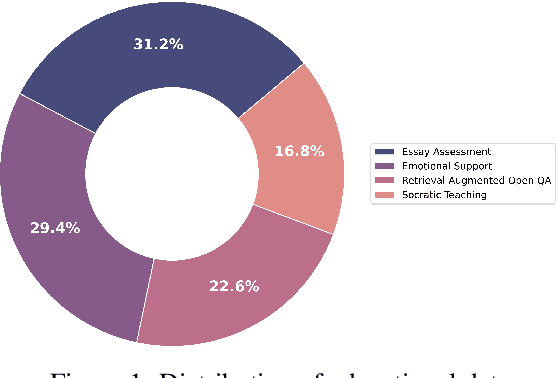
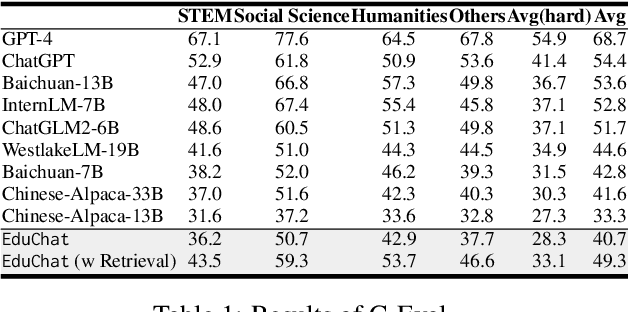
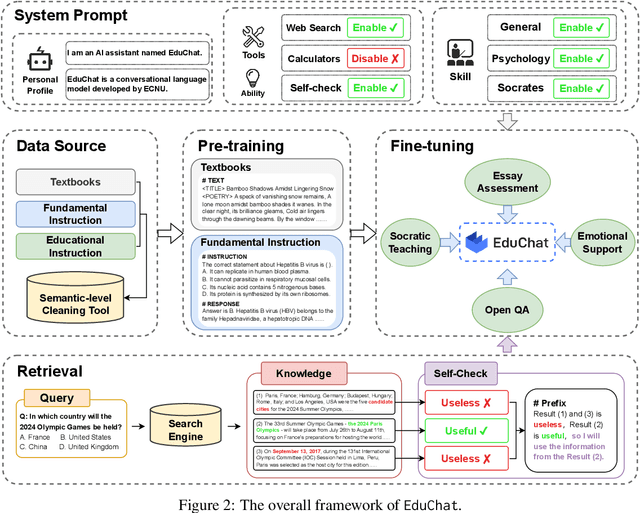

EduChat (https://www.educhat.top/) is a large-scale language model (LLM)-based chatbot system in the education domain. Its goal is to support personalized, fair, and compassionate intelligent education, serving teachers, students, and parents. Guided by theories from psychology and education, it further strengthens educational functions such as open question answering, essay assessment, Socratic teaching, and emotional support based on the existing basic LLMs. Particularly, we learn domain-specific knowledge by pre-training on the educational corpus and stimulate various skills with tool use by fine-tuning on designed system prompts and instructions. Currently, EduChat is available online as an open-source project, with its code, data, and model parameters available on platforms (e.g., GitHub https://github.com/icalk-nlp/EduChat, Hugging Face https://huggingface.co/ecnu-icalk ). We also prepare a demonstration of its capabilities online (https://vimeo.com/851004454). This initiative aims to promote research and applications of LLMs for intelligent education.