 Add to Chrome
 Add to Firefox
 Add to Edge
Structured Event Reasoning with Large Language Models
Aug 28, 2024
Reasoning about real-life events is a unifying challenge in AI and NLP that has profound utility in a variety of domains, while fallacy in high-stake applications could be catastrophic. Able to work with diverse text in these domains, large language models (LLMs) have proven capable of answering questions and solving problems. However, I show that end-to-end LLMs still systematically fail to reason about complex events, and they lack interpretability due to their black-box nature. To address these issues, I propose three general approaches to use LLMs in conjunction with a structured representation of events. The first is a language-based representation involving relations of sub-events that can be learned by LLMs via fine-tuning. The second is a semi-symbolic representation involving states of entities that can be predicted and leveraged by LLMs via few-shot prompting. The third is a fully symbolic representation that can be predicted by LLMs trained with structured data and be executed by symbolic solvers. On a suite of event reasoning tasks spanning common-sense inference and planning, I show that each approach greatly outperforms end-to-end LLMs with more interpretability. These results suggest manners of synergy between LLMs and structured representations for event reasoning and beyond.

CURE4Rec: A Benchmark for Recommendation Unlearning with Deeper Influence
Aug 26, 2024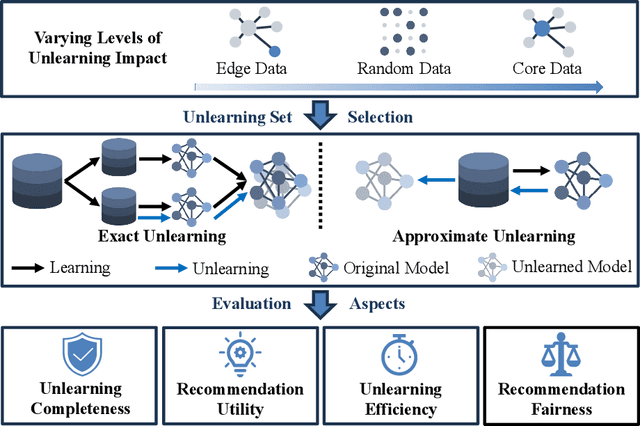

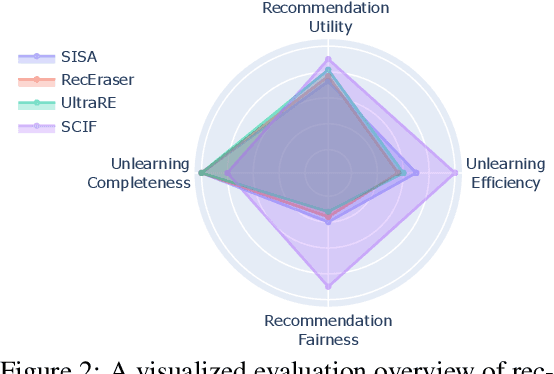

With increasing privacy concerns in artificial intelligence, regulations have mandated the right to be forgotten, granting individuals the right to withdraw their data from models. Machine unlearning has emerged as a potential solution to enable selective forgetting in models, particularly in recommender systems where historical data contains sensitive user information. Despite recent advances in recommendation unlearning, evaluating unlearning methods comprehensively remains challenging due to the absence of a unified evaluation framework and overlooked aspects of deeper influence, e.g., fairness. To address these gaps, we propose CURE4Rec, the first comprehensive benchmark for recommendation unlearning evaluation. CURE4Rec covers four aspects, i.e., unlearning Completeness, recommendation Utility, unleaRning efficiency, and recommendation fairnEss, under three data selection strategies, i.e., core data, edge data, and random data. Specifically, we consider the deeper influence of unlearning on recommendation fairness and robustness towards data with varying impact levels. We construct multiple datasets with CURE4Rec evaluation and conduct extensive experiments on existing recommendation unlearning methods. Our code is released at https://github.com/xiye7lai/CURE4Rec.
PropSAM: A Propagation-Based Model for Segmenting Any 3D Objects in Multi-Modal Medical Images
Aug 25, 2024


Volumetric segmentation is crucial for medical imaging but is often constrained by labor-intensive manual annotations and the need for scenario-specific model training. Furthermore, existing general segmentation models are inefficient due to their design and inferential approaches. Addressing this clinical demand, we introduce PropSAM, a propagation-based segmentation model that optimizes the use of 3D medical structure information. PropSAM integrates a CNN-based UNet for intra-slice processing with a Transformer-based module for inter-slice propagation, focusing on structural and semantic continuities to enhance segmentation across various modalities. Distinctively, PropSAM operates on a one-view prompt, such as a 2D bounding box or sketch mask, unlike conventional models that require two-view prompts. It has demonstrated superior performance, significantly improving the Dice Similarity Coefficient (DSC) across 44 medical datasets and various imaging modalities, outperforming models like MedSAM and SegVol with an average DSC improvement of 18.1%. PropSAM also maintains stable predictions despite prompt deviations and varying propagation configurations, confirmed by one-way ANOVA tests with P>0.5985 and P>0.6131, respectively. Moreover, PropSAM's efficient architecture enables faster inference speeds (Wilcoxon rank-sum test, P<0.001) and reduces user interaction time by 37.8% compared to two-view prompt models. Its ability to handle irregular and complex objects with robust performance further demonstrates its potential in clinical settings, facilitating more automated and reliable medical imaging analyses with minimal retraining.
What Do You Want? User-centric Prompt Generation for Text-to-image Synthesis via Multi-turn Guidance
Aug 23, 2024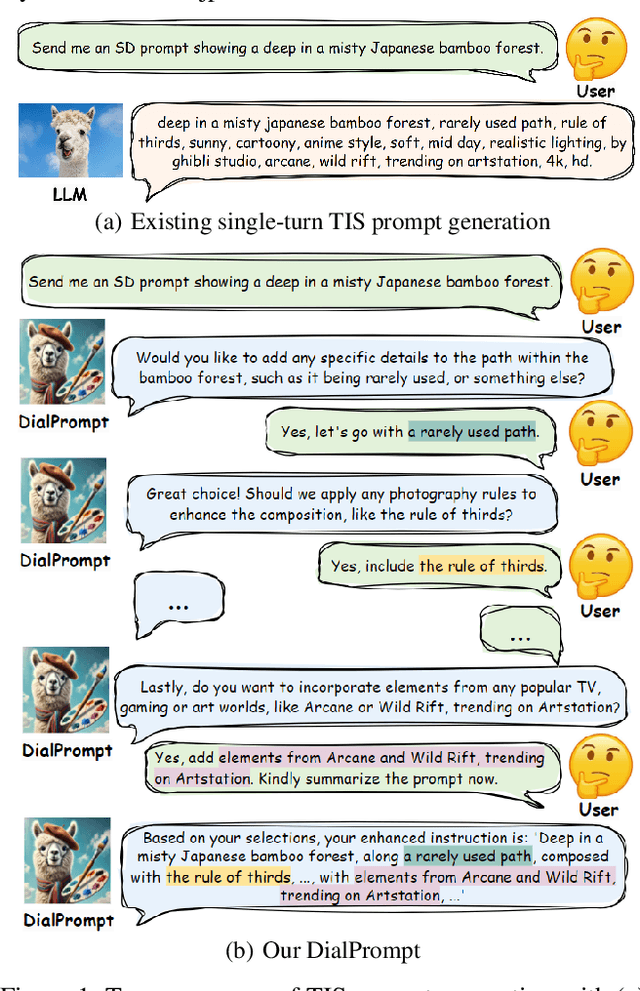
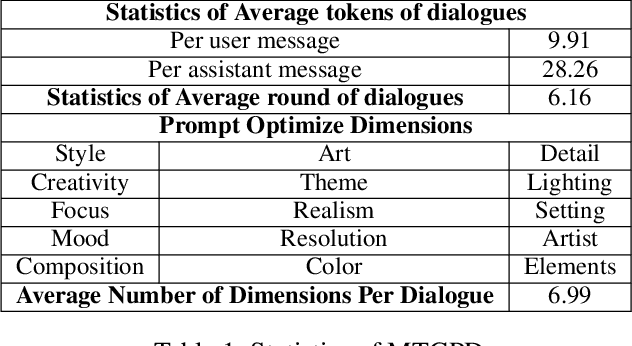
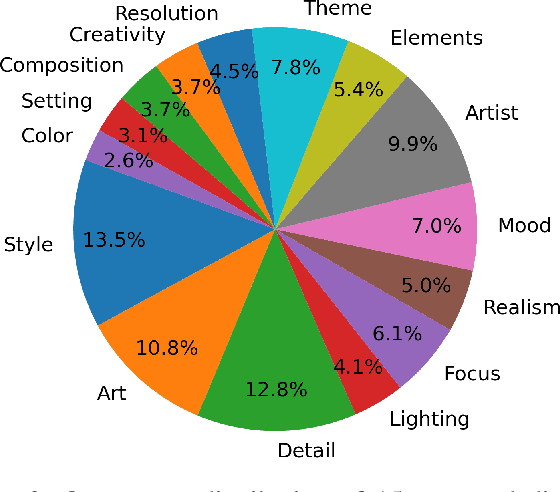
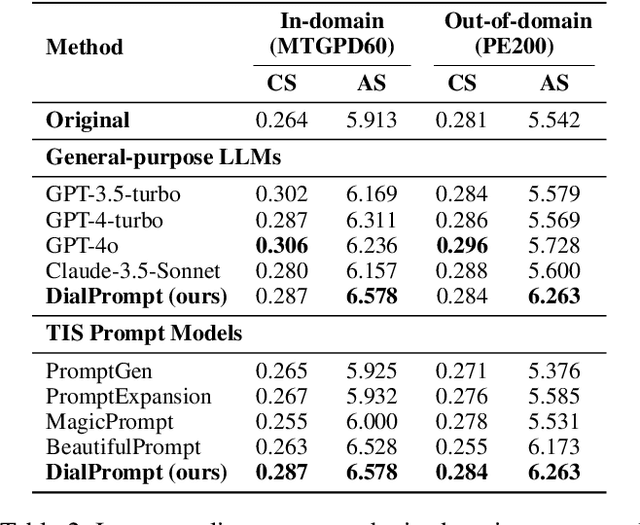
The emergence of text-to-image synthesis (TIS) models has significantly influenced digital image creation by producing high-quality visuals from written descriptions. Yet these models heavily rely on the quality and specificity of textual prompts, posing a challenge for novice users who may not be familiar with TIS-model-preferred prompt writing. Existing solutions relieve this via automatic model-preferred prompt generation from user queries. However, this single-turn manner suffers from limited user-centricity in terms of result interpretability and user interactivity. To address these issues, we propose DialPrompt, a multi-turn dialogue-based TIS prompt generation model that emphasises user-centricity. DialPrompt is designed to follow a multi-turn guidance workflow, where in each round of dialogue the model queries user with their preferences on possible optimization dimensions before generating the final TIS prompt. To achieve this, we mined 15 essential dimensions for high-quality prompts from advanced users and curated a multi-turn dataset. Through training on this dataset, DialPrompt can improve interpretability by allowing users to understand the correlation between specific phrases and image attributes. Additionally, it enables greater user control and engagement in the prompt generation process, leading to more personalized and visually satisfying outputs. Experiments indicate that DialPrompt achieves a competitive result in the quality of synthesized images, outperforming existing prompt engineering approaches by 5.7%. Furthermore, in our user evaluation, DialPrompt outperforms existing approaches by 46.5% in user-centricity score and is rated 7.9/10 by 19 human reviewers.
Enhancing LLM-Based Automated Program Repair with Design Rationales
Aug 22, 2024Automatic Program Repair (APR) endeavors to autonomously rectify issues within specific projects, which generally encompasses three categories of tasks: bug resolution, new feature development, and feature enhancement. Despite extensive research proposing various methodologies, their efficacy in addressing real issues remains unsatisfactory. It's worth noting that, typically, engineers have design rationales (DR) on solution-planed solutions and a set of underlying reasons-before they start patching code. In open-source projects, these DRs are frequently captured in issue logs through project management tools like Jira. This raises a compelling question: How can we leverage DR scattered across the issue logs to efficiently enhance APR? To investigate this premise, we introduce DRCodePilot, an approach designed to augment GPT-4-Turbo's APR capabilities by incorporating DR into the prompt instruction. Furthermore, given GPT-4's constraints in fully grasping the broader project context and occasional shortcomings in generating precise identifiers, we have devised a feedback-based self-reflective framework, in which we prompt GPT-4 to reconsider and refine its outputs by referencing a provided patch and suggested identifiers. We have established a benchmark comprising 938 issue-patch pairs sourced from two open-source repositories hosted on GitHub and Jira. Our experimental results are impressive: DRCodePilot achieves a full-match ratio that is a remarkable 4.7x higher than when GPT-4 is utilized directly. Additionally, the CodeBLEU scores also exhibit promising enhancements. Moreover, our findings reveal that the standalone application of DR can yield promising increase in the full-match ratio across CodeLlama, GPT-3.5, and GPT-4 within our benchmark suite. We believe that our DRCodePilot initiative heralds a novel human-in-the-loop avenue for advancing the field of APR.
DeepInteraction++: Multi-Modality Interaction for Autonomous Driving
Aug 09, 2024


Existing top-performance autonomous driving systems typically rely on the multi-modal fusion strategy for reliable scene understanding. This design is however fundamentally restricted due to overlooking the modality-specific strengths and finally hampering the model performance. To address this limitation, in this work, we introduce a novel modality interaction strategy that allows individual per-modality representations to be learned and maintained throughout, enabling their unique characteristics to be exploited during the whole perception pipeline. To demonstrate the effectiveness of the proposed strategy, we design DeepInteraction++, a multi-modal interaction framework characterized by a multi-modal representational interaction encoder and a multi-modal predictive interaction decoder. Specifically, the encoder is implemented as a dual-stream Transformer with specialized attention operation for information exchange and integration between separate modality-specific representations. Our multi-modal representational learning incorporates both object-centric, precise sampling-based feature alignment and global dense information spreading, essential for the more challenging planning task. The decoder is designed to iteratively refine the predictions by alternately aggregating information from separate representations in a unified modality-agnostic manner, realizing multi-modal predictive interaction. Extensive experiments demonstrate the superior performance of the proposed framework on both 3D object detection and end-to-end autonomous driving tasks. Our code is available at https://github.com/fudan-zvg/DeepInteraction.
Nighttime Pedestrian Detection Based on Fore-Background Contrast Learning
Aug 06, 2024


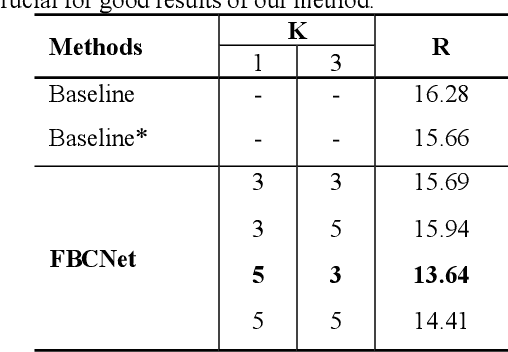
The significance of background information is frequently overlooked in contemporary research concerning channel attention mechanisms. This study addresses the issue of suboptimal single-spectral nighttime pedestrian detection performance under low-light conditions by incorporating background information into the channel attention mechanism. Despite numerous studies focusing on the development of efficient channel attention mechanisms, the relevance of background information has been largely disregarded. By adopting a contrast learning approach, we reexamine channel attention with regard to pedestrian objects and background information for nighttime pedestrian detection, resulting in the proposed Fore-Background Contrast Attention (FBCA). FBCA possesses two primary attributes: (1) channel descriptors form remote dependencies with global spatial feature information; (2) the integration of background information enhances the distinction between channels concentrating on low-light pedestrian features and those focusing on background information. Consequently, the acquired channel descriptors exhibit a higher semantic level and spatial accuracy. Experimental outcomes demonstrate that FBCA significantly outperforms existing methods in single-spectral nighttime pedestrian detection, achieving state-of-the-art results on the NightOwls and TJU-DHD-pedestrian datasets. Furthermore, this methodology also yields performance improvements for the multispectral LLVIP dataset. These findings indicate that integrating background information into the channel attention mechanism effectively mitigates detector performance degradation caused by illumination factors in nighttime scenarios.
Controllable Unlearning for Image-to-Image Generative Models via $\varepsilon$-Constrained Optimization
Aug 03, 2024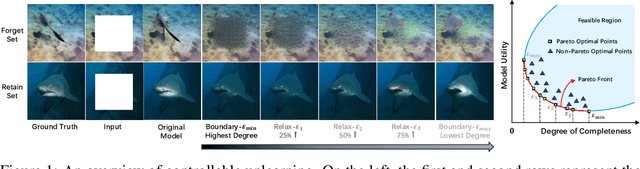
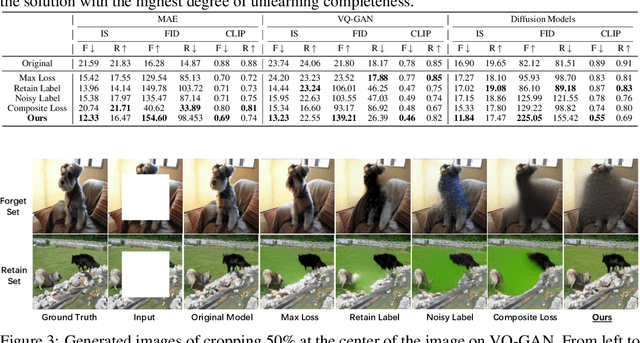
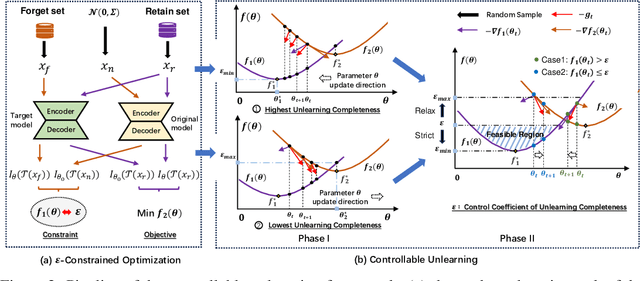
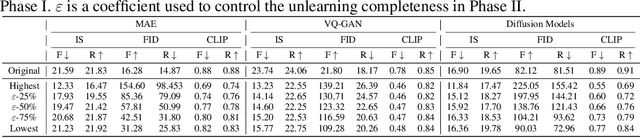
While generative models have made significant advancements in recent years, they also raise concerns such as privacy breaches and biases. Machine unlearning has emerged as a viable solution, aiming to remove specific training data, e.g., containing private information and bias, from models. In this paper, we study the machine unlearning problem in Image-to-Image (I2I) generative models. Previous studies mainly treat it as a single objective optimization problem, offering a solitary solution, thereby neglecting the varied user expectations towards the trade-off between complete unlearning and model utility. To address this issue, we propose a controllable unlearning framework that uses a control coefficient $\varepsilon$ to control the trade-off. We reformulate the I2I generative model unlearning problem into a $\varepsilon$-constrained optimization problem and solve it with a gradient-based method to find optimal solutions for unlearning boundaries. These boundaries define the valid range for the control coefficient. Within this range, every yielded solution is theoretically guaranteed with Pareto optimality. We also analyze the convergence rate of our framework under various control functions. Extensive experiments on two benchmark datasets across three mainstream I2I models demonstrate the effectiveness of our controllable unlearning framework.
DuA: Dual Attentive Transformer in Long-Term Continuous EEG Emotion Analysis
Jul 30, 2024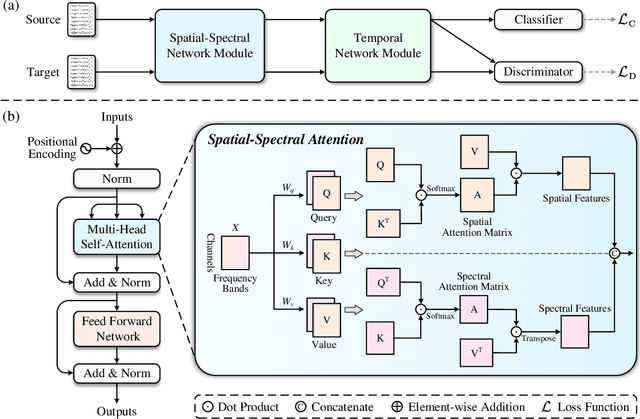
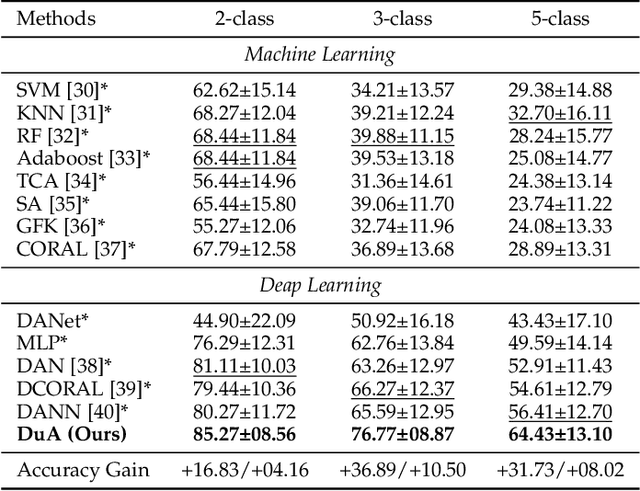
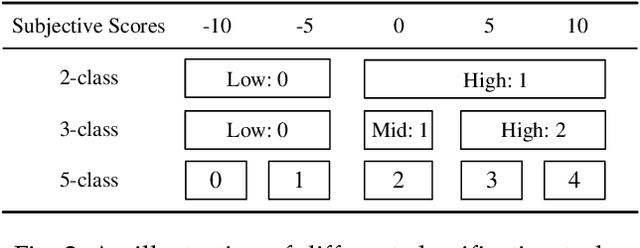
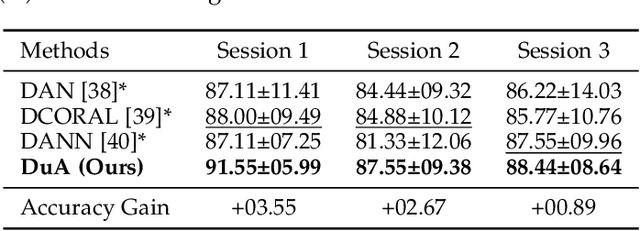
Affective brain-computer interfaces (aBCIs) are increasingly recognized for their potential in monitoring and interpreting emotional states through electroencephalography (EEG) signals. Current EEG-based emotion recognition methods perform well with short segments of EEG data. However, these methods encounter significant challenges in real-life scenarios where emotional states evolve over extended periods. To address this issue, we propose a Dual Attentive (DuA) transformer framework for long-term continuous EEG emotion analysis. Unlike segment-based approaches, the DuA transformer processes an entire EEG trial as a whole, identifying emotions at the trial level, referred to as trial-based emotion analysis. This framework is designed to adapt to varying signal lengths, providing a substantial advantage over traditional methods. The DuA transformer incorporates three key modules: the spatial-spectral network module, the temporal network module, and the transfer learning module. The spatial-spectral network module simultaneously captures spatial and spectral information from EEG signals, while the temporal network module detects temporal dependencies within long-term EEG data. The transfer learning module enhances the model's adaptability across different subjects and conditions. We extensively evaluate the DuA transformer using a self-constructed long-term EEG emotion database, along with two benchmark EEG emotion databases. On the basis of the trial-based leave-one-subject-out cross-subject cross-validation protocol, our experimental results demonstrate that the proposed DuA transformer significantly outperforms existing methods in long-term continuous EEG emotion analysis, with an average enhancement of 5.28%.
MoE-DiffIR: Task-customized Diffusion Priors for Universal Compressed Image Restoration
Jul 15, 2024We present MoE-DiffIR, an innovative universal compressed image restoration (CIR) method with task-customized diffusion priors. This intends to handle two pivotal challenges in the existing CIR methods: (i) lacking adaptability and universality for different image codecs, e.g., JPEG and WebP; (ii) poor texture generation capability, particularly at low bitrates. Specifically, our MoE-DiffIR develops the powerful mixture-of-experts (MoE) prompt module, where some basic prompts cooperate to excavate the task-customized diffusion priors from Stable Diffusion (SD) for each compression task. Moreover, the degradation-aware routing mechanism is proposed to enable the flexible assignment of basic prompts. To activate and reuse the cross-modality generation prior of SD, we design the visual-to-text adapter for MoE-DiffIR, which aims to adapt the embedding of low-quality images from the visual domain to the textual domain as the textual guidance for SD, enabling more consistent and reasonable texture generation. We also construct one comprehensive benchmark dataset for universal CIR, covering 21 types of degradations from 7 popular traditional and learned codecs. Extensive experiments on universal CIR have demonstrated the excellent robustness and texture restoration capability of our proposed MoE-DiffIR. The project can be found at https://renyulin-f.github.io/MoE-DiffIR.github.io/.