 Add to Chrome
 Add to Firefox
 Add to Edge
Beyond "What to Retrieve": Uncertainty in Retrieval-Augmented Code Generation
Jul 29, 2026
Repository-level code generation relies on heterogeneous evidence whose relevance, compatibility, and completeness are inherently uncertain. Similar-code examples, repository context, and project-specific APIs may provide complementary information, but can also introduce noisy, redundant, or conflicting signals. Existing retrieval-augmented approaches primarily optimize retrieval relevance without explicitly modeling how uncertainty in retrieved evidence affects downstream generation. We introduce OpenCoder, an uncertainty-aware framework that estimates source-specific uncertainty, uses it to filter and rank heterogeneous evidence, and guides generation, verification, and repair. A factorial analysis over API knowledge, repository context, and similar-code evidence reveals no universal additive source ranking; instead, significant cross-source interactions depend on the accompanying evidence and LLM backend. On an expanded 32-task RepoExec-inline evaluation, OpenCoder improves GPT selected-output correctness over Baseline RAG from 56.25\% to 78.13\%. However, it matches a verification-and-repair control, and the corresponding Gemini improvement is not statistically supported, indicating backend-dependent benefits. Target-aware API refinement also substantially improves API-set retrieval. These findings support treating uncertainty as an actionable control signal for repository-level retrieval, verification, and repair.

Beyond Self-Knowledge: Propagating Uncertainty Across Reasoning and Retrieval in LLMs
Jul 29, 2026Retrieval-augmented generation improves knowledge-intensive question answering, but indiscriminate retrieval can introduce irrelevant evidence and unnecessary computation. We investigate whether verbalized confidence from black-box language models can serve as an actionable signal for retrieval routing. Our method, BeyondUncertainty, first elicits a structured provisional answer and confidence estimate, then applies a model-specific threshold selected on held-out validation data and frozen before test evaluation. Low-confidence questions receive top-5 TF-IDF retrieval followed by a second answer call, whereas high-confidence questions return the provisional answer directly. We evaluate 27,000 policy instances across six QA benchmarks, three model families, and three retrieval policies. BeyondUncertainty achieves 0.483 mean token-level F1, compared with 0.467 for always retrieval and 0.401 for no retrieval, while reducing retrieved passages by 20.4\% relative to always retrieval. When matched on the number of questions routed to retrieval within each dataset-model cell, it outperforms a post-hoc random allocation in 17 of 18 settings, with an average gain of 0.024 F1. Although poorly calibrated as an absolute probability, probe uncertainty modestly predicts question-level retrieval benefit (AUROC = 0.628). However, the additional probe increases total token usage by 28.2\%, revealing a trade-off between more selective evidence acquisition and end-to-end token efficiency.
Uncertainty and Fairness Awareness in LLM-Based Recommendation Systems
Jan 31, 2026Large language models (LLMs) enable powerful zero-shot recommendations by leveraging broad contextual knowledge, yet predictive uncertainty and embedded biases threaten reliability and fairness. This paper studies how uncertainty and fairness evaluations affect the accuracy, consistency, and trustworthiness of LLM-generated recommendations. We introduce a benchmark of curated metrics and a dataset annotated for eight demographic attributes (31 categorical values) across two domains: movies and music. Through in-depth case studies, we quantify predictive uncertainty (via entropy) and demonstrate that Google DeepMind's Gemini 1.5 Flash exhibits systematic unfairness for certain sensitive attributes; measured similarity-based gaps are SNSR at 0.1363 and SNSV at 0.0507. These disparities persist under prompt perturbations such as typographical errors and multilingual inputs. We further integrate personality-aware fairness into the RecLLM evaluation pipeline to reveal personality-linked bias patterns and expose trade-offs between personalization and group fairness. We propose a novel uncertainty-aware evaluation methodology for RecLLMs, present empirical insights from deep uncertainty case studies, and introduce a personality profile-informed fairness benchmark that advances explainability and equity in LLM recommendations. Together, these contributions establish a foundation for safer, more interpretable RecLLMs and motivate future work on multi-model benchmarks and adaptive calibration for trustworthy deployment.
SecureReviewer: Enhancing Large Language Models for Secure Code Review through Secure-aware Fine-tuning
Oct 30, 2025Identifying and addressing security issues during the early phase of the development lifecycle is critical for mitigating the long-term negative impacts on software systems. Code review serves as an effective practice that enables developers to check their teammates' code before integration into the codebase. To streamline the generation of review comments, various automated code review approaches have been proposed, where LLM-based methods have significantly advanced the capabilities of automated review generation. However, existing models primarily focus on general-purpose code review, their effectiveness in identifying and addressing security-related issues remains underexplored. Moreover, adapting existing code review approaches to target security issues faces substantial challenges, including data scarcity and inadequate evaluation metrics. To address these limitations, we propose SecureReviewer, a new approach designed for enhancing LLMs' ability to identify and resolve security-related issues during code review. Specifically, we first construct a dataset tailored for training and evaluating secure code review capabilities. Leveraging this dataset, we fine-tune LLMs to generate code review comments that can effectively identify security issues and provide fix suggestions with our proposed secure-aware fine-tuning strategy. To mitigate hallucination in LLMs and enhance the reliability of their outputs, we integrate the RAG technique, which grounds the generated comments in domain-specific security knowledge. Additionally, we introduce SecureBLEU, a new evaluation metric designed to assess the effectiveness of review comments in addressing security issues. Experimental results demonstrate that SecureReviewer outperforms state-of-the-art baselines in both security issue detection accuracy and the overall quality and practical utility of generated review comments.
An Empirical Study on Failures in Automated Issue Solving
Sep 17, 2025Automated issue solving seeks to autonomously identify and repair defective code snippets across an entire codebase. SWE-Bench has emerged as the most widely adopted benchmark for evaluating progress in this area. While LLM-based agentic tools show great promise, they still fail on a substantial portion of tasks. Moreover, current evaluations primarily report aggregate issue-solving rates, which obscure the underlying causes of success and failure, making it challenging to diagnose model weaknesses or guide targeted improvements. To bridge this gap, we first analyze the performance and efficiency of three SOTA tools, spanning both pipeline-based and agentic architectures, in automated issue solving tasks of SWE-Bench-Verified under varying task characteristics. Furthermore, to move from high-level performance metrics to underlying cause analysis, we conducted a systematic manual analysis of 150 failed instances. From this analysis, we developed a comprehensive taxonomy of failure modes comprising 3 primary phases, 9 main categories, and 25 fine-grained subcategories. Then we systematically analyze the distribution of the identified failure modes, the results reveal distinct failure fingerprints between the two architectural paradigms, with the majority of agentic failures stemming from flawed reasoning and cognitive deadlocks. Motivated by these insights, we propose a collaborative Expert-Executor framework. It introduces a supervisory Expert agent tasked with providing strategic oversight and course-correction for a primary Executor agent. This architecture is designed to correct flawed reasoning and break the cognitive deadlocks that frequently lead to failure. Experiments show that our framework solves 22.2% of previously intractable issues for a leading single agent. These findings pave the way for building more robust agents through diagnostic evaluation and collaborative design.
CleanMAP: Distilling Multimodal LLMs for Confidence-Driven Crowdsourced HD Map Updates
Apr 14, 2025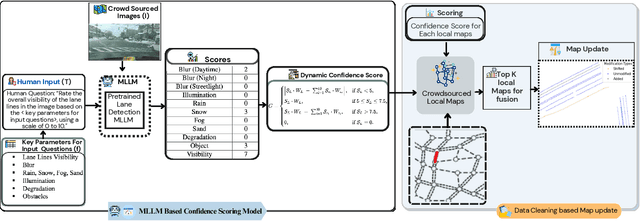
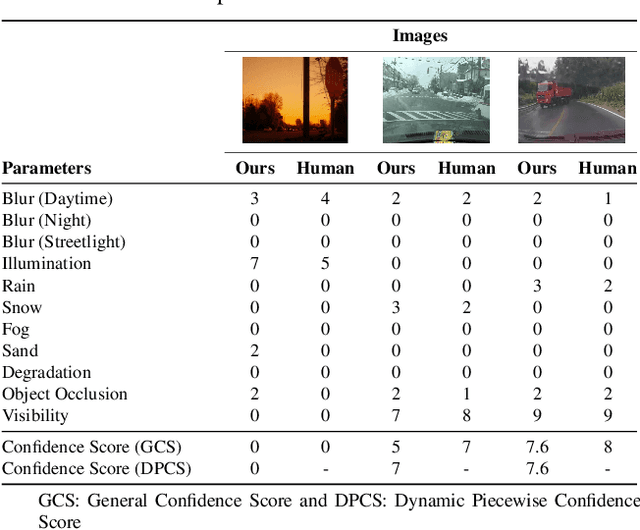
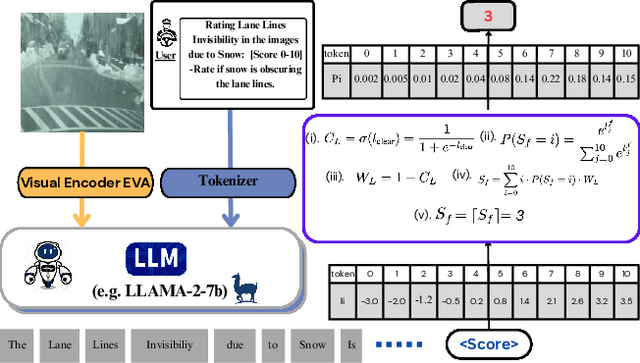
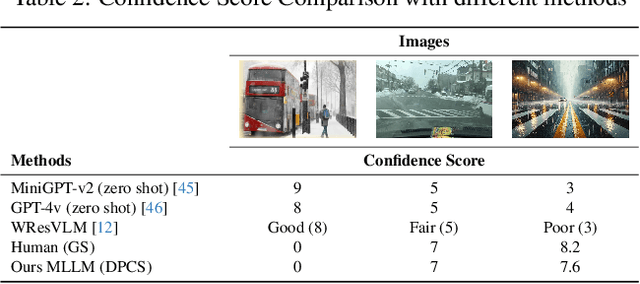
The rapid growth of intelligent connected vehicles (ICVs) and integrated vehicle-road-cloud systems has increased the demand for accurate, real-time HD map updates. However, ensuring map reliability remains challenging due to inconsistencies in crowdsourced data, which suffer from motion blur, lighting variations, adverse weather, and lane marking degradation. This paper introduces CleanMAP, a Multimodal Large Language Model (MLLM)-based distillation framework designed to filter and refine crowdsourced data for high-confidence HD map updates. CleanMAP leverages an MLLM-driven lane visibility scoring model that systematically quantifies key visual parameters, assigning confidence scores (0-10) based on their impact on lane detection. A novel dynamic piecewise confidence-scoring function adapts scores based on lane visibility, ensuring strong alignment with human evaluations while effectively filtering unreliable data. To further optimize map accuracy, a confidence-driven local map fusion strategy ranks and selects the top-k highest-scoring local maps within an optimal confidence range (best score minus 10%), striking a balance between data quality and quantity. Experimental evaluations on a real-world autonomous vehicle dataset validate CleanMAP's effectiveness, demonstrating that fusing the top three local maps achieves the lowest mean map update error of 0.28m, outperforming the baseline (0.37m) and meeting stringent accuracy thresholds (<= 0.32m). Further validation with real-vehicle data confirms 84.88% alignment with human evaluators, reinforcing the model's robustness and reliability. This work establishes CleanMAP as a scalable and deployable solution for crowdsourced HD map updates, ensuring more precise and reliable autonomous navigation. The code will be available at https://Ankit-Zefan.github.io/CleanMap/
FairEval: Evaluating Fairness in LLM-Based Recommendations with Personality Awareness
Apr 10, 2025Recent advances in Large Language Models (LLMs) have enabled their application to recommender systems (RecLLMs), yet concerns remain regarding fairness across demographic and psychological user dimensions. We introduce FairEval, a novel evaluation framework to systematically assess fairness in LLM-based recommendations. FairEval integrates personality traits with eight sensitive demographic attributes,including gender, race, and age, enabling a comprehensive assessment of user-level bias. We evaluate models, including ChatGPT 4o and Gemini 1.5 Flash, on music and movie recommendations. FairEval's fairness metric, PAFS, achieves scores up to 0.9969 for ChatGPT 4o and 0.9997 for Gemini 1.5 Flash, with disparities reaching 34.79 percent. These results highlight the importance of robustness in prompt sensitivity and support more inclusive recommendation systems.
Advancing Autonomous Vehicle Intelligence: Deep Learning and Multimodal LLM for Traffic Sign Recognition and Robust Lane Detection
Mar 08, 2025Autonomous vehicles (AVs) require reliable traffic sign recognition and robust lane detection capabilities to ensure safe navigation in complex and dynamic environments. This paper introduces an integrated approach combining advanced deep learning techniques and Multimodal Large Language Models (MLLMs) for comprehensive road perception. For traffic sign recognition, we systematically evaluate ResNet-50, YOLOv8, and RT-DETR, achieving state-of-the-art performance of 99.8% with ResNet-50, 98.0% accuracy with YOLOv8, and achieved 96.6% accuracy in RT-DETR despite its higher computational complexity. For lane detection, we propose a CNN-based segmentation method enhanced by polynomial curve fitting, which delivers high accuracy under favorable conditions. Furthermore, we introduce a lightweight, Multimodal, LLM-based framework that directly undergoes instruction tuning using small yet diverse datasets, eliminating the need for initial pretraining. This framework effectively handles various lane types, complex intersections, and merging zones, significantly enhancing lane detection reliability by reasoning under adverse conditions. Despite constraints in available training resources, our multimodal approach demonstrates advanced reasoning capabilities, achieving a Frame Overall Accuracy (FRM) of 53.87%, a Question Overall Accuracy (QNS) of 82.83%, lane detection accuracies of 99.6% in clear conditions and 93.0% at night, and robust performance in reasoning about lane invisibility due to rain (88.4%) or road degradation (95.6%). The proposed comprehensive framework markedly enhances AV perception reliability, thus contributing significantly to safer autonomous driving across diverse and challenging road scenarios.
CodeSwift: Accelerating LLM Inference for Efficient Code Generation
Feb 24, 2025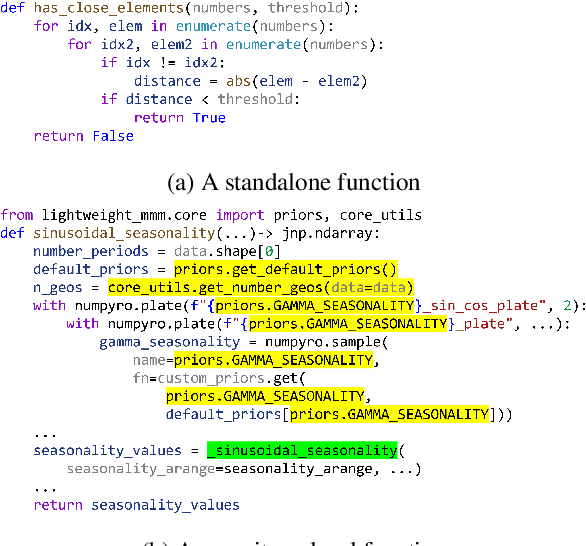
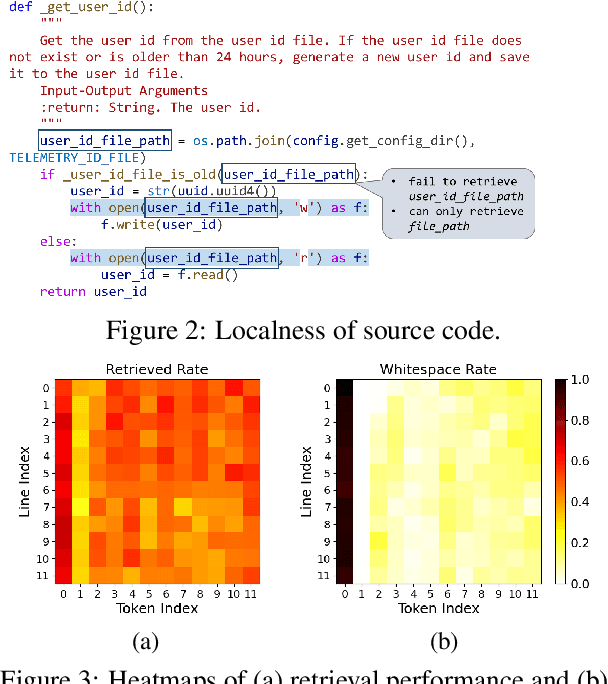
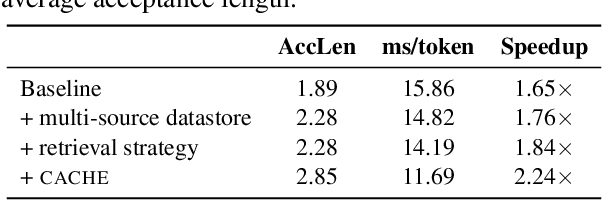

Code generation is a latency-sensitive task that demands high timeliness, but the autoregressive decoding mechanism of Large Language Models (LLMs) leads to poor inference efficiency. Existing LLM inference acceleration methods mainly focus on standalone functions using only built-in components. Moreover, they treat code like natural language sequences, ignoring its unique syntax and semantic characteristics. As a result, the effectiveness of these approaches in code generation tasks remains limited and fails to align with real-world programming scenarios. To alleviate this issue, we propose CodeSwift, a simple yet highly efficient inference acceleration approach specifically designed for code generation, without comprising the quality of the output. CodeSwift constructs a multi-source datastore, providing access to both general and project-specific knowledge, facilitating the retrieval of high-quality draft sequences. Moreover, CodeSwift reduces retrieval cost by controlling retrieval timing, and enhances efficiency through parallel retrieval and a context- and LLM preference-aware cache. Experimental results show that CodeSwift can reach up to 2.53x and 2.54x speedup compared to autoregressive decoding in repository-level and standalone code generation tasks, respectively, outperforming state-of-the-art inference acceleration approaches by up to 88%.
A Multi-Agent Framework for Extensible Structured Text Generation in PLCs
Dec 03, 2024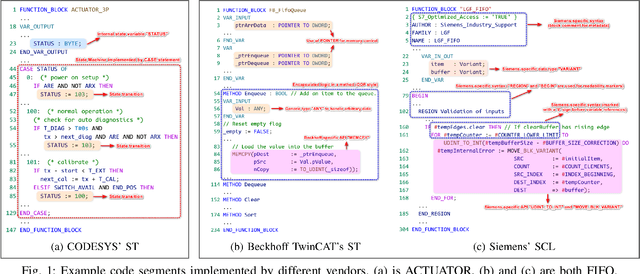
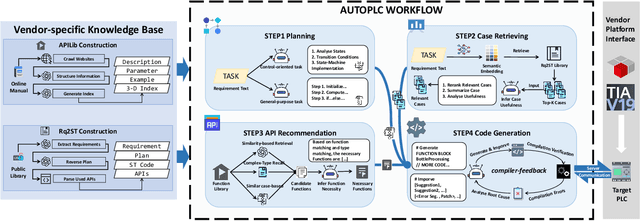
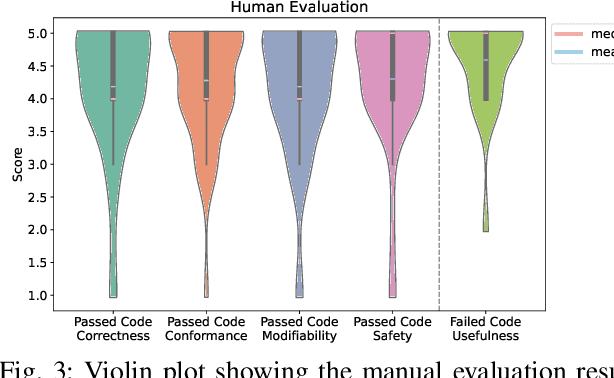
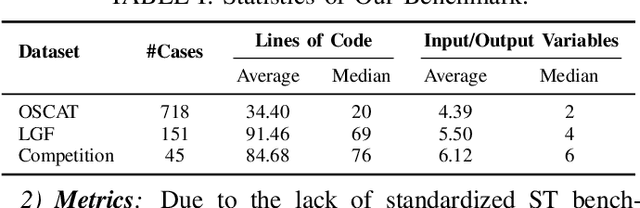
Programmable Logic Controllers (PLCs) are microcomputers essential for automating factory operations. Structured Text (ST), a high-level language adhering to the IEC 61131-3 standard, is pivotal for PLCs due to its ability to express logic succinctly and to seamlessly integrate with other languages within the same standard. However, vendors develop their own customized versions of ST, and the lack of comprehensive and standardized documentation for the full semantics of ST has contributed to inconsistencies in how the language is implemented. Consequently, the steep learning curve associated with ST, combined with ever-evolving industrial requirements, presents significant challenges for developers. In response to these issues, we present AutoPLC, an LLM-based approach designed to automate the generation of vendor-specific ST code. To facilitate effective code generation, we first built a comprehensive knowledge base, including Rq2ST Case Library (requirements and corresponding implementations) and Instruction libraries. Then we developed a retrieval module to incorporate the domain-specific knowledge by identifying pertinent cases and instructions, guiding the LLM to generate code that meets the requirements. In order to verify and improve the quality of the generated code, we designed an adaptable code checker. If errors are detected, we initiate an iterative self-improvement process to instruct the LLM to revise the generated code. We evaluate AutoPLC's performance against seven state-of-the-art baselines using three benchmarks, one for open-source basic ST and two for commercial Structured Control Language (SCL) from Siemens. The results show that our approach consistently achieves superior performance across all benchmarks. Ablation study emphasizes the significance of our modules. Further manual analysis confirm the practical utility of the ST code generated by AutoPLC.