 Add to Chrome
 Add to Firefox
 Add to Edge
DeFine: A Decomposed and Fine-Grained Annotated Dataset for Long-form Article Generation
Mar 10, 2025
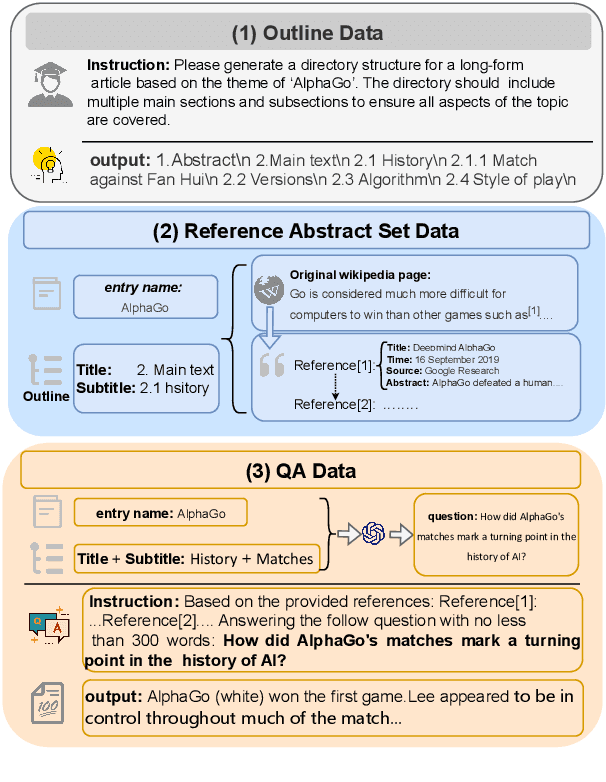
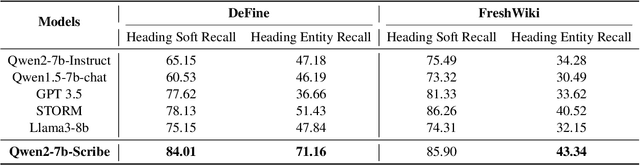
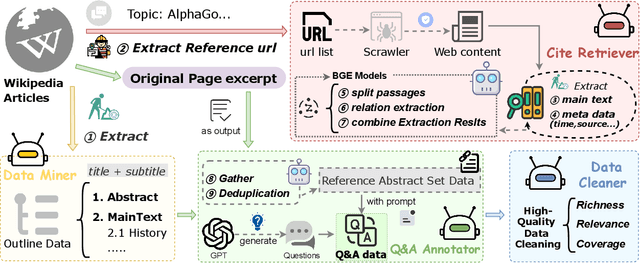
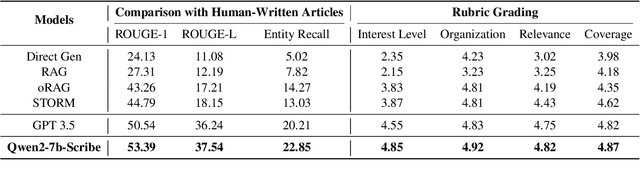
Long-form article generation (LFAG) presents challenges such as maintaining logical consistency, comprehensive topic coverage, and narrative coherence across extended articles. Existing datasets often lack both the hierarchical structure and fine-grained annotation needed to effectively decompose tasks, resulting in shallow, disorganized article generation. To address these limitations, we introduce DeFine, a Decomposed and Fine-grained annotated dataset for long-form article generation. DeFine is characterized by its hierarchical decomposition strategy and the integration of domain-specific knowledge with multi-level annotations, ensuring granular control and enhanced depth in article generation. To construct the dataset, a multi-agent collaborative pipeline is proposed, which systematically segments the generation process into four parts: Data Miner, Cite Retreiver, Q&A Annotator and Data Cleaner. To validate the effectiveness of DeFine, we designed and tested three LFAG baselines: the web retrieval, the local retrieval, and the grounded reference. We fine-tuned the Qwen2-7b-Instruct model using the DeFine training dataset. The experimental results showed significant improvements in text quality, specifically in topic coverage, depth of information, and content fidelity. Our dataset publicly available to facilitate future research.

Treble Counterfactual VLMs: A Causal Approach to Hallucination
Mar 08, 2025
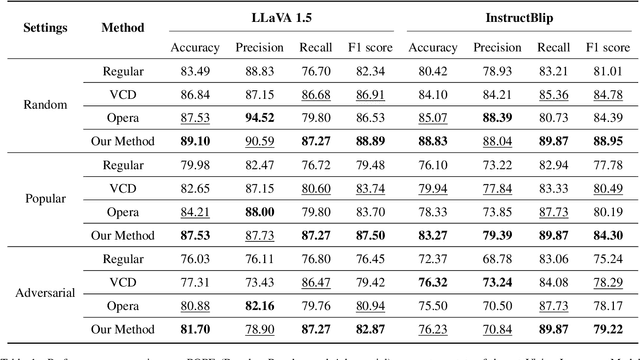
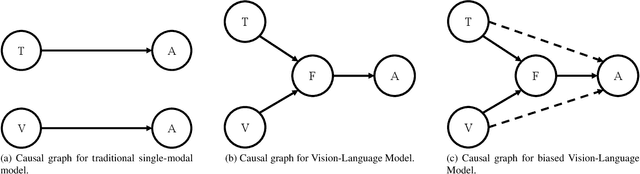

Vision-Language Models (VLMs) have advanced multi-modal tasks like image captioning, visual question answering, and reasoning. However, they often generate hallucinated outputs inconsistent with the visual context or prompt, limiting reliability in critical applications like autonomous driving and medical imaging. Existing studies link hallucination to statistical biases, language priors, and biased feature learning but lack a structured causal understanding. In this work, we introduce a causal perspective to analyze and mitigate hallucination in VLMs. We hypothesize that hallucination arises from unintended direct influences of either the vision or text modality, bypassing proper multi-modal fusion. To address this, we construct a causal graph for VLMs and employ counterfactual analysis to estimate the Natural Direct Effect (NDE) of vision, text, and their cross-modal interaction on the output. We systematically identify and mitigate these unintended direct effects to ensure that responses are primarily driven by genuine multi-modal fusion. Our approach consists of three steps: (1) designing structural causal graphs to distinguish correct fusion pathways from spurious modality shortcuts, (2) estimating modality-specific and cross-modal NDE using perturbed image representations, hallucinated text embeddings, and degraded visual inputs, and (3) implementing a test-time intervention module to dynamically adjust the model's dependence on each modality. Experimental results demonstrate that our method significantly reduces hallucination while preserving task performance, providing a robust and interpretable framework for improving VLM reliability. To enhance accessibility and reproducibility, our code is publicly available at https://github.com/TREE985/Treble-Counterfactual-VLMs.
Secure On-Device Video OOD Detection Without Backpropagation
Mar 08, 2025Out-of-Distribution (OOD) detection is critical for ensuring the reliability of machine learning models in safety-critical applications such as autonomous driving and medical diagnosis. While deploying personalized OOD detection directly on edge devices is desirable, it remains challenging due to large model sizes and the computational infeasibility of on-device training. Federated learning partially addresses this but still requires gradient computation and backpropagation, exceeding the capabilities of many edge devices. To overcome these challenges, we propose SecDOOD, a secure cloud-device collaboration framework for efficient on-device OOD detection without requiring device-side backpropagation. SecDOOD utilizes cloud resources for model training while ensuring user data privacy by retaining sensitive information on-device. Central to SecDOOD is a HyperNetwork-based personalized parameter generation module, which adapts cloud-trained models to device-specific distributions by dynamically generating local weight adjustments, effectively combining central and local information without local fine-tuning. Additionally, our dynamic feature sampling and encryption strategy selectively encrypts only the most informative feature channels, largely reducing encryption overhead without compromising detection performance. Extensive experiments across multiple datasets and OOD scenarios demonstrate that SecDOOD achieves performance comparable to fully fine-tuned models, enabling secure, efficient, and personalized OOD detection on resource-limited edge devices. To enhance accessibility and reproducibility, our code is publicly available at https://github.com/Dystopians/SecDOOD.
AsymLoRA: Harmonizing Data Conflicts and Commonalities in MLLMs
Feb 27, 2025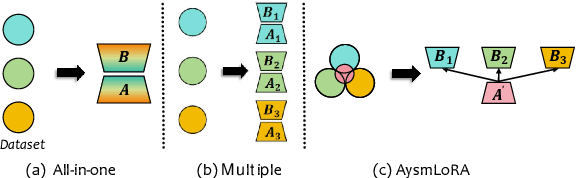
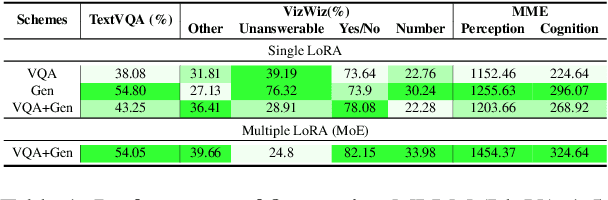
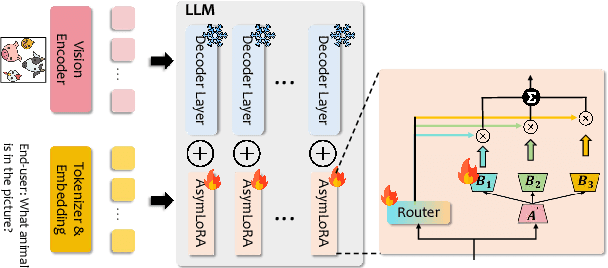

Effective instruction fine-tuning on diverse image-text datasets is crucial for developing a versatile Multimodal Large Language Model (MLLM), where dataset composition dictates the model's adaptability across multimodal tasks. However, complex datasets often contain inherent conflicts -- stemming from modality-specific optimization objectives -- and latent commonalities that enable cross-task transfer, which most existing approaches handle separately. To bridge this gap, we introduce AsymLoRA, a parameter-efficient tuning framework that unifies knowledge modularization and cross-modal coordination via asymmetric LoRA: task-specific low-rank projections (matrix B) that preserve distinct adaptation pathways for conflicting objectives, and a shared projection (matrix A) that consolidates cross-modal commonalities. Extensive evaluations demonstrate that AsymLoRA consistently surpasses both vanilla LoRA, which captures only commonalities, and LoRA-MoE, which focuses solely on conflicts, achieving superior model performance and system efficiency across diverse benchmarks.\href{Code}{https://github.com/Clin0212/HydraLoRA/blob/main/MLLM-HydraLoRA/README.md}.
Towards Seamless Hierarchical Federated Learning under Intermittent Client Participation: A Stagewise Decision-Making Methodology
Feb 13, 2025Federated Learning (FL) offers a pioneering distributed learning paradigm that enables devices/clients to build a shared global model. This global model is obtained through frequent model transmissions between clients and a central server, which may cause high latency, energy consumption, and congestion over backhaul links. To overcome these drawbacks, Hierarchical Federated Learning (HFL) has emerged, which organizes clients into multiple clusters and utilizes edge nodes (e.g., edge servers) for intermediate model aggregations between clients and the central server. Current research on HFL mainly focus on enhancing model accuracy, latency, and energy consumption in scenarios with a stable/fixed set of clients. However, addressing the dynamic availability of clients -- a critical aspect of real-world scenarios -- remains underexplored. This study delves into optimizing client selection and client-to-edge associations in HFL under intermittent client participation so as to minimize overall system costs (i.e., delay and energy), while achieving fast model convergence. We unveil that achieving this goal involves solving a complex NP-hard problem. To tackle this, we propose a stagewise methodology that splits the solution into two stages, referred to as Plan A and Plan B. Plan A focuses on identifying long-term clients with high chance of participation in subsequent model training rounds. Plan B serves as a backup, selecting alternative clients when long-term clients are unavailable during model training rounds. This stagewise methodology offers a fresh perspective on client selection that can enhance both HFL and conventional FL via enabling low-overhead decision-making processes. Through evaluations on MNIST and CIFAR-10 datasets, we show that our methodology outperforms existing benchmarks in terms of model accuracy and system costs.
Disentangling Length Bias In Preference Learning Via Response-Conditioned Modeling
Feb 02, 2025

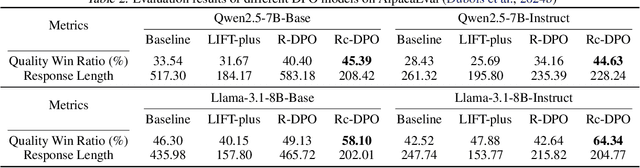
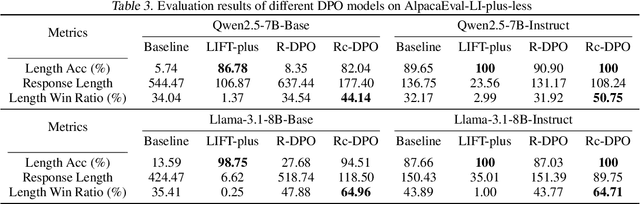
Reinforcement Learning from Human Feedback (RLHF) has achieved considerable success in aligning large language models (LLMs) by modeling human preferences with a learnable reward model and employing a reinforcement learning algorithm to maximize the reward model's scores. However, these reward models are susceptible to exploitation through various superficial confounding factors, with length bias emerging as a particularly significant concern. Moreover, while the pronounced impact of length bias on preference modeling suggests that LLMs possess an inherent sensitivity to length perception, our preliminary investigations reveal that fine-tuned LLMs consistently struggle to adhere to explicit length instructions. To address these two limitations, we propose a novel framework wherein the reward model explicitly differentiates between human semantic preferences and response length requirements. Specifically, we introduce a Response-conditioned Bradley-Terry (Rc-BT) model that enhances the reward model's capability in length bias mitigating and length instruction following, through training on our augmented dataset. Furthermore, we propose the Rc-DPO algorithm to leverage the Rc-BT model for direct policy optimization (DPO) of LLMs, simultaneously mitigating length bias and promoting adherence to length instructions. Extensive evaluations demonstrate that our approach substantially improves both preference modeling and length instruction compliance, with its effectiveness validated across various foundational models and preference datasets.
EICopilot: Search and Explore Enterprise Information over Large-scale Knowledge Graphs with LLM-driven Agents
Jan 23, 2025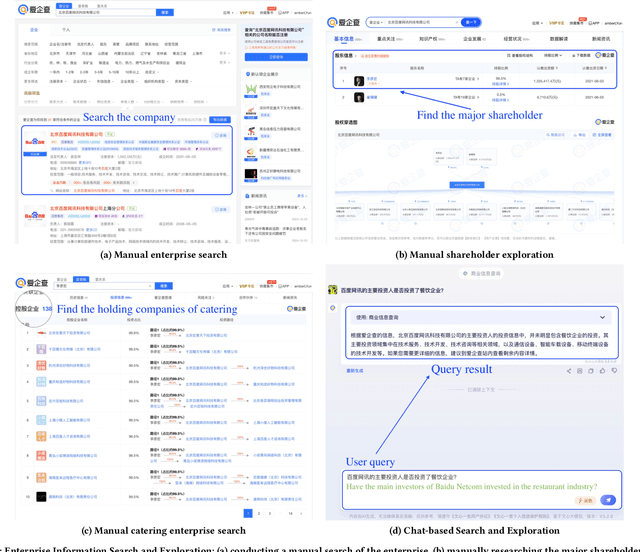
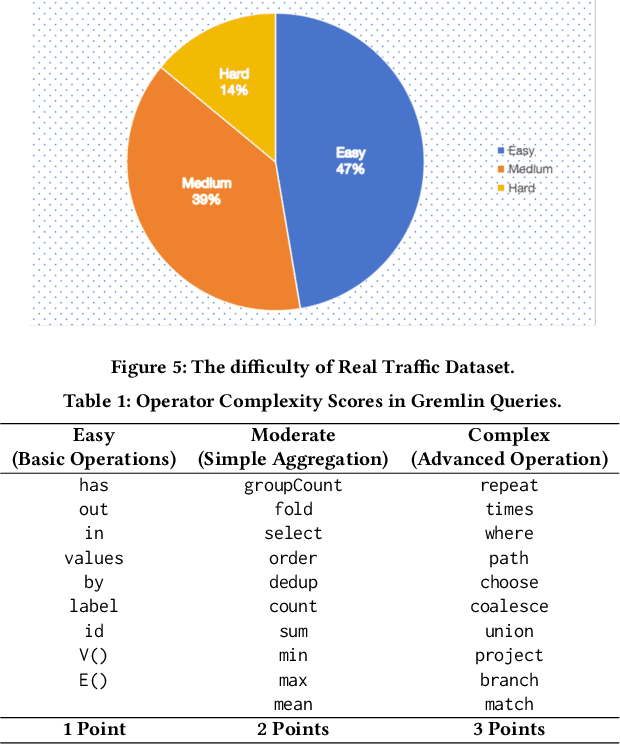
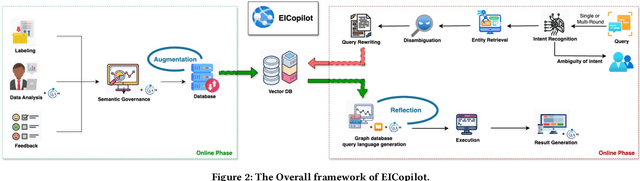
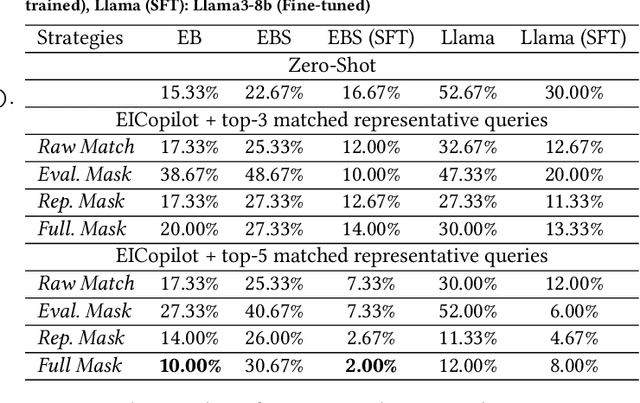
The paper introduces EICopilot, an novel agent-based solution enhancing search and exploration of enterprise registration data within extensive online knowledge graphs like those detailing legal entities, registered capital, and major shareholders. Traditional methods necessitate text-based queries and manual subgraph explorations, often resulting in time-consuming processes. EICopilot, deployed as a chatbot via Baidu Enterprise Search, improves this landscape by utilizing Large Language Models (LLMs) to interpret natural language queries. This solution automatically generates and executes Gremlin scripts, providing efficient summaries of complex enterprise relationships. Distinct feature a data pre-processing pipeline that compiles and annotates representative queries into a vector database of examples for In-context learning (ICL), a comprehensive reasoning pipeline combining Chain-of-Thought with ICL to enhance Gremlin script generation for knowledge graph search and exploration, and a novel query masking strategy that improves intent recognition for heightened script accuracy. Empirical evaluations demonstrate the superior performance of EICopilot, including speed and accuracy, over baseline methods, with the \emph{Full Mask} variant achieving a syntax error rate reduction to as low as 10.00% and an execution correctness of up to 82.14%. These components collectively contribute to superior querying capabilities and summarization of intricate datasets, positioning EICopilot as a groundbreaking tool in the exploration and exploitation of large-scale knowledge graphs for enterprise information search.
Sparse Point Clouds Assisted Learned Image Compression
Dec 20, 2024

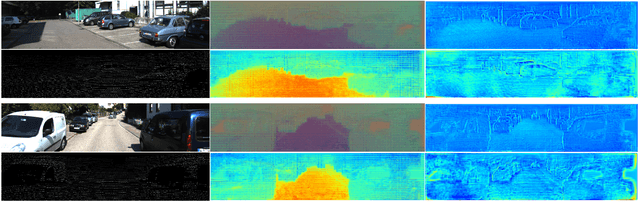

In the field of autonomous driving, a variety of sensor data types exist, each representing different modalities of the same scene. Therefore, it is feasible to utilize data from other sensors to facilitate image compression. However, few techniques have explored the potential benefits of utilizing inter-modality correlations to enhance the image compression performance. In this paper, motivated by the recent success of learned image compression, we propose a new framework that uses sparse point clouds to assist in learned image compression in the autonomous driving scenario. We first project the 3D sparse point cloud onto a 2D plane, resulting in a sparse depth map. Utilizing this depth map, we proceed to predict camera images. Subsequently, we use these predicted images to extract multi-scale structural features. These features are then incorporated into learned image compression pipeline as additional information to improve the compression performance. Our proposed framework is compatible with various mainstream learned image compression models, and we validate our approach using different existing image compression methods. The experimental results show that incorporating point cloud assistance into the compression pipeline consistently enhances the performance.
Comprehensive Survey on Adversarial Examples in Cybersecurity: Impacts, Challenges, and Mitigation Strategies
Dec 16, 2024Deep learning (DL) has significantly transformed cybersecurity, enabling advancements in malware detection, botnet identification, intrusion detection, user authentication, and encrypted traffic analysis. However, the rise of adversarial examples (AE) poses a critical challenge to the robustness and reliability of DL-based systems. These subtle, crafted perturbations can deceive models, leading to severe consequences like misclassification and system vulnerabilities. This paper provides a comprehensive review of the impact of AE attacks on key cybersecurity applications, highlighting both their theoretical and practical implications. We systematically examine the methods used to generate adversarial examples, their specific effects across various domains, and the inherent trade-offs attackers face between efficacy and resource efficiency. Additionally, we explore recent advancements in defense mechanisms, including gradient masking, adversarial training, and detection techniques, evaluating their potential to enhance model resilience. By summarizing cutting-edge research, this study aims to bridge the gap between adversarial research and practical security applications, offering insights to fortify the adoption of DL solutions in cybersecurity.
Protect Your Secrets: Understanding and Measuring Data Exposure in VSCode Extensions
Dec 01, 2024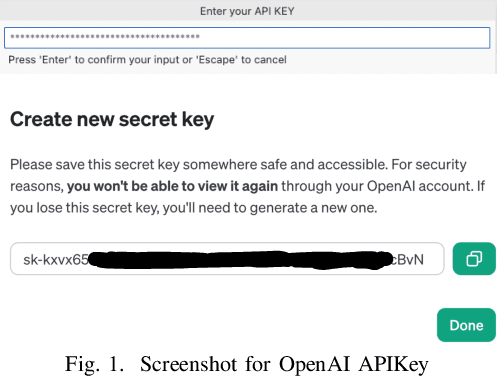
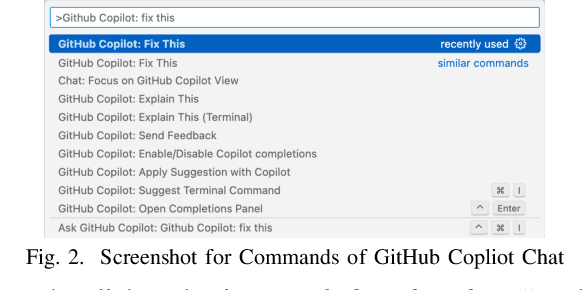

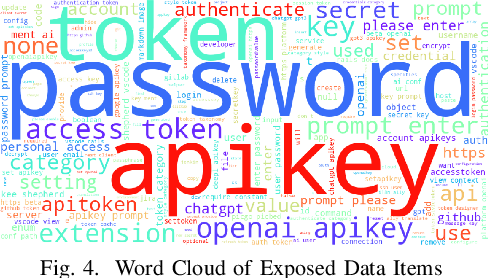
Recent years have witnessed the emerging trend of extensions in modern Integrated Development Environments (IDEs) like Visual Studio Code (VSCode) that significantly enhance developer productivity. Especially, popular AI coding assistants like GitHub Copilot and Tabnine provide conveniences like automated code completion and debugging. While these extensions offer numerous benefits, they may introduce privacy and security concerns to software developers. However, there is no existing work that systematically analyzes the security and privacy concerns, including the risks of data exposure in VSCode extensions. In this paper, we investigate on the security issues of cross-extension interactions in VSCode and shed light on the vulnerabilities caused by data exposure among different extensions. Our study uncovers high-impact security flaws that could allow adversaries to stealthily acquire or manipulate credential-related data (e.g., passwords, API keys, access tokens) from other extensions if not properly handled by extension vendors. To measure their prevalence, we design a novel automated risk detection framework that leverages program analysis and natural language processing techniques to automatically identify potential risks in VSCode extensions. By applying our tool to 27,261 real-world VSCode extensions, we discover that 8.5\% of them (i.e., 2,325 extensions) are exposed to credential-related data leakage through various vectors, such as commands, user input, and configurations. Our study sheds light on the security challenges and flaws of the extension-in-IDE paradigm and provides suggestions and recommendations for improving the security of VSCode extensions and mitigating the risks of data exposure.