 Add to Chrome
 Add to Firefox
 Add to Edge
GroupForward: Building Referable 3D Scenes via Instance-Grouped Feed-Forward Gaussian Splatting
Aug 18, 2026
Simultaneously reconstructing and understanding 3D environments is essential for embodied agents. Toward this goal, feed-forward semantic 3D Gaussian Splatting (3DGS) efficiently constructs semantic scene representations from sparse multi-view observations. However, existing methods lack explicit instance discrimination and mainly support category- or phrase-based semantic queries. To this end, we propose GroupForward, an instance-grouped feed-forward Gaussian splatting model that reconstructs geometry, appearance, instance structure, and semantics from sparse, unposed, and uncalibrated multi-view images. Unlike existing methods that attach high-dimensional semantic features to each Gaussian, GroupForward learns compact instance embeddings that group Gaussians into cross-view consistent 3D instances, reformulating feed-forward semantic 3DGS from per-Gaussian semantic feature rendering to instance-level semantic aggregation and propagation. Building on these instance groups, we further propose a Referential Scene Reasoning Framework (RSRF) for complex 3D referring segmentation. RSRF constructs an instance-grouped 3D scene graph and retrieves candidate instances for a given referring expression. A vision-language model then reasons over structured instance evidence and multi-view observations to identify the referred instance among the candidates. RSRF thereby extends language interaction from simple semantic querying to complex referential scene reasoning. Experiments on semantic reconstruction and referential reasoning demonstrate the effectiveness of our instance-grouped reconstruction and reasoning framework.

SPARED: Reasoning-Based AI-Generated Image Detection via Adversarially Edited Data
Aug 13, 2026Detecting AI-generated images is only half the task: a deployed detector must also justify its verdict, yet existing detectors inherit three failure modes from their training data: real and fake images collected from different sources invite provenance shortcuts, supervised explanation corpora teach templated rationales, and a static forgery corpus leaves the decision boundary standing still while generators keep moving. We introduce \methodname{}, an adversarial reinforcement learning framework that pits two heterogeneous models against each other. A diffusion image editor learns to edit real photographs into fake counterparts of those same photographs that fool the current detector, while a reasoning MLLM learns to expose them with a verdict grounded in free-form reasoning. Both rewards are shortcut-proof by design: the attacker is credited only when its edit is faithfully executed, and the defender only when its verdict is correct. As the two models alternate, each round's attacker regenerates a harder training pool aimed at the current detector's blind spots, so the detector must generalize rather than memorize any fixed artifact distribution. Although the explanation is never rewarded, its quality rises round over round as a side effect of accuracy-only training. A detector trained within this loop improves monotonically across rounds on each of three external benchmarks.
Scaling with Confidence: Calibrating Confidence of LLMs for Adaptive Test Time Scaling
Jul 02, 2026Training large language models (LLMs) with reinforcement learning (RL) has significantly advanced their performance on reasoning and question-answering tasks. However, prevailing RL reward designs typically prioritize response correctness, neglecting to incentivize models to express their confidence accurately. This leads to a critical problem: performance gains are often accompanied by poor calibration between confidence and accuracy, misleading models to overconfidently hallucinate when uncertain. To address this limitation, we propose $\textbf{C}$orrectness and $\textbf{C}$onfidence $\textbf{C}$alibration $\textbf{R}$einforcement $\textbf{L}$earning ($\textbf{C3RL}$), a novel RL algorithm integrating correctness, calibration and dataset-informed reference accuracy rewards together. Comprehensive evaluation across 8 text and multimodal datasets demonstrates that C3RL enhances calibration without sacrificing accuracy, outperforming the current state-of-the-art method in both performance and calibration metrics. Utilizing the well-calibrated verbalized confidence from C3RL, we further introduce $\textbf{C}$onfidence-based $\textbf{A}$daptive Test Time $\textbf{S}$caling ($\textbf{CAS}$), an adjustable inference-time strategy that allocates computational resources based on response confidence. Experiments show that CAS surpasses majority voting on both in-domain and out-of-domain datasets while reducing the inference budget by up to 12.33 times. We believe the synergy of C3RL and CAS paves the way for deploying more reliable and resource-efficient LLMs. The code, data and models will be released.
Safactory: A Scalable Agent Factory for Trustworthy Autonomous Intelligence
May 07, 2026As large models evolve from conversational assistants into autonomous agents, challenges increasingly arise from long-horizon decision making, tool use, and real environment interaction. Existing agenticinfrastructure remain fragmented across evaluation, data management, and agent evolution, making it difficult to discover risks systematically and improve models in a continuous closed loop. In this report, we present \textbf{Safactory}, a scalable agent factory for trustworthy autonomous intelligence. Safactory integrates three tightly coupled platforms: a \textbf{Parallel Simulation Platform} for trajectory generation, a \textbf{Trustworthy Data Platform} for trajectory storage and experience extraction, and an \textbf{Autonomous Evolution Platform} for asynchronous reinforcement learning and on-policy distillation. As far as we know, Safactory is the first framework to propose a unified evolutionary pipeline for next-generation trustworthy autonomous intelligence.
DailyArt: Discovering Articulation from Single Static Images via Latent Dynamics
Apr 09, 2026Articulated objects are essential for embodied AI and world models, yet inferring their kinematics from a single closed-state image remains challenging because crucial motion cues are often occluded. Existing methods either require multi-state observations or rely on explicit part priors, retrieval, or other auxiliary inputs that partially expose the structure to be inferred. In this work, we present DailyArt, which formulates articulated joint estimation from a single static image as a synthesis-mediated reasoning problem. Instead of directly regressing joints from a heavily occluded observation, DailyArt first synthesizes a maximally articulated opened state under the same camera view to expose articulation cues, and then estimates the full set of joint parameters from the discrepancy between the observed and synthesized states. Using a set-prediction formulation, DailyArt recovers all joints simultaneously without requiring object-specific templates, multi-view inputs, or explicit part annotations at test time. Taking estimated joints as conditions, the framework further supports part-level novel state synthesis as a downstream capability. Extensive experiments show that DailyArt achieves strong performance in articulated joint estimation and supports part-level novel state synthesis conditioned on joints. Project page is available at https://rangooo123.github.io/DaliyArt.github.io/.
Towards Trustworthy Report Generation: A Deep Research Agent with Progressive Confidence Estimation and Calibration
Apr 07, 2026As agent-based systems continue to evolve, deep research agents are capable of automatically generating research-style reports across diverse domains. While these agents promise to streamline information synthesis and knowledge exploration, existing evaluation frameworks-typically based on subjective dimensions-fail to capture a critical aspect of report quality: trustworthiness. In open-ended research scenarios where ground-truth answers are unavailable, current evaluation methods cannot effectively measure the epistemic confidence of generated content, making calibration difficult and leaving users susceptible to misleading or hallucinated information. To address this limitation, we propose a novel deep research agent that incorporates progressive confidence estimation and calibration within the report generation pipeline. Our system leverages a deliberative search model, featuring deep retrieval and multi-hop reasoning to ground outputs in verifiable evidence while assigning confidence scores to individual claims. Combined with a carefully designed workflow, this approach produces trustworthy reports with enhanced transparency. Experimental results and case studies demonstrate that our method substantially improves interpretability and significantly increases user trust.
Decoupled Reasoning with Implicit Fact Tokens (DRIFT): A Dual-Model Framework for Efficient Long-Context Inference
Feb 10, 2026The integration of extensive, dynamic knowledge into Large Language Models (LLMs) remains a significant challenge due to the inherent entanglement of factual data and reasoning patterns. Existing solutions, ranging from non-parametric Retrieval-Augmented Generation (RAG) to parametric knowledge editing, are often constrained in practice by finite context windows, retriever noise, or the risk of catastrophic forgetting. In this paper, we propose DRIFT, a novel dual-model architecture designed to explicitly decouple knowledge extraction from the reasoning process. Unlike static prompt compression, DRIFT employs a lightweight knowledge model to dynamically compress document chunks into implicit fact tokens conditioned on the query. These dense representations are projected into the reasoning model's embedding space, replacing raw, redundant text while maintaining inference accuracy. Extensive experiments show that DRIFT significantly improves performance on long-context tasks, outperforming strong baselines among comparably sized models. Our approach provides a scalable and efficient paradigm for extending the effective context window and reasoning capabilities of LLMs. Our code is available at https://github.com/Lancelot-Xie/DRIFT.
Explore with Long-term Memory: A Benchmark and Multimodal LLM-based Reinforcement Learning Framework for Embodied Exploration
Jan 11, 2026An ideal embodied agent should possess lifelong learning capabilities to handle long-horizon and complex tasks, enabling continuous operation in general environments. This not only requires the agent to accurately accomplish given tasks but also to leverage long-term episodic memory to optimize decision-making. However, existing mainstream one-shot embodied tasks primarily focus on task completion results, neglecting the crucial process of exploration and memory utilization. To address this, we propose Long-term Memory Embodied Exploration (LMEE), which aims to unify the agent's exploratory cognition and decision-making behaviors to promote lifelong learning.We further construct a corresponding dataset and benchmark, LMEE-Bench, incorporating multi-goal navigation and memory-based question answering to comprehensively evaluate both the process and outcome of embodied exploration. To enhance the agent's memory recall and proactive exploration capabilities, we propose MemoryExplorer, a novel method that fine-tunes a multimodal large language model through reinforcement learning to encourage active memory querying. By incorporating a multi-task reward function that includes action prediction, frontier selection, and question answering, our model achieves proactive exploration. Extensive experiments against state-of-the-art embodied exploration models demonstrate that our approach achieves significant advantages in long-horizon embodied tasks.
FLEG: Feed-Forward Language Embedded Gaussian Splatting from Any Views
Dec 19, 2025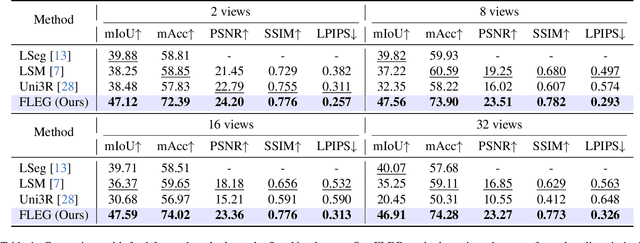
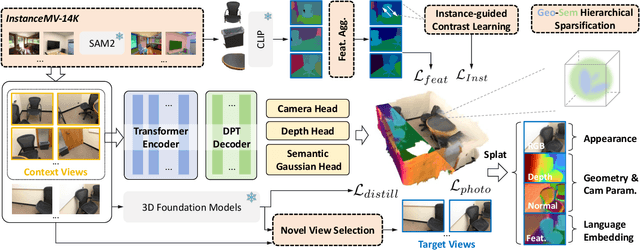
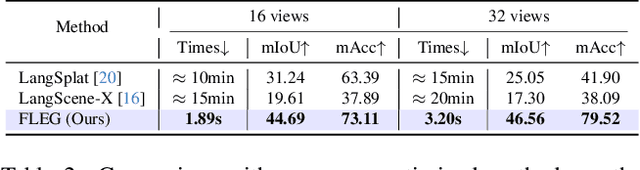
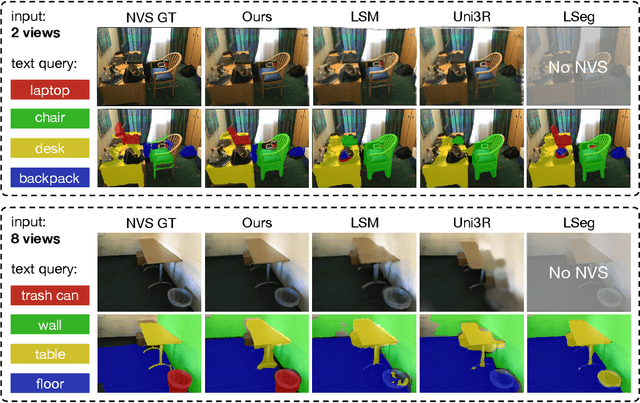
We present FLEG, a feed-forward network that reconstructs language-embedded 3D Gaussians from any views. Previous straightforward solutions combine feed-forward reconstruction with Gaussian heads but suffer from fixed input views and insufficient 3D training data. In contrast, we propose a 3D-annotation-free training framework for 2D-to-3D lifting from arbitrary uncalibrated and unposed multi-view images. Since the framework does not require 3D annotations, we can leverage large-scale video data with easily obtained 2D instance information to enrich semantic embedding. We also propose an instance-guided contrastive learning to align 2D semantics with the 3D representations. In addition, to mitigate the high memory and computational cost of dense views, we further propose a geometry-semantic hierarchical sparsification strategy. Our FLEG efficiently reconstructs language-embedded 3D Gaussian representation in a feed-forward manner from arbitrary sparse or dense views, jointly producing accurate geometry, high-fidelity appearance, and language-aligned semantics. Extensive experiments show that it outperforms existing methods on various related tasks. Project page: https://fangzhou2000.github.io/projects/fleg.
UniMark: Artificial Intelligence Generated Content Identification Toolkit
Dec 13, 2025The rapid proliferation of Artificial Intelligence Generated Content has precipitated a crisis of trust and urgent regulatory demands. However, existing identification tools suffer from fragmentation and a lack of support for visible compliance marking. To address these gaps, we introduce the \textbf{UniMark}, an open-source, unified framework for multimodal content governance. Our system features a modular unified engine that abstracts complexities across text, image, audio, and video modalities. Crucially, we propose a novel dual-operation strategy, natively supporting both \emph{Hidden Watermarking} for copyright protection and \emph{Visible Marking} for regulatory compliance. Furthermore, we establish a standardized evaluation framework with three specialized benchmarks (Image/Video/Audio-Bench) to ensure rigorous performance assessment. This toolkit bridges the gap between advanced algorithms and engineering implementation, fostering a more transparent and secure digital ecosystem.