 Add to Chrome
 Add to Firefox
 Add to Edge
Partially Supervised Unpaired Multi-Modal Learning for Label-Efficient Medical Image Segmentation
Mar 07, 2025
Unpaired Multi-Modal Learning (UMML) which leverages unpaired multi-modal data to boost model performance on each individual modality has attracted a lot of research interests in medical image analysis. However, existing UMML methods require multi-modal datasets to be fully labeled, which incurs tremendous annotation cost. In this paper, we investigate the use of partially labeled data for label-efficient unpaired multi-modal learning, which can reduce the annotation cost by up to one half. We term the new learning paradigm as Partially Supervised Unpaired Multi-Modal Learning (PSUMML) and propose a novel Decomposed partial class adaptation with snapshot Ensembled Self-Training (DEST) framework for it. Specifically, our framework consists of a compact segmentation network with modality specific normalization layers for learning with partially labeled unpaired multi-modal data. The key challenge in PSUMML lies in the complex partial class distribution discrepancy due to partial class annotation, which hinders effective knowledge transfer across modalities. We theoretically analyze this phenomenon with a decomposition theorem and propose a decomposed partial class adaptation technique to precisely align the partially labeled classes across modalities to reduce the distribution discrepancy. We further propose a snapshot ensembled self-training technique to leverage the valuable snapshot models during training to assign pseudo-labels to partially labeled pixels for self-training to boost model performance. We perform extensive experiments under different scenarios of PSUMML for two medical image segmentation tasks, namely cardiac substructure segmentation and abdominal multi-organ segmentation. Our framework outperforms existing methods significantly.

MagicInfinite: Generating Infinite Talking Videos with Your Words and Voice
Mar 07, 2025We present MagicInfinite, a novel diffusion Transformer (DiT) framework that overcomes traditional portrait animation limitations, delivering high-fidelity results across diverse character types-realistic humans, full-body figures, and stylized anime characters. It supports varied facial poses, including back-facing views, and animates single or multiple characters with input masks for precise speaker designation in multi-character scenes. Our approach tackles key challenges with three innovations: (1) 3D full-attention mechanisms with a sliding window denoising strategy, enabling infinite video generation with temporal coherence and visual quality across diverse character styles; (2) a two-stage curriculum learning scheme, integrating audio for lip sync, text for expressive dynamics, and reference images for identity preservation, enabling flexible multi-modal control over long sequences; and (3) region-specific masks with adaptive loss functions to balance global textual control and local audio guidance, supporting speaker-specific animations. Efficiency is enhanced via our innovative unified step and cfg distillation techniques, achieving a 20x inference speed boost over the basemodel: generating a 10 second 540x540p video in 10 seconds or 720x720p in 30 seconds on 8 H100 GPUs, without quality loss. Evaluations on our new benchmark demonstrate MagicInfinite's superiority in audio-lip synchronization, identity preservation, and motion naturalness across diverse scenarios. It is publicly available at https://www.hedra.com/, with examples at https://magicinfinite.github.io/.
Occlusion-Aware Consistent Model Predictive Control for Robot Navigation in Occluded Obstacle-Dense Environments
Mar 06, 2025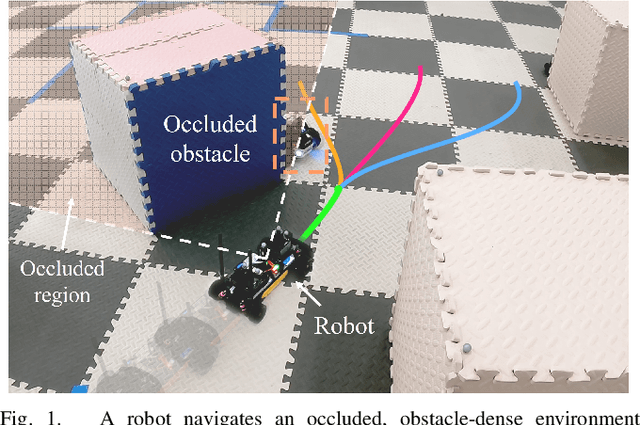
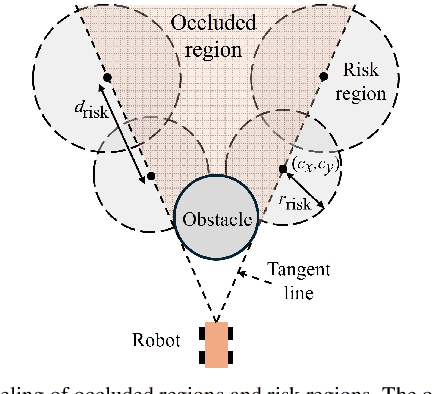

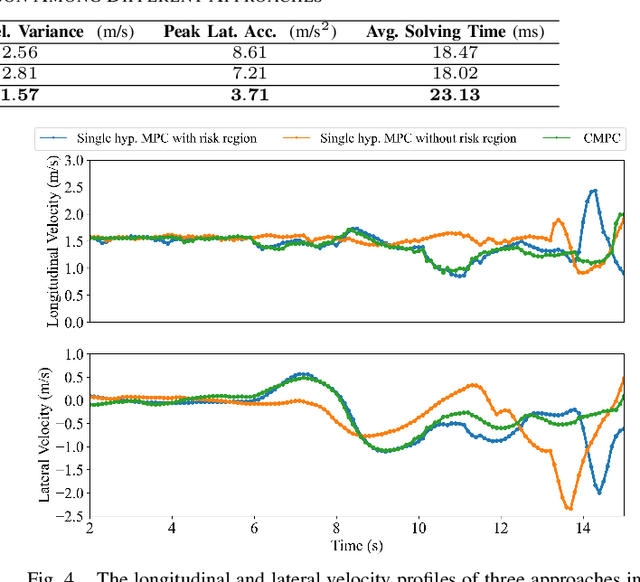
Ensuring safety and motion consistency for robot navigation in occluded, obstacle-dense environments is a critical challenge. In this context, this study presents an occlusion-aware Consistent Model Predictive Control (CMPC) strategy. To account for the occluded obstacles, it incorporates adjustable risk regions that represent their potential future locations. Subsequently, dynamic risk boundary constraints are developed online to ensure safety. The CMPC then constructs multiple locally optimal trajectory branches (each tailored to different risk regions) to balance between exploitation and exploration. A shared consensus trunk is generated to ensure smooth transitions between branches without significant velocity fluctuations, further preserving motion consistency. To facilitate high computational efficiency and ensure coordination across local trajectories, we use the alternating direction method of multipliers (ADMM) to decompose the CMPC into manageable sub-problems for parallel solving. The proposed strategy is validated through simulation and real-world experiments on an Ackermann-steering robot platform. The results demonstrate the effectiveness of the proposed CMPC strategy through comparisons with baseline approaches in occluded, obstacle-dense environments.
Provable Ordering and Continuity in Vision-Language Pretraining for Generalizable Embodied Agents
Feb 03, 2025Pre-training vision-language representations on human action videos has emerged as a promising approach to reduce reliance on large-scale expert demonstrations for training embodied agents. However, prior methods often employ time contrastive learning based on goal-reaching heuristics, progressively aligning language instructions from the initial to the final frame. This overemphasis on future frames can result in erroneous vision-language associations, as actions may terminate early or include irrelevant moments in the end. To address this issue, we propose Action Temporal Coherence Learning (AcTOL) to learn ordered and continuous vision-language representations without rigid goal-based constraint. AcTOL treats a video as a continuous trajectory where it (1) contrasts semantic differences between frames to reflect their natural ordering, and (2) imposes a local Brownian bridge constraint to ensure smooth transitions across intermediate frames. Extensive imitation learning experiments across varying numbers of demonstrations show that the pretrained features significantly enhance downstream manipulation tasks by up to 49% with high robustness to different linguistic styles of instructions, offering a viable pathway toward generalized embodied agents. The source code is included in the supplementary material for reference.
Learning Semantic Facial Descriptors for Accurate Face Animation
Jan 29, 2025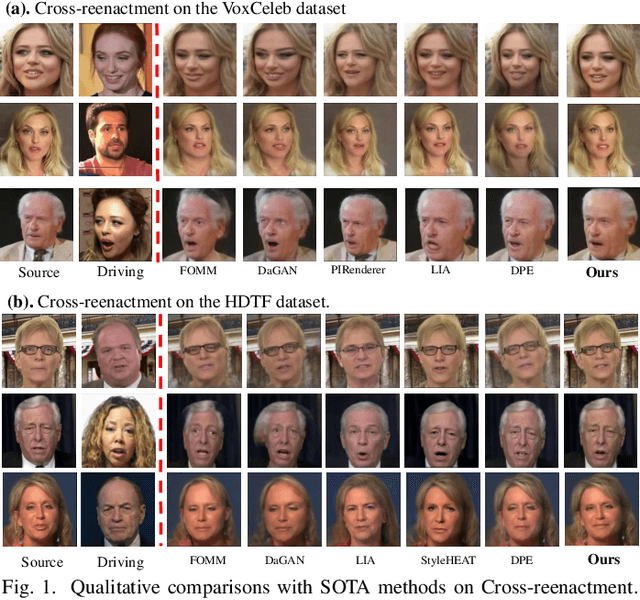
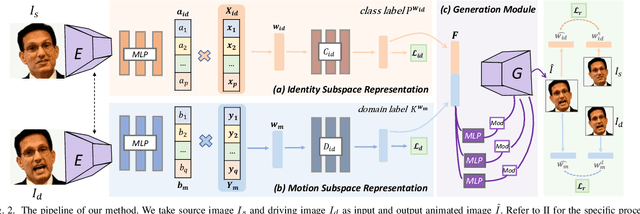
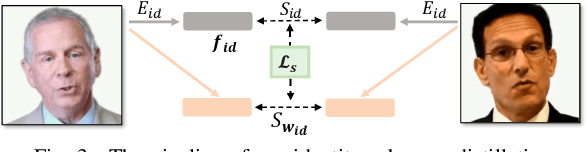
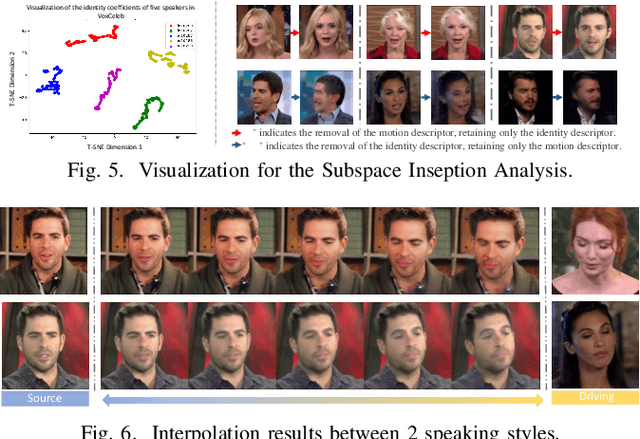
Face animation is a challenging task. Existing model-based methods (utilizing 3DMMs or landmarks) often result in a model-like reconstruction effect, which doesn't effectively preserve identity. Conversely, model-free approaches face challenges in attaining a decoupled and semantically rich feature space, thereby making accurate motion transfer difficult to achieve. We introduce the semantic facial descriptors in learnable disentangled vector space to address the dilemma. The approach involves decoupling the facial space into identity and motion subspaces while endowing each of them with semantics by learning complete orthogonal basis vectors. We obtain basis vector coefficients by employing an encoder on the source and driving faces, leading to effective facial descriptors in the identity and motion subspaces. Ultimately, these descriptors can be recombined as latent codes to animate faces. Our approach successfully addresses the issue of model-based methods' limitations in high-fidelity identity and the challenges faced by model-free methods in accurate motion transfer. Extensive experiments are conducted on three challenging benchmarks (i.e. VoxCeleb, HDTF, CelebV). Comprehensive quantitative and qualitative results demonstrate that our model outperforms SOTA methods with superior identity preservation and motion transfer.
V2C-CBM: Building Concept Bottlenecks with Vision-to-Concept Tokenizer
Jan 09, 2025
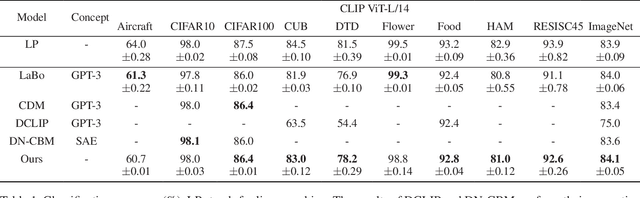
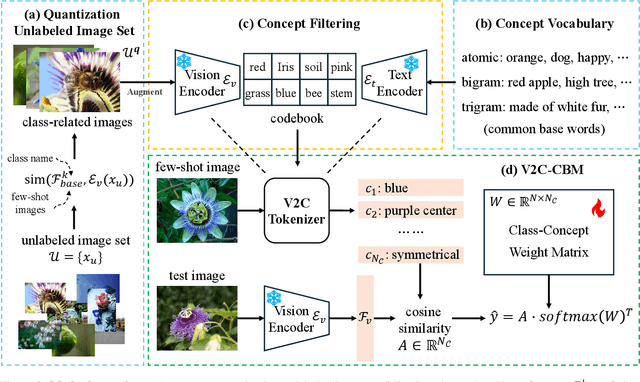
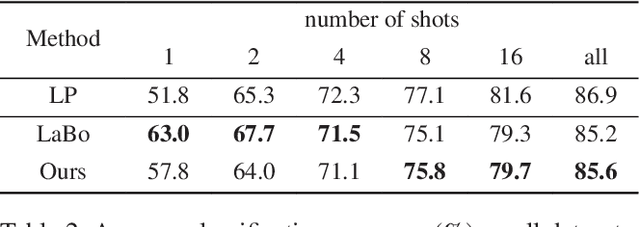
Concept Bottleneck Models (CBMs) offer inherent interpretability by initially translating images into human-comprehensible concepts, followed by a linear combination of these concepts for classification. However, the annotation of concepts for visual recognition tasks requires extensive expert knowledge and labor, constraining the broad adoption of CBMs. Recent approaches have leveraged the knowledge of large language models to construct concept bottlenecks, with multimodal models like CLIP subsequently mapping image features into the concept feature space for classification. Despite this, the concepts produced by language models can be verbose and may introduce non-visual attributes, which hurts accuracy and interpretability. In this study, we investigate to avoid these issues by constructing CBMs directly from multimodal models. To this end, we adopt common words as base concept vocabulary and leverage auxiliary unlabeled images to construct a Vision-to-Concept (V2C) tokenizer that can explicitly quantize images into their most relevant visual concepts, thus creating a vision-oriented concept bottleneck tightly coupled with the multimodal model. This leads to our V2C-CBM which is training efficient and interpretable with high accuracy. Our V2C-CBM has matched or outperformed LLM-supervised CBMs on various visual classification benchmarks, validating the efficacy of our approach.
CALMM-Drive: Confidence-Aware Autonomous Driving with Large Multimodal Model
Dec 05, 2024

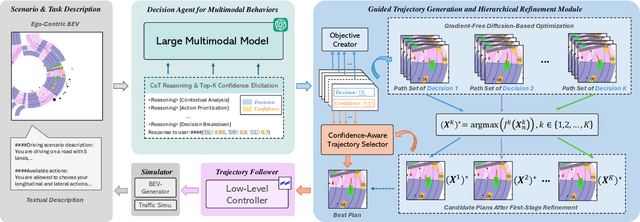
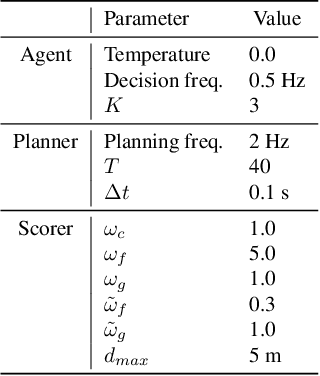
Decision-making and motion planning are pivotal in ensuring the safety and efficiency of Autonomous Vehicles (AVs). Existing methodologies typically adopt two paradigms: decision then planning or generation then scoring. However, the former often struggles with misalignment between decisions and planning, while the latter encounters significant challenges in integrating short-term operational utility with long-term tactical efficacy. To address these issues, we introduce CALMM-Drive, a novel Confidence-Aware Large Multimodal Model (LMM) empowered Autonomous Driving framework. Our approach employs Top-K confidence elicitation, which facilitates the generation of multiple candidate decisions along with their confidence levels. Furthermore, we propose a novel planning module that integrates a diffusion model for trajectory generation and a hierarchical refinement process to find the optimal path. This framework enables the selection of the best plan accounting for both low-level solution quality and high-level tactical confidence, which mitigates the risks of one-shot decisions and overcomes the limitations induced by short-sighted scoring mechanisms. Comprehensive evaluations in nuPlan closed-loop simulation environments demonstrate the effectiveness of CALMM-Drive in achieving reliable and flexible driving performance, showcasing a significant advancement in the integration of uncertainty in LMM-empowered AVs. The code will be released upon acceptance.
DRIVE: Dual-Robustness via Information Variability and Entropic Consistency in Source-Free Unsupervised Domain Adaptation
Nov 24, 2024
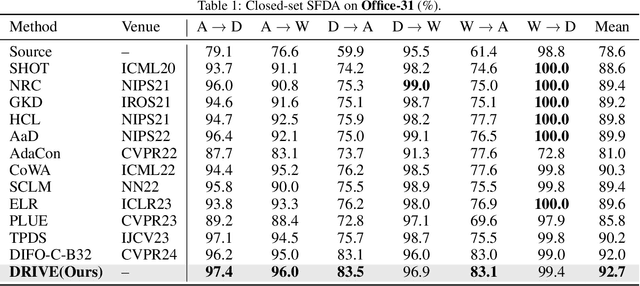
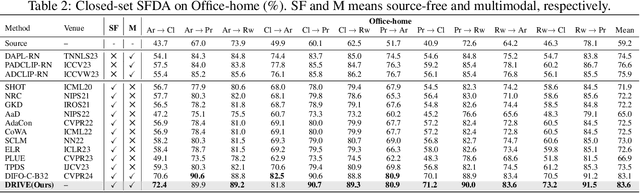
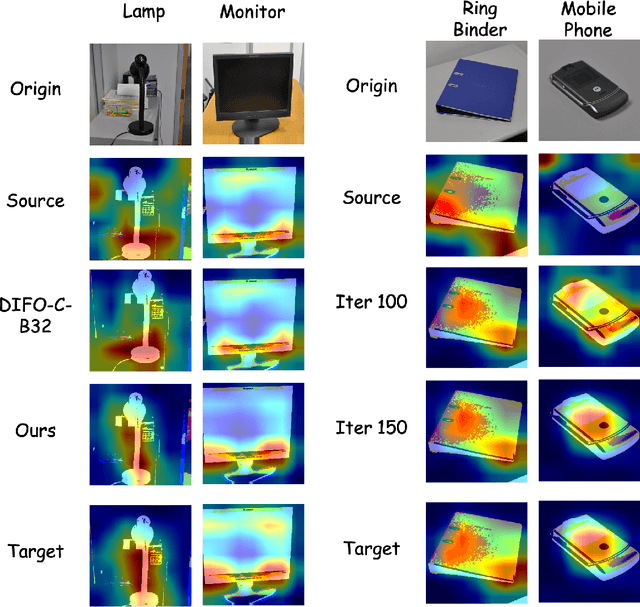
Adapting machine learning models to new domains without labeled data, especially when source data is inaccessible, is a critical challenge in applications like medical imaging, autonomous driving, and remote sensing. This task, known as Source-Free Unsupervised Domain Adaptation (SFUDA), involves adapting a pre-trained model to a target domain using only unlabeled target data, which can lead to issues such as overfitting, underfitting, and poor generalization due to domain discrepancies and noise. Existing SFUDA methods often rely on single-model architectures, struggling with uncertainty and variability in the target domain. To address these challenges, we propose DRIVE (Dual-Robustness through Information Variability and Entropy), a novel SFUDA framework leveraging a dual-model architecture. The two models, initialized with identical weights, work in parallel to capture diverse target domain characteristics. One model is exposed to perturbations via projection gradient descent (PGD) guided by mutual information, focusing on high-uncertainty regions. We also introduce an entropy-aware pseudo-labeling strategy that adjusts label weights based on prediction uncertainty, ensuring the model focuses on reliable data while avoiding noisy regions. The adaptation process has two stages: the first aligns the models on stable features using a mutual information consistency loss, and the second dynamically adjusts the perturbation level based on the loss from the first stage, encouraging the model to explore a broader range of the target domain while preserving existing performance. This enhances generalization capabilities and robustness against interference. Evaluations on standard SFUDA benchmarks show that DRIVE consistently outperforms previous methods, delivering improved adaptation accuracy and stability across complex target domains.
Revisiting the Integration of Convolution and Attention for Vision Backbone
Nov 21, 2024Convolutions (Convs) and multi-head self-attentions (MHSAs) are typically considered alternatives to each other for building vision backbones. Although some works try to integrate both, they apply the two operators simultaneously at the finest pixel granularity. With Convs responsible for per-pixel feature extraction already, the question is whether we still need to include the heavy MHSAs at such a fine-grained level. In fact, this is the root cause of the scalability issue w.r.t. the input resolution for vision transformers. To address this important problem, we propose in this work to use MSHAs and Convs in parallel \textbf{at different granularity levels} instead. Specifically, in each layer, we use two different ways to represent an image: a fine-grained regular grid and a coarse-grained set of semantic slots. We apply different operations to these two representations: Convs to the grid for local features, and MHSAs to the slots for global features. A pair of fully differentiable soft clustering and dispatching modules is introduced to bridge the grid and set representations, thus enabling local-global fusion. Through extensive experiments on various vision tasks, we empirically verify the potential of the proposed integration scheme, named \textit{GLMix}: by offloading the burden of fine-grained features to light-weight Convs, it is sufficient to use MHSAs in a few (e.g., 64) semantic slots to match the performance of recent state-of-the-art backbones, while being more efficient. Our visualization results also demonstrate that the soft clustering module produces a meaningful semantic grouping effect with only IN1k classification supervision, which may induce better interpretability and inspire new weakly-supervised semantic segmentation approaches. Code will be available at \url{https://github.com/rayleizhu/GLMix}.
Federated Domain Generalization via Prompt Learning and Aggregation
Nov 15, 2024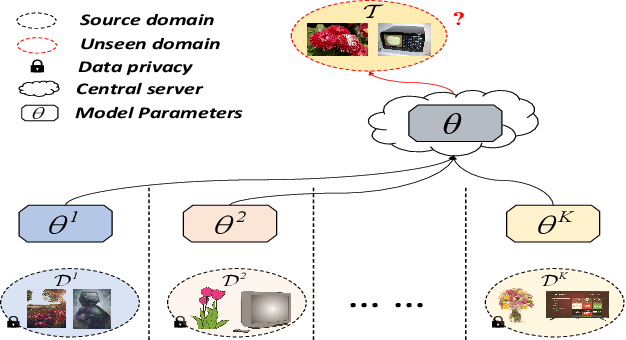
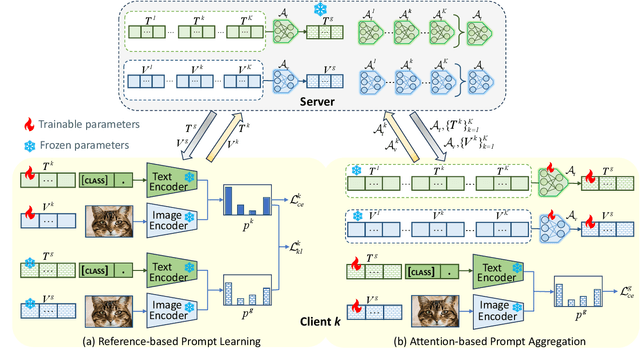
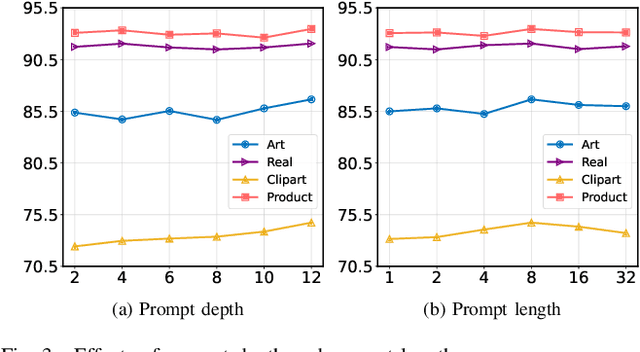
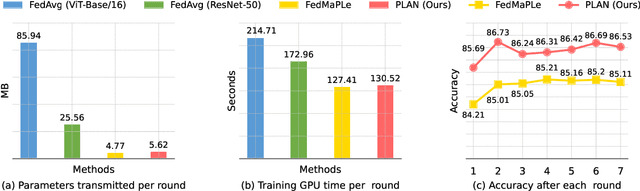
Federated domain generalization (FedDG) aims to improve the global model generalization in unseen domains by addressing data heterogeneity under privacy-preserving constraints. A common strategy in existing FedDG studies involves sharing domain-specific knowledge among clients, such as spectrum information, class prototypes, and data styles. However, this knowledge is extracted directly from local client samples, and sharing such sensitive information poses a potential risk of data leakage, which might not fully meet the requirements of FedDG. In this paper, we introduce prompt learning to adapt pre-trained vision-language models (VLMs) in the FedDG scenario, and leverage locally learned prompts as a more secure bridge to facilitate knowledge transfer among clients. Specifically, we propose a novel FedDG framework through Prompt Learning and AggregatioN (PLAN), which comprises two training stages to collaboratively generate local prompts and global prompts at each federated round. First, each client performs both text and visual prompt learning using their own data, with local prompts indirectly synchronized by regarding the global prompts as a common reference. Second, all domain-specific local prompts are exchanged among clients and selectively aggregated into the global prompts using lightweight attention-based aggregators. The global prompts are finally applied to adapt VLMs to unseen target domains. As our PLAN framework requires training only a limited number of prompts and lightweight aggregators, it offers notable advantages in computational and communication efficiency for FedDG. Extensive experiments demonstrate the superior generalization ability of PLAN across four benchmark datasets.