 Add to Chrome
 Add to Firefox
 Add to Edge
Self-Supervised Scene Flow Estimation with Point-Voxel Fusion and Surface Representation
Oct 17, 2024
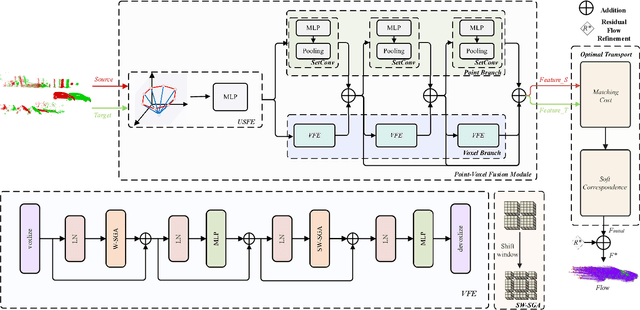
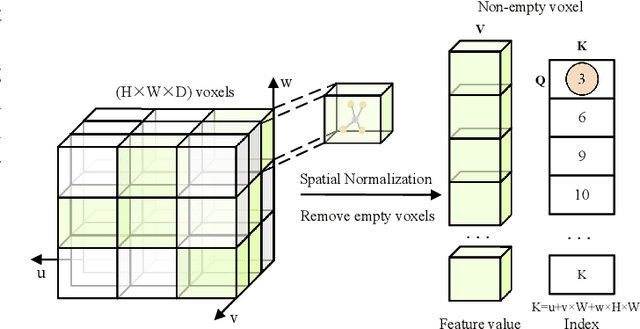
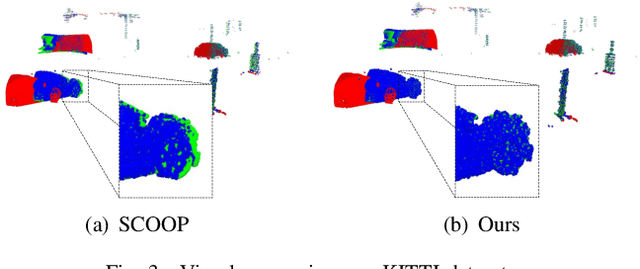

Scene flow estimation aims to generate the 3D motion field of points between two consecutive frames of point clouds, which has wide applications in various fields. Existing point-based methods ignore the irregularity of point clouds and have difficulty capturing long-range dependencies due to the inefficiency of point-level computation. Voxel-based methods suffer from the loss of detail information. In this paper, we propose a point-voxel fusion method, where we utilize a voxel branch based on sparse grid attention and the shifted window strategy to capture long-range dependencies and a point branch to capture fine-grained features to compensate for the information loss in the voxel branch. In addition, since xyz coordinates are difficult to describe the geometric structure of complex 3D objects in the scene, we explicitly encode the local surface information of the point cloud through the umbrella surface feature extraction (USFE) module. We verify the effectiveness of our method by conducting experiments on the Flyingthings3D and KITTI datasets. Our method outperforms all other self-supervised methods and achieves highly competitive results compared to fully supervised methods. We achieve improvements in all metrics, especially EPE, which is reduced by 8.51% and 10.52% on the KITTIo and KITTIs datasets, respectively.

UniG: Modelling Unitary 3D Gaussians for View-consistent 3D Reconstruction
Oct 17, 2024


In this work, we present UniG, a view-consistent 3D reconstruction and novel view synthesis model that generates a high-fidelity representation of 3D Gaussians from sparse images. Existing 3D Gaussians-based methods usually regress Gaussians per-pixel of each view, create 3D Gaussians per view separately, and merge them through point concatenation. Such a view-independent reconstruction approach often results in a view inconsistency issue, where the predicted positions of the same 3D point from different views may have discrepancies. To address this problem, we develop a DETR (DEtection TRansformer)-like framework, which treats 3D Gaussians as decoder queries and updates their parameters layer by layer by performing multi-view cross-attention (MVDFA) over multiple input images. In this way, multiple views naturally contribute to modeling a unitary representation of 3D Gaussians, thereby making 3D reconstruction more view-consistent. Moreover, as the number of 3D Gaussians used as decoder queries is irrespective of the number of input views, allow an arbitrary number of input images without causing memory explosion. Extensive experiments validate the advantages of our approach, showcasing superior performance over existing methods quantitatively (improving PSNR by 4.2 dB when trained on Objaverse and tested on the GSO benchmark) and qualitatively.
LKASeg:Remote-Sensing Image Semantic Segmentation with Large Kernel Attention and Full-Scale Skip Connections
Oct 14, 2024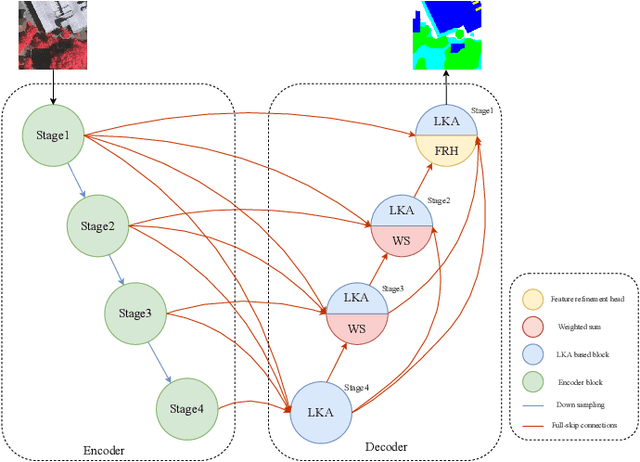
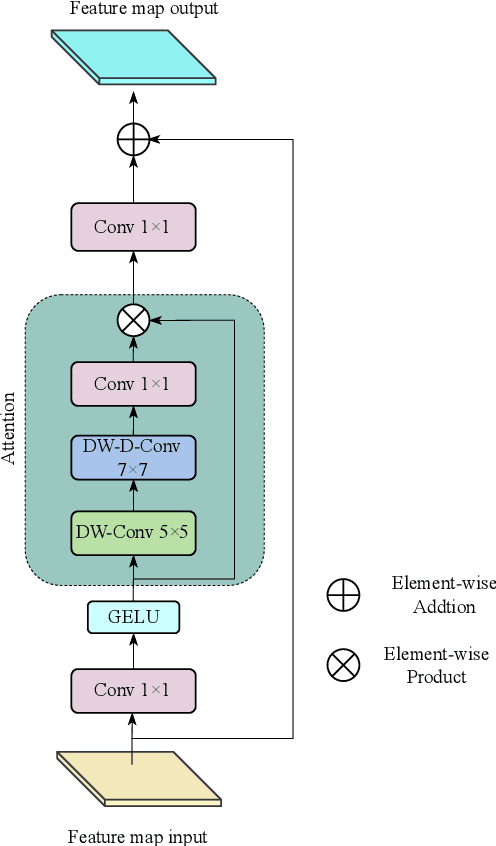
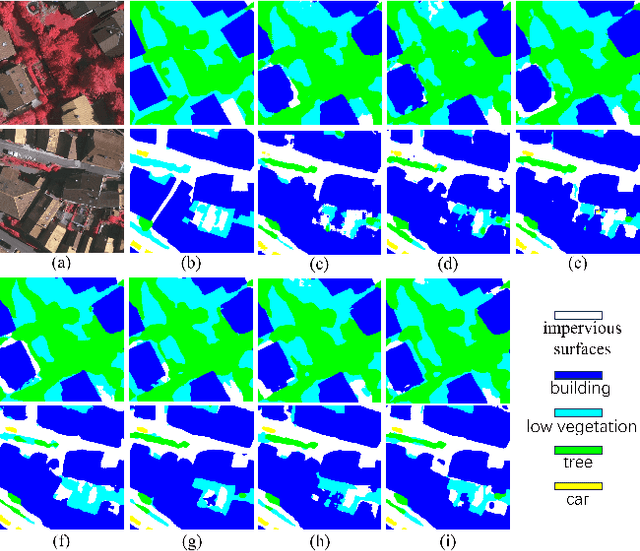

Semantic segmentation of remote sensing images is a fundamental task in geospatial research. However, widely used Convolutional Neural Networks (CNNs) and Transformers have notable drawbacks: CNNs may be limited by insufficient remote sensing modeling capability, while Transformers face challenges due to computational complexity. In this paper, we propose a remote-sensing image semantic segmentation network named LKASeg, which combines Large Kernel Attention(LSKA) and Full-Scale Skip Connections(FSC). Specifically, we propose a decoder based on Large Kernel Attention (LKA), which extract global features while avoiding the computational overhead of self-attention and providing channel adaptability. To achieve full-scale feature learning and fusion, we apply Full-Scale Skip Connections (FSC) between the encoder and decoder. We conducted experiments by combining the LKA-based decoder with FSC. On the ISPRS Vaihingen dataset, the mF1 and mIoU scores achieved 90.33% and 82.77%.
Visual-O1: Understanding Ambiguous Instructions via Multi-modal Multi-turn Chain-of-thoughts Reasoning
Oct 04, 2024


As large-scale models evolve, language instructions are increasingly utilized in multi-modal tasks. Due to human language habits, these instructions often contain ambiguities in real-world scenarios, necessitating the integration of visual context or common sense for accurate interpretation. However, even highly intelligent large models exhibit significant performance limitations on ambiguous instructions, where weak reasoning abilities of disambiguation can lead to catastrophic errors. To address this issue, this paper proposes Visual-O1, a multi-modal multi-turn chain-of-thought reasoning framework. It simulates human multi-modal multi-turn reasoning, providing instantial experience for highly intelligent models or empirical experience for generally intelligent models to understand ambiguous instructions. Unlike traditional methods that require models to possess high intelligence to understand long texts or perform lengthy complex reasoning, our framework does not significantly increase computational overhead and is more general and effective, even for generally intelligent models. Experiments show that our method not only significantly enhances the performance of models of different intelligence levels on ambiguous instructions but also improves their performance on general datasets. Our work highlights the potential of artificial intelligence to work like humans in real-world scenarios with uncertainty and ambiguity. We will release our data and code.
Ruler: A Model-Agnostic Method to Control Generated Length for Large Language Models
Sep 27, 2024
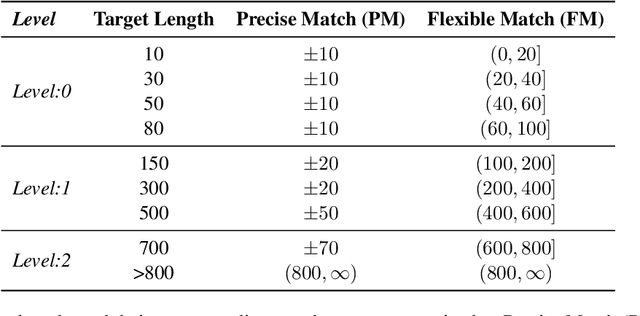
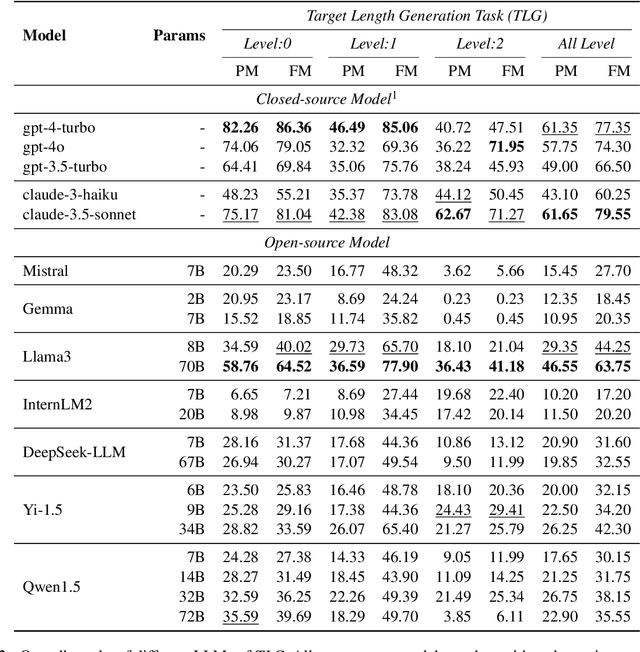
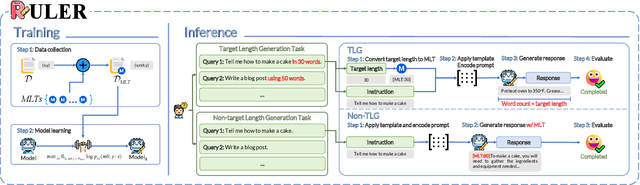
The instruction-following ability of large language models enables humans to interact with AI agents in a natural way. However, when required to generate responses of a specific length, large language models often struggle to meet users' needs due to their inherent difficulty in accurately perceiving numerical constraints. To explore the ability of large language models to control the length of generated responses, we propose the Target Length Generation Task (TLG) and design two metrics, Precise Match (PM) and Flexible Match (FM) to evaluate the model's performance in adhering to specified response lengths. Furthermore, we introduce a novel, model-agnostic approach called Ruler, which employs Meta Length Tokens (MLTs) to enhance the instruction-following ability of large language models under length-constrained instructions. Specifically, Ruler equips LLMs with the ability to generate responses of a specified length based on length constraints within the instructions. Moreover, Ruler can automatically generate appropriate MLT when length constraints are not explicitly provided, demonstrating excellent versatility and generalization. Comprehensive experiments show the effectiveness of Ruler across different LLMs on Target Length Generation Task, e.g., at All Level 27.97 average gain on PM, 29.57 average gain on FM. In addition, we conduct extensive ablation experiments to further substantiate the efficacy and generalization of Ruler. Our code and data is available at https://github.com/Geaming2002/Ruler.
LKA-ReID:Vehicle Re-Identification with Large Kernel Attention
Sep 26, 2024With the rapid development of intelligent transportation systems and the popularity of smart city infrastructure, Vehicle Re-ID technology has become an important research field. The vehicle Re-ID task faces an important challenge, which is the high similarity between different vehicles. Existing methods use additional detection or segmentation models to extract differentiated local features. However, these methods either rely on additional annotations or greatly increase the computational cost. Using attention mechanism to capture global and local features is crucial to solve the challenge of high similarity between classes in vehicle Re-ID tasks. In this paper, we propose LKA-ReID with large kernel attention. Specifically, the large kernel attention (LKA) utilizes the advantages of self-attention and also benefits from the advantages of convolution, which can extract the global and local features of the vehicle more comprehensively. We also introduce hybrid channel attention (HCA) combines channel attention with spatial information, so that the model can better focus on channels and feature regions, and ignore background and other disturbing information. Experiments on VeRi-776 dataset demonstrated the effectiveness of LKA-ReID, with mAP reaches 86.65% and Rank-1 reaches 98.03%.
Path-adaptive Spatio-Temporal State Space Model for Event-based Recognition with Arbitrary Duration
Sep 25, 2024Event cameras are bio-inspired sensors that capture the intensity changes asynchronously and output event streams with distinct advantages, such as high temporal resolution. To exploit event cameras for object/action recognition, existing methods predominantly sample and aggregate events in a second-level duration at every fixed temporal interval (or frequency). However, they often face difficulties in capturing the spatiotemporal relationships for longer, e.g., minute-level, events and generalizing across varying temporal frequencies. To fill the gap, we present a novel framework, dubbed PAST-SSM, exhibiting superior capacity in recognizing events with arbitrary duration (e.g., 0.1s to 4.5s) and generalizing to varying inference frequencies. Our key insight is to learn the spatiotemporal relationships from the encoded event features via the state space model (SSM) -- whose linear complexity makes it ideal for modeling high temporal resolution events with longer sequences. To achieve this goal, we first propose a Path-Adaptive Event Aggregation and Scan (PEAS) module to encode events of varying duration into features with fixed dimensions by adaptively scanning and selecting aggregated event frames. On top of PEAS, we introduce a novel Multi-faceted Selection Guiding (MSG) loss to minimize the randomness and redundancy of the encoded features. This subtly enhances the model generalization across different inference frequencies. Lastly, the SSM is employed to better learn the spatiotemporal properties from the encoded features. Moreover, we build a minute-level event-based recognition dataset, named ArDVS100, with arbitrary duration for the benefit of the community. Extensive experiments prove that our method outperforms prior arts by +3.45%, +0.38% and +8.31% on the DVS Action, SeAct and HARDVS datasets, respectively.
DreamWaltz-G: Expressive 3D Gaussian Avatars from Skeleton-Guided 2D Diffusion
Sep 25, 2024



Leveraging pretrained 2D diffusion models and score distillation sampling (SDS), recent methods have shown promising results for text-to-3D avatar generation. However, generating high-quality 3D avatars capable of expressive animation remains challenging. In this work, we present DreamWaltz-G, a novel learning framework for animatable 3D avatar generation from text. The core of this framework lies in Skeleton-guided Score Distillation and Hybrid 3D Gaussian Avatar representation. Specifically, the proposed skeleton-guided score distillation integrates skeleton controls from 3D human templates into 2D diffusion models, enhancing the consistency of SDS supervision in terms of view and human pose. This facilitates the generation of high-quality avatars, mitigating issues such as multiple faces, extra limbs, and blurring. The proposed hybrid 3D Gaussian avatar representation builds on the efficient 3D Gaussians, combining neural implicit fields and parameterized 3D meshes to enable real-time rendering, stable SDS optimization, and expressive animation. Extensive experiments demonstrate that DreamWaltz-G is highly effective in generating and animating 3D avatars, outperforming existing methods in both visual quality and animation expressiveness. Our framework further supports diverse applications, including human video reenactment and multi-subject scene composition.
Qwen2.5-Coder Technical Report
Sep 18, 2024


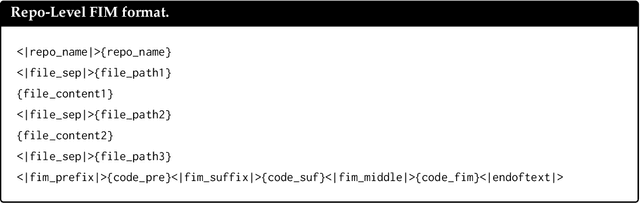
In this report, we introduce the Qwen2.5-Coder series, a significant upgrade from its predecessor, CodeQwen1.5. This series includes two models: Qwen2.5-Coder-1.5B and Qwen2.5-Coder-7B. As a code-specific model, Qwen2.5-Coder is built upon the Qwen2.5 architecture and continues pretrained on a vast corpus of over 5.5 trillion tokens. Through meticulous data cleaning, scalable synthetic data generation, and balanced data mixing, Qwen2.5-Coder demonstrates impressive code generation capabilities while retaining general versatility. The model has been evaluated on a wide range of code-related tasks, achieving state-of-the-art (SOTA) performance across more than 10 benchmarks, including code generation, completion, reasoning, and repair, consistently outperforming larger models of the same model size. We believe that the release of the Qwen2.5-Coder series will not only push the boundaries of research in code intelligence but also, through its permissive licensing, encourage broader adoption by developers in real-world applications.
ClearDepth: Enhanced Stereo Perception of Transparent Objects for Robotic Manipulation
Sep 13, 2024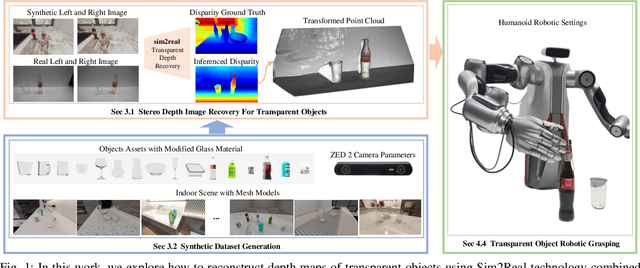
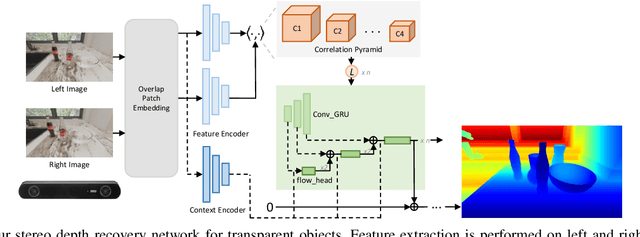
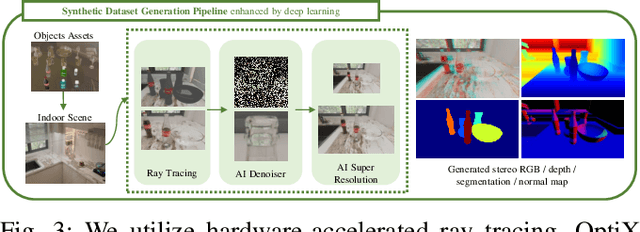
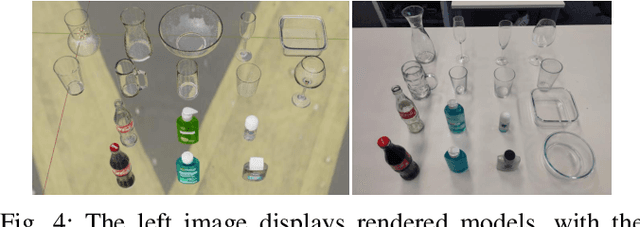
Transparent object depth perception poses a challenge in everyday life and logistics, primarily due to the inability of standard 3D sensors to accurately capture depth on transparent or reflective surfaces. This limitation significantly affects depth map and point cloud-reliant applications, especially in robotic manipulation. We developed a vision transformer-based algorithm for stereo depth recovery of transparent objects. This approach is complemented by an innovative feature post-fusion module, which enhances the accuracy of depth recovery by structural features in images. To address the high costs associated with dataset collection for stereo camera-based perception of transparent objects, our method incorporates a parameter-aligned, domain-adaptive, and physically realistic Sim2Real simulation for efficient data generation, accelerated by AI algorithm. Our experimental results demonstrate the model's exceptional Sim2Real generalizability in real-world scenarios, enabling precise depth mapping of transparent objects to assist in robotic manipulation. Project details are available at https://sites.google.com/view/cleardepth/ .