 Add to Chrome
 Add to Firefox
 Add to Edge
Extracting and Transferring Abilities For Building Multi-lingual Ability-enhanced Large Language Models
Oct 10, 2024


Multi-lingual ability transfer has become increasingly important for the broad application of large language models (LLMs). Existing work highly relies on training with the multi-lingual ability-related data, which may be not available for low-resource languages. To solve it, we propose a Multi-lingual Ability Extraction and Transfer approach, named as MAET. Our key idea is to decompose and extract language-agnostic ability-related weights from LLMs, and transfer them across different languages by simple addition and subtraction operations without training. Specially, our MAET consists of the extraction and transfer stages. In the extraction stage, we firstly locate key neurons that are highly related to specific abilities, and then employ them to extract the transferable ability-specific weights. In the transfer stage, we further select the ability-related parameter tensors, and design the merging strategy based on the linguistic and ability specific weights, to build the multi-lingual ability-enhanced LLM. To demonstrate the effectiveness of our proposed approach, we conduct extensive experiments on mathematical and scientific tasks in both high-resource lingual and low-resource lingual scenarios. Experiment results have shown that MAET can effectively and efficiently extract and transfer the advanced abilities, and outperform training-based baseline methods. Our code and data are available at \url{https://github.com/RUCAIBox/MAET}.

Enabling Synergistic Full-Body Control in Prompt-Based Co-Speech Motion Generation
Oct 01, 2024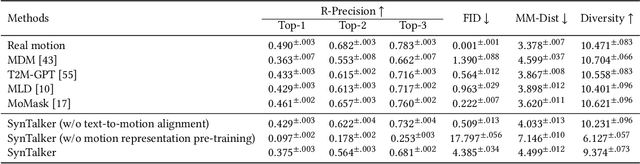
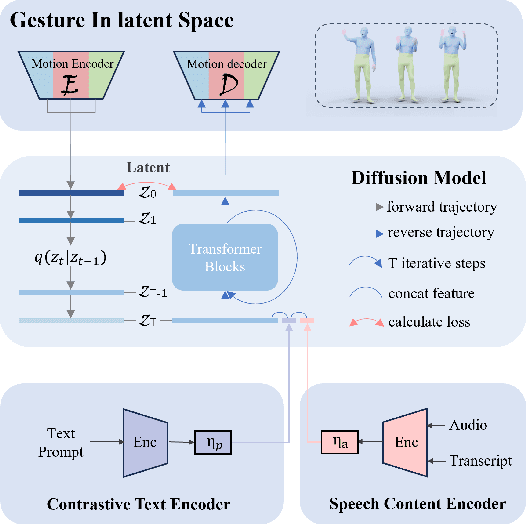
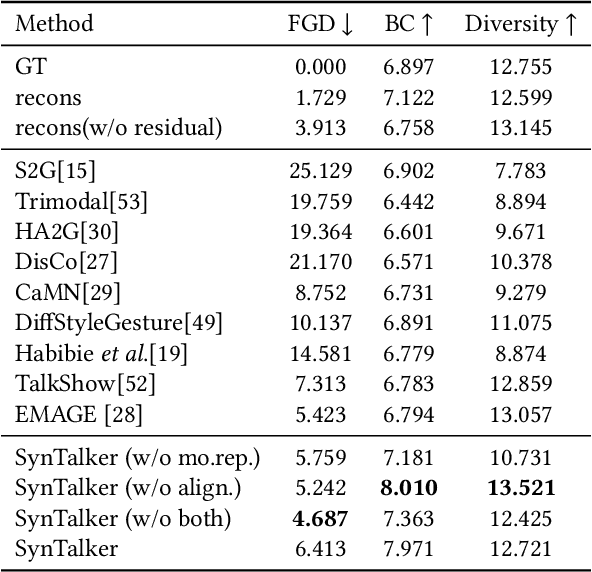
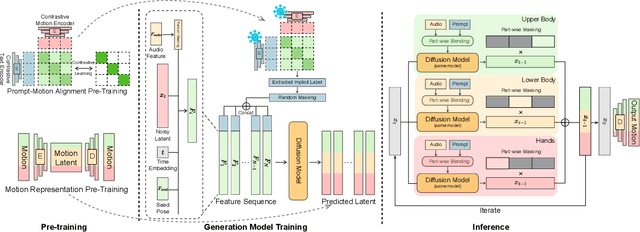
Current co-speech motion generation approaches usually focus on upper body gestures following speech contents only, while lacking supporting the elaborate control of synergistic full-body motion based on text prompts, such as talking while walking. The major challenges lie in 1) the existing speech-to-motion datasets only involve highly limited full-body motions, making a wide range of common human activities out of training distribution; 2) these datasets also lack annotated user prompts. To address these challenges, we propose SynTalker, which utilizes the off-the-shelf text-to-motion dataset as an auxiliary for supplementing the missing full-body motion and prompts. The core technical contributions are two-fold. One is the multi-stage training process which obtains an aligned embedding space of motion, speech, and prompts despite the significant distributional mismatch in motion between speech-to-motion and text-to-motion datasets. Another is the diffusion-based conditional inference process, which utilizes the separate-then-combine strategy to realize fine-grained control of local body parts. Extensive experiments are conducted to verify that our approach supports precise and flexible control of synergistic full-body motion generation based on both speeches and user prompts, which is beyond the ability of existing approaches.
GenesisTex2: Stable, Consistent and High-Quality Text-to-Texture Generation
Sep 27, 2024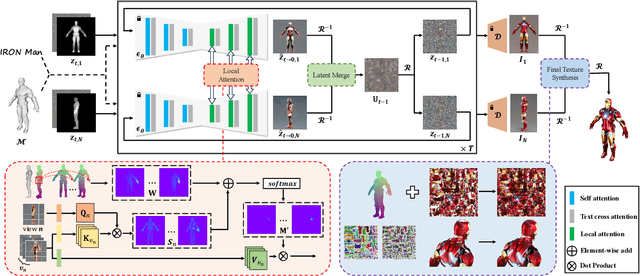
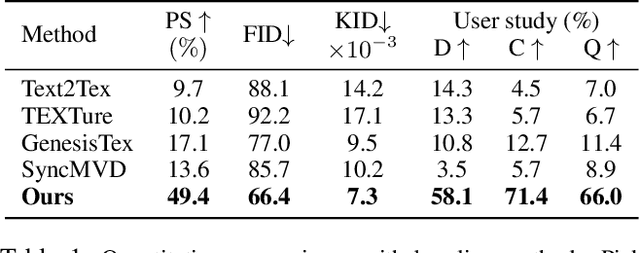


Large-scale text-guided image diffusion models have shown astonishing results in text-to-image (T2I) generation. However, applying these models to synthesize textures for 3D geometries remains challenging due to the domain gap between 2D images and textures on a 3D surface. Early works that used a projecting-and-inpainting approach managed to preserve generation diversity but often resulted in noticeable artifacts and style inconsistencies. While recent methods have attempted to address these inconsistencies, they often introduce other issues, such as blurring, over-saturation, or over-smoothing. To overcome these challenges, we propose a novel text-to-texture synthesis framework that leverages pretrained diffusion models. We first introduce a local attention reweighing mechanism in the self-attention layers to guide the model in concentrating on spatial-correlated patches across different views, thereby enhancing local details while preserving cross-view consistency. Additionally, we propose a novel latent space merge pipeline, which further ensures consistency across different viewpoints without sacrificing too much diversity. Our method significantly outperforms existing state-of-the-art techniques regarding texture consistency and visual quality, while delivering results much faster than distillation-based methods. Importantly, our framework does not require additional training or fine-tuning, making it highly adaptable to a wide range of models available on public platforms.
Emotional Dimension Control in Language Model-Based Text-to-Speech: Spanning a Broad Spectrum of Human Emotions
Sep 25, 2024Current emotional text-to-speech (TTS) systems face challenges in mimicking a broad spectrum of human emotions due to the inherent complexity of emotions and limitations in emotional speech datasets and models. This paper proposes a TTS framework that facilitates control over pleasure, arousal, and dominance, and can synthesize a diversity of emotional styles without requiring any emotional speech data during TTS training. We train an emotional attribute predictor using only categorical labels from speech data, aligning with psychological research and incorporating anchored dimensionality reduction on self-supervised learning (SSL) features. The TTS framework converts text inputs into phonetic tokens via an autoregressive language model and uses pseudo-emotional dimensions to guide the parallel prediction of fine-grained acoustic details. Experiments conducted on the LibriTTS dataset demonstrate that our framework can synthesize speech with enhanced naturalness and a variety of emotional styles by effectively controlling emotional dimensions, even without the inclusion of any emotional speech during TTS training.
Enhancing Emotional Text-to-Speech Controllability with Natural Language Guidance through Contrastive Learning and Diffusion Models
Sep 10, 2024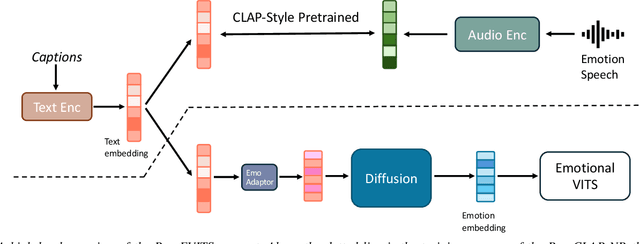
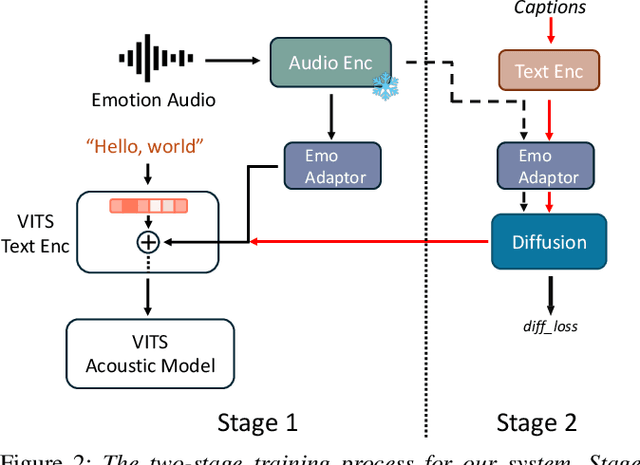

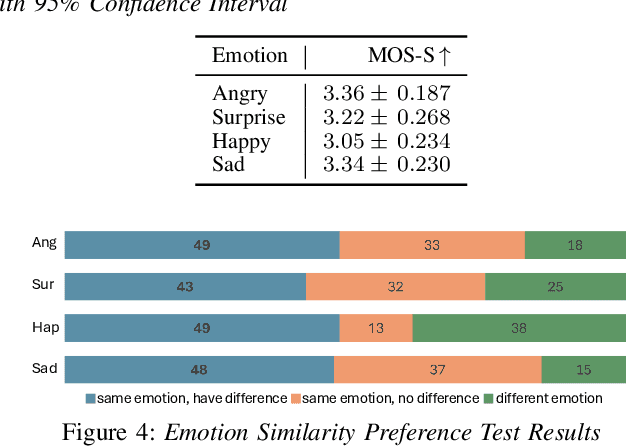
While current emotional text-to-speech (TTS) systems can generate highly intelligible emotional speech, achieving fine control over emotion rendering of the output speech still remains a significant challenge. In this paper, we introduce ParaEVITS, a novel emotional TTS framework that leverages the compositionality of natural language to enhance control over emotional rendering. By incorporating a text-audio encoder inspired by ParaCLAP, a contrastive language-audio pretraining (CLAP) model for computational paralinguistics, the diffusion model is trained to generate emotional embeddings based on textual emotional style descriptions. Our framework first trains on reference audio using the audio encoder, then fine-tunes a diffusion model to process textual inputs from ParaCLAP's text encoder. During inference, speech attributes such as pitch, jitter, and loudness are manipulated using only textual conditioning. Our experiments demonstrate that ParaEVITS effectively control emotion rendering without compromising speech quality. Speech demos are publicly available.
Unveiling Advanced Frequency Disentanglement Paradigm for Low-Light Image Enhancement
Sep 03, 2024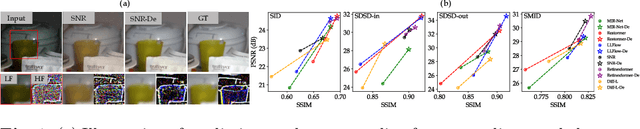
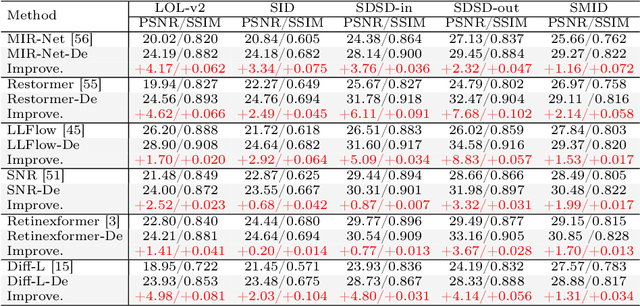


Previous low-light image enhancement (LLIE) approaches, while employing frequency decomposition techniques to address the intertwined challenges of low frequency (e.g., illumination recovery) and high frequency (e.g., noise reduction), primarily focused on the development of dedicated and complex networks to achieve improved performance. In contrast, we reveal that an advanced disentanglement paradigm is sufficient to consistently enhance state-of-the-art methods with minimal computational overhead. Leveraging the image Laplace decomposition scheme, we propose a novel low-frequency consistency method, facilitating improved frequency disentanglement optimization. Our method, seamlessly integrating with various models such as CNNs, Transformers, and flow-based and diffusion models, demonstrates remarkable adaptability. Noteworthy improvements are showcased across five popular benchmarks, with up to 7.68dB gains on PSNR achieved for six state-of-the-art models. Impressively, our approach maintains efficiency with only 88K extra parameters, setting a new standard in the challenging realm of low-light image enhancement.
Progressive Radiance Distillation for Inverse Rendering with Gaussian Splatting
Aug 14, 2024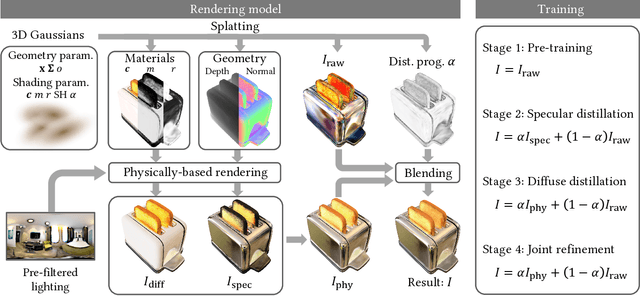
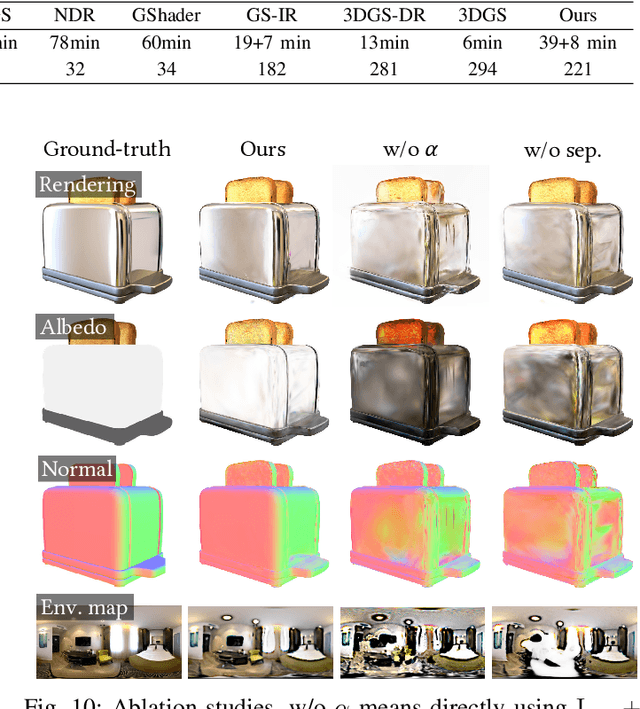
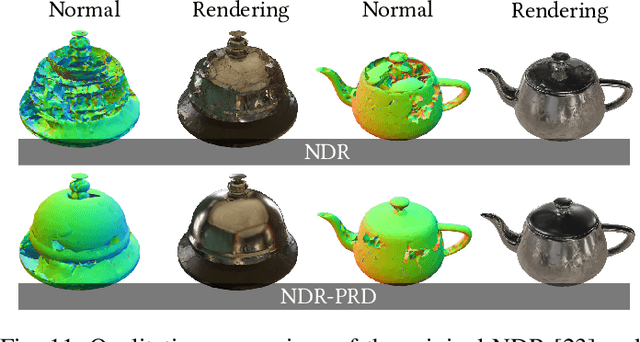
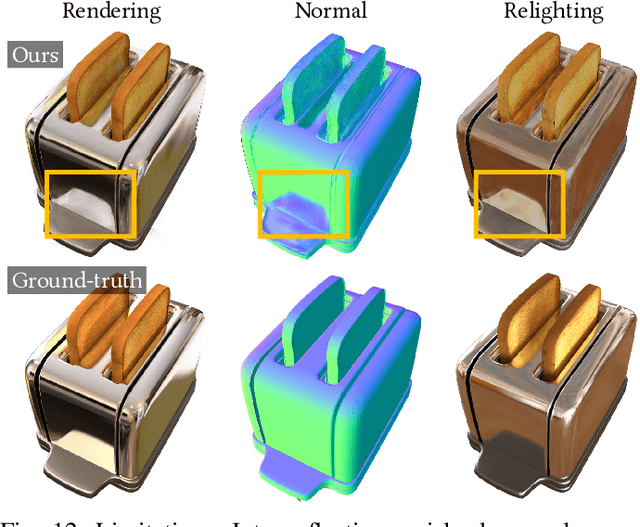
We propose progressive radiance distillation, an inverse rendering method that combines physically-based rendering with Gaussian-based radiance field rendering using a distillation progress map. Taking multi-view images as input, our method starts from a pre-trained radiance field guidance, and distills physically-based light and material parameters from the radiance field using an image-fitting process. The distillation progress map is initialized to a small value, which favors radiance field rendering. During early iterations when fitted light and material parameters are far from convergence, the radiance field fallback ensures the sanity of image loss gradients and avoids local minima that attracts under-fit states. As fitted parameters converge, the physical model gradually takes over and the distillation progress increases correspondingly. In presence of light paths unmodeled by the physical model, the distillation progress never finishes on affected pixels and the learned radiance field stays in the final rendering. With this designed tolerance for physical model limitations, we prevent unmodeled color components from leaking into light and material parameters, alleviating relighting artifacts. Meanwhile, the remaining radiance field compensates for the limitations of the physical model, guaranteeing high-quality novel views synthesis. Experimental results demonstrate that our method significantly outperforms state-of-the-art techniques quality-wise in both novel view synthesis and relighting. The idea of progressive radiance distillation is not limited to Gaussian splatting. We show that it also has positive effects for prominently specular scenes when adapted to a mesh-based inverse rendering method.
Towards Effective and Efficient Continual Pre-training of Large Language Models
Jul 26, 2024

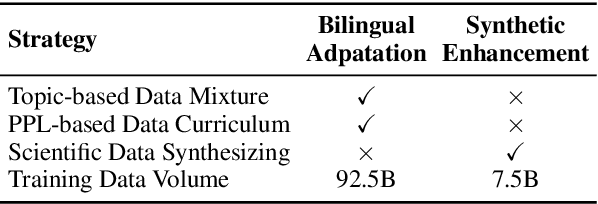

Continual pre-training (CPT) has been an important approach for adapting language models to specific domains or tasks. To make the CPT approach more traceable, this paper presents a technical report for continually pre-training Llama-3 (8B), which significantly enhances the Chinese language ability and scientific reasoning ability of the backbone model. To enhance the new abilities while retaining the original abilities, we design specific data mixture and curriculum strategies by utilizing existing datasets and synthesizing high-quality datasets. Specifically, we synthesize multidisciplinary scientific question and answer (QA) pairs based on related web pages, and subsequently incorporate these synthetic data to improve the scientific reasoning ability of Llama-3. We refer to the model after CPT as Llama-3-SynE (Synthetic data Enhanced Llama-3). We also present the tuning experiments with a relatively small model -- TinyLlama, and employ the derived findings to train the backbone model. Extensive experiments on a number of evaluation benchmarks show that our approach can largely improve the performance of the backbone models, including both the general abilities (+8.81 on C-Eval and +6.31 on CMMLU) and the scientific reasoning abilities (+12.00 on MATH and +4.13 on SciEval), without hurting the original capacities. Our model, data, and codes are available at https://github.com/RUC-GSAI/Llama-3-SynE.
Interactive Rendering of Relightable and Animatable Gaussian Avatars
Jul 15, 2024

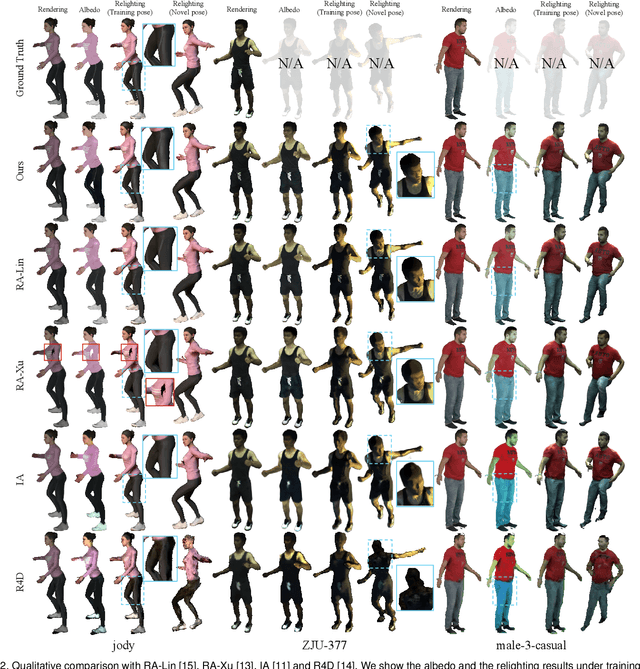

Creating relightable and animatable avatars from multi-view or monocular videos is a challenging task for digital human creation and virtual reality applications. Previous methods rely on neural radiance fields or ray tracing, resulting in slow training and rendering processes. By utilizing Gaussian Splatting, we propose a simple and efficient method to decouple body materials and lighting from sparse-view or monocular avatar videos, so that the avatar can be rendered simultaneously under novel viewpoints, poses, and lightings at interactive frame rates (6.9 fps). Specifically, we first obtain the canonical body mesh using a signed distance function and assign attributes to each mesh vertex. The Gaussians in the canonical space then interpolate from nearby body mesh vertices to obtain the attributes. We subsequently deform the Gaussians to the posed space using forward skinning, and combine the learnable environment light with the Gaussian attributes for shading computation. To achieve fast shadow modeling, we rasterize the posed body mesh from dense viewpoints to obtain the visibility. Our approach is not only simple but also fast enough to allow interactive rendering of avatar animation under environmental light changes. Experiments demonstrate that, compared to previous works, our method can render higher quality results at a faster speed on both synthetic and real datasets.
Pattern Guided UV Recovery for Realistic Video Garment Texturing
Jul 14, 2024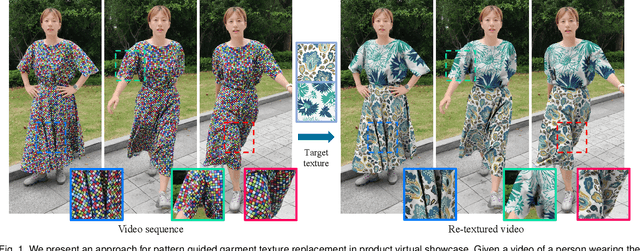
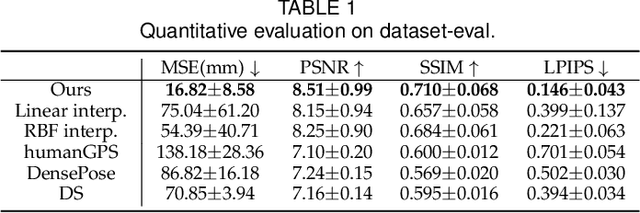

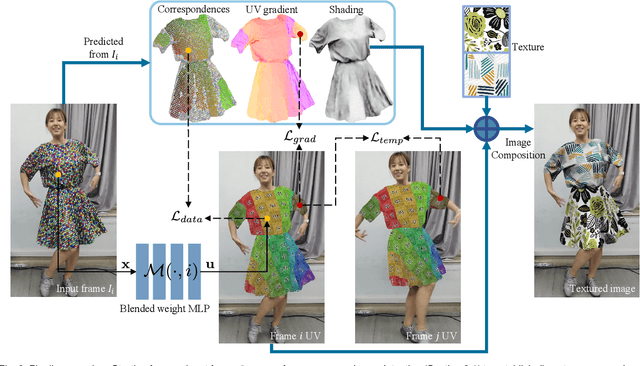
The fast growth of E-Commerce creates a global market worth USD 821 billion for online fashion shopping. What unique about fashion presentation is that, the same design can usually be offered with different cloths textures. However, only real video capturing or manual per-frame editing can be used for virtual showcase on the same design with different textures, both of which are heavily labor intensive. In this paper, we present a pattern-based approach for UV and shading recovery from a captured real video so that the garment's texture can be replaced automatically. The core of our approach is a per-pixel UV regression module via blended-weight multilayer perceptrons (MLPs) driven by the detected discrete correspondences from the cloth pattern. We propose a novel loss on the Jacobian of the UV mapping to create pleasant seams around the folding areas and the boundary of occluded regions while avoiding UV distortion. We also adopts the temporal constraint to ensure consistency and accuracy in UV prediction across adjacent frames. We show that our approach is robust to a variety type of clothes, in the wild illuminations and with challenging motions. We show plausible texture replacement results in our experiment, in which the folding and overlapping of the garment can be greatly preserved. We also show clear qualitative and quantitative improvement compared to the baselines as well. With the one-click setup, we look forward to our approach contributing to the growth of fashion E-commerce.