 Add to Chrome
 Add to Firefox
 Add to Edge
SelectTSL: Prompt-Guided Selective Target Sound Localization in Complex Scenarios
Jul 02, 2026
Humans can selectively attend to a target sound and estimate its direction in complex scenarios, whereas such selective localization remains challenging for current deep learning-based systems. Sound source localization (SSL) has achieved remarkable success with deep learning, yet most methods localize all active sources without selectivity. Conversely, target sound extraction (TSE) extracts sources using multimodal prompts but typically fails to preserve the multichannel spatial information required for accurate localization. To bridge this gap, we formulate the task of prompt-guided selective target sound localization and propose SelectTSL, an end-to-end architecture that localizes only the user-specified target in multi-source acoustic scenes. Specifically, we design a target-aware selective localization strategy that employs a Prompt-Guided Selective Attention Module (PGSA) to generate prompt-informed embeddings. These embeddings guide an inter-channel phase difference (IPD) enhancer to refine raw phase cues, fusing with target magnitudes to jointly estimate direction of arrival (DoA) and target-source cardinality, i.e., the number of target sound sources. This coupled design effectively focuses on the user-specified target spatial cues for selective localization and also handles time-varying numbers of target sources. Extensive experiments on both synthetic data and real-world recordings demonstrate that our proposed method consistently outperforms other baselines and exhibits robust generalization to real acoustic environments.

LuSeeL: Language-queried Binaural Universal Sound Event Extraction and Localization
Jan 27, 2026Most universal sound extraction algorithms focus on isolating a target sound event from single-channel audio mixtures. However, the real world is three-dimensional, and binaural audio, which mimics human hearing, can capture richer spatial information, including sound source location. This spatial context is crucial for understanding and modeling complex auditory scenes, as it inherently informs sound detection and extraction. In this work, we propose a language-driven universal sound extraction network that isolates text-described sound events from binaural mixtures by effectively leveraging the spatial cues present in binaural signals. Additionally, we jointly predict the direction of arrival (DoA) of the target sound using spatial features from the extraction network. This dual-task approach exploits complementary location information to improve extraction performance while enabling accurate DoA estimation. Experimental results on the in-the-wild AudioCaps dataset show that our proposed LuSeeL model significantly outperforms single-channel and uni-task baselines.
Beyond Lips: Integrating Gesture and Lip Cues for Robust Audio-visual Speaker Extraction
Jan 27, 2026Most audio-visual speaker extraction methods rely on synchronized lip recording to isolate the speech of a target speaker from a multi-talker mixture. However, in natural human communication, co-speech gestures are also temporally aligned with speech, often emphasizing specific words or syllables. These gestures provide complementary visual cues that can be especially valuable when facial or lip regions are occluded or distant. In this work, we move beyond lip-centric approaches and propose SeLG, a model that integrates both lip and upper-body gesture information for robust speaker extraction. SeLG features a cross-attention-based fusion mechanism that enables each visual modality to query and selectively attend to relevant speech features in the mixture. To improve the alignment of gesture representations with speech dynamics, SeLG also employs a contrastive InfoNCE loss that encourages gesture embeddings to align more closely with corresponding lip embeddings, which are more strongly correlated with speech. Experimental results on the YGD dataset, containing TED talks, demonstrate that the proposed contrastive learning strategy significantly improves gesture-based speaker extraction, and that our proposed SeLG model, by effectively fusing lip and gesture cues with an attention mechanism and InfoNCE loss, achieves superior performance compared to baselines, across both complete and partial (i.e., missing-modality) conditions.
FlowSE-GRPO: Training Flow Matching Speech Enhancement via Online Reinforcement Learning
Jan 23, 2026Generative speech enhancement offers a promising alternative to traditional discriminative methods by modeling the distribution of clean speech conditioned on noisy inputs. Post-training alignment via reinforcement learning (RL) effectively aligns generative models with human preferences and downstream metrics in domains such as natural language processing, but its use in speech enhancement remains limited, especially for online RL. Prior work explores offline methods like Direct Preference Optimization (DPO); online methods such as Group Relative Policy Optimization (GRPO) remain largely uninvestigated. In this paper, we present the first successful integration of online GRPO into a flow-matching speech enhancement framework, enabling efficient post-training alignment to perceptual and task-oriented metrics with few update steps. Unlike prior GRPO work on Large Language Models, we adapt the algorithm to the continuous, time-series nature of speech and to the dynamics of flow-matching generative models. We show that optimizing a single reward yields rapid metric gains but often induces reward hacking that degrades audio fidelity despite higher scores. To mitigate this, we propose a multi-metric reward optimization strategy that balances competing objectives, substantially reducing overfitting and improving overall performance. Our experiments validate online GRPO for speech enhancement and provide practical guidance for RL-based post-training of generative audio models.
FunAudio-ASR Technical Report
Sep 15, 2025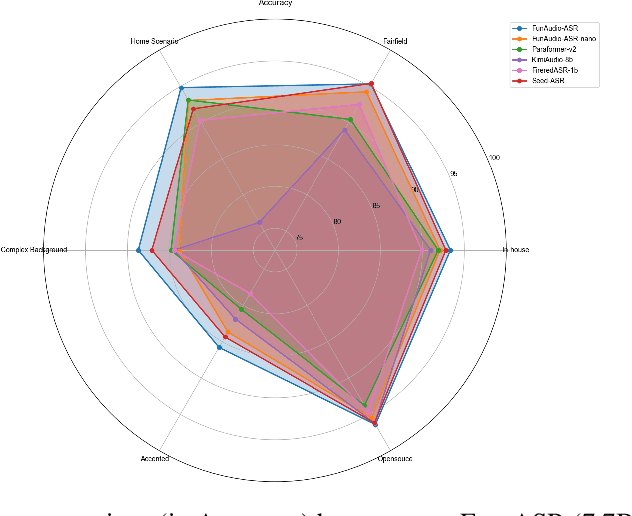
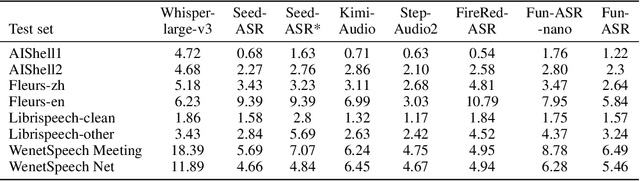
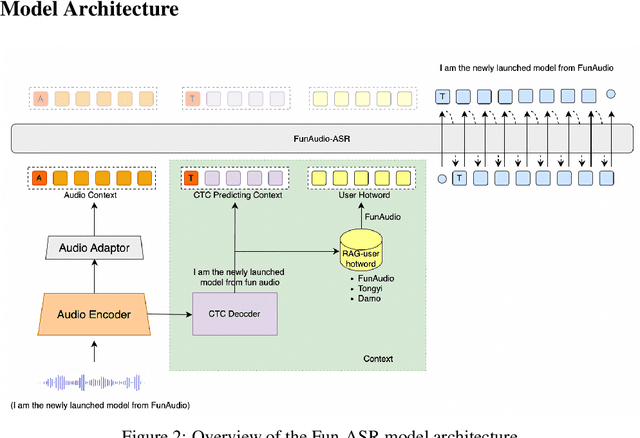
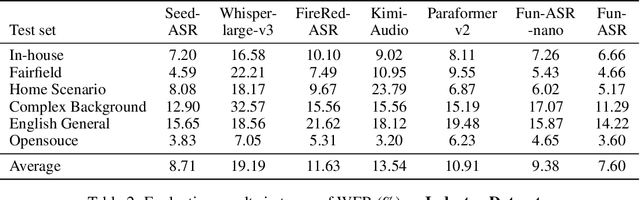
In recent years, automatic speech recognition (ASR) has witnessed transformative advancements driven by three complementary paradigms: data scaling, model size scaling, and deep integration with large language models (LLMs). However, LLMs are prone to hallucination, which can significantly degrade user experience in real-world ASR applications. In this paper, we present FunAudio-ASR, a large-scale, LLM-based ASR system that synergistically combines massive data, large model capacity, LLM integration, and reinforcement learning to achieve state-of-the-art performance across diverse and complex speech recognition scenarios. Moreover, FunAudio-ASR is specifically optimized for practical deployment, with enhancements in streaming capability, noise robustness, code-switching, hotword customization, and satisfying other real-world application requirements. Experimental results show that while most LLM-based ASR systems achieve strong performance on open-source benchmarks, they often underperform on real industry evaluation sets. Thanks to production-oriented optimizations, FunAudio-ASR achieves SOTA performance on real application datasets, demonstrating its effectiveness and robustness in practical settings.
ClearerVoice-Studio: Bridging Advanced Speech Processing Research and Practical Deployment
Jun 24, 2025This paper introduces ClearerVoice-Studio, an open-source, AI-powered speech processing toolkit designed to bridge cutting-edge research and practical application. Unlike broad platforms like SpeechBrain and ESPnet, ClearerVoice-Studio focuses on interconnected speech tasks of speech enhancement, separation, super-resolution, and multimodal target speaker extraction. A key advantage is its state-of-the-art pretrained models, including FRCRN with 3 million uses and MossFormer with 2.5 million uses, optimized for real-world scenarios. It also offers model optimization tools, multi-format audio support, the SpeechScore evaluation toolkit, and user-friendly interfaces, catering to researchers, developers, and end-users. Its rapid adoption attracting 3000 GitHub stars and 239 forks highlights its academic and industrial impact. This paper details ClearerVoice-Studio's capabilities, architectures, training strategies, benchmarks, community impact, and future plan. Source code is available at https://github.com/modelscope/ClearerVoice-Studio.
Plug-and-Play Co-Occurring Face Attention for Robust Audio-Visual Speaker Extraction
May 27, 2025Audio-visual speaker extraction isolates a target speaker's speech from a mixture speech signal conditioned on a visual cue, typically using the target speaker's face recording. However, in real-world scenarios, other co-occurring faces are often present on-screen, providing valuable speaker activity cues in the scene. In this work, we introduce a plug-and-play inter-speaker attention module to process these flexible numbers of co-occurring faces, allowing for more accurate speaker extraction in complex multi-person environments. We integrate our module into two prominent models: the AV-DPRNN and the state-of-the-art AV-TFGridNet. Extensive experiments on diverse datasets, including the highly overlapped VoxCeleb2 and sparsely overlapped MISP, demonstrate that our approach consistently outperforms baselines. Furthermore, cross-dataset evaluations on LRS2 and LRS3 confirm the robustness and generalizability of our method.
Causal Self-supervised Pretrained Frontend with Predictive Code for Speech Separation
Apr 03, 2025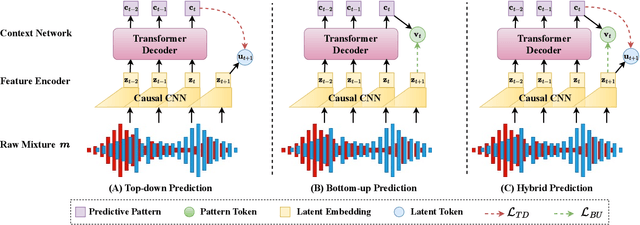
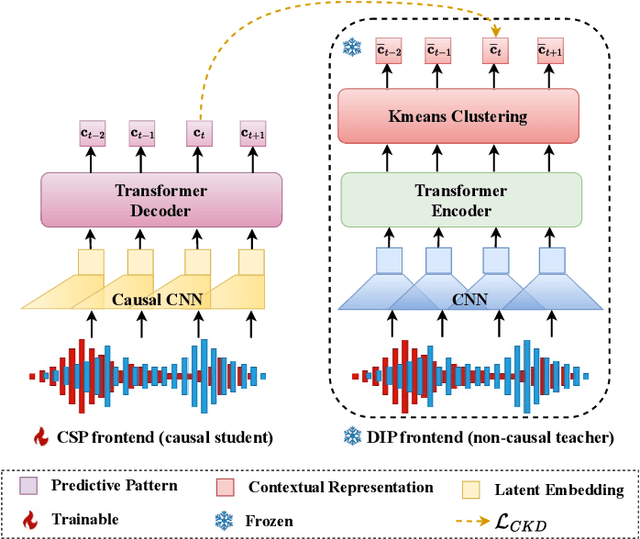
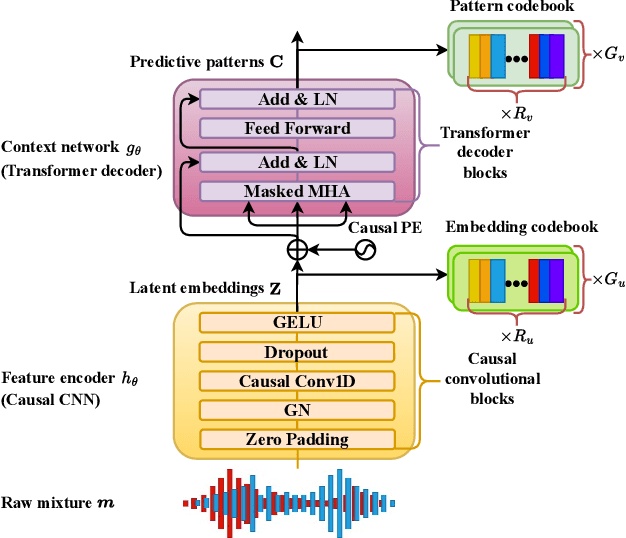
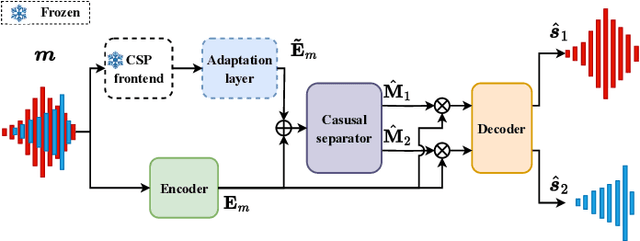
Speech separation (SS) seeks to disentangle a multi-talker speech mixture into single-talker speech streams. Although SS can be generally achieved using offline methods, such a processing paradigm is not suitable for real-time streaming applications. Causal separation models, which rely only on past and present information, offer a promising solution for real-time streaming. However, these models typically suffer from notable performance degradation due to the absence of future context. In this paper, we introduce a novel frontend that is designed to mitigate the mismatch between training and run-time inference by implicitly incorporating future information into causal models through predictive patterns. The pretrained frontend employs a transformer decoder network with a causal convolutional encoder as the backbone and is pretrained in a self-supervised manner with two innovative pretext tasks: autoregressive hybrid prediction and contextual knowledge distillation. These tasks enable the model to capture predictive patterns directly from mixtures in a self-supervised manner. The pretrained frontend subsequently serves as a feature extractor to generate high-quality predictive patterns. Comprehensive evaluations on synthetic and real-world datasets validated the effectiveness of the proposed pretrained frontend.
Context-Aware Two-Step Training Scheme for Domain Invariant Speech Separation
Mar 16, 2025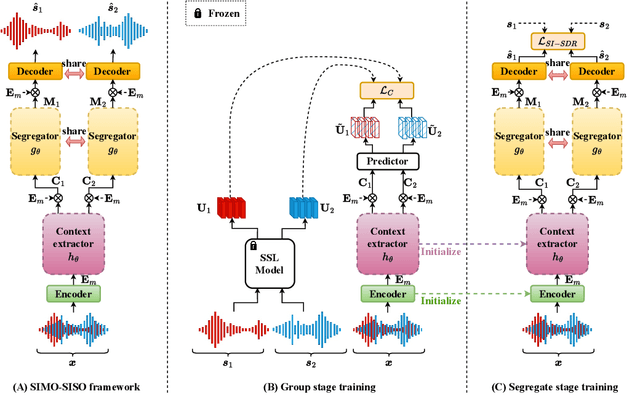
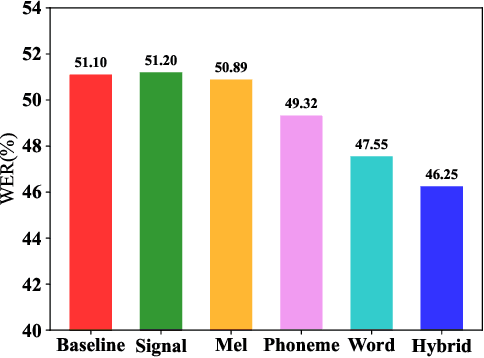
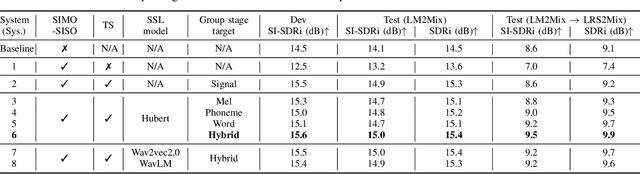
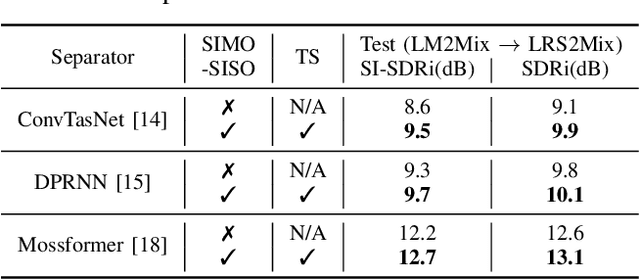
Speech separation seeks to isolate individual speech signals from a multi-talk speech mixture. Despite much progress, a system well-trained on synthetic data often experiences performance degradation on out-of-domain data, such as real-world speech mixtures. To address this, we introduce a novel context-aware, two-stage training scheme for speech separation models. In this training scheme, the conventional end-to-end architecture is replaced with a framework that contains a context extractor and a segregator. The two modules are trained step by step to simulate the speech separation process of an auditory system. We evaluate the proposed training scheme through cross-domain experiments on both synthetic and real-world speech mixtures, and demonstrate that our new scheme effectively boosts separation quality across different domains without adaptation, as measured by signal quality metrics and word error rate (WER). Additionally, an ablation study on the real test set highlights that the context information, including phoneme and word representations from pretrained SSL models, serves as effective domain invariant training targets for separation models.
Conditional Latent Diffusion-Based Speech Enhancement Via Dual Context Learning
Jan 17, 2025Recently, the application of diffusion probabilistic models has advanced speech enhancement through generative approaches. However, existing diffusion-based methods have focused on the generation process in high-dimensional waveform or spectral domains, leading to increased generation complexity and slower inference speeds. Additionally, these methods have primarily modelled clean speech distributions, with limited exploration of noise distributions, thereby constraining the discriminative capability of diffusion models for speech enhancement. To address these issues, we propose a novel approach that integrates a conditional latent diffusion model (cLDM) with dual-context learning (DCL). Our method utilizes a variational autoencoder (VAE) to compress mel-spectrograms into a low-dimensional latent space. We then apply cLDM to transform the latent representations of both clean speech and background noise into Gaussian noise by the DCL process, and a parameterized model is trained to reverse this process, conditioned on noisy latent representations and text embeddings. By operating in a lower-dimensional space, the latent representations reduce the complexity of the generation process, while the DCL process enhances the model's ability to handle diverse and unseen noise environments. Our experiments demonstrate the strong performance of the proposed approach compared to existing diffusion-based methods, even with fewer iterative steps, and highlight the superior generalization capability of our models to out-of-domain noise datasets (https://github.com/modelscope/ClearerVoice-Studio).