 Add to Chrome
 Add to Firefox
 Add to Edge
X-Translator: A Real-Time Multilingual Speaker-Aware Speech-to-Speech Translation System
Jul 20, 2026
Real-time speech-to-speech translation (S2ST) systems must balance translation quality, latency, speech naturalness, and speaker consistency. Publicly documented S2ST systems have advanced direct, multilingual, streaming, and expressive modeling, while proprietary products and APIs increasingly expose real-time translation capabilities to users. However, practical deployment remains challenging for open and reproducible systems, especially in long-form and multi-speaker conversations where partial ASR hypotheses are unstable, turn boundaries are ambiguous, and target speech must be generated with an appropriate speaker prompt. We present X-Translator, a low-cost modular cascaded S2ST system that combines streaming ASR, machine translation, and prompt-conditioned TTS through a session-level runtime controller. The system uses incremental segment commitment to convert unstable ASR streams into translation-ready units, and an online speaker prompt manager to bind source speech spans to speaker-specific voice prompts for synthesis. We evaluate translation, speech quality, and latency with OpenSTBench, compare against proprietary speech translation APIs as behavioral baselines, measure long-form voice stability, evaluate speaker preservation in multi-speaker conversations, and assess multilingual translation quality. X-Translator provides an open platform for understanding the practical trade-offs of deployment-oriented S2ST. Code and demo are available at https://github.com/zhaoyx239/X-Translator.

Compress the Cache, Not the Speech Embedding: KV Compression for Efficient Speech LLMs
Jul 07, 2026Speech large language models (Speech LLMs) typically encode speech into sequences far longer than text, creating a major efficiency bottleneck during autoregressive decoding. A common remedy is to compress the speech sequence at the adapter level to remove temporal redundancy before it enters the LLM; however, such early downsampling risks discarding fine-grained information that cannot be recovered. We propose SpeechKV, which applies a learned pooling to the KV cache of speech tokens inside the LLM. This design allows the LLM to fuse speech and text internally while directly accelerating decoding. Trained on 71K hours of speech data, SpeechKV compresses the speech to approximately text-level granularity yet maintains performance on par with or even slightly better than the uncompressed baseline, with relative gains of 6.6% on out-of-domain entity recognition and 2.3% on OpenASR, while delivering at least 1.49 times decoding speedup that scales with audio length.
Rethinking Speech-LLM Integration for ASR: Effective Joint Speech-Text Training by Interleaving
Jul 02, 2026Speech-LLM integration has shown promising results by leveraging extensive textual pretraining, yet its specific benefits for automatic speech recognition (ASR) remain unclear. We observe that as supervised ASR training data increases, the contribution of LLM priors becomes less evident, and simple speech-text joint training under-utilizes textual knowledge. We therefore propose Joint Speech-Text Interleaved Pretraining (JSTIP), an ASR-oriented pretraining strategy that constructs word-level and segment-level interleaved speech-text sequences within aligned pairs for speech-LLM architectures that accept continuous inputs. Experiments on 38k hours of ASR data show consistent entity accuracy improvement compared to ASR-only and joint speech-text training baselines. JSTIP achieves on-par entity recognition performance using domain transcription text compared to synthetic speech-text pairs, simplifying domain adaptation. Benefiting from textual pretraining and domain text data, JSTIP is competitive with open-source ASR and Speech-LLM systems in medical entity recognition. The zero-shot speech question answering behaviors further suggest that interleaving reduces the speech-text modality gap and preserves the LLM generative prior, which is likely the reason for the entity improvements on the ASR task.
OpenSTBench: Beyond Semantic Evaluation for Speech Translation
May 29, 2026Speech translation systems increasingly span speech-to-text translation (S2TT), speech-to-speech translation (S2ST), offline translation, and streaming generation, producing outputs that differ in modality, speech realization, and timing behavior. Existing evaluation practices assess important aspects such as translation quality, speech quality, and temporal quality, but these aspects are often evaluated under separate protocols, making it difficult to compare heterogeneous systems comprehensively. To address this gap, we present OpenSTBench, a unified multidimensional evaluation framework that organizes heterogeneous speech translation outputs into a shared evaluation format. OpenSTBench supports both S2TT and S2ST systems in offline and streaming settings, and jointly evaluates translation quality, speech quality, speaker preservation, emotion and paralinguistic fidelity, temporal consistency, and latency. Through experiments on representative speech translation systems, we show that systems with strong translation quality can still differ substantially in speech quality, as well as in temporal quality. OpenSTBench provides a reproducible protocol for analyzing these cross-dimensional differences and supporting application-oriented comparison of speech translation systems. The code and datasets are available at https://github.com/sjtuayj/OpenSTBench.
UNIQUE: Universal Top-k Sparse Attention for Training-free Inference and Sparsity-aware Training
May 26, 2026Long-context inference in large language models (LLMs) is bottlenecked by the linear growth of the self-attention key-value (KV) cache. Top-k sparse attention alleviates this by loading only a small fraction of the KV cache, but accurately and cheaply estimating cache importance, for both training-free use and sparsity-aware training, remains challenging. This paper proposes UNIQUE, a universal top-k sparse attention framework that addresses both requirements and stays consistently effective across LLM modalities. UNIQUE operates at the granularity of KV pages and estimates per-page importance with a simple yet accurate score combining the mean of the page's keys as a representative vector with their standard deviation as an offset term. To further close the train-inference gap, this paper introduces a soft-mask sparsity-aware training scheme that uses the top-k score boundary as a per-query threshold and a sigmoid soft mask around it, requiring neither auxiliary losses nor architectural changes. Experiments on text and speech LLMs show that UNIQUE preserves task performance on long-context benchmarks such as LongBench Pro and on long-form speech recognition, while delivering up to 11.4x attention-kernel speedup over FlashInfer dense attention and at least 5.3x end-to-end decoding speedup over a vLLM-based dense model.
Speech LLMs are Contextual Reasoning Transcribers
Apr 01, 2026Despite extensions to speech inputs, effectively leveraging the rich knowledge and contextual understanding of large language models (LLMs) in automatic speech recognition (ASR) remains non-trivial, as the task primarily involves direct speech-to-text mapping. To address this, this paper proposes chain-of-thought ASR (CoT-ASR), which constructs a reasoning chain that enables LLMs to first analyze the input speech and generate contextual analysis, thereby fully exploiting their generative capabilities. With this contextual reasoning, CoT-ASR then performs more informed speech recognition and completes both reasoning and transcription in a single pass. Moreover, CoT-ASR naturally supports user-guided transcription: while designed to self-generate reasoning, it can also seamlessly incorporate user-provided context to guide transcription, further extending ASR functionality. To reduce the modality gap, this paper introduces a CTC-guided Modality Adapter, which uses CTC non-blank token probabilities to weight LLM embeddings, efficiently aligning speech encoder outputs with the LLM's textual latent space. Experiments show that, compared to standard LLM-based ASR, CoT-ASR achieves a relative reduction of 8.7% in word error rate (WER) and 16.9% in entity error rate (EER).
SimulS2S-LLM: Unlocking Simultaneous Inference of Speech LLMs for Speech-to-Speech Translation
Apr 22, 2025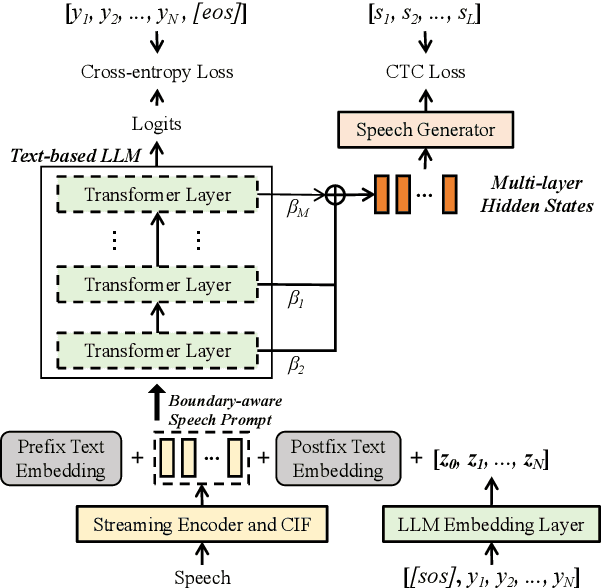
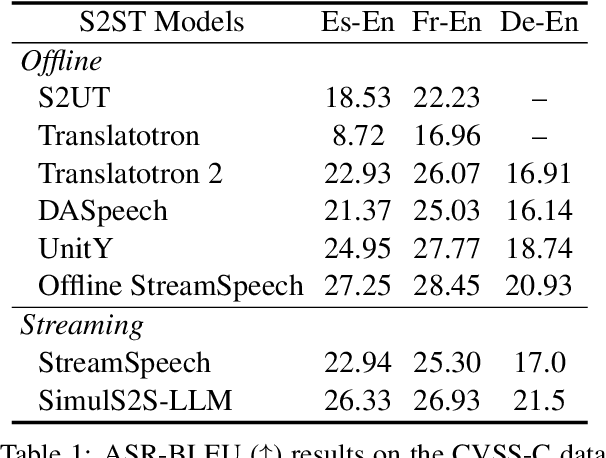
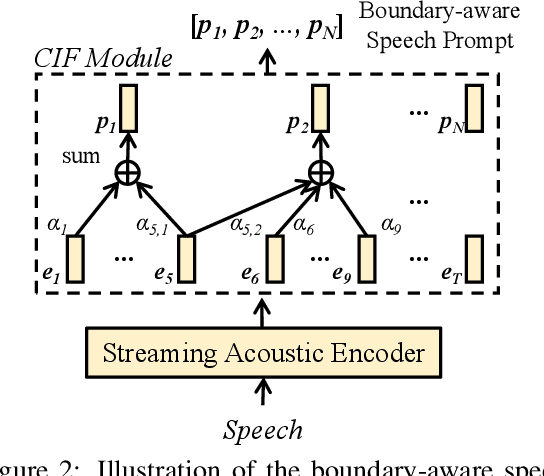
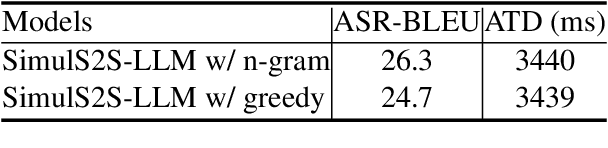
Simultaneous speech translation (SST) outputs translations in parallel with streaming speech input, balancing translation quality and latency. While large language models (LLMs) have been extended to handle the speech modality, streaming remains challenging as speech is prepended as a prompt for the entire generation process. To unlock LLM streaming capability, this paper proposes SimulS2S-LLM, which trains speech LLMs offline and employs a test-time policy to guide simultaneous inference. SimulS2S-LLM alleviates the mismatch between training and inference by extracting boundary-aware speech prompts that allows it to be better matched with text input data. SimulS2S-LLM achieves simultaneous speech-to-speech translation (Simul-S2ST) by predicting discrete output speech tokens and then synthesising output speech using a pre-trained vocoder. An incremental beam search is designed to expand the search space of speech token prediction without increasing latency. Experiments on the CVSS speech data show that SimulS2S-LLM offers a better translation quality-latency trade-off than existing methods that use the same training data, such as improving ASR-BLEU scores by 3 points at similar latency.
Transducer-Llama: Integrating LLMs into Streamable Transducer-based Speech Recognition
Dec 21, 2024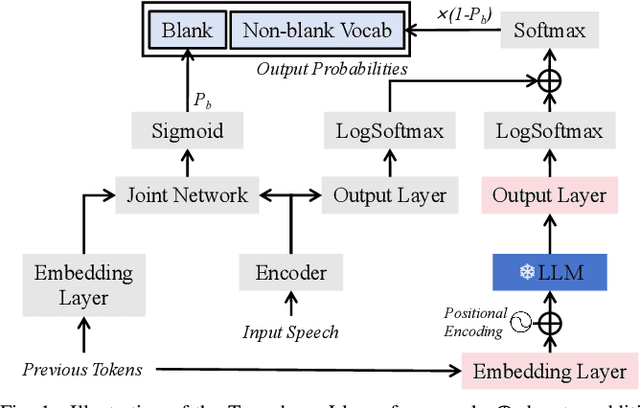
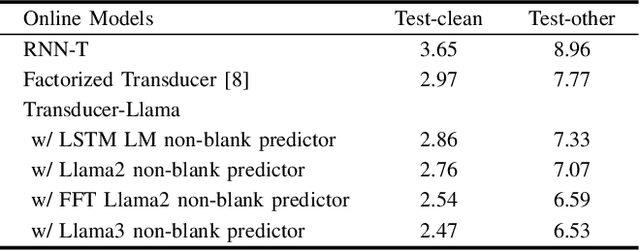
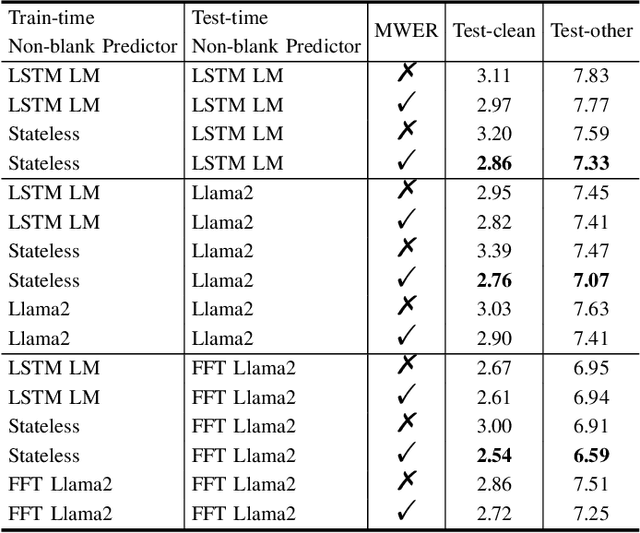
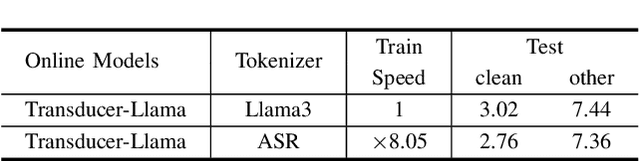
While large language models (LLMs) have been applied to automatic speech recognition (ASR), the task of making the model streamable remains a challenge. This paper proposes a novel model architecture, Transducer-Llama, that integrates LLMs into a Factorized Transducer (FT) model, naturally enabling streaming capabilities. Furthermore, given that the large vocabulary of LLMs can cause data sparsity issue and increased training costs for spoken language systems, this paper introduces an efficient vocabulary adaptation technique to align LLMs with speech system vocabularies. The results show that directly optimizing the FT model with a strong pre-trained LLM-based predictor using the RNN-T loss yields some but limited improvements over a smaller pre-trained LM predictor. Therefore, this paper proposes a weak-to-strong LM swap strategy, using a weak LM predictor during RNN-T loss training and then replacing it with a strong LLM. After LM replacement, the minimum word error rate (MWER) loss is employed to finetune the integration of the LLM predictor with the Transducer-Llama model. Experiments on the LibriSpeech and large-scale multi-lingual LibriSpeech corpora show that the proposed streaming Transducer-Llama approach gave a 17% relative WER reduction (WERR) over a strong FT baseline and a 32% WERR over an RNN-T baseline.
F5-TTS: A Fairytaler that Fakes Fluent and Faithful Speech with Flow Matching
Oct 09, 2024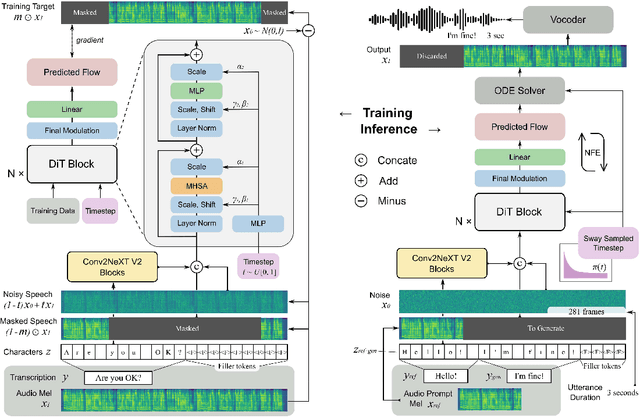
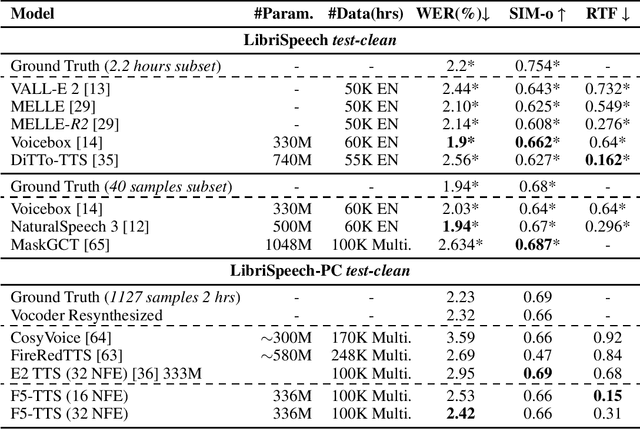
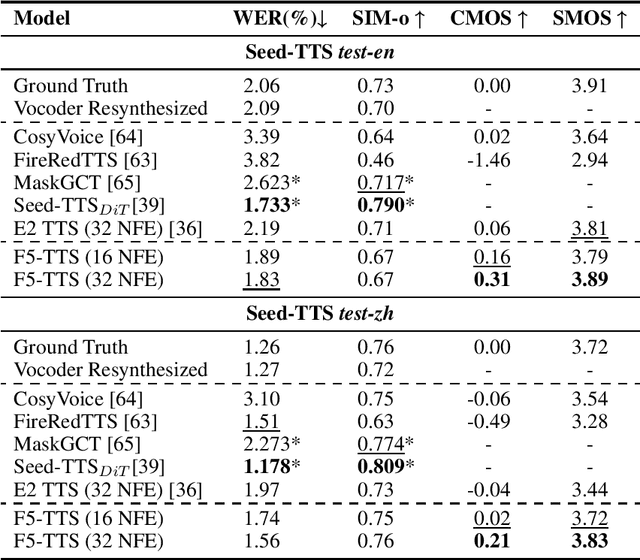
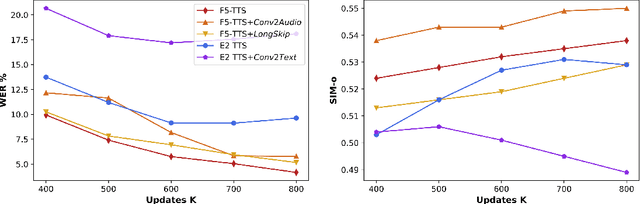
This paper introduces F5-TTS, a fully non-autoregressive text-to-speech system based on flow matching with Diffusion Transformer (DiT). Without requiring complex designs such as duration model, text encoder, and phoneme alignment, the text input is simply padded with filler tokens to the same length as input speech, and then the denoising is performed for speech generation, which was originally proved feasible by E2 TTS. However, the original design of E2 TTS makes it hard to follow due to its slow convergence and low robustness. To address these issues, we first model the input with ConvNeXt to refine the text representation, making it easy to align with the speech. We further propose an inference-time Sway Sampling strategy, which significantly improves our model's performance and efficiency. This sampling strategy for flow step can be easily applied to existing flow matching based models without retraining. Our design allows faster training and achieves an inference RTF of 0.15, which is greatly improved compared to state-of-the-art diffusion-based TTS models. Trained on a public 100K hours multilingual dataset, our Fairytaler Fakes Fluent and Faithful speech with Flow matching (F5-TTS) exhibits highly natural and expressive zero-shot ability, seamless code-switching capability, and speed control efficiency. Demo samples can be found at https://SWivid.github.io/F5-TTS. We release all code and checkpoints to promote community development.
CoT-ST: Enhancing LLM-based Speech Translation with Multimodal Chain-of-Thought
Sep 29, 2024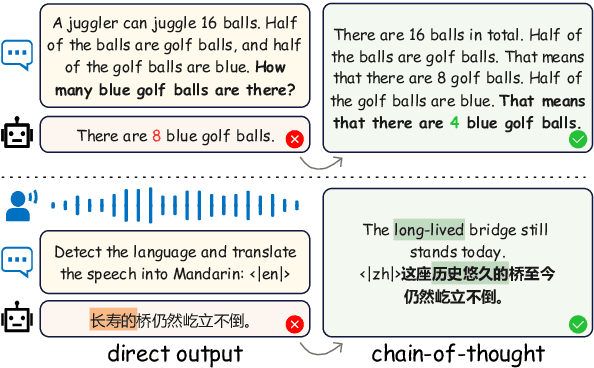
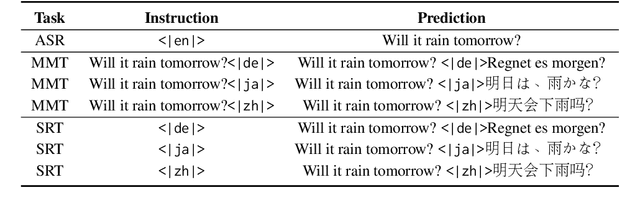
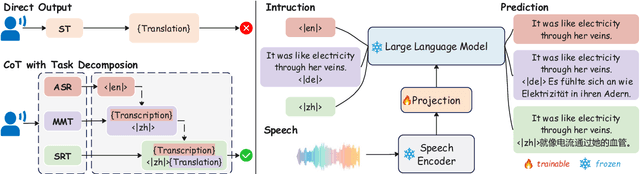
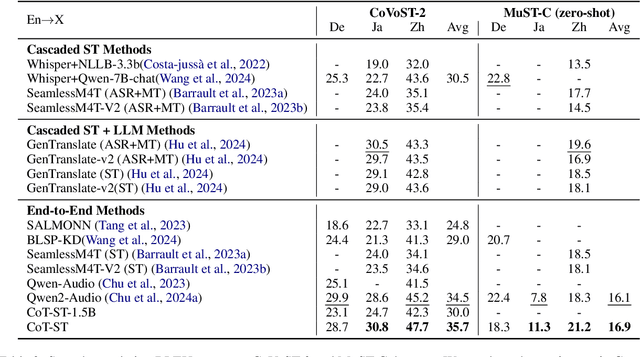
Speech Language Models (SLMs) have demonstrated impressive performance on speech translation tasks. However, existing research primarily focuses on direct instruction fine-tuning and often overlooks the inherent reasoning capabilities of SLMs. In this paper, we introduce a three-stage training framework designed to activate the chain-of-thought (CoT) capabilities of SLMs. We propose CoT-ST, a speech translation model that utilizes multimodal CoT to decompose speech translation into sequential steps of speech recognition and translation. We validated the effectiveness of our method on two datasets: the CoVoST-2 dataset and MuST-C dataset. The experimental results demonstrate that CoT-ST outperforms previous state-of-the-art methods, achieving higher BLEU scores (CoVoST-2 en-ja: 30.5->30.8, en-zh: 45.2->47.7, MuST-C en-zh: 19.6->21.2). This work is open sourced at https://github.com/X-LANCE/SLAM-LLM/tree/main/examples/st_covost2 .