 Add to Chrome
 Add to Firefox
 Add to Edge
One Perturbation is Enough: On Generating Universal Adversarial Perturbations against Vision-Language Pre-training Models
Jun 08, 2024


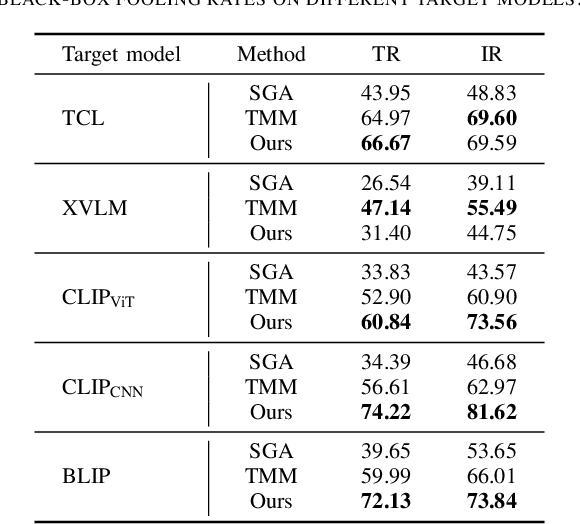
Vision-Language Pre-training (VLP) models trained on large-scale image-text pairs have demonstrated unprecedented capability in many practical applications. However, previous studies have revealed that VLP models are vulnerable to adversarial samples crafted by a malicious adversary. While existing attacks have achieved great success in improving attack effect and transferability, they all focus on instance-specific attacks that generate perturbations for each input sample. In this paper, we show that VLP models can be vulnerable to a new class of universal adversarial perturbation (UAP) for all input samples. Although initially transplanting existing UAP algorithms to perform attacks showed effectiveness in attacking discriminative models, the results were unsatisfactory when applied to VLP models. To this end, we revisit the multimodal alignments in VLP model training and propose the Contrastive-training Perturbation Generator with Cross-modal conditions (C-PGC). Specifically, we first design a generator that incorporates cross-modal information as conditioning input to guide the training. To further exploit cross-modal interactions, we propose to formulate the training objective as a multimodal contrastive learning paradigm based on our constructed positive and negative image-text pairs. By training the conditional generator with the designed loss, we successfully force the adversarial samples to move away from its original area in the VLP model's feature space, and thus essentially enhance the attacks. Extensive experiments show that our method achieves remarkable attack performance across various VLP models and Vision-and-Language (V+L) tasks. Moreover, C-PGC exhibits outstanding black-box transferability and achieves impressive results in fooling prevalent large VLP models including LLaVA and Qwen-VL.

Advancing Financial Risk Prediction Through Optimized LSTM Model Performance and Comparative Analysis
May 31, 2024This paper focuses on the application and optimization of LSTM model in financial risk prediction. The study starts with an overview of the architecture and algorithm foundation of LSTM, and then details the model training process and hyperparameter tuning strategy, and adjusts network parameters through experiments to improve performance. Comparative experiments show that the optimized LSTM model shows significant advantages in AUC index compared with random forest, BP neural network and XGBoost, which verifies its efficiency and practicability in the field of financial risk prediction, especially its ability to deal with complex time series data, which lays a solid foundation for the application of the model in the actual production environment.
GI-NAS: Boosting Gradient Inversion Attacks through Adaptive Neural Architecture Search
May 31, 2024Gradient Inversion Attacks invert the transmitted gradients in Federated Learning (FL) systems to reconstruct the sensitive data of local clients and have raised considerable privacy concerns. A majority of gradient inversion methods rely heavily on explicit prior knowledge (e.g., a well pre-trained generative model), which is often unavailable in realistic scenarios. To alleviate this issue, researchers have proposed to leverage the implicit prior knowledge of an over-parameterized network. However, they only utilize a fixed neural architecture for all the attack settings. This would hinder the adaptive use of implicit architectural priors and consequently limit the generalizability. In this paper, we further exploit such implicit prior knowledge by proposing Gradient Inversion via Neural Architecture Search (GI-NAS), which adaptively searches the network and captures the implicit priors behind neural architectures. Extensive experiments verify that our proposed GI-NAS can achieve superior attack performance compared to state-of-the-art gradient inversion methods, even under more practical settings with high-resolution images, large-sized batches, and advanced defense strategies.
MGCP: A Multi-Grained Correlation based Prediction Network for Multivariate Time Series
May 30, 2024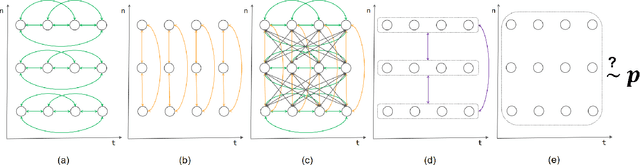


Multivariate time series prediction is widely used in daily life, which poses significant challenges due to the complex correlations that exist at multi-grained levels. Unfortunately, the majority of current time series prediction models fail to simultaneously learn the correlations of multivariate time series at multi-grained levels, resulting in suboptimal performance. To address this, we propose a Multi-Grained Correlations-based Prediction (MGCP) Network, which simultaneously considers the correlations at three granularity levels to enhance prediction performance. Specifically, MGCP utilizes Adaptive Fourier Neural Operators and Graph Convolutional Networks to learn the global spatiotemporal correlations and inter-series correlations, enabling the extraction of potential features from multivariate time series at fine-grained and medium-grained levels. Additionally, MGCP employs adversarial training with an attention mechanism-based predictor and conditional discriminator to optimize prediction results at coarse-grained level, ensuring high fidelity between the generated forecast results and the actual data distribution. Finally, we compare MGCP with several state-of-the-art time series prediction algorithms on real-world benchmark datasets, and our results demonstrate the generality and effectiveness of the proposed model.
Color Shift Estimation-and-Correction for Image Enhancement
May 29, 2024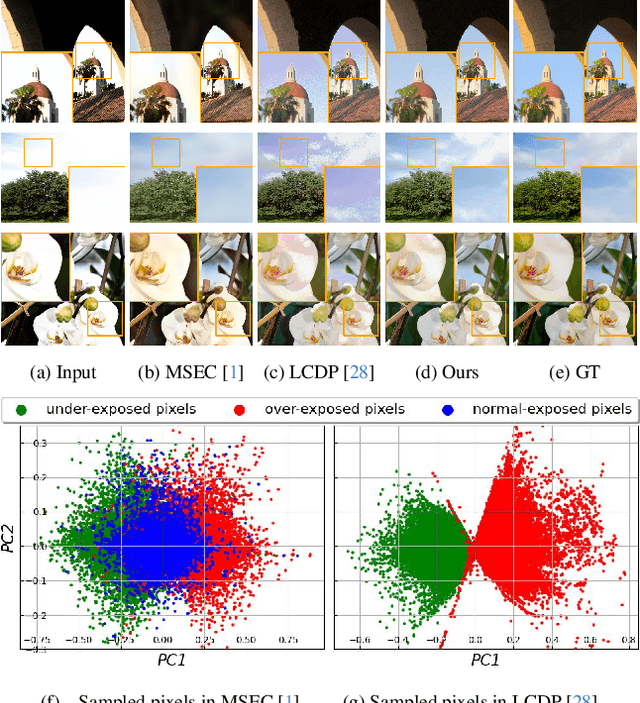
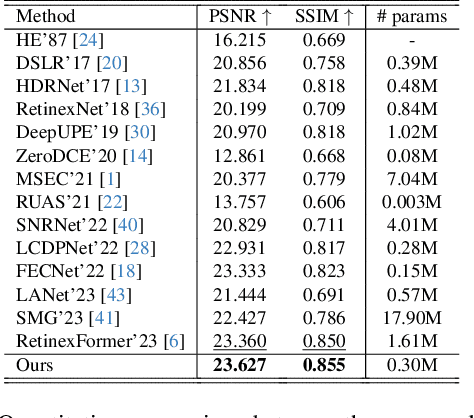
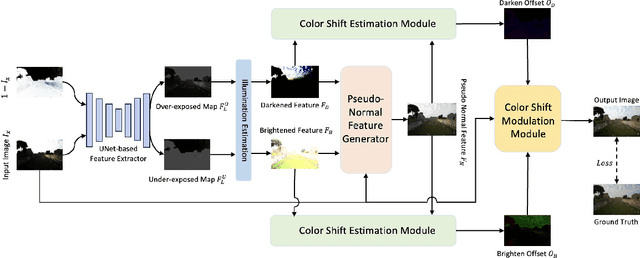
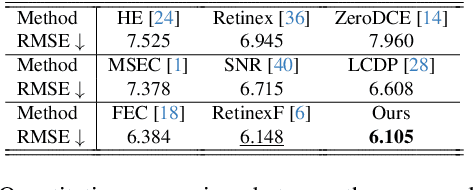
Images captured under sub-optimal illumination conditions may contain both over- and under-exposures. Current approaches mainly focus on adjusting image brightness, which may exacerbate the color tone distortion in under-exposed areas and fail to restore accurate colors in over-exposed regions. We observe that over- and under-exposed regions display opposite color tone distribution shifts with respect to each other, which may not be easily normalized in joint modeling as they usually do not have ``normal-exposed'' regions/pixels as reference. In this paper, we propose a novel method to enhance images with both over- and under-exposures by learning to estimate and correct such color shifts. Specifically, we first derive the color feature maps of the brightened and darkened versions of the input image via a UNet-based network, followed by a pseudo-normal feature generator to produce pseudo-normal color feature maps. We then propose a novel COlor Shift Estimation (COSE) module to estimate the color shifts between the derived brightened (or darkened) color feature maps and the pseudo-normal color feature maps. The COSE module corrects the estimated color shifts of the over- and under-exposed regions separately. We further propose a novel COlor MOdulation (COMO) module to modulate the separately corrected colors in the over- and under-exposed regions to produce the enhanced image. Comprehensive experiments show that our method outperforms existing approaches. Project webpage: https://github.com/yiyulics/CSEC.
Leveraging Logical Rules in Knowledge Editing: A Cherry on the Top
May 27, 2024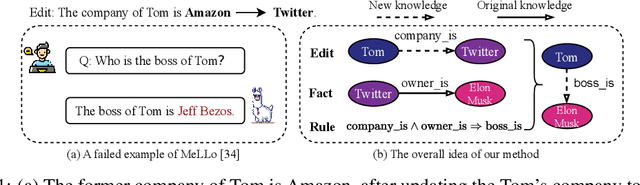
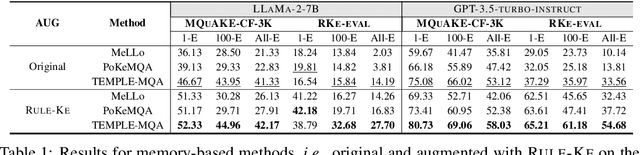
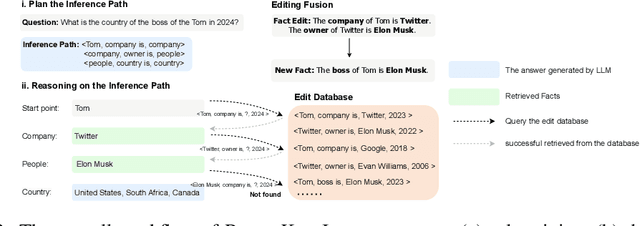
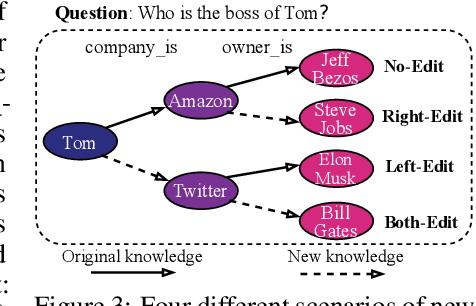
Multi-hop Question Answering (MQA) under knowledge editing (KE) is a key challenge in Large Language Models (LLMs). While best-performing solutions in this domain use a plan and solve paradigm to split a question into sub-questions followed by response generation, we claim that this approach is sub-optimal as it fails for hard to decompose questions, and it does not explicitly cater to correlated knowledge updates resulting as a consequence of knowledge edits. This has a detrimental impact on the overall consistency of the updated knowledge. To address these issues, in this paper, we propose a novel framework named RULE-KE, i.e., RULE based Knowledge Editing, which is a cherry on the top for augmenting the performance of all existing MQA methods under KE. Specifically, RULE-KE leverages rule discovery to discover a set of logical rules. Then, it uses these discovered rules to update knowledge about facts highly correlated with the edit. Experimental evaluation using existing and newly curated datasets (i.e., RKE-EVAL) shows that RULE-KE helps augment both performances of parameter-based and memory-based solutions up to 92% and 112.9%, respectively.
Enhancing Boundary Segmentation for Topological Accuracy with Skeleton-based Methods
Apr 29, 2024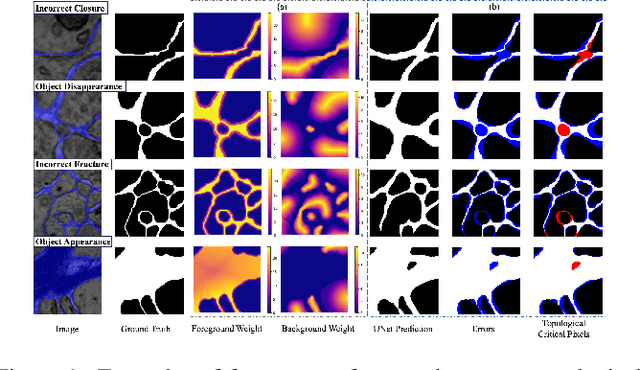
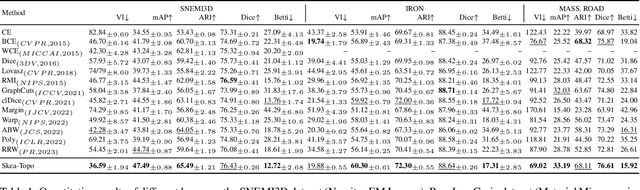
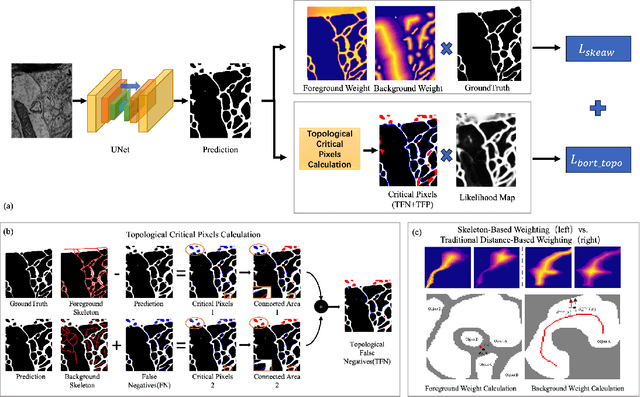
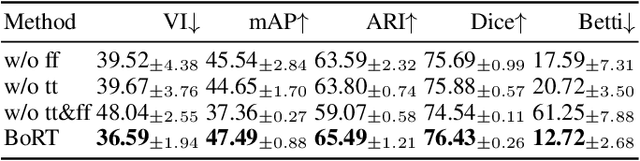
Topological consistency plays a crucial role in the task of boundary segmentation for reticular images, such as cell membrane segmentation in neuron electron microscopic images, grain boundary segmentation in material microscopic images and road segmentation in aerial images. In these fields, topological changes in segmentation results have a serious impact on the downstream tasks, which can even exceed the misalignment of the boundary itself. To enhance the topology accuracy in segmentation results, we propose the Skea-Topo Aware loss, which is a novel loss function that takes into account the shape of each object and topological significance of the pixels. It consists of two components. First, the skeleton-aware weighted loss improves the segmentation accuracy by better modeling the object geometry with skeletons. Second, a boundary rectified term effectively identifies and emphasizes topological critical pixels in the prediction errors using both foreground and background skeletons in the ground truth and predictions. Experiments prove that our method improves topological consistency by up to 7 points in VI compared to 13 state-of-art methods, based on objective and subjective assessments across three different boundary segmentation datasets. The code is available at https://github.com/clovermini/Skea_topo.
Mixed Supervised Graph Contrastive Learning for Recommendation
Apr 25, 2024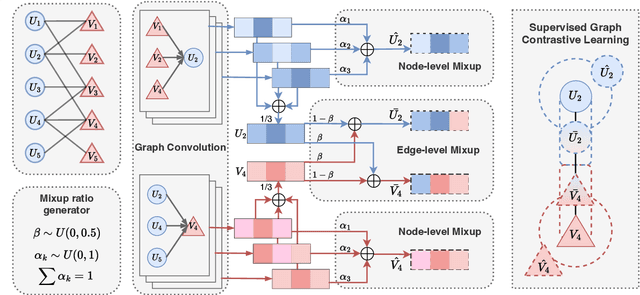
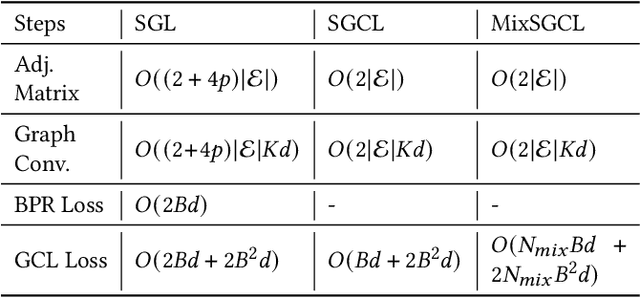
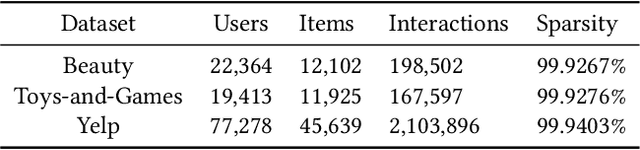
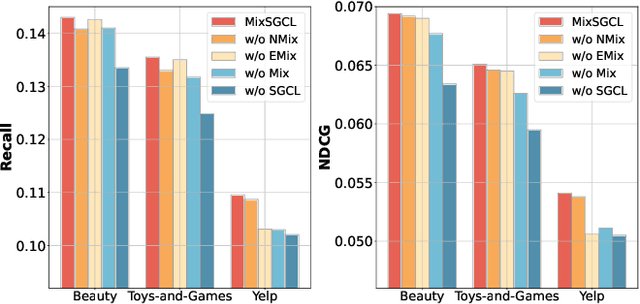
Recommender systems (RecSys) play a vital role in online platforms, offering users personalized suggestions amidst vast information. Graph contrastive learning aims to learn from high-order collaborative filtering signals with unsupervised augmentation on the user-item bipartite graph, which predominantly relies on the multi-task learning framework involving both the pair-wise recommendation loss and the contrastive loss. This decoupled design can cause inconsistent optimization direction from different losses, which leads to longer convergence time and even sub-optimal performance. Besides, the self-supervised contrastive loss falls short in alleviating the data sparsity issue in RecSys as it learns to differentiate users/items from different views without providing extra supervised collaborative filtering signals during augmentations. In this paper, we propose Mixed Supervised Graph Contrastive Learning for Recommendation (MixSGCL) to address these concerns. MixSGCL originally integrates the training of recommendation and unsupervised contrastive losses into a supervised contrastive learning loss to align the two tasks within one optimization direction. To cope with the data sparsity issue, instead unsupervised augmentation, we further propose node-wise and edge-wise mixup to mine more direct supervised collaborative filtering signals based on existing user-item interactions. Extensive experiments on three real-world datasets demonstrate that MixSGCL surpasses state-of-the-art methods, achieving top performance on both accuracy and efficiency. It validates the effectiveness of MixSGCL with our coupled design on supervised graph contrastive learning.
HILL: Hierarchy-aware Information Lossless Contrastive Learning for Hierarchical Text Classification
Mar 26, 2024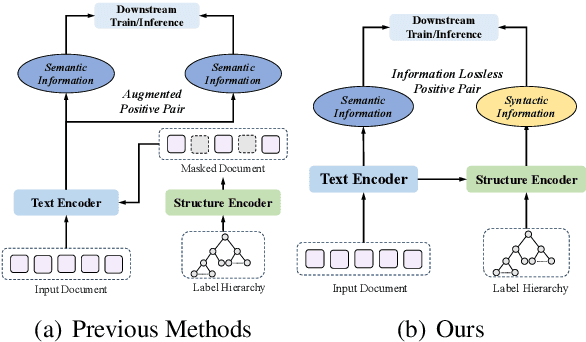
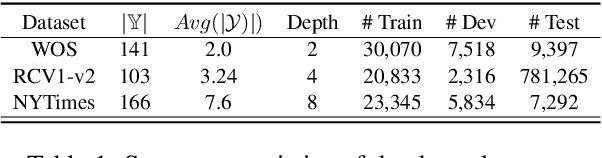
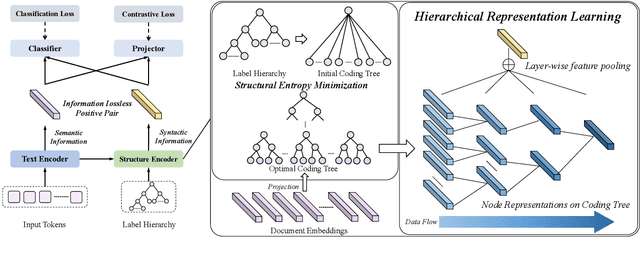
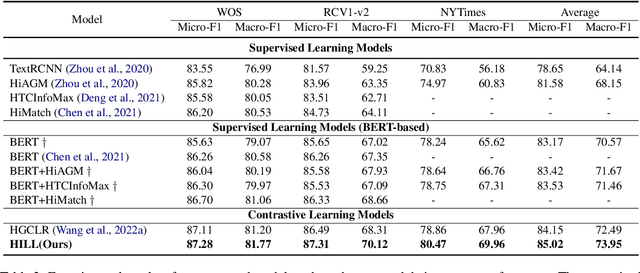
Existing self-supervised methods in natural language processing (NLP), especially hierarchical text classification (HTC), mainly focus on self-supervised contrastive learning, extremely relying on human-designed augmentation rules to generate contrastive samples, which can potentially corrupt or distort the original information. In this paper, we tend to investigate the feasibility of a contrastive learning scheme in which the semantic and syntactic information inherent in the input sample is adequately reserved in the contrastive samples and fused during the learning process. Specifically, we propose an information lossless contrastive learning strategy for HTC, namely \textbf{H}ierarchy-aware \textbf{I}nformation \textbf{L}ossless contrastive \textbf{L}earning (HILL), which consists of a text encoder representing the input document, and a structure encoder directly generating the positive sample. The structure encoder takes the document embedding as input, extracts the essential syntactic information inherent in the label hierarchy with the principle of structural entropy minimization, and injects the syntactic information into the text representation via hierarchical representation learning. Experiments on three common datasets are conducted to verify the superiority of HILL.
TDIP: Tunable Deep Image Processing, a Real Time Melt Pool Monitoring Solution
Mar 26, 2024In the era of Industry 4.0, Additive Manufacturing (AM), particularly metal AM, has emerged as a significant contributor due to its innovative and cost-effective approach to fabricate highly intricate geometries. Despite its potential, this industry still lacks real-time capable process monitoring algorithms. Recent advancements in this field suggest that Melt Pool (MP) signatures during the fabrication process contain crucial information about process dynamics and quality. To obtain this information, various sensory approaches, such as high-speed cameras-based vision modules are employed for online fabrication monitoring. However, many conventional in-depth analyses still cannot process all the recorded data simultaneously. Although conventional Image Processing (ImP) solutions provide a targeted tunable approach, they pose a trade-off between convergence certainty and convergence speed. As a result, conventional methods are not suitable for a dynamically changing application like MP monitoring. Therefore, this article proposes the implementation of a Tunable Deep Image Processing (TDIP) method to address the data-rich monitoring needs in real-time. The proposed model is first trained to replicate an ImP algorithm with tunable features and methodology. The TDIP model is then further improved to account for MP geometries and fabrication quality based on the vision input and process parameters. The TDIP model achieved over 94% estimation accuracy with more than 96% R2 score for quality, geometry, and MP signature estimation and isolation. The TDIP model can process 500 images per second, while conventional methods taking a few minutes per image. This significant processing time reduction enables the integration of vision-based monitoring in real-time for processes and quality estimation.