 Add to Chrome
 Add to Firefox
 Add to Edge
Movable Antenna Enhanced Dual-Functional Radar-Communication: A Symbol-Level Precoding Approach
May 27, 2026
This letter investigates a symbol-level precoder design for movable antenna (MA)-enhanced dual-functional radar-communication (DFRC) systems. To enhance radar sensing capabilities, we formulate an optimization problem aimed at maximizing the minimum radar signal-to-interference-plus-noise ratio (SINR) across multiple targets in a cluttered environment. Our approach jointly designs the space-time transmitted waveforms, receiving filters, and antenna placement. However, the resulting problem is intractable to solve due to practical waveform constraints and the non-linear mapping from antenna positions to the corresponding channel coefficients. To address these challenges, we develop a bi-level optimization framework by leveraging deep reinforcement learning (DRL). Specifically, the twin delayed deep deterministic policy gradient (TD3) algorithm is employed in the outer layer to optimize antenna placement, while penalty convex-concave procedure (CCP) and majorization-minimization (MM) techniques are incorporated in the inner layer for regularizing waveform design. Simulation results demonstrate that the proposed method significantly improves radar SINR and achieves a superior sensing-communication trade-off compared to benchmark schemes.

Multi-Agent SAC Enabled Beamforming Design for Joint Secret Key Generation and Data Transmission
Mar 14, 2026Physical layer key generation (PLKG) has emerged as a promising solution for achieving highly secured and low-latency key distribution, offering information-theoretic security that is inherently resilient to quantum attacks. However, simultaneously ensuring a high data transmission rate and a high secret key generation rate under eavesdropping attacks remains a major challenge. In time-division duplex (TDD) systems with multiple antennas, we derive closed-form expressions for both rates by modeling the legitimate channel as a time-correlated autoregressive (AR) process. This formulation leads to a highly nonconvex and time-coupled optimization problem, rendering traditional optimization methods ineffective. To address this issue, we propose a multi-agent soft actor-critic (SAC) framework equipped with a long short-term memory (LSTM) adversary prediction module to cope with the partial observability of the eavesdropper's mode. Simulation results demonstrate that the proposed approach achieves superior performance compared with other benchmark algorithms, while effectively balancing the trade-off between secret key generation rate and data transmission rate. The results also confirm the robustness of the proposed framework against intelligent eavesdropping and partial observation uncertainty.
UrbanHuRo: A Two-Layer Human-Robot Collaboration Framework for the Joint Optimization of Heterogeneous Urban Services
Mar 04, 2026In the vision of smart cities, technologies are being developed to enhance the efficiency of urban services and improve residents' quality of life. However, most existing research focuses on optimizing individual services in isolation, without adequately considering reciprocal interactions among heterogeneous urban services that could yield higher efficiency and improved resource utilization. For example, human couriers could collect traffic and air quality data along their delivery routes, while sensing robots could assist with on-demand delivery during peak hours, enhancing both sensing coverage and delivery efficiency. However, the joint optimization of different urban services is challenging due to potentially conflicting objectives and the need for real-time coordination in dynamic environments. In this paper, we propose UrbanHuRo, a two-layer human-robot collaboration framework for joint optimization of heterogeneous urban services, demonstrated through crowdsourced delivery and urban sensing. UrbanHuRo includes two key designs: (i) a scalable distributed MapReduce-based K-submodular maximization module for efficient order dispatch, and (ii) a deep submodular reward reinforcement learning algorithm for sensing route planning. Experimental evaluations on real-world datasets from a food delivery platform demonstrate that UrbanHuRo improves sensing coverage by 29.7% and courier income by 39.2% on average in most settings, while also significantly reducing the number of overdue orders.
Nonparametric Variational Bayesian Learning for Channel Estimation with OTFS Modulation
Feb 11, 2026Orthogonal time frequency space (OTFS) modulation has demonstrated significant advantages in high-mobility scenarios in future 6G networks. However, existing channel estimation methods often overlook the structured sparsity and clustering characteristics inherent in realistic clustered delay line (CDL) channels, leading to degraded performance in practical systems. To address this issue, we propose a novel nonparametric Bayesian learning (NPBL) framework for OTFS channel estimation. Specifically, a stick-breaking process is introduced to automatically infer the number of multipath components and assign each path to its corresponding cluster. The channel coefficients within each cluster are modeled by a Gaussian mixture distribution to capture complex fading statistics. Furthermore, an effective pruning criterion is designed to eliminate spurious multipath components, thereby enhancing estimation accuracy and reducing computational complexity. Simulation results demonstrate that the proposed method achieves superior performance in terms of normalized mean squared error compared to existing methods.
Multivariate Time Series Data Imputation via Distributionally Robust Regularization
Jan 31, 2026Multivariate time series (MTS) imputation is often compromised by mismatch between observed and true data distributions -- a bias exacerbated by non-stationarity and systematic missingness. Standard methods that minimize reconstruction error or encourage distributional alignment risk overfitting these biased observations. We propose the Distributionally Robust Regularized Imputer Objective (DRIO), which jointly minimizes reconstruction error and the divergence between the imputer and a worst-case distribution within a Wasserstein ambiguity set. We derive a tractable dual formulation that reduces infinite-dimensional optimization over measures to adversarial search over sample trajectories, and propose an adversarial learning algorithm compatible with flexible deep learning backbones. Comprehensive experiments on diverse real-world datasets show DRIO consistently improves imputation under both missing-completely-at-random and missing-not-at-random settings, reaching Pareto-optimal trade-offs between reconstruction accuracy and distributional alignment.
Movable Antenna Empowered Covert Dual-Functional Radar-Communication
Jan 21, 2026Movable antenna (MA) has emerged as a promising technology to flexibly reconfigure wireless channels by adjusting antenna placement. In this paper, we study a secured dual-functional radar-communication (DFRC) system aided by movable antennas. To enhance the communication security, we aim to maximize the achievable sum rate by jointly optimizing the transmitter beamforming vectors, receiving filter, and antenna placement, subject to radar signal-to-noise ratio (SINR) and transmission covertness constraints. We consider multiple Willies operating in both non-colluding and colluding modes. For noncolluding Willies, we first employ a Lagrangian dual transformation procedure to reformulate the challenging optimization problem into a more tractable form. Subsequently, we develop an efficient block coordinate descent (BCD) algorithm that integrates semidefinite relaxation (SDR), projected gradient descent (PGD), Dinkelbach transformation, and successive convex approximation (SCA) techniques to tackle the resulting problem. For colluding Willies, we first derive the minimum detection error probability (DEP) by characterizing the optimal detection statistic, which is proven to follow the generalized Erlang distribution. Then, we develop a minimum mean square error (MMSE)-based algorithm to address the colluding detection problem. We further provide a comprehensive complexity analysis on the unified design framework. Simulation results demonstrate that the proposed method can significantly improve the covert sum rate, and achieve a superior balance between communication and radar performance compared with existing benchmark schemes.
How Different from the Past? Spatio-Temporal Time Series Forecasting with Self-Supervised Deviation Learning
Oct 06, 2025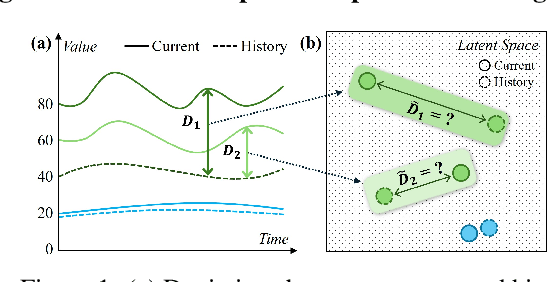

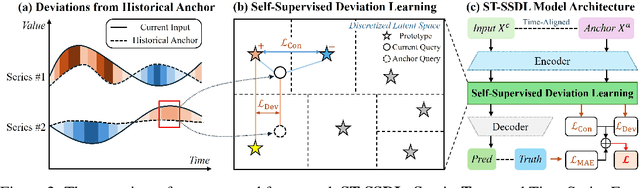
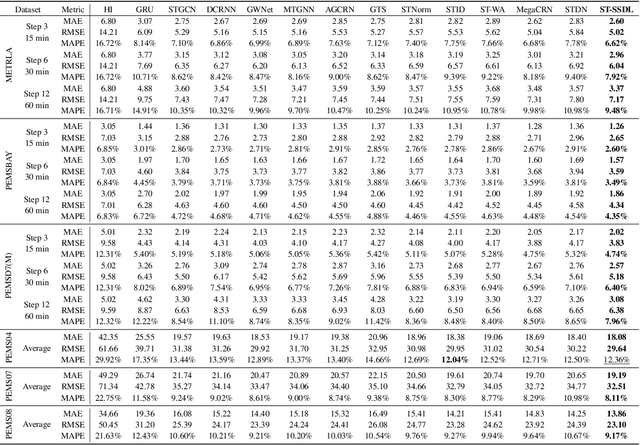
Spatio-temporal forecasting is essential for real-world applications such as traffic management and urban computing. Although recent methods have shown improved accuracy, they often fail to account for dynamic deviations between current inputs and historical patterns. These deviations contain critical signals that can significantly affect model performance. To fill this gap, we propose ST-SSDL, a Spatio-Temporal time series forecasting framework that incorporates a Self-Supervised Deviation Learning scheme to capture and utilize such deviations. ST-SSDL anchors each input to its historical average and discretizes the latent space using learnable prototypes that represent typical spatio-temporal patterns. Two auxiliary objectives are proposed to refine this structure: a contrastive loss that enhances inter-prototype discriminability and a deviation loss that regularizes the distance consistency between input representations and corresponding prototypes to quantify deviation. Optimized jointly with the forecasting objective, these components guide the model to organize its hidden space and improve generalization across diverse input conditions. Experiments on six benchmark datasets show that ST-SSDL consistently outperforms state-of-the-art baselines across multiple metrics. Visualizations further demonstrate its ability to adaptively respond to varying levels of deviation in complex spatio-temporal scenarios. Our code and datasets are available at https://github.com/Jimmy-7664/ST-SSDL.
Crosstalk-Resilient Beamforming for Movable Antenna Enabled Integrated Sensing and Communication
Sep 03, 2025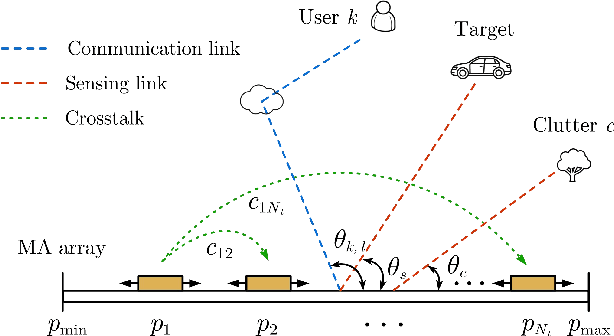
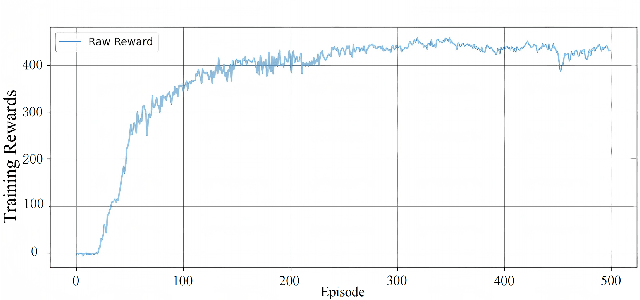
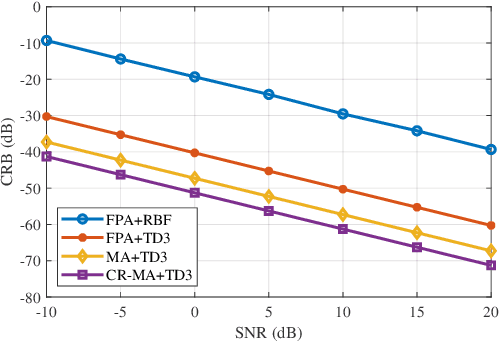
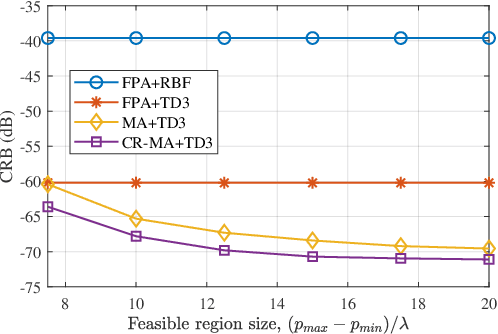
This paper investigates a movable antenna (MA) enabled integrated sensing and communication (ISAC) system under the influence of antenna crosstalk. First, it generalizes the antenna crosstalk model from the conventional fixed-position antenna (FPA) system to the MA scenario. Then, a Cramer-Rao bound (CRB) minimization problem driven by joint beamforming and antenna position design is presented. Specifically, to address this highly non-convex flexible beamforming problem, we deploy a deep reinforcement learning (DRL) approach to train a flexible beamforming agent. To ensure stability during training, a Twin Delayed Deep Deterministic Policy Gradient (TD3) algorithm is adopted to balance exploration with reward maximization for efficient and reliable learning. Numerical results demonstrate that the proposed crosstalk-resilient (CR) algorithm enhances the overall ISAC performance compared to other benchmark schemes.
Robust Transceiver Design for RIS Enhanced Dual-Functional Radar-Communication with Movable Antenna
Jun 09, 2025Movable antennas (MAs) have demonstrated significant potential in enhancing the performance of dual-functional radar-communication (DFRC) systems. In this paper, we explore an MA-aided DFRC system that utilizes a reconfigurable intelligent surface (RIS) to enhance signal coverage for communications in dead zones. To enhance the radar sensing performance in practical DFRC environments, we propose a unified robust transceiver design framework aimed at maximizing the minimum radar signal-to-interference-plus-noise ratio (SINR) in a cluttered environment. Our approach jointly optimizes transmit beamforming, receive filtering, antenna placement, and RIS reflecting coefficients under imperfect channel state information (CSI) for both sensing and communication channels. To deal with the channel uncertainty-constrained issue, we leverage the convex hull method to transform the primal problem into a more tractable form. We then introduce a two-layer block coordinate descent (BCD) algorithm, incorporating fractional programming (FP), successive convex approximation (SCA), S-Lemma, and penalty techniques to reformulate it into a series of semidefinite program (SDP) subproblems that can be efficiently solved. We provide a comprehensive analysis of the convergence and computational complexity for the proposed design framework. Simulation results demonstrate the robustness of the proposed method, and show that the MA-based design framework can significantly enhance the radar SINR performance while achieving an effective balance between the radar and communication performance.
Deep spatio-temporal point processes: Advances and new directions
Apr 08, 2025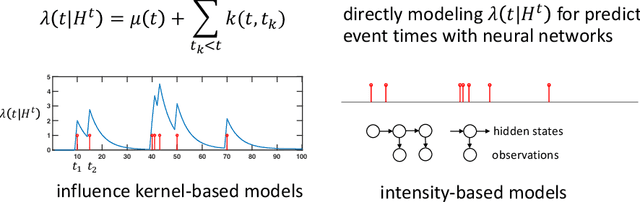

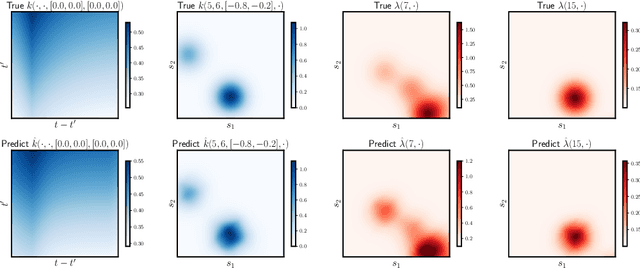

Spatio-temporal point processes (STPPs) model discrete events distributed in time and space, with important applications in areas such as criminology, seismology, epidemiology, and social networks. Traditional models often rely on parametric kernels, limiting their ability to capture heterogeneous, nonstationary dynamics. Recent innovations integrate deep neural architectures -- either by modeling the conditional intensity function directly or by learning flexible, data-driven influence kernels, substantially broadening their expressive power. This article reviews the development of the deep influence kernel approach, which enjoys statistical explainability, since the influence kernel remains in the model to capture the spatiotemporal propagation of event influence and its impact on future events, while also possessing strong expressive power, thereby benefiting from both worlds. We explain the main components in developing deep kernel point processes, leveraging tools such as functional basis decomposition and graph neural networks to encode complex spatial or network structures, as well as estimation using both likelihood-based and likelihood-free methods, and address computational scalability for large-scale data. We also discuss the theoretical foundation of kernel identifiability. Simulated and real-data examples highlight applications to crime analysis, earthquake aftershock prediction, and sepsis prediction modeling, and we conclude by discussing promising directions for the field.