 Add to Chrome
 Add to Firefox
 Add to Edge
What Is a Skill Worth? Structure-Aware Shapley Valuation of Agent Skills
Aug 05, 2026
Agent skills are increasingly optimized by automated feedback loops, producing long structured artifacts whose internal value remains unclear. We study skill valuation: assigning credit to the internal units of a fixed skill, such as rules, examples, scripts, and heuristics, under a fixed agent and held-out task distribution. Skill valuation differs from data or prompt-span valuation because skill units are structured: they may depend on other units, belong to a document hierarchy, trigger agent behavior, and consume limited prompt context. We introduce SkillSV, a structure-aware Shapley-style framework for skill valuation. SkillSV compiles a skill into units, dependencies, and hierarchy, so that only valid counterfactual skills are evaluated. It uses paired deletion and length-neutral padding to separate content value from context cost, and estimates the resulting values with a rollout-budgeted estimator for noisy agent evaluations. On four agentic benchmarks, we assess the faithfulness, actionability, and explanation of SkillSV: it recovers unit interactions, preserves aggregate skill lift, and guides safe pruning and compression.

Hallucination Self-Play: Bootstrapping Reinforced Detector via Evolved Generator
Jul 08, 2026Identifying faithfulness hallucinations in LLM-generated outputs remains challenging due to the scarcity of high-quality annotated data. Recent work relies on advanced LLMs to synthesize training data, including rationales, labels, and hallucinated claims. However, these methods treat the generator as a static component, limiting iterative improvement of the detector. To address this limitation, we introduce Hallucination Self-Play (HSP), a novel framework that enables the detector to bootstrap with an evolved generator. HSP involves two roles initialized from the same base model, a detector that assesses the faithfulness of model outputs, and a generator that produces increasingly hard-to-detect hallucinated responses. Specifically, the detector is first fine-tuned on human-labeled data and then employed as a reward model to train the generator via reinforcement learning from AI feedback (RLAIF). In turn, the evolved generator synthesizes hallucination data to further optimize the detector through rule-based reinforcement learning. Experiments on RAGTruth benchmark and two model families demonstrate that the proposed framework can progressively enhance a small LLM to match or even outperform advanced LLMs without external supervision. Our code is available at https://anonymous.4open.science/r/Hallucination-Self-Play-50B5 .
Mixture of Rationale: Multi-Modal Reasoning Mixture for Visual Question Answering
Jun 03, 2024Zero-shot visual question answering (VQA) is a challenging task that requires reasoning across modalities. While some existing methods rely on a single rationale within the Chain of Thoughts (CoT) framework, they may fall short of capturing the complexity of the VQA problem. On the other hand, some other methods that use multiple rationales may still suffer from low diversity, poor modality alignment, and inefficient retrieval and fusion. In response to these challenges, we propose \emph{Mixture of Rationales (MoR)}, a novel multi-modal reasoning method that mixes multiple rationales for VQA. MoR uses a single frozen Vision-and-Language Pre-trained Models (VLPM) model to {dynamically generate, retrieve and fuse multi-modal thoughts}. We evaluate MoR on two challenging VQA datasets, i.e. NLVR2 and OKVQA, with two representative backbones OFA and VL-T5. MoR achieves a 12.43\% accuracy improvement on NLVR2, and a 2.45\% accuracy improvement on OKVQA-S( the science and technology category of OKVQA).
Hypertext Entity Extraction in Webpage
Mar 04, 2024
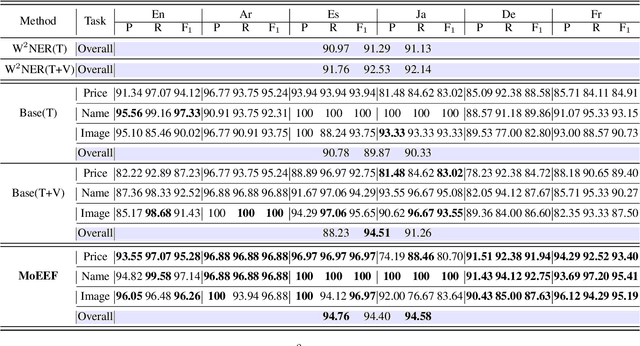
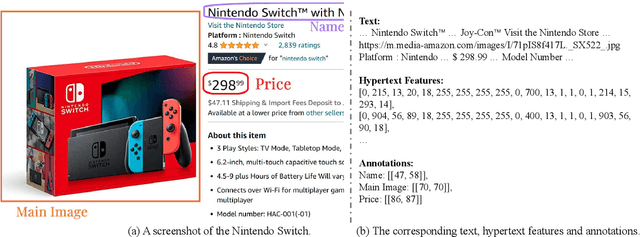

Webpage entity extraction is a fundamental natural language processing task in both research and applications. Nowadays, the majority of webpage entity extraction models are trained on structured datasets which strive to retain textual content and its structure information. However, existing datasets all overlook the rich hypertext features (e.g., font color, font size) which show their effectiveness in previous works. To this end, we first collect a \textbf{H}ypertext \textbf{E}ntity \textbf{E}xtraction \textbf{D}ataset (\textit{HEED}) from the e-commerce domains, scraping both the text and the corresponding explicit hypertext features with high-quality manual entity annotations. Furthermore, we present the \textbf{Mo}E-based \textbf{E}ntity \textbf{E}xtraction \textbf{F}ramework (\textit{MoEEF}), which efficiently integrates multiple features to enhance model performance by Mixture of Experts and outperforms strong baselines, including the state-of-the-art small-scale models and GPT-3.5-turbo. Moreover, the effectiveness of hypertext features in \textit{HEED} and several model components in \textit{MoEEF} are analyzed.
Beyond Surface: Probing LLaMA Across Scales and Layers
Dec 14, 2023This paper presents an in-depth analysis of Large Language Models (LLMs), focusing on LLaMA, a prominent open-source foundational model in natural language processing. Instead of assessing LLaMA through its generative output, we design multiple-choice tasks to probe its intrinsic understanding in high-order tasks such as reasoning and computation. We examine the model horizontally, comparing different sizes, and vertically, assessing different layers. We unveil several key and uncommon findings based on the designed probing tasks: (1) Horizontally, enlarging model sizes almost could not automatically impart additional knowledge or computational prowess. Instead, it can enhance reasoning abilities, especially in math problem solving, and helps reduce hallucinations, but only beyond certain size thresholds; (2) In vertical analysis, the lower layers of LLaMA lack substantial arithmetic and factual knowledge, showcasing logical thinking, multilingual and recognitive abilities, with top layers housing most computational power and real-world knowledge.
Instructed Language Models with Retrievers Are Powerful Entity Linkers
Nov 06, 2023Generative approaches powered by large language models (LLMs) have demonstrated emergent abilities in tasks that require complex reasoning abilities. Yet the generative nature still makes the generated content suffer from hallucinations, thus unsuitable for entity-centric tasks like entity linking (EL) requiring precise entity predictions over a large knowledge base. We present Instructed Generative Entity Linker (INSGENEL), the first approach that enables casual language models to perform entity linking over knowledge bases. Several methods to equip language models with EL capability were proposed in this work, including (i) a sequence-to-sequence training EL objective with instruction-tuning, (ii) a novel generative EL framework based on a light-weight potential mention retriever that frees the model from heavy and non-parallelizable decoding, achieving 4$\times$ speedup without compromise on linking metrics. INSGENEL outperforms previous generative alternatives with +6.8 F1 points gain on average, also with a huge advantage in training data efficiency and training compute consumption. In addition, our skillfully engineered in-context learning (ICL) framework for EL still lags behind INSGENEL significantly, reaffirming that the EL task remains a persistent hurdle for general LLMs.
Coherent Entity Disambiguation via Modeling Topic and Categorical Dependency
Nov 06, 2023
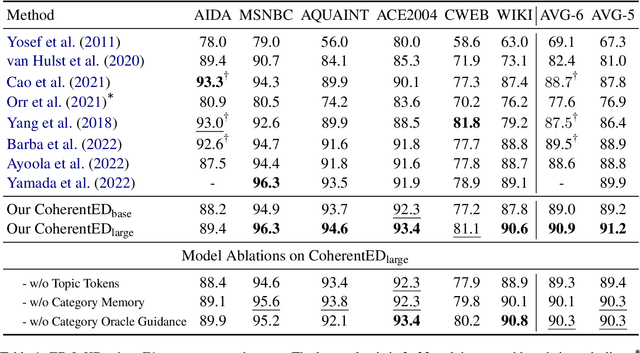

Previous entity disambiguation (ED) methods adopt a discriminative paradigm, where prediction is made based on matching scores between mention context and candidate entities using length-limited encoders. However, these methods often struggle to capture explicit discourse-level dependencies, resulting in incoherent predictions at the abstract level (e.g. topic or category). We propose CoherentED, an ED system equipped with novel designs aimed at enhancing the coherence of entity predictions. Our method first introduces an unsupervised variational autoencoder (VAE) to extract latent topic vectors of context sentences. This approach not only allows the encoder to handle longer documents more effectively, conserves valuable input space, but also keeps a topic-level coherence. Additionally, we incorporate an external category memory, enabling the system to retrieve relevant categories for undecided mentions. By employing step-by-step entity decisions, this design facilitates the modeling of entity-entity interactions, thereby maintaining maximum coherence at the category level. We achieve new state-of-the-art results on popular ED benchmarks, with an average improvement of 1.3 F1 points. Our model demonstrates particularly outstanding performance on challenging long-text scenarios.
RUEL: Retrieval-Augmented User Representation with Edge Browser Logs for Sequential Recommendation
Sep 19, 2023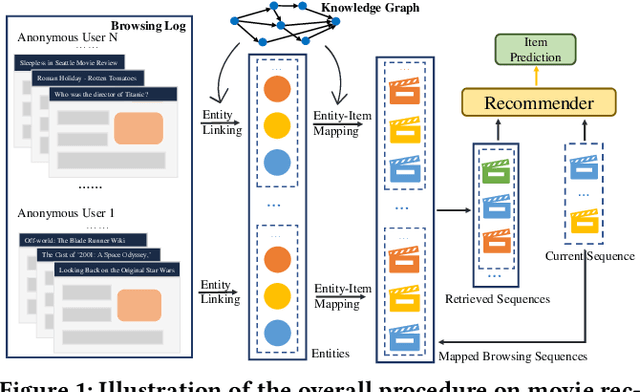
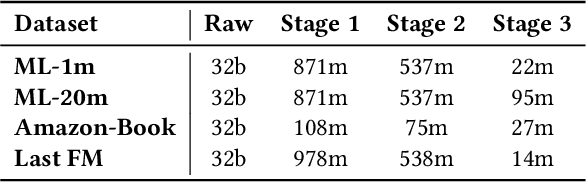
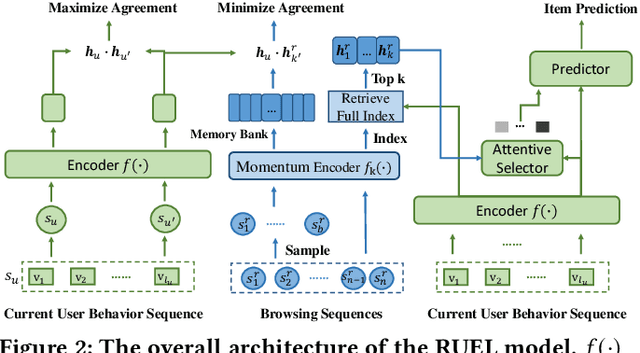
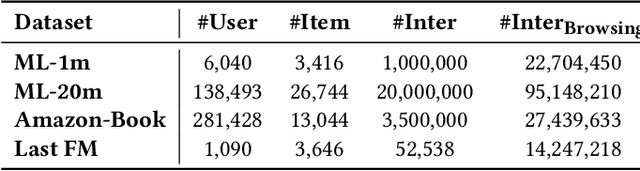
Online recommender systems (RS) aim to match user needs with the vast amount of resources available on various platforms. A key challenge is to model user preferences accurately under the condition of data sparsity. To address this challenge, some methods have leveraged external user behavior data from multiple platforms to enrich user representation. However, all of these methods require a consistent user ID across platforms and ignore the information from similar users. In this study, we propose RUEL, a novel retrieval-based sequential recommender that can effectively incorporate external anonymous user behavior data from Edge browser logs to enhance recommendation. We first collect and preprocess a large volume of Edge browser logs over a one-year period and link them to target entities that correspond to candidate items in recommendation datasets. We then design a contrastive learning framework with a momentum encoder and a memory bank to retrieve the most relevant and diverse browsing sequences from the full browsing log based on the semantic similarity between user representations. After retrieval, we apply an item-level attentive selector to filter out noisy items and generate refined sequence embeddings for the final predictor. RUEL is the first method that connects user browsing data with typical recommendation datasets and can be generalized to various recommendation scenarios and datasets. We conduct extensive experiments on four real datasets for sequential recommendation tasks and demonstrate that RUEL significantly outperforms state-of-the-art baselines. We also conduct ablation studies and qualitative analysis to validate the effectiveness of each component of RUEL and provide additional insights into our method.
Alleviating Over-smoothing for Unsupervised Sentence Representation
May 09, 2023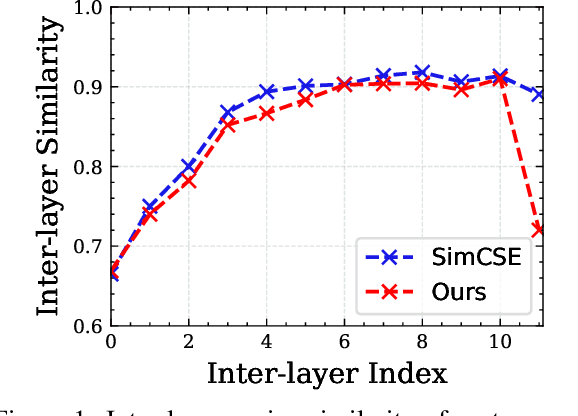
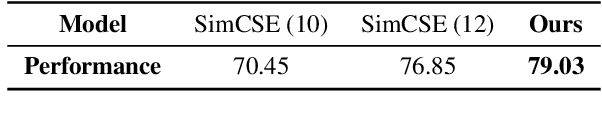
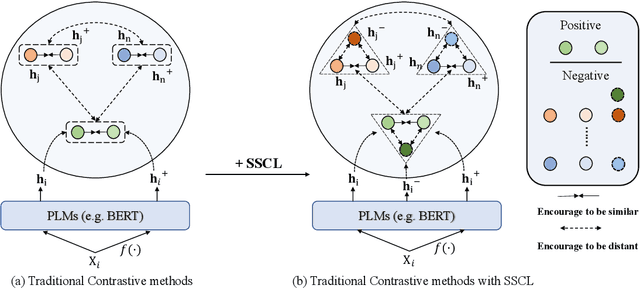
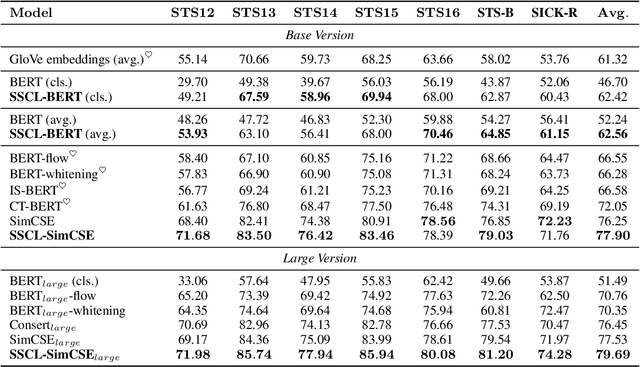
Currently, learning better unsupervised sentence representations is the pursuit of many natural language processing communities. Lots of approaches based on pre-trained language models (PLMs) and contrastive learning have achieved promising results on this task. Experimentally, we observe that the over-smoothing problem reduces the capacity of these powerful PLMs, leading to sub-optimal sentence representations. In this paper, we present a Simple method named Self-Contrastive Learning (SSCL) to alleviate this issue, which samples negatives from PLMs intermediate layers, improving the quality of the sentence representation. Our proposed method is quite simple and can be easily extended to various state-of-the-art models for performance boosting, which can be seen as a plug-and-play contrastive framework for learning unsupervised sentence representation. Extensive results prove that SSCL brings the superior performance improvements of different strong baselines (e.g., BERT and SimCSE) on Semantic Textual Similarity and Transfer datasets. Our codes are available at https://github.com/nuochenpku/SSCL.
* 13 pages
Augmenting Passage Representations with Query Generation for Enhanced Cross-Lingual Dense Retrieval
May 06, 2023Effective cross-lingual dense retrieval methods that rely on multilingual pre-trained language models (PLMs) need to be trained to encompass both the relevance matching task and the cross-language alignment task. However, cross-lingual data for training is often scarcely available. In this paper, rather than using more cross-lingual data for training, we propose to use cross-lingual query generation to augment passage representations with queries in languages other than the original passage language. These augmented representations are used at inference time so that the representation can encode more information across the different target languages. Training of a cross-lingual query generator does not require additional training data to that used for the dense retriever. The query generator training is also effective because the pre-training task for the generator (T5 text-to-text training) is very similar to the fine-tuning task (generation of a query). The use of the generator does not increase query latency at inference and can be combined with any cross-lingual dense retrieval method. Results from experiments on a benchmark cross-lingual information retrieval dataset show that our approach can improve the effectiveness of existing cross-lingual dense retrieval methods. Implementation of our methods, along with all generated query files are made publicly available at https://github.com/ielab/xQG4xDR.